The Lad Who Went To The North Wind
The Lad Who Went To The North Wind: Once on a time there was an old widow who had one son; and as she was poorly and weak, her son had to go up into the safe
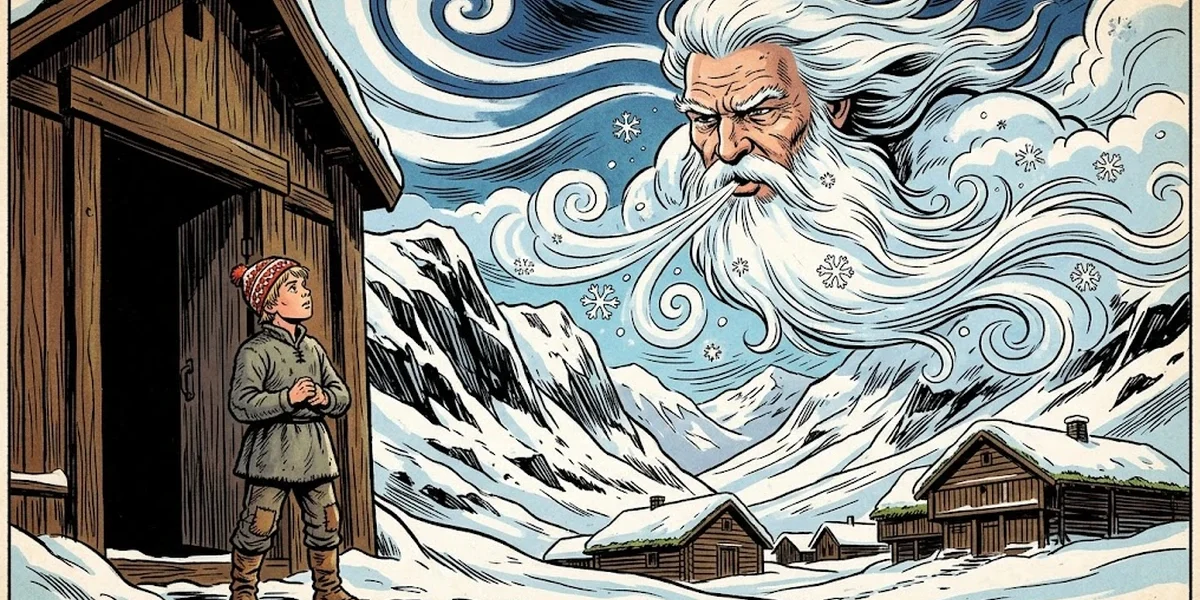
Of all the bright, brisk tales that Norwegian storytellers carried from farm to farm through the long dark winters, few open with so bold a premise as this one: a poor boy, robbed of his family’s last handful of meal, sets out across the world to knock on the door of the wind itself and demand his property back. There is no king to petition, no court to appeal to, no magic at the start — only a hungry widow’s son and a stubborn certainty that what was taken from him ought to be returned.
“The Lad Who Went to the North Wind” is a story about that certainty, and about what the world does with a person who refuses to be quietly cheated. The North Wind, gruff and enormous, cannot give back the scattered meal — but he can give the lad three wonderful gifts instead, and the tale turns on what happens to those gifts at a roadside inn. It is a comedy, a justice-story, and a small lesson in courage all at once, and it has been making listeners grin and cheer for the better part of two centuries.
Where the Story Comes From
“The Lad Who Went to the North Wind” is a Norwegian folktale, known in Norwegian as Gutten som gikk til nordavinden og krevde igjen melet — literally “the boy who went to the North Wind and demanded the flour back.” It was collected and set down by Peter Christen Asbjørnsen (1812–1885) and Jørgen Moe (1813–1882) for their great national collection Norske Folkeeventyr (“Norwegian Folktales”), which they published in instalments beginning in 1841. Asbjørnsen, a naturalist who tramped the rural valleys gathering tales, and Moe, a parson and poet, wrote their stories down in a plain, vigorous Norwegian that helped shape the modern written language — doing for Norway much what the brothers Grimm had done a generation earlier for Germany.
English-speaking readers met the tale through Sir George Webbe Dasent, whose translation Popular Tales from the Norse (Edinburgh, 1859) gave us the title and the brisk, cheerful wording still in use today. Dasent’s renderings proved so durable that they were reprinted for generations, and this particular tale found a lasting home in the celebrated gift-book East of the Sun and West of the Moon. In the original Norwegian editions the stories carried the now-famous illustrations of Erik Werenskiøld and Theodor Kittelsen, the two artists whose drawings fixed the look of Norwegian folktale in the national imagination.
Folklorists class the story as international tale type ATU 563, “The Table, the Ass, and the Stick,” in the Aarne–Thompson–Uther index of folk narratives. It is one of the most widely travelled tale types in the world. Its closest and most famous cousin is the German tale collected by the brothers Grimm as Tischchen deck dich, Goldesel und Knüppel aus dem Sack — “The Wishing-Table, the Gold-Ass, and the Cudgel in the Sack” — number 36 in their Kinder- und Hausmärchen. The same three magical gifts, the same thieving innkeeper, and the same final reckoning with a stick that beats of its own accord turn up across Europe and far into Asia. That wide scattering tells us the pattern answered something people everywhere recognised: the wish for a power that finally makes a cheat give back what he stole.
The North Wind as a Story Character
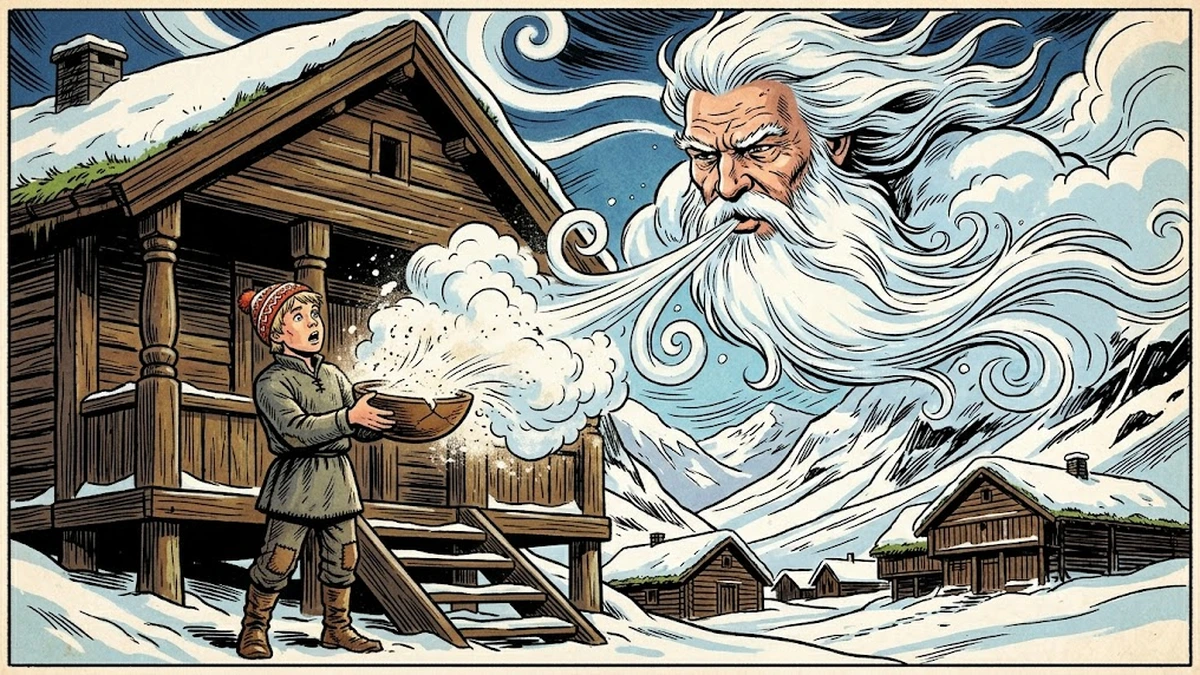
One of the quiet pleasures of this tale is the way it treats the wind. The North Wind is not described as a god, nor as a demon, nor even as a spirit to be feared. He is, for all his “loud and gruff” voice and his habit of arriving in a gale, something far more homely: a powerful neighbour. He can be called on at his house, greeted with a polite “good day,” and reasoned with across a doorstep. When the lad accuses him of carrying off the meal, the North Wind does not bluster or threaten — he listens, admits the meal is gone past recovering, and sets about making honest amends. Three times the boy comes back disappointed, and three times the North Wind receives him without anger and tries again. It is one of the most patient, decent characters in all of Norwegian folktale.
This down-to-earth handling of a natural force is very characteristic of the Norse tradition Asbjørnsen and Moe recorded. In a country shaped by hard weather, where the wind off the mountains and the sea could ruin a harvest or sink a boat, storytellers did not turn the wind into a distant abstraction. They made it a being one could talk to, bargain with, and even hold to account. The tale gently suggests that the forces which seem to rule our lives are not beyond all appeal — that even the weather, met with courage and courtesy, may owe a debt and pay it. For a poor child listening by the fire, that was a quietly radical and deeply comforting idea.
A Tale from the Lean Years
To feel the weight of the story’s opening, it helps to picture the household it grew from. On a poor Norwegian smallholding, meal — ground grain for porridge and flatbread — was not a convenience but the very margin between getting through the winter and going hungry. It was kept in the stabbur, the raised storehouse on staddle-stones that every farm possessed, and it was fetched in careful measures. When the tale says the widow was “poorly and weak” and sent her son up the storehouse steps for meal to cook, every listener understood at once that this was a family living close to the edge.
So when the North Wind comes “puffing and blowing” and snatches the meal out of the boy’s hands — not once, but three times over — the loss is no small mischief. It is the loss of dinner, and perhaps of more than one dinner. The lad’s anger is the anger of real hunger, and his decision is the heart of the whole tale: rather than weep, rather than simply accept the theft as bad luck, he resolves to go and find the North Wind and ask, plainly and to his face, for his meal back. In a culture that prized quiet endurance, the boy’s blunt, almost cheeky boldness is exactly what makes him a hero. He treats a force of nature as a neighbour who owes him a debt — and, remarkably, the North Wind treats him the same way in return.
The Cloth That Spread Itself
The lad walks and walks until he reaches the North Wind’s house, and greets the great blustering creature with disarming courtesy: “Good day, and thank you for coming to see us yesterday.” The North Wind, in his loud and gruff voice, thanks him back. There is something deeply satisfying in this exchange — the smallest, poorest person in the world standing at the door of the weather itself and speaking as an equal. When the lad explains that his family has little to live on and cannot spare the meal, the North Wind answers honestly: he does not have the meal, it is scattered beyond recovering. But he will not send the boy away empty-handed. He gives him a cloth, with the words to make it work: “Cloth, spread yourself, and serve up all kinds of good dishes.”
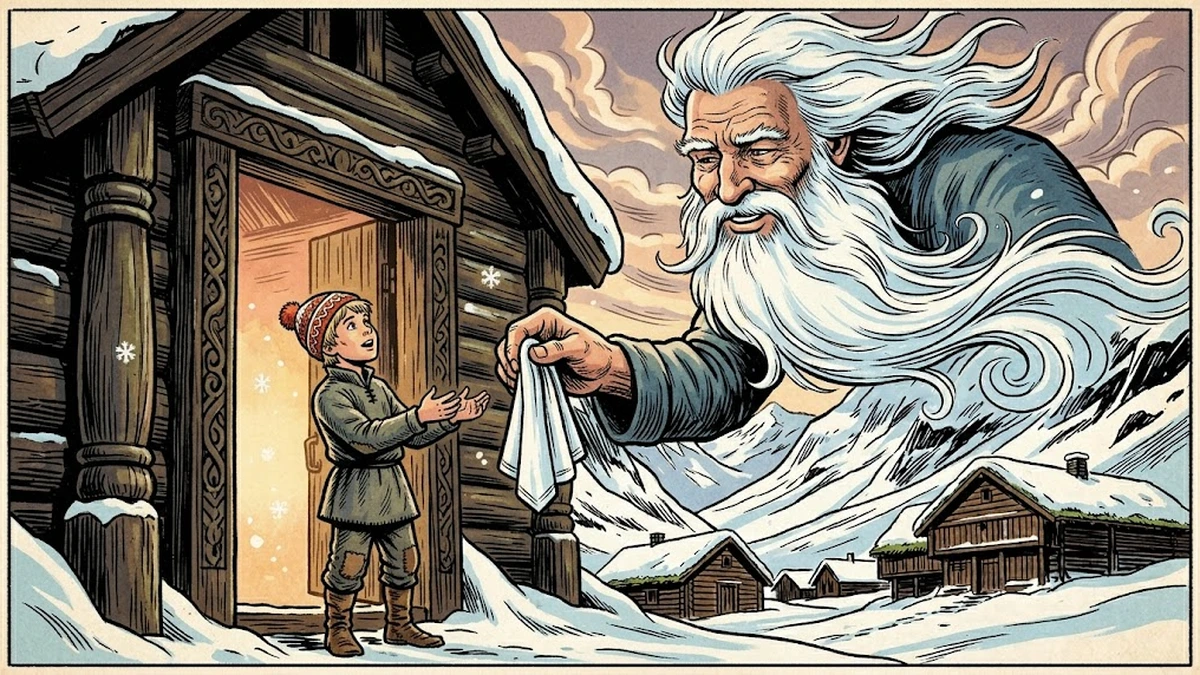
The lad is overjoyed, and well he might be: a tablecloth that conjures a feast is the answer to every hungry family’s prayer. But the way home is long, and he stops for the night at a wayside inn. There, foolishly proud of his new treasure, he lays the cloth on a table and calls up a supper before the whole company. The landlady watches the food appear and knows at once what she is looking at. In the dead of night, while everyone sleeps, she takes the magic cloth and leaves an ordinary one in its place — one that “couldn’t so much as serve up a bit of dry bread.” The lad carries the worthless cloth home, proud and unsuspecting, and only when his sceptical mother says “seeing is believing” and the cloth produces nothing does the theft come to light. The boy’s reply is the engine of the rest of the story: “There’s no help for it but to go to the North Wind again.”
The Ram and the Stolen Gold
Back the lad trudges to the North Wind’s house. The North Wind hears him out and is not angry; he simply tries again. This time the gift is a ram that coins money on command: say “Ram, ram! make money!” and the creature drops gold pieces. Once more the lad sets off, and once more he cannot reach home before nightfall, and once more he stops at the same inn. And here the tale shows its quiet wisdom about human nature: the boy has been robbed once already, yet he still cannot resist showing off. He works the ram before the landlady’s greedy eyes, and that night she swaps the wonderful ram for an ordinary one, just as she swapped the cloth.
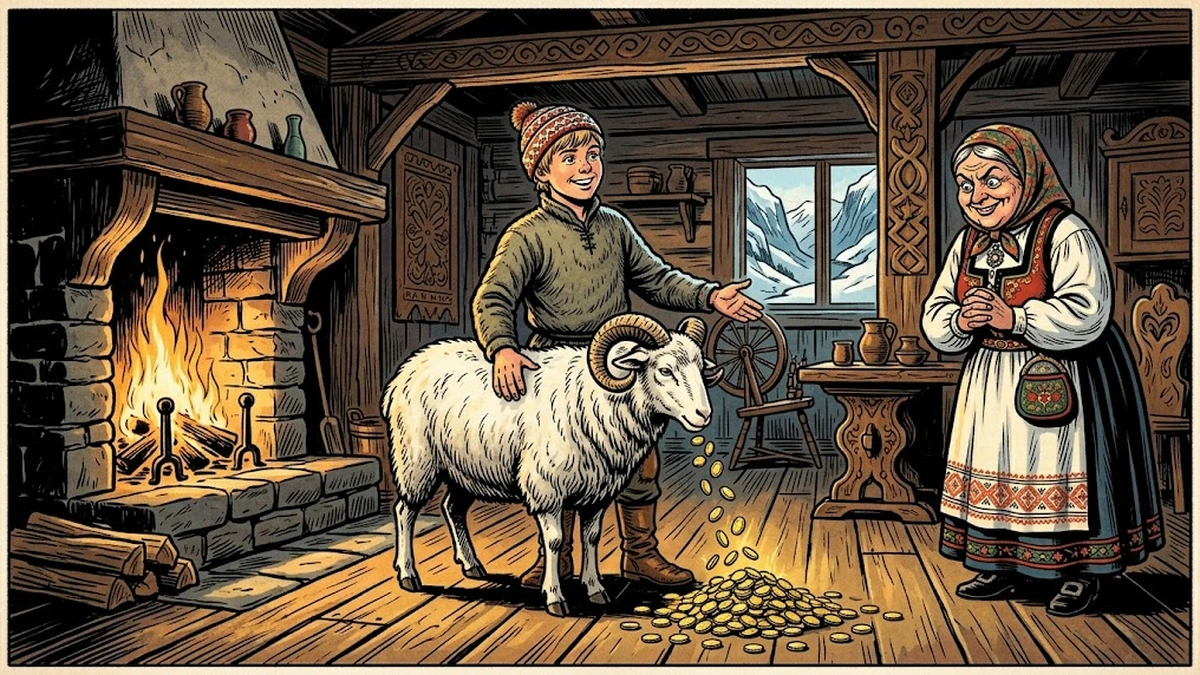
The lad reaches home with a ram that will not coin so much as a copper. The pattern has now repeated twice, and a listening child can feel the story tightening like a spring. We know the boy will go to the North Wind a third time; we know he will be given a third gift; and we sense — because folktales teach us their own grammar — that this third gift will be of a different kind altogether. The cloth fed; the ram enriched; both were gentle, generous things, and both were stolen because they were defenceless. The story has been patiently teaching us that generosity without protection is simply an invitation to a thief. What the boy needs now is not another gift to be robbed of, but a gift that cannot be robbed at all.
The Stick That Settled the Account
The third time the lad comes to the North Wind’s house, the great wind gives him a stick, and a warning with it. If the boy says “Stick, stick! lay on!” the stick will beat without stopping until he says “Stick, stick! now stop!” — and only the lad himself can call it off. This time the boy has learned. At the inn he does not show the stick off; instead he lies down on a bench and pretends to be fast asleep, and waits. The landlady, certain the stick must be as magical as the cloth and the ram, creeps over in the night to make the swap.
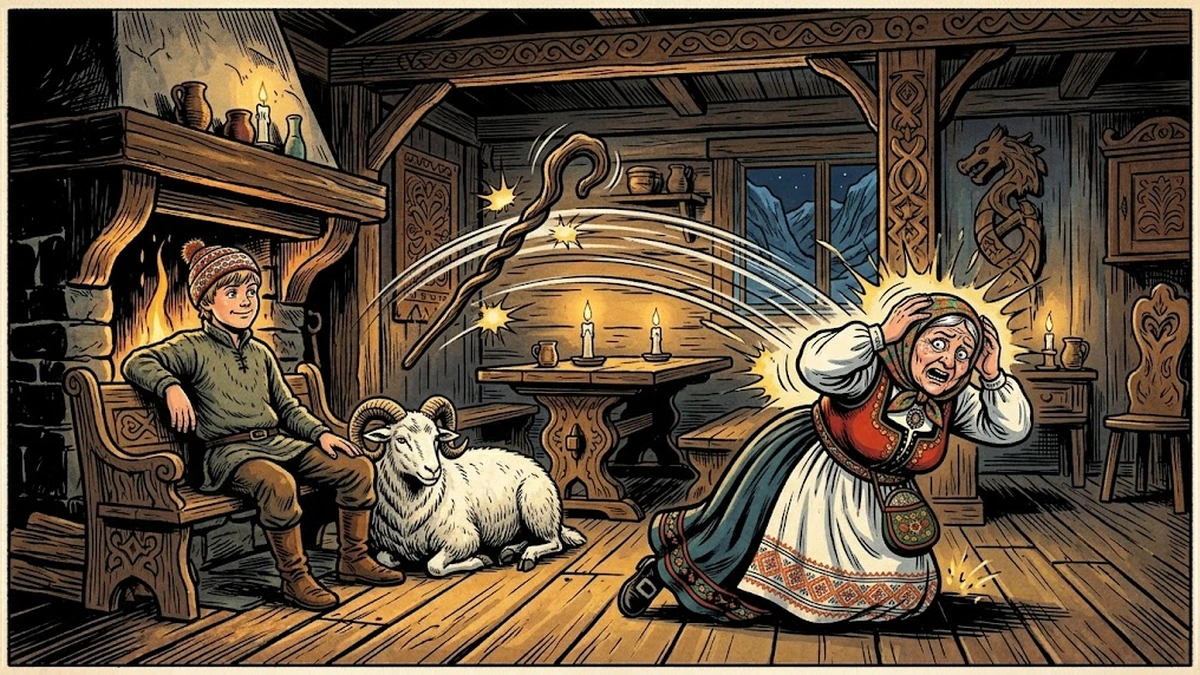
The moment her hand closes on it, the lad shouts “Stick, stick! lay on!” — and the stick begins to beat her about the room. She leaps and screams and begs, and at last she promises to give everything back if only he will call the stick off. The boy lets her suffer just long enough to be sure she means it, then names his terms: the cloth and the ram, returned, before the stick will stop. The landlady hands over both treasures, the lad says the words that still the stick, and he goes home at last with all three gifts — the cloth that feeds, the ram that enriches, and the stick that guards them both. The thief is punished by her own greedy hand; the honest boy is made secure; and the account, opened on the storehouse steps with a fistful of stolen meal, is finally closed.
The Tale’s Cousins Around the World
Because it belongs to ATU 563, “The Lad Who Went to the North Wind” has relatives scattered across an enormous range of countries, and comparing them shows how a single sturdy pattern bends to fit each land that adopts it. In the German version recorded by the brothers Grimm, the three gifts come not from the wind but as wages earned by three brothers in service, and the magic objects are a self-laying table, a donkey that drops gold, and a cudgel that springs from a sack. In other European tellings the giver is a saint, a stranger met on the road, or a grateful animal; the thief is sometimes an innkeeper, sometimes a priest, sometimes a king. Yet the spine of the story never changes: a generous gift, a sly theft by swapping, and a final gift that punishes the thief and forces the others back.
What makes the Norwegian telling distinctive is its beginning. Most versions of the type open with a journey or a term of service; this one opens with an injury — the stolen meal — and a demand for justice. That gives the Norse tale a sharper moral edge than many of its cousins. The lad is not merely seeking his fortune; he is owed something, and he means to collect. It is a small change of emphasis, but it is the reason the story feels less like a wonder-tale and more like a satisfying account being settled. Folklorists treasure exactly these differences, because the way each people reshapes a borrowed story tells us what that people most wanted a story to say.
The Rule of Three and the Three Gifts
Like almost every folktale that has survived by being told aloud, “The Lad Who Went to the North Wind” is built on the number three, and it uses that number with real craft. The North Wind blows the meal away three times before the boy ever sets out — just enough repetition to make a child certain that something must now be done. The lad then journeys to the wind’s house three times, and each journey ends in a gift. Two of those gifts are stolen at the same inn by the same landlady, in the same way, on the same kind of night. This patterning is not laziness; it is the storyteller’s memory at work. A tale shaped by threes is a tale that can be carried in the head and retold without a book, and it lets the listener feel the shape of what is coming and lean forward to meet it.
The three gifts themselves are chosen with a folk wisdom worth pausing over. The cloth answers hunger; the ram answers poverty; the stick answers injustice. The first two are gifts of plenty — soft, generous, and, the tale is careful to show, helpless. They can be picked up and carried off by any thief bold enough to try. The third gift is different in kind: it gives the boy nothing to eat and nothing to spend, but it gives him the power to keep the other two. In the simple arithmetic of the story, a hungry family needs food and money — but to hold on to food and money in a world with thieves in it, they also need the means to defend what is theirs. The tale hands its hero all three, in exactly that order, and trusts its listeners to notice that the order is the lesson.
It is worth saying, too, that the stick is never used cruelly. The lad does not seek out the landlady to punish her; he simply lays a trap and lets her walk into it, and he calls the beating off the moment she returns what she stole. The stick is not vengeance — it is leverage, the plain power to make a wrong be put right. That restraint is part of why the ending feels just rather than savage, and why generations of parents have been content to tell this story to their children.
The Moral of the Story
“The Lad Who Went to the North Wind” carries two lessons folded into one cheerful shape. The first belongs to the boy: do not meekly accept being cheated of what is rightfully yours. His journey begins because he refuses to treat a theft as mere misfortune, and that refusal — courteous but unbending — is what brings the North Wind’s gifts to his door in the first place. The second lesson belongs to the landlady: dishonest gain carries its own punishment, and the cheat is, in the end, beaten by the very thing she reached out to steal. Generosity is good, the tale says, but generosity must also be guarded; kindness needs a stick at its side if thieves are not to feed on it.
Den som intet våger, intet vinner. — “He who ventures nothing, wins nothing.” This old Norwegian proverb is the lad’s whole story in six words: only because he dared to walk to the house of the wind and demand his due did the gifts ever come to him at all.
Why the Story Has Lasted
This little tale has outlived the cottages and storehouses it was first told in because it satisfies something that does not change. Everyone, child or grown, has known the helpless anger of being cheated by someone too big or too sly to be answered. The lad gives that feeling a happy ending. He is not strong, not clever, not lucky — he is simply unwilling to let the matter rest, and the story rewards him for it. And the third gift, the beating stick, delivers the exact justice that real life so often withholds: the thief gets back, measure for measure, precisely what she gave. Told in a few brisk minutes by a winter fire, “The Lad Who Went to the North Wind” still does what the storytellers of Asbjørnsen and Moe’s Norway meant it to do — it sends its listeners away certain that boldness is worth the road, and that a cheat, sooner or later, meets the stick.
You May Also Like
 Norse Folk Tales
Ages 9-12
Norse Folk Tales
Ages 9-12
Soria Moria Castle
Soria Moria Castle: Once on a time there was a poor couple who had a son whose name was _Halvor_. Ever since he was a little boy he would turn his hand to
 Norse Folk Tales
Ages 9-12
Norse Folk Tales
Ages 9-12
Tyr and the Binding of Fenrir
Tyr and the Binding of Fenrir: In the time before Ragnarok, when the gods still believed they could prevent the end times through cunning and sacrifice, there
 Norse Folk Tales
Ages 9-12
Norse Folk Tales
Ages 9-12
The Cat On The Dovrefell
A traveller's 'white cat' is really a great white bear — and on Christmas Eve he teaches a band of trolls a lesson they never forget.