Odin’s Quest for Wisdom
Odin's Quest for Wisdom: From the moment of his birth, Odin All-Father burned with a need that nothing could satisfy. While other gods delighted in feasts and
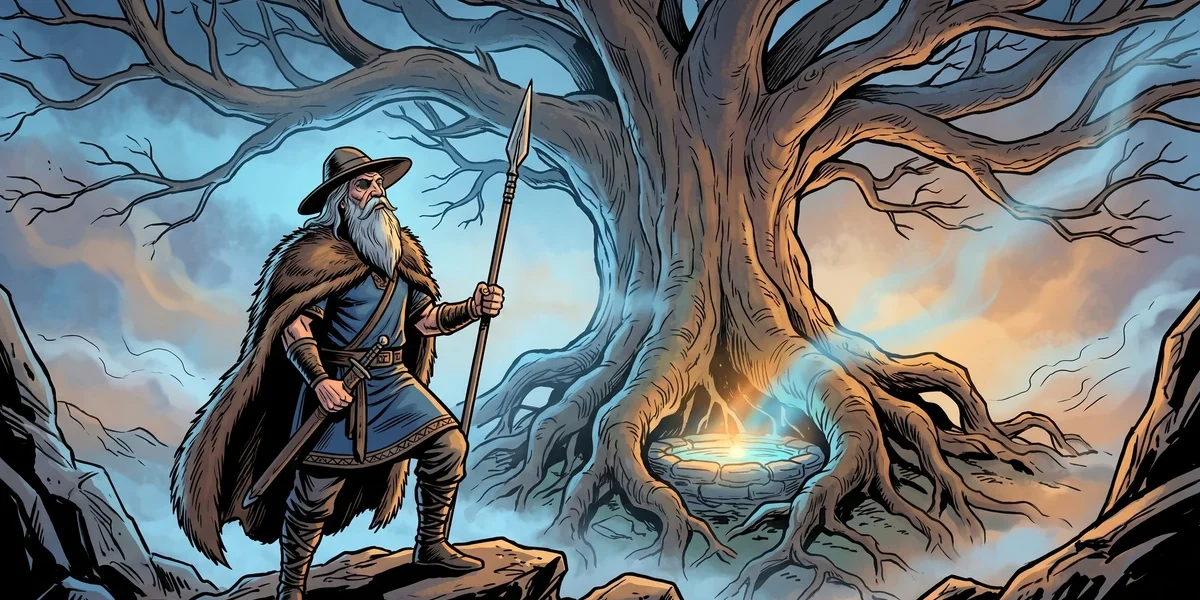
Of all the gods the Norse imagined, Odin is the strangest and the most unsettling. He is the chief of the Aesir, the All-Father, the lord of victory and kingship — and yet the stories told about him are not, on the whole, stories of triumph. They are stories of a god who gives things away. He surrenders an eye. He hangs himself on a tree. He wanders the Nine Worlds in a beggar’s cloak, trading comfort for knowledge at every turn. The quest for wisdom is the thread that runs through nearly everything the Norse said about him, and it is a quest with a price attached to every step.
This is the tale of how Odin paid that price twice over: first at the well of Mímir, where he gave his eye for a single draught of understanding, and then upon Yggdrasil itself, where he hung wounded for nine nights and nine days to win the secret of the runes. It is not a comfortable story. It insists, with the bleak honesty the Norse loved, that real wisdom is never free, and that the deepest knowledge is bought with the deepest pain.
Where the Story Comes From
Odin’s pursuit of wisdom is one of the central preoccupations of Norse mythology, and it survives in two great medieval Icelandic sources. The fuller mythic framework comes from the Prose Edda, the handbook of myth and skaldic poetics composed by the Icelandic chieftain, lawspeaker and historian Snorri Sturluson around the year 1220. In its first major section, Gylfaginning (“The Beguiling of Gylfi”), Snorri describes the well that lies beneath one of the roots of the world-tree, the well of Mímir, “in which wisdom and understanding are hidden,” and records plainly that Odin came there and asked for a single drink, “but he did not get it until he gave his eye as a pledge.”
The older and more haunting source is the Poetic Edda, a collection of anonymous mythological poems preserved chiefly in the Icelandic manuscript known as the Codex Regius (GKS 2365 4to), written down in the second half of the thirteenth century but transmitting verse considerably older. The crucial poem is the Hávamál, “The Sayings of the High One” — that is, the sayings of Odin himself. Toward its close stands a section that scholars call the Rúnatal, or “Odin’s Rune Song,” running from roughly stanza 138 to stanza 145. There, in the god’s own voice, the Hávamál describes the self-sacrifice on the windswept tree. The poem Völuspá (“The Prophecy of the Seeress”), also in the Codex Regius, confirms the other half of the story, recalling that Odin’s eye lies hidden in Mímir’s well, and that the wise Mímir drinks mead from that pledge each morning.
The story belongs to a pattern that folklorists and historians of religion recognise far beyond Scandinavia: the seeker who must be wounded, who must descend, fast, and suffer at the boundary of death before sacred knowledge can be won. The motif of wisdom acquired through ordeal — and the closely related figure of the wounded sky-god or shaman who hangs upon the world-tree — places Odin’s quest within a very old current of human storytelling. What the Norse added was their own unflinching tone. They did not soften the cost, and they did not promise that the knowledge would bring peace.
The Restless All-Father
From the moment of his making, the stories say, Odin burned with a hunger that nothing could satisfy. While the other gods of Asgard delighted in feasting and the clash of friendly games, while they basked in power and the adoration of worshippers, Odin alone could not rest. His mind was a fire that consumed whatever it touched, and what it craved above all was knowledge. He travelled through the Nine Worlds in disguise, learning secrets from frost-giants and dwarves, from the dead and from living men, gathering riddles and runelore and the names of hidden things. Yet his thirst never lessened. Every answer only sharpened the next question.
This is the first thing the Norse want us to understand about their highest god: he is not wise because wisdom came easily to him. He is wise because he could not stop searching, and because he was willing, again and again, to pay. The other gods accepted the world as it was given to them. Odin alone insisted on understanding the pattern beneath it — the threads of fate, the shape of things to come, the doom that even the gods could not escape. And he sensed, with the particular dread of a mind that sees too far, that the most important knowledge lay just beyond his reach.
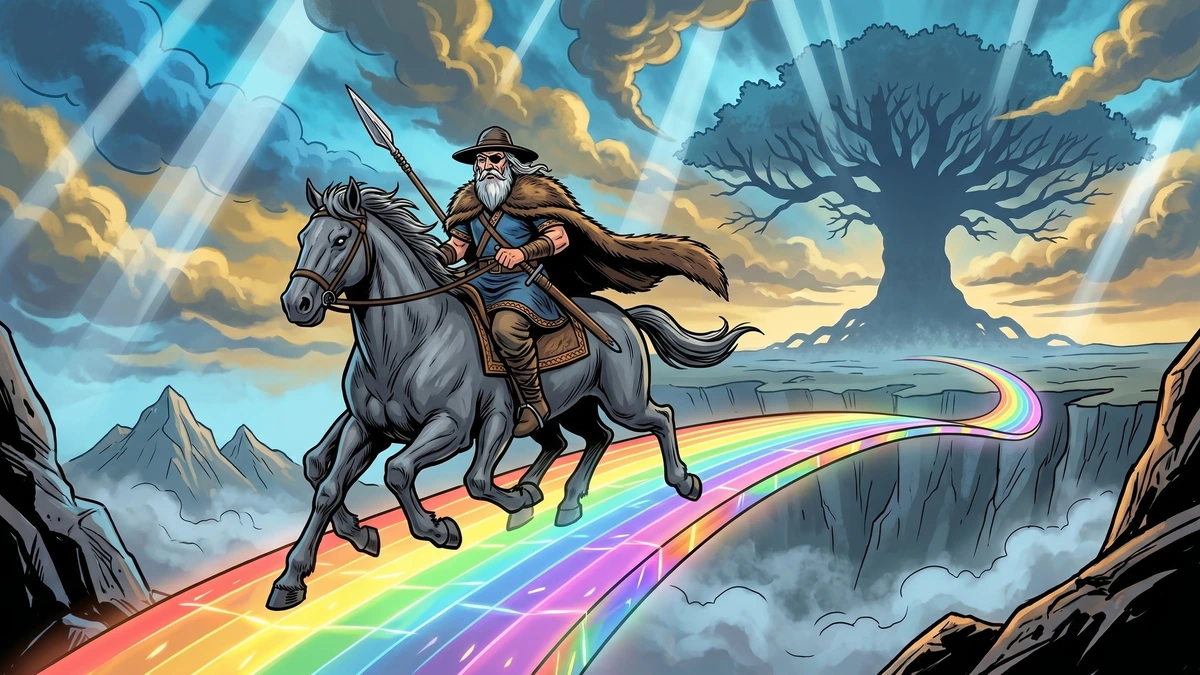
One day word came to him of a well that lay at the base of Yggdrasil, the great ash-tree whose roots stretched into all the Nine Worlds and whose branches held the sky. This was Mímir’s well, and its waters were said to hold wisdom beyond measure — for any who drank from it would see the hidden connections of all things. The well was kept by Mímir, oldest and wisest of beings, whose memory reached back to before the beginning of the world. But Mímir, Odin was warned, did not give his wisdom freely. There was always a price.
The Well Beneath the World-Tree
Odin prepared for the journey with the gravity of one marching toward a battle he was not sure he would survive. He put on his travelling clothes — the broad grey cloak and the wide-brimmed hat pulled low that he wore whenever he wished to pass unrecognised through the worlds. He saddled Sleipnir, his eight-legged horse, swiftest of all creatures, and rode out from Asgard, down across the trembling rainbow bridge of Bifröst, through the lands of men, and on toward the place where the deepest root of Yggdrasil gripped the earth.
The road was long and strange. He passed through forests whose trees were older than the gods, through mountains whose peaks scraped against the sky, and across rivers that ran backwards against all natural law. At last he came to a place of twilight and unbroken silence, where the world itself seemed to be holding its breath. Before him rose the world-tree — Yggdrasil, the cosmic ash, its trunk so vast that whole kingdoms might have stood upon it, its roots descending into a darkness from which no light had ever returned.
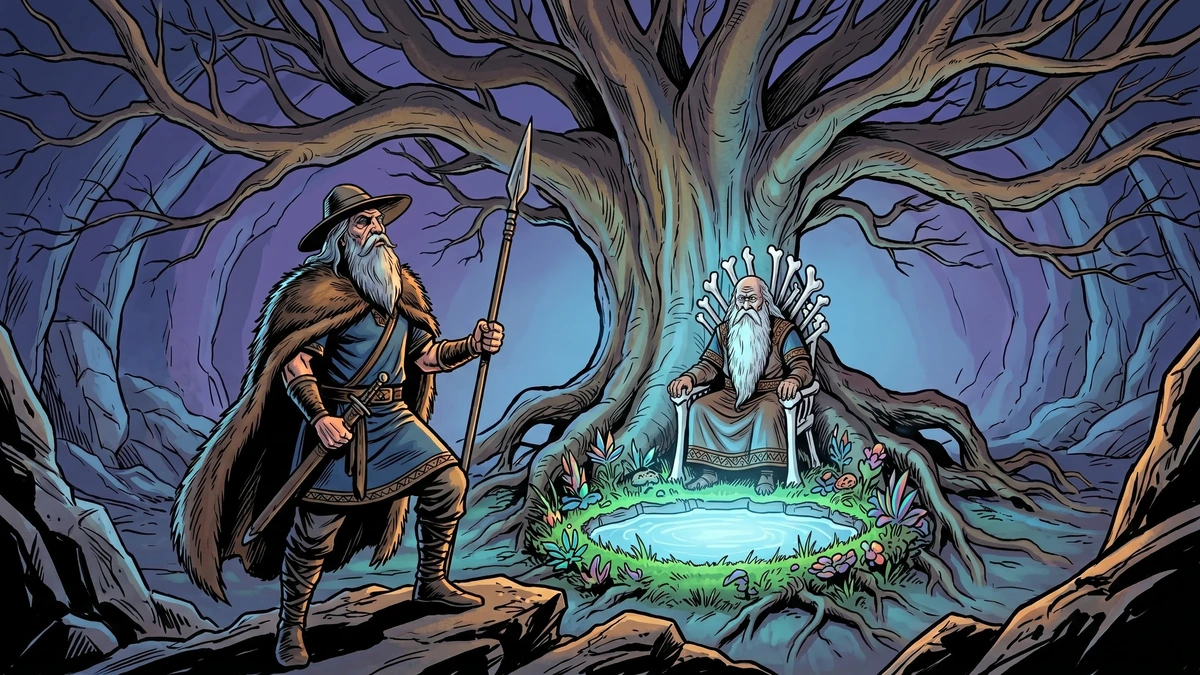
At the foot of the greatest root lay the well: water so clear and so still that it seemed a sheet of glass, glowing faintly with a light of its own. Around it grew grass of an impossible green, and flowers seen nowhere else in creation. And there, upon a throne the colour of old bone, sat Mímir. He was ancient beyond reckoning. His single eye held the weight of countless ages, and his long white beard seemed to hold secrets folded within it. When he saw the traveller approach, he smiled — but it was a smile touched with sorrow, the smile of one who already knows how a story ends.
The Price of an Eye
“I have been expecting you, All-Father,” Mímir said. “You come seeking the wisdom of my well. Many have come before you, gods and men alike. But there is always a price for such knowledge.”
“Name it,” Odin answered at once. “I am prepared to pay whatever you demand.”
Mímir rose and walked slowly around the god, studying him with an intensity that seemed to reach past flesh and bone to the very core of his being. “The price of wisdom,” he said at last, “is always sacrifice. You cannot gain something so precious without losing something equally precious. What will you give me, Odin? What are you willing to lose?”
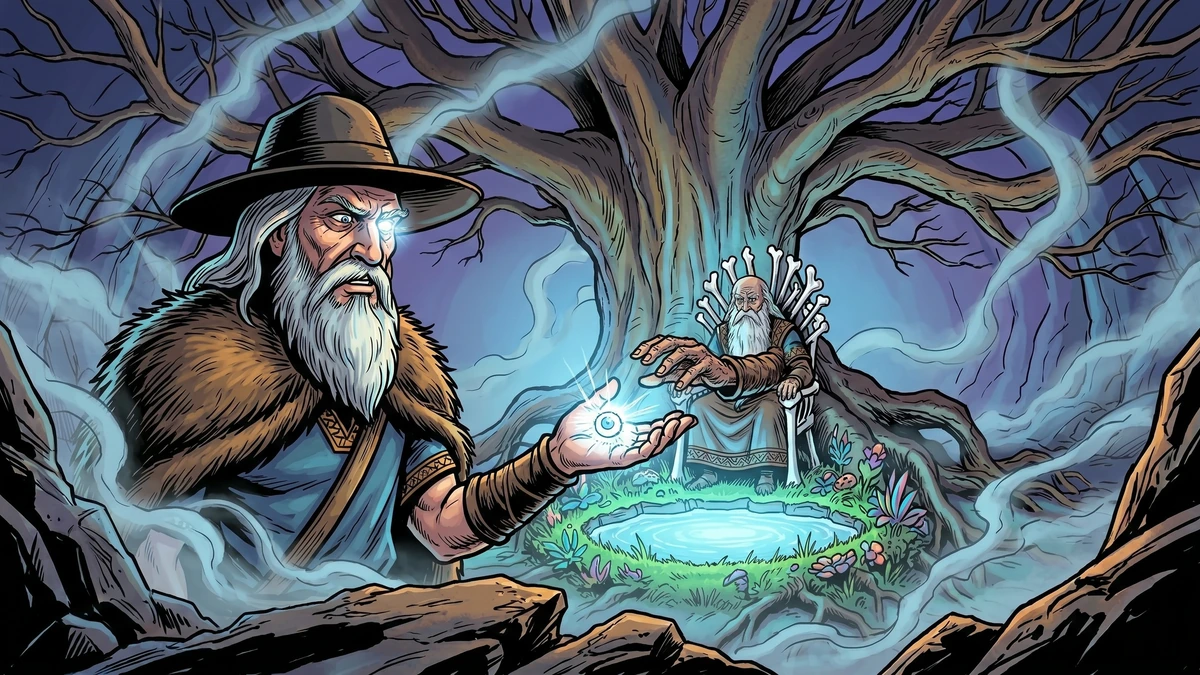
Without hesitation — though, the story admits, his hand trembled — Odin reached up and drew his own eye from its socket. He held it out, and it gleamed in that strange light like a fallen star. “Take my eye,” he said. “Take my sight in the world of solid things. Let me see less of what is, so that I may understand more of what will be.” Mímir accepted the eye and the bargain was sealed. Odin knelt at the rim of the well and drank, and as the water touched his lips his mind blazed open. He saw the patterns that govern all of existence, the connections binding every thing to every other thing, the hidden threads from which fate is woven.
Yet even as the cold water ran through him, Odin felt the edges of this knowledge — felt that it had a limit. He understood that Mímir had spoken truly: there was a wisdom deeper still. “What is this greater knowledge?” he asked. “What price would buy it?” Mímir’s face grew grave. “There is a knowledge the runes hold,” he said. “The runes are the alphabet of creation itself, written into the fabric of all that exists. To master them is to grasp magic and fate at their root. But that knowledge cannot be studied or observed. It can be won only through direct experience — through suffering.”
Nine Nights upon the Windswept Tree
Mímir told him what the runes demanded. Odin must hang himself upon Yggdrasil for nine days and nine nights, pierced by his own spear. He must endure hunger and cold and pain. He must watch the worlds turn beneath him through darkness and light, taking neither food nor drink nor sleep. Only by offering himself to himself, only by standing at the very boundary between life and death, could he unlock what the runes contained. It was not, Mímir said, a request for a payment. It was a request for a transformation.
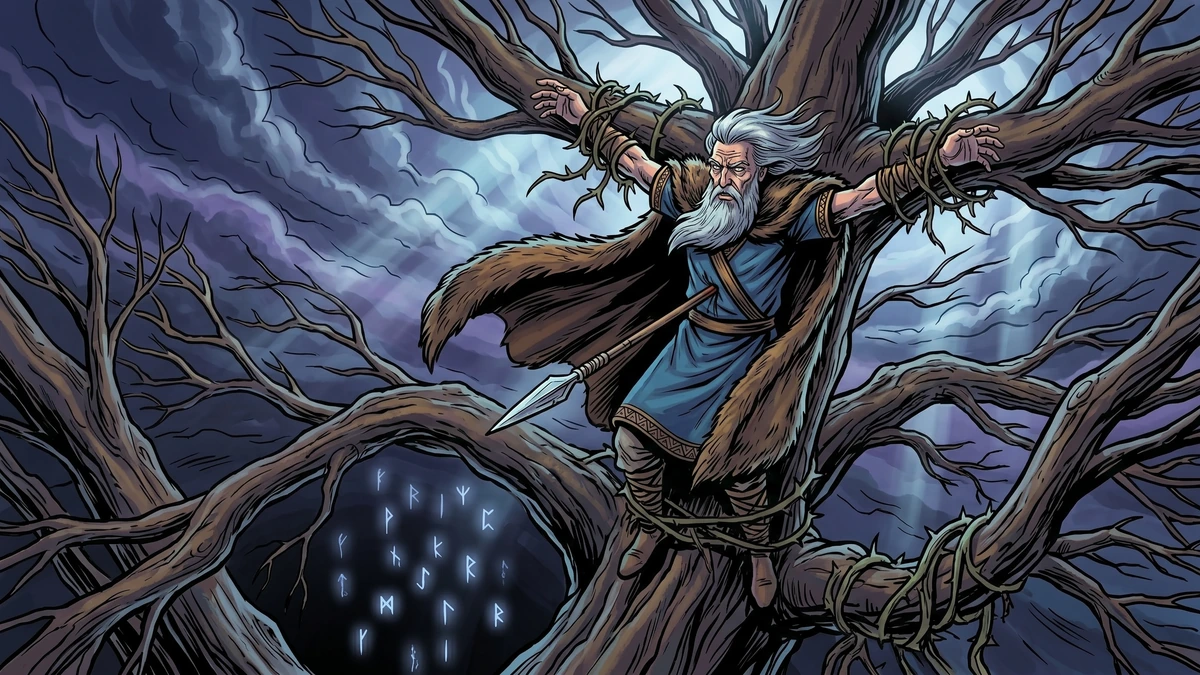
Odin looked up at the immensity of the tree, and he understood. He took up his spear, Gungnir, which never missed its mark and never failed to wound, and he climbed to the high reaches of Yggdrasil’s branches, where the wind howled without ceasing and the sky pressed down with its weight. There he made himself ready. With his own hands he drove the spear through his side, and he bound himself to the tree, and he hung.
He hung in wind and weather, in rain and in driving snow, in the burning of the sun and the deep freezing of the nights. For nine days and nine nights he remained, neither sleeping nor eating, given no bread and offered no horn of drink. His body weakened. His mind, strangely, grew sharper and clearer, as though the failing of the flesh were sharpening the spirit. His vision — already darkened by the loss of his eye — turned inward, away from the world the eyes can see and toward the world they never can. He was, in the words the Norse used, a sacrifice given to a god: and the god to whom Odin was given was Odin himself.
The Runes Revealed
On the ninth night, at the very edge of death, the thing he had suffered for came to him. Looking down into the dark beneath the tree, into the shadowed water and the tangled roots, Odin saw them at last — the runes, rising toward him out of the deep. They were not letters as men first imagine letters. They were the bones of reality, the shapes from which words and worlds and wyrd itself are built. With a final cry he reached down and seized them, and as he took them up the spell was broken. He fell back from the tree, alive, and rose again — no longer only a god of war and kingship, but the master of a knowledge that no one in the Nine Worlds had ever held before.
He returned to Asgard changed. He could now carve the runes and stain them and put them to use; he could heal, and bind, and loosen, and turn aside the weapons of enemies, and speak with the hanged dead, and read the fate folded into things. The Hávamál lists these powers one after another, a catalogue of hard-won mastery. But the poem never lets us forget what they cost. Odin is, ever afterward, the one-eyed god — and the image of the missing eye is the Norse way of saying that he is the god who chose to give part of himself away in order to see what others could not.
Odin: The God Who Chose to Suffer
It is worth pausing on the figure at the centre of this myth, because Odin is unlike almost any other chief god in the world’s mythologies. He does not rule by sitting comfortably above the world. He is, by his own choice, a wounded god. He gave an eye; he hung pierced upon a tree; he is forever associated with the gallows and the spear and the restless wandering of the seeker. Even his name carries the idea — it is connected to an Old Norse word for fury, frenzy, inspired ecstasy, the ecstatic state of the poet and the seer.
What the Norse were saying, through him, is that the highest things — wisdom, poetry, foresight, the power to shape fate — do not belong to the comfortable. They belong to those willing to be changed by what they seek, and to pay for it in their own flesh. Odin is a king, but he is the kind of king who would rather know the truth than be spared it, even when the truth is his own doom. For Odin, in all the foresight he bought so dearly, sees Ragnarök coming. He knows the wolf will swallow him. He drinks the well’s water and hangs upon the tree anyway. That is the Norse ideal at its starkest: to face what cannot be escaped with open eyes — or, in his case, with one open eye, given freely for the privilege of seeing clearly.
The Moral of the Tale
It would be easy to take a shallow lesson from this story — that knowledge is good, and worth some effort. But the Norse meant something far harder. They meant that genuine wisdom is not information; it is transformation, and transformation hurts. You cannot drink from Mímir’s well and remain who you were. You cannot hang upon Yggdrasil and climb down unchanged. The story insists that there is a difference between knowing about the world and being remade by what you know, and that only the second kind of knowing is worth the name of wisdom.
The Norse said this plainly in the Hávamál, in the very stanza where Odin describes the ordeal on the tree — the most famous lines in all of Eddic poetry:
“Veit ek, at ek hekk
vindga meiði á
nætr allar níu,
geiri undaðr
ok gefinn Óðni,
sjalfr sjalfum mér.”“I know that I hung on a windswept tree
nine long nights,
wounded by a spear and given to Odin,
myself given to myself.”
Sjalfr sjalfum mér — “myself to myself.” In those three words the whole meaning of the tale is folded. Wisdom is not taken from someone else. It is paid for out of your own substance. The seeker and the sacrifice are the same person. To become wise, Odin had to be willing to lose part of who he was, and to offer it to who he might become.
Why the Story Has Lasted
This myth has survived for the better part of a thousand years, carried out of pagan Scandinavia by Christian scribes who valued it enough to write it down even when they no longer worshipped its god. It has lasted because it refuses to lie to us. Most stories about wisdom are reassuring; they suggest that if we simply read and listen and pay attention, understanding will accumulate gently over time. Odin’s quest says otherwise. It says that the knowledge that matters most is on the far side of a sacrifice, and that we will not get there without giving something up.
Anyone who has ever truly learned something difficult — a craft, a grief, a hard truth about themselves — recognises the shape of this story. There is always an eye to be surrendered, always a long cold hanging in the dark before the runes rise out of the deep. The Norse simply told that ordinary human experience in the grandest possible terms, and gave it to their highest god to live out on our behalf. Odin hangs on the tree so that the meaning of every smaller hanging can be seen clearly: that to understand the world, you must be willing to be wounded by it, and that the wisdom worth having is always, in the end, paid for with the self.
You May Also Like
 Norse Folk Tales
Ages 9-12
Norse Folk Tales
Ages 9-12
Thor and the Giant’s Kettle
Thor and the Giant's Kettle: In the golden halls of Asgard, where the gods feasted and plotted, the need for a new cauldron had become undeniable. The old
 Norse Folk Tales
Ages 6-8
Norse Folk Tales
Ages 6-8
Loki and the Dwarves’ Wager
A Norse myth about Loki's foolish bet with the dwarves Sindri and Brokkr — the origin of Thor's hammer and a classic warning about reckless promises.
 Norse Folk Tales
Ages 9-12
Norse Folk Tales
Ages 9-12
The Blue Belt
The Blue Belt: Once on a time there was an old beggar-woman, who had gone out to beg. She had a little lad with her, and when she had got her bag full she