The Blue Belt
The Blue Belt: Once on a time there was an old beggar-woman, who had gone out to beg. She had a little lad with her, and when she had got her bag full she
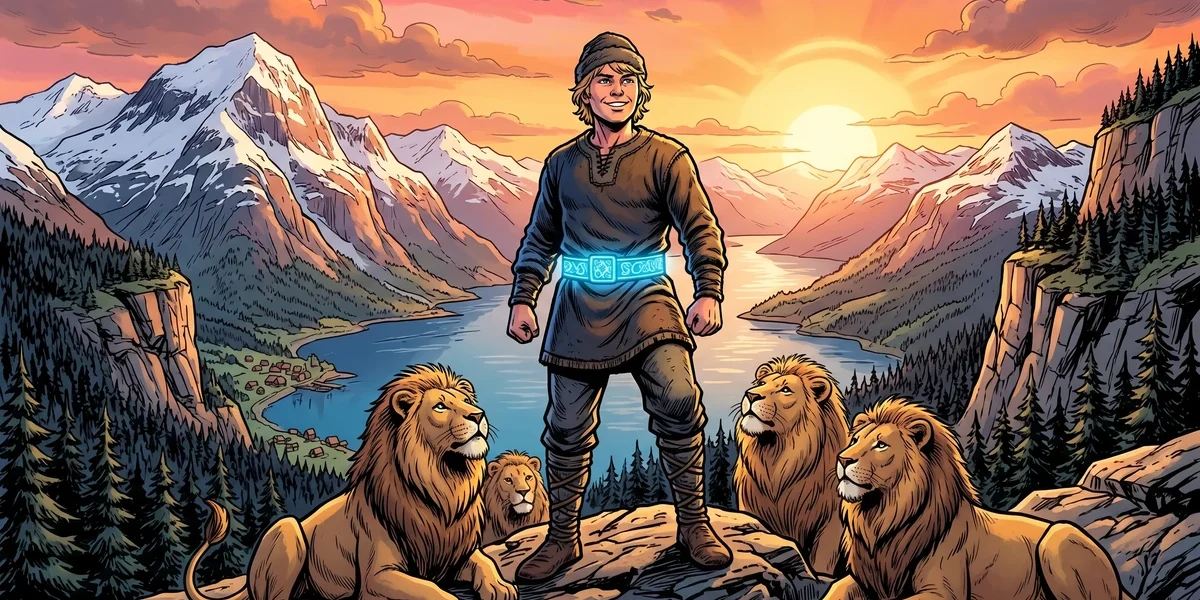
Norway gathered a great store of tales about poor boys who walked out of beggary into castles, but few of them are as strange, as fierce, or as quietly wise as the story of a ragged lad, a length of blue ribbon lying in the grass where two paths crossed, and the terrible strength it gave to anyone who tied it round his waist. It is a tale of giants and lions and a bird big enough to drop an island on a fleet — and yet the thing it cares about most is none of those wonders.
On its surface “The Blue Belt” is an adventure: a boy made mighty by a magic talisman, set against trolls who plot his death three times over. But the deepest turn of the story is not a monster at all. It is the moment the boy’s own mother takes the belt from him by trickery, blinds him, and sets him adrift to die. The tale asks a hard question and answers it plainly — what is a person worth once the source of his strength is stolen, and the betrayal comes from the one place he never thought to guard? The answer the old Norwegian tellers gave is that the belt was never really the point. What carried the boy through was something the mother could not cut off and twist round her fist.
The Belt Where Two Paths Met
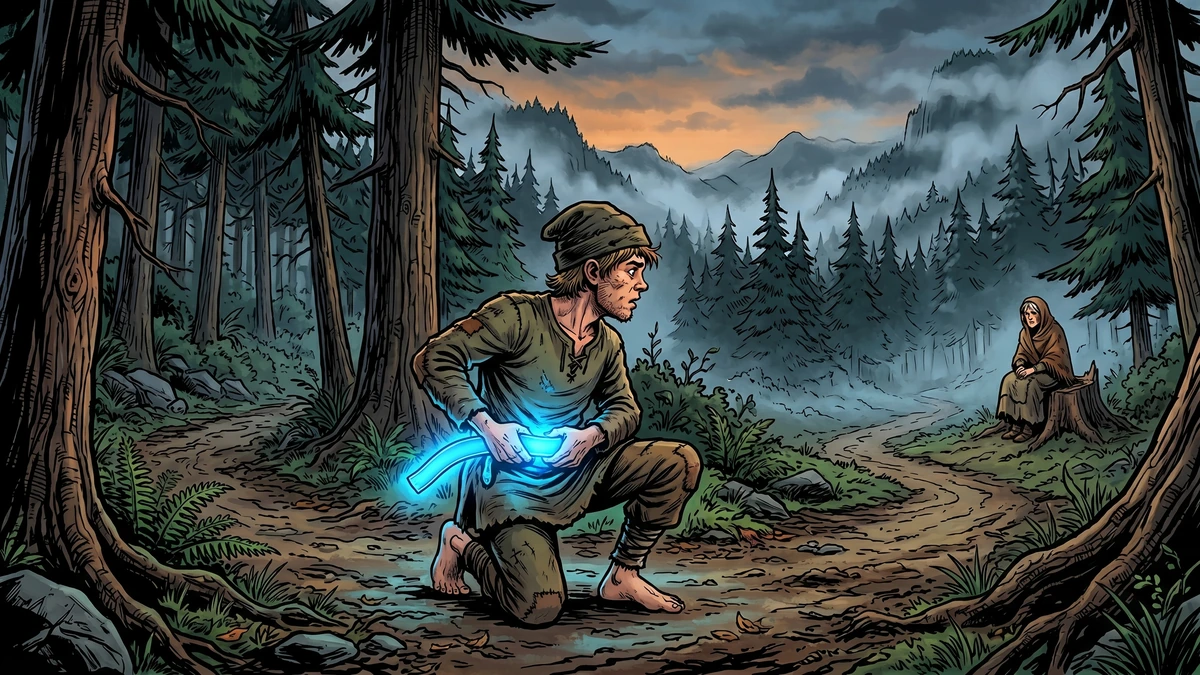
There was once an old beggar-woman who tramped the hill country with a little son at her heels, and one evening, with her bag at last full of scraps, she turned for home across the high ground. Where two footpaths crossed they came upon a small blue belt lying in the grass, and the boy asked leave to pick it up. His mother forbade it sharply — there might be witchcraft in the thing, she said — and drove him on with threats. But a little later the boy slipped aside into the wood on a pretext, ran back to the crossing, and tied the belt round his waist. At once a strength poured into him as though he could lift the whole hillside off its roots. He told his mother nothing, and they walked on into the dark.
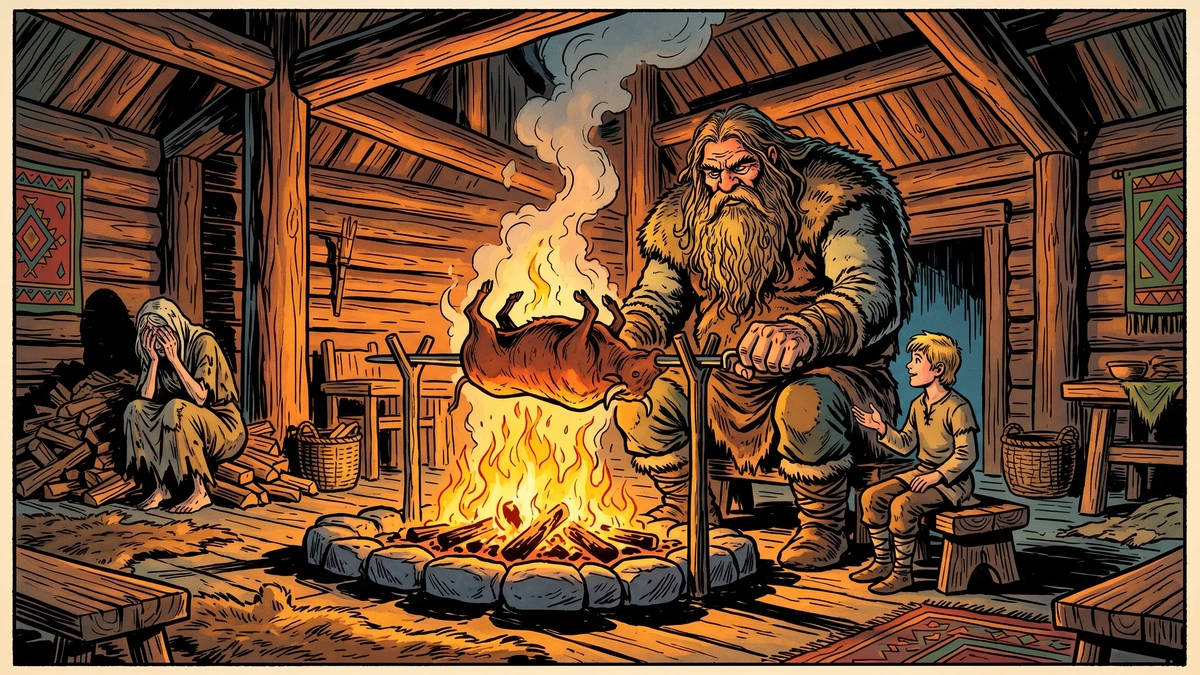
When she grew too weary to climb, the boy carried both her and the heavy bag up a sheer crag as easily as a man carries a coat, and from the top he had already seen a light burning to the north. They came at last to a great house painted red, and the old woman shrank back, for she knew the forest and knew that no Christian folk lived in it — only trolls. The boy went in anyway. On a bench inside sat a man at least twenty feet high, and the boy walked straight up to him and said, “Good evening, grandfather.” The giant was so astonished he could hardly speak. Three hundred years he had sat there, he said, and no one had ever called him grandfather before.
It is worth pausing on that single word, because the whole tale balances on it. The mother faints clean away at the sight of the giant; she spends every scene that follows cowering on a heap of firewood, too frightened to meet anyone’s eye. The boy, facing exactly the same monster, simply chooses a courtesy — and a courtesy that costs him nothing — and by it he turns a creature that could crush him into something almost like a host. The troll roasted a whole ox on the embers for his guests and broached a cask of wine, and the boy ate and thanked him and sat down to gossip by the fire as though they were old friends. Fear, the story is already saying, is a choice about how to walk into a room.
Three Plots and Twelve Lions
That night, lying awake in a cradle the size of a four-poster bed, the boy heard the troll murmuring to his mother in the dark — and what he heard was that the two of them might live happily together, if only the boy could be got rid of. Three times over the troll laid a trap, and three times the mother played her part, shamming sickness to send her son into danger. First the troll took him to the quarry to roll a crag down on him; the boy held the falling rock aside, then tipped a greater stone down on the troll and broke his thigh — and afterwards carried the screaming giant home on his back and lifted the rock off him. Then the mother begged for lion’s milk, and the boy walked into a garden of twelve roaring lions, dashed the largest against the stones until the rest crept whimpering to his feet, and came home with the milk and eleven tame lions padding behind him.
The third plot sent him to an orchard whose apples brought a three-day sleep, where the troll’s two far stronger brothers waited to tear the sleeper apart. The boy ate the apples and slept — but the eleven lions lay round him in a ring, and when the brother-trolls came snorting up like man-eating horses, the lions tore them to shreds. In the castle beyond the orchard the boy found a captive princess, the daughter of the King of Arabia, seized and carried off against her will. He took down one of the trolls’ vast swords from the wall, tossed it and caught it by the hilt, and from that hour carried it with him; and the princess, after they had lived a while together, sailed home to tell her parents she was alive.
Notice what the story has quietly done across this whole stretch. The boy’s strength is real and the belt is real — but every single danger is undone by something more than muscle. He survives the quarry because he watches and thinks; he survives the lions because the eleven he spared become loyal to him; he survives the orchard only because of those same lions, lying faithfully round a sleeping man who cannot help himself. The tale is laying its evidence carefully. A magic belt makes you strong. It does not make anyone stand guard over you while you sleep. That has to be earned by how you treat the creatures in your power.
The Belt Betrayed
When the boy went back to fetch his mother to his new castle, she walked beside him and coaxed out of him the secret of his strength — the blue belt, tied still round his waist. He opened his shirt to show it to her, trusting her as a son trusts a mother. She tore it off and twisted it round her own fist, and there in an instant was the whole of her heart laid bare: she would dash his brains out, she said, were that not too kind a death. It was the troll who proposed the crueller thing. They burned out the boy’s eyes, and they set him adrift in a little boat on the cold sea, blind and alone, deaf to all his weeping.
This is the black centre of the tale, and it is worth saying plainly how dark it is. The boy has done nothing wrong. He spared the troll’s life twice; he carried the wounded giant home; he fetched his mother medicine again and again. His only failure is that he could not imagine his own mother wishing him dead — and folklorists have a cold technical name for this whole family of stories, ATU 590, “The Faithless Mother.” The tale does not pretend the wound is small. It lets the boy drift out to sea with the wreck of everything, and only then begins to answer the question it has been building toward.
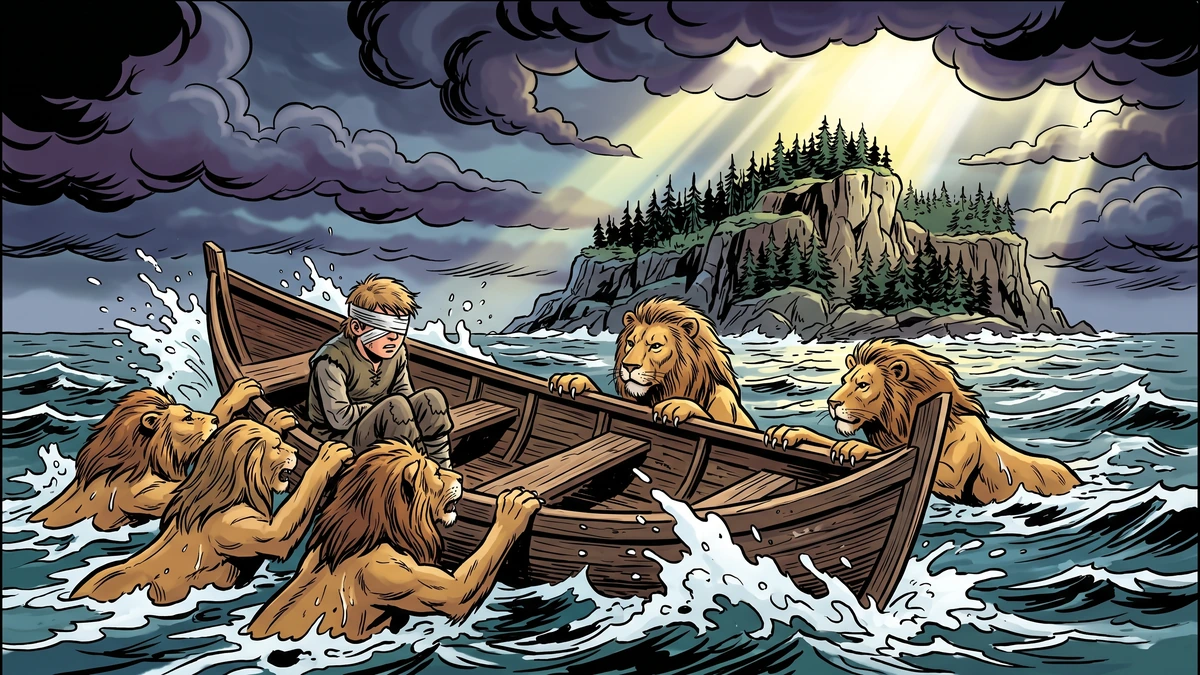
The answer comes from the lions. They swam after the boat, dragged it ashore on an island, caught game and made him a bed of down — the loyalty he had earned, paying him back when he had nothing left to give. And the cure came by watching. The biggest lion was chasing a blind hare when the hare blundered into a spring and came out with its sight restored; the lion at once understood, and dragged the boy to the same water and dipped him under, and the boy’s eyes were healed. He had the lions raft him back across the water on their own backs, stole into the castle, and took the belt again. The justice he then dealt out was exact and terrible — the doom his mother had pronounced on him, he carried out on her; the blinding and the open boat the troll had devised, he gave to the troll. The tale offers no soft forgiveness here. It insists instead that betrayal has a true weight, and that the weight comes home.
The Dancing Bear and the King of Arabia
Alone now, and aching for the princess, the boy loaded four ships and sailed for Arabia. On the way his sailors found a monstrous egg they could not crack; the boy split it with one stroke and out stepped a chick the size of an elephant. Knowing the parent bird would come for vengeance, he raced his fleet onward — and when the giant bird dropped a whole island on the empty ships and swept down on the shore, the boy met it with the troll’s sword and brought it dead out of the sky.
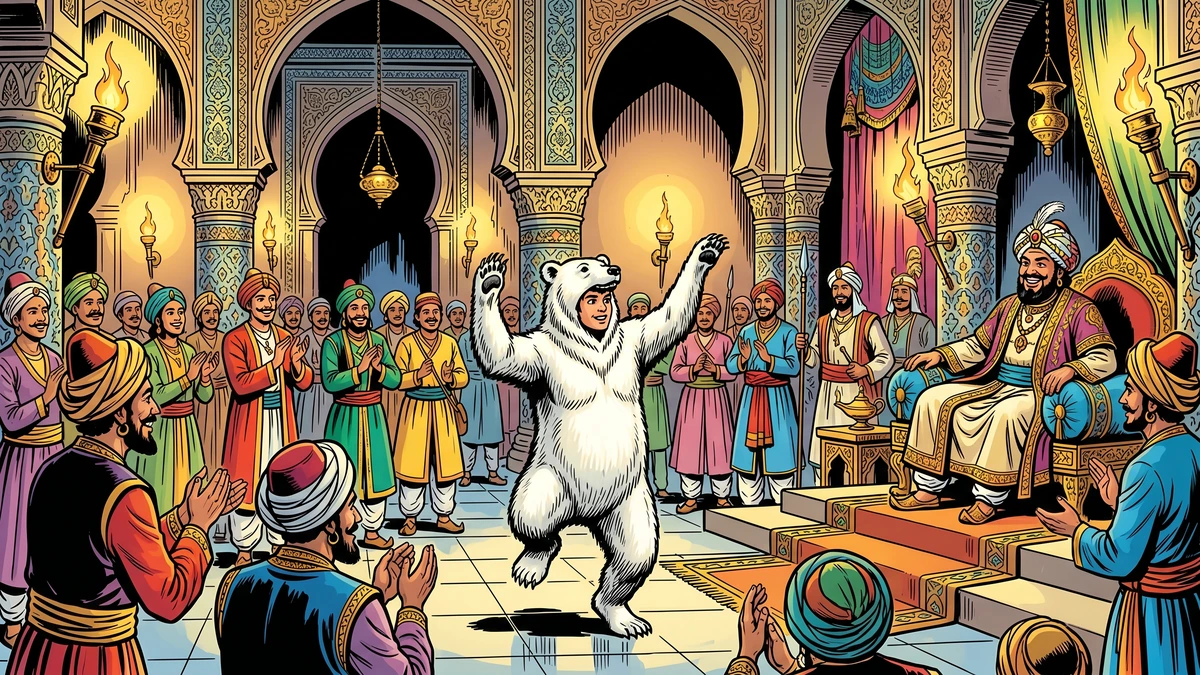
In Arabia he found the King had hidden his daughter away in a secret house on the sea and promised her hand to any man who could find her, on pain of death for failing. So the boy bought a white bear-skin, drew it on, and let a captain lead him chained into the court as a dancing bear. The trick worked: charmed by the dancing beast, the King himself carried the “bear” through gallery after locked gallery down to the hidden house, to perform for the princess. Once they were left alone she undid the bear’s collar, the boy drew off the head, and she knew her deliverer at once — but he asked her to keep the secret one night more, for he meant to earn her openly.
The next day, dressed now as a prince, he came to the King and asked leave to seek the princess, with his life forfeit if he failed within the day. He let the hours run down while the court watched him pity himself for nothing — “while there’s life there’s hope,” he kept saying — and then in the last minutes he led the King down the very galleries, hauled up the hidden house from the water, and kicked its door to splinters when the King fumbled and swore he had lost the key. The princess stepped out, named the boy as the deliverer on whom her heart was set, and so the beggar-woman’s ragged son married the daughter of the King of Arabia. The belt had begun the story; it did not finish it. What finished it was nerve, patience, and a promise kept.
The Moral of the Tale
It would be easy to read “The Blue Belt” as a story about a magic object — the lucky charm that lifts a poor boy out of beggary. But the tale itself argues the opposite, and argues it hard. It takes the belt away from the boy at its very centre, in the cruellest way it can devise, and then spends its whole second half showing that he is not finished. Blind, robbed, betrayed and adrift, he is still rescued — by lions he was kind enough to spare, by a habit of watching the world closely enough to learn from a blind hare, by a refusal to lie down in the bottom of the boat and call it the end. The belt was strength. Everything that actually saved his life was character.
And the tale draws a sharp line between the boy and his mother to make the point unmistakable. They meet the very same trolls. She faints, cowers, and is so eaten by fear that she will betray her own child to be rid of the terror. He calls the giant “grandfather” and sits down to supper. The danger is identical; only the response differs. The old Norwegian tellers, who knew hard winters and hard houses, put the truth of it in a plain saying:
“Frykt er ofte større enn faren.”
— Traditional Norwegian ordtak: “Fear is often greater than the danger itself.”
The boy is not fearless — the tale never claims that. He is something better: he acts rightly while the fear is still in the room. He shows a giant courtesy, he spares a beaten enemy, he keeps a promise when breaking it would be easier, and he keeps moving when sitting still would be the natural thing to do. That, and not the ribbon round his waist, is the strength the story wants its listeners to carry home. A talisman can be stolen in a single careless moment. Courage, kindness to the creatures in your power, and the patience to keep going are the only kind of strength that no one can tear off and twist round their fist.
The Tale’s Origins and Canonical Sources
“The Blue Belt” — in Norwegian, Det blå båndet — comes from the Norske Folkeeventyr, the great Norwegian national collection of folk tales gathered by Peter Christen Asbjørnsen (1812–1885) and Jørgen Moe (1813–1882). The two friends collected tales from oral storytellers across Norway and published them in instalments from 1841, doing for Norway much what the Brothers Grimm had done for Germany: rescuing a vanishing oral tradition and, in the act, helping to forge a national literature in a country where Danish was still the language of books. The English-speaking world met the tale through Sir George Webbe Dasent, whose translation Popular Tales from the Norse (1859) carried “The Blue Belt” into English in the rolling, colloquial voice — “the lad,” “the old dame” — that readers have loved ever since; it was later reprinted in the collection East of the Sun and West of the Moon: Old Tales from the North.
In the international Aarne–Thompson–Uther index of tale types the story is classified as ATU 590, “The Prince and the Arm Bands” — a type also known to scholars by the blunter name “The Faithless Mother” (German Die treulose Mutter). In Ørnulf Hodne’s catalogue The Types of the Norwegian Folktale (1984), “The Blue Belt” stands as the model Norwegian example of the type, which there carries the tale’s own title. The folklorist Stith Thompson observed that ATU 590 and its sister-type ATU 315, “The Faithless Sister,” are so alike — both turning on a female relative who falls for a villain and conspires to kill the hero — that they seem almost a single story; later scholars such as Hasan El-Shamy have grouped them, with ATU 590A “The Treacherous Wife,” into one family.
The type is an old and far-travelled one. Thompson supposed it first took shape in Eastern Europe — he pointed especially toward Romania — and noted that its strongest concentrations lie in the Balkans, Russia, the Baltic lands, North Africa, and the Near East, where tale type 590 is a familiar shape in the Arabic tradition. Versions of the wonder-belt itself reach back further still: the blue belt that floods a boy with a giant’s strength is a clear cousin of Megingjörð, the belt of strength worn by the god Thor in the Prose Edda of the Icelandic poet Snorri Sturluson. When the Norwegian storytellers fitted this widely shared plot to their own country, they dressed it in what lay around them — red-painted timber houses, twenty-foot trolls who turn to stone in daylight, lions and a far-off King of Arabia borrowed from the wider world of wonder — and so made an Eastern European tale type unmistakably their own.
Why the Tale Has Lasted
One reason “The Blue Belt” has held its place for the better part of two centuries in print — and untold generations of telling before that — is its sheer narrative appetite. It is a tale that never slows down: a magic belt, a courteous giant, three murderous plots, twelve lions, sleeping apples, a rescued princess, a blinding and an open boat, a healing spring, an elephant-sized chick, an island dropped from the sky, a hero disguised as a dancing bear. Few folk tales pack so much into so short a space, and that headlong generosity is part of why children have always loved to hear it told.
But the deeper reason is the hard, honest thing at its core. Most adventure tales protect their hero; this one does not. It hands him a betrayal so complete — his own mother, his own trust, his eyes, his strength, all gone in a single scene — that the story seems for a moment to have no road left. And then it shows the road anyway: kindness already given comes back as loyalty, attention already practised comes back as a cure, and a refusal to give up comes back as a kingdom. Anyone who has been let down by someone who should have stood by them can recognise the cold water of that middle chapter. And to them the tale offers its steady, unsentimental promise — that the worst betrayal is real, and so is the long way back, and that what you build in your character before disaster strikes is exactly what carries you through it. That is why “The Blue Belt” is still read on a page like this one, generations after the red house in the forest and the little boat on the cold grey sea — because it tells us, in the plain voice of an old Norwegian winter, that the strength worth having is the kind no one can ever take off your waist.
You May Also Like
 Norse Folk Tales
Ages 9-12
Norse Folk Tales
Ages 9-12
The Three Princesses In The Blue Mountain
The Three Princesses In The Blue Mountain: There were once upon a time a _King_ and _Queen_ who had no children, and they took it so much to heart that they
 Norse Folk Tales
Ages 6-8
Norse Folk Tales
Ages 6-8
Loki and the Dwarves’ Wager
A Norse myth about Loki's foolish bet with the dwarves Sindri and Brokkr — the origin of Thor's hammer and a classic warning about reckless promises.
 Norse Folk Tales
Ages 9-12
Norse Folk Tales
Ages 9-12
Tyr and the Binding of Fenrir
Tyr and the Binding of Fenrir: In the time before Ragnarok, when the gods still believed they could prevent the end times through cunning and sacrifice, there