The Glass Mountain: A Polish Tale of Cleverness Over Strength
The Glass Mountain: A Polish Tale of Cleverness Over Strength: In a distant kingdom of Poland, there stood a mountain unlike any other in all the world.
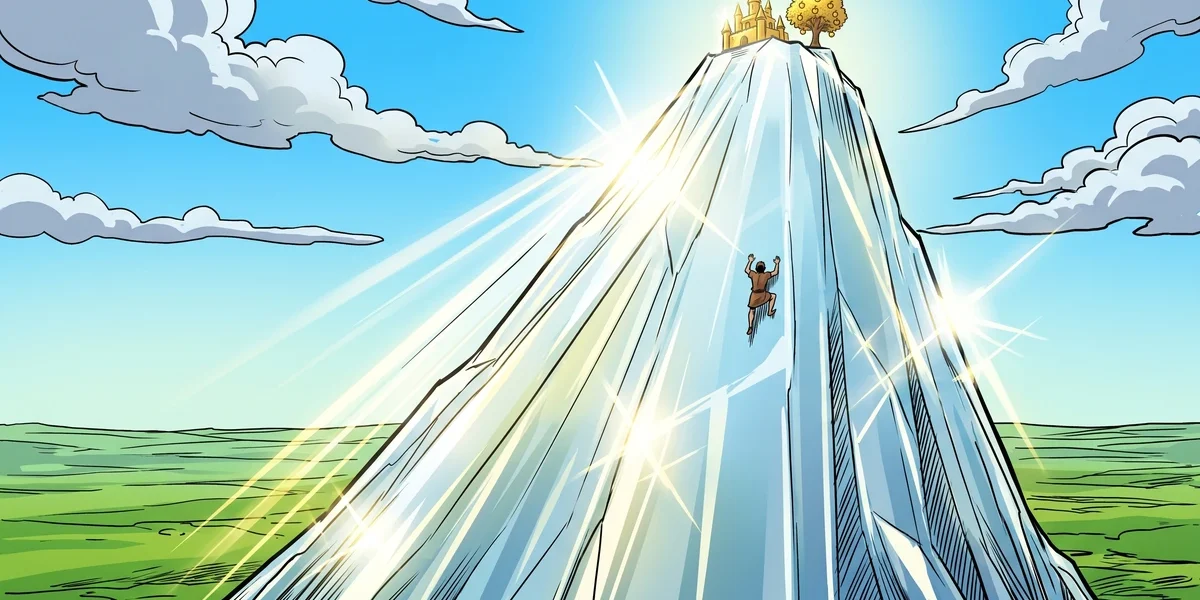
Few images in the folklore of Eastern Europe are as instantly arresting as a mountain made entirely of glass. It is a paradox carved into landscape: a peak that is at once dazzling and useless, beautiful and pitiless, a thing that promises everything and offers no foothold at all. “The Glass Mountain” — in Polish, Szklana Góra — is one of the most cherished and most frequently retold wonder tales of the Polish countryside, a story in which the obstacle itself becomes the moral. It asks a simple, devastating question: when brute force and noble blood have failed against an impossible problem, what is left? The answer the tale gives — patience, observation, and a willingness to turn the enemy’s own strength to your purpose — has kept this story alive for the better part of two centuries.
What follows is a faithful retelling of the Polish tale as it passed from village hearths into the great nineteenth-century collections, followed by a discussion of where the story comes from, how folklorists have classified it, and why a mountain of glass still speaks to readers who have never seen a knight or a golden apple.
Origins and Canonical Attribution
“The Glass Mountain” is a Polish fairy tale, and its written history can be traced with unusual precision. Its earliest substantial appearance in print is in Kazimierz Władysław Wójcicki’s Klechdy: starożytne podania i powieści ludu polskiego i Rusi (“Klechdy: Ancient Legends and Tales of the Polish and Ruthenian Folk”), Tome II, published in Warsaw in 1837, where the tale occupies pages 34–43. The Polish word klechda — an old term for a traditional legend or folk narrative — signals exactly the kind of material Wójcicki was preserving: oral stories gathered from the peasantry at a moment when Polish national identity was under enormous political pressure, and when collecting the people’s tales had become an act of cultural conservation.
The story crossed into German almost immediately. In 1839 it appeared as Der Glasberg in Wójcicki and Friedrich Heinrich Lewestan’s Polnische Volkssagen und Märchen (Berlin, pp. 115–119). A few years later Hermann Kletke included it in his Märchensaal: Märchen aller Völker für Jung und Alt (Volume II, Berlin: C. Reimarus, 1845, pp. 106–108), the great mid-century anthology of “tales of all peoples.” It was Kletke’s German text, sourced explicitly as Polish, that gave the English-speaking world its most famous version: Andrew Lang translated it for The Yellow Fairy Book (Longmans, Green and Co., 1894), where it has been read by generations of children ever since. Later collections, including Wonder-World (London, 1875) and Elsie Byrde’s The Polish Fairy Book (1925), kept both the story and its title.
Folklorists classify the tale as Aarne–Thompson–Uther type ATU 530, “The Princess on the Glass Mountain” (often called “The Princess on the Glass Hill”). This is one of the most widely distributed wonder-tale types in the world, found densely across northern and eastern Europe and recorded as far afield as the Caucasus, Turkey, the Near East, and India. Its best-known relatives include the Norwegian “The Princess on the Glass Hill,” collected by Peter Christen Asbjørnsen and Jørgen Moe, and the Russian “Sivko-Burko.” The Polish ethnographer Oskar Kolberg, in his monumental survey Lud, recorded numerous regional variants — “O szklannéj górze,” “O trzech braciach rycerzach” (“About Three Knightly Brothers”), and others — confirming that the glass-mountain motif was, in the words of folklore scholarship, one of the most frequent in the entire Polish tradition.
The tale’s deeper ancestry has been the subject of genuine scholarly debate. The folklorist John Th. Honti, writing in Béaloideas in 1936, speculated that the story descends ultimately from the ancient Egyptian “Tale of the Doomed Prince,” a fragmentary text of the late second millennium BCE in which a prince must leap on horseback to reach a princess locked in a high window. Other scholars have argued for an Indian origin. Whatever its remotest source, the story reached Poland centuries ago and was thoroughly naturalised there, its glass mountain becoming a fixture of the Slavic imagination.
The Mountain That Could Not Be Climbed
In a far country there once rose a mountain made wholly of glass. It was not a mountain of rock dusted with ice, nor a hill of crystal here and there; it was glass from base to summit, smooth and seamless, throwing back the sun in long blinding ribbons of light. No traveller who saw it ever forgot it, and no traveller who tried to climb it ever forgot the trying.
At the very top stood a castle of pure gold, and before the castle grew a single apple tree heavy with apples of gold. The fruit was not merely precious. Whoever could pluck even one apple would find the castle gates swinging open to receive him, and inside the castle waited a princess of extraordinary beauty, enchanted and alone, who would belong to whoever reached her. She had been shut up there long ago, and the only key to her freedom was the impossible ascent itself.
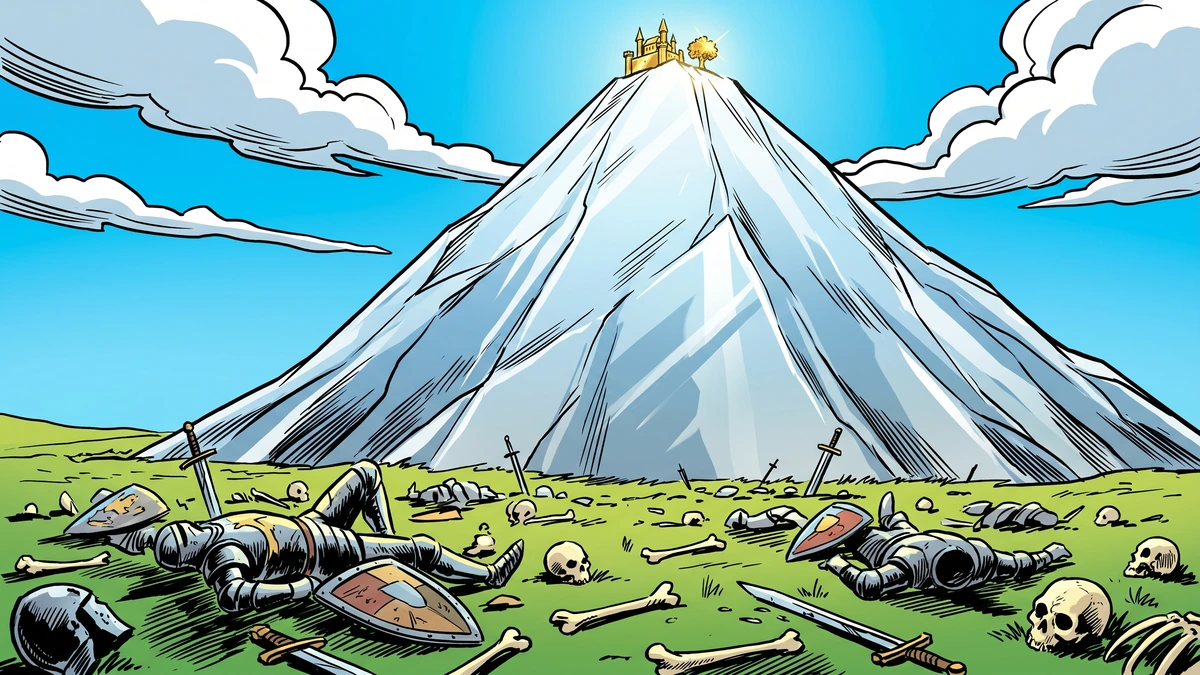
From every kingdom the bold and the desperate came. Knights in bright mail, princes with proud horses, adventurers who had never failed at anything — all of them set their eyes on the golden castle and spurred upward. And all of them slid back. The glass gave no crack to wedge a blade into, no ledge to rest a boot upon, no roughness anywhere. Horses scrabbled and screamed; men clawed until their fingers bled; and one by one they lost their grip and tumbled down the shining slope. So many had died in the attempt that the foot of the mountain had become a grim field, scattered with the bones and armour of those the glass had defeated. Still the apples glittered overhead, and still the princess waited, and still new challengers came — for hope, the tale tells us, is harder to kill than any man.

The Knight in Golden Armour
Among all who came, none looked more certain of victory than a knight who arrived one morning clad head to foot in armour of gold. He was strong, he was fearless, and he had a fine horse shod with sharpened iron, and the crowd at the mountain’s foot murmured that here, at last, was a man the glass would not beat.
On his first day the golden knight climbed with great care. He drove his horse up the slope a little at a time, testing each step, and when he had reached the halfway point he did something none of the dead had done: he turned, calmly, and rode back down again. He had measured the mountain. He would not waste his strength.
The next day he climbed in earnest. Higher and higher he went, steady and unhurried, until the golden castle seemed almost within a spear’s length. But the castle had a guardian. From the battlements a great eagle launched itself into the air, an enormous bird that wheeled once against the sun and then dropped upon the knight with its talons spread. The horse reared in terror on the frictionless glass. There was nothing to hold, nothing to grip, no second chance. Knight and horse fell together, down the long bright curve of the mountain, and were still at the bottom among all the others who had dared and died. The golden armour, men said afterward, was the most beautiful thing ever to lie broken at the foot of the Glass Mountain — and proof, if any were needed, that courage and strength alone were not enough.

The Schoolboy and the Lynx’s Claws
Now there came to the mountain a young man no one expected anything of at all. He was not a knight and owned no armour; he was a poor schoolboy, a student with quick eyes and an even quicker mind, and he had been watching the mountain for a long time before he ever set foot on it. He had watched the knights fall. He had watched the eagle. He had watched, above all, the way the glass refused every kind of grip — and he understood that the problem was not the height of the mountain but the smoothness of it. What he needed was not greater strength. What he needed was claws.
So the boy went into the forest and hunted until he killed a lynx, a wild cat whose curved claws were as hard and sharp as iron hooks. He cut the claws away and bound them carefully to his own hands and feet, and when he set himself against the glass he found that they bit and held where no boot or fingertip ever could. Slowly, terribly slowly, hooking one claw and then the next, the boy began to climb. A day passed, and a night, and another day. His arms shook. The mountain seemed endless. At last, exhausted beyond bearing, he stopped to rest on the bare slope, clinging by the lynx-claws, and there he fell into a desperate sleep — halfway between the dead below and the golden apples above.
It was the eagle that woke him — or nearly killed him first. Seeing the motionless figure on the glass, the great bird took him for carrion, for one more dead climber to be feasted upon, and it came gliding down with its talons reaching for him. But the boy was not dead, and he was not slow. As the eagle settled on him he flung up his arms and seized it fast by both legs and would not let go.

The Eagle’s Flight and the Healing Apples
The eagle was enormous and the eagle was furious. It beat its great wings and heaved itself into the air to shake the boy loose — and in doing so it carried him upward. This was exactly what the boy had hoped. He hung on grimly while the bird, struggling to be rid of him, lifted them both higher and higher up the impossible slope, until the golden apple tree was almost overhead. Then, with the last of his strength, the boy drew his knife and cut the eagle’s feet from its body. The bird shrieked and fled, and the boy dropped — not to the deadly glass, but straight down into the spreading branches of the golden apple tree, which caught him and held him safe.
He was badly hurt from the climb and the cutting, but the tree itself was his cure. The peels of its golden apples, pressed to his wounds, healed them clean and whole; and when he had restored himself he gathered the bright fruit into his arms. As the old tale promised, the moment he held the golden apples the gates of the castle swung open before him. Inside waited the enchanted princess, and her long imprisonment was over at last. The boy who owned nothing but his wits had won what every armoured prince had died failing to win, and the two were married in the golden castle on the summit of the mountain.
But the story keeps one last mercy in reserve. When the wounded eagle’s blood ran down and fell upon the slope, it touched the bones of all those who had perished trying to climb — and they rose, alive again, knight and prince and adventurer, restored to the world they had lost. The clever boy’s victory did not stand on a mountain of the dead. His success became, in the end, everyone’s deliverance.
The Tale Across Borders
Part of what makes “The Glass Mountain” so rewarding to study is the sheer breadth of its family. As ATU 530, the story belongs to one of the great international tale types, and its siblings reveal how a single core idea — an unreachable height, a waiting princess, an unlikely victor — can be reclothed in the costume of almost any culture.
Within Poland alone the variation is remarkable. Oskar Kolberg’s Lud preserves versions in which the climber is not a schoolboy but the youngest and seemingly foolish of three brothers, the others having ridden off in their pride and failed; in another, the hero is a humble chimney-sweep. The Masurian tale Der Ritt in das vierte Stockwerk (“The Ride to the Fourth Floor”), recorded by Max Töppen in 1867, replaces the glass slope with a glass-walled castle: a farmer’s youngest son keeps a lonely vigil at his father’s grave, is rewarded with a magical horse, and must leap to a princess waiting on the fourth storey. The constants across these Polish variants are striking — the underestimated hero, the obstacle that mocks ordinary effort, and the supernatural helper who must be earned through patience rather than seized by force.
Beyond Poland, the type stretches across the continent. In the Norwegian “The Princess on the Glass Hill,” collected by Asbjørnsen and Moe, the youngest of three brothers wins three magnificent horses by guarding a hayfield and uses them to leap up a glass hill toward a princess holding golden apples in her lap. In the Russian “Sivko-Burko,” a despised youngest son named Ivan summons a magic horse from his father’s grave and bounds to a princess at a high window. Whether the obstacle is a hill, a tower, or a true mountain of glass, and whether the helper is a horse, an eagle, or the claws of a lynx, the message holds: the world’s golden prizes are reserved not for the strongest contestant but for the one who is watchful, humble, and willing to win in an unexpected way.
The Moral of the Tale
“The Glass Mountain” is, at its heart, a meditation on the difference between force and intelligence. The knights who fail are not cowards and not weaklings; they are the strongest and bravest of their age, and that is precisely the point. The mountain is designed to defeat strength. It cannot be conquered by anyone who answers it on its own terms — only by someone who first stops, watches, and understands what kind of problem it really is. The schoolboy wins not because he is mightier than the golden knight but because he is more observant: he sees that the obstacle is smoothness, and he answers smoothness with claws; he sees that the eagle is a danger, and he turns the eagle into a vehicle.
Polish folk wisdom has long held this truth in a single proverb, and the tale is almost a dramatisation of it:
“Gdzie siła nie poradzi, tam rozum doradzi.”
“Where strength cannot prevail, reason will advise.”
There is a second, quieter moral in the eagle’s blood. The clever hero is not merely clever; he is, in the end, generous. His triumph spills outward and revives the very rivals he outdid. The tale refuses to let cleverness curdle into cruelty: the worthiest victory is the one that lifts others rather than standing upon them.
Why the Tale Has Lasted
Stories survive for centuries only when their central image keeps meaning something. The Glass Mountain has lasted because almost everyone, sooner or later, faces a glass mountain of their own — an obstacle that seems flawless, sheer, and indifferent to effort, a problem against which working harder simply means sliding back faster. The tale’s enduring promise is that such problems are not climbed; they are solved. The breakthrough comes from a change of approach, not an increase of force — from finding the lynx-claws no one else thought to look for.
That is why the story crossed so easily from a Polish village hearth into Wójcicki’s Klechdy, into Kletke’s German Märchensaal, into Andrew Lang’s Yellow Fairy Book, and on into the wider world as ATU 530. It flatters no one’s pedigree and demands no one’s sword. It tells the poorest reader in the room — the schoolboy with nothing but his eyes and his patience — that the golden castle on the impossible peak was, all along, waiting for exactly them. Two centuries on, the Glass Mountain still glitters, and the tale still insists that the way up is not the way you would expect.
You May Also Like
 Celtic Folk Tales
Ages 3-5
Celtic Folk Tales
Ages 3-5
The Three Golden Hairs of Grandfather Know-All: A Czech Tale of Wit and Destiny
The Three Golden Hairs of Grandfather Know-All: A Czech Tale of Wit: In the Kingdom of Bohemia, there lived a nobleman who was obsessed with destiny. He had
 Celtic Folk Tales
Ages 9-12
Celtic Folk Tales
Ages 9-12
The Children of Lir
The Children of Lir: In the time when magic still dwelt in the lands of Ireland and the boundaries between the mortal world and the realm of the Sidhe were
 Celtic Folk Tales
Ages 3-5
Celtic Folk Tales
Ages 3-5
Baba Dochia and the Coming of Spring: A Romanian Tale of Humility
Baba Dochia and the Coming of Spring: A Romanian Tale of Humility: High in the Carpathian Mountains of Romania, where snow fell thick and heavy for months on