Gold-Tree And Silver-Tree
Gold-Tree And Silver-Tree: Once upon a time there was a king who had a wife, whose name was Silver-tree, and a daughter, whose name was Gold-tree. On a certain

Gold-Tree and Silver-Tree is a Scottish Highland folk tale collected by the Australian-born folklorist Joseph Jacobs in his celebrated 1892 anthology Celtic Fairy Tales (London: David Nutt). It is the fourteenth tale in that volume, and Jacobs’s notes record that it was sent to him by the Gaelic poet and clergyman Kenneth MacLeod, who had taken it down in the West Highlands shortly before. The story sits within the great oral tradition of the Scottish Gàidhealtachd that John Francis Campbell of Islay had begun to systematically preserve in his bilingual Popular Tales of the West Highlands (4 volumes, 1860–1862). In the original Gaelic, the names of the two queens are Craobh-òir (Gold-Tree) and Craobh-airgid (Silver-Tree).
Folklorists classify Gold-Tree and Silver-Tree as Aarne–Thompson–Uther tale type ATU 709, “Snow White”, the same international story-pattern that the Brothers Grimm fixed in print as KHM 53, Schneewittchen (Berlin, 1812). Yet the Scottish version is no mere translation of Grimm. Where the German tale gives Snow White seven dwarves, an apple, and a glass coffin, the Highland tale gives Gold-Tree a foreign king for a husband, a poisoned needle hidden in a finger, and — most strikingly — a clever second wife who rescues her instead of a passing prince. That second-wife motif is unusual in European Snow-White variants and points to an older, more cosmopolitan layer of Gaelic storytelling, in which polygamy, exile across the seas, and feminine ingenuity all play larger roles than they do in the more familiar Continental versions.
1. The Trout in the Glen
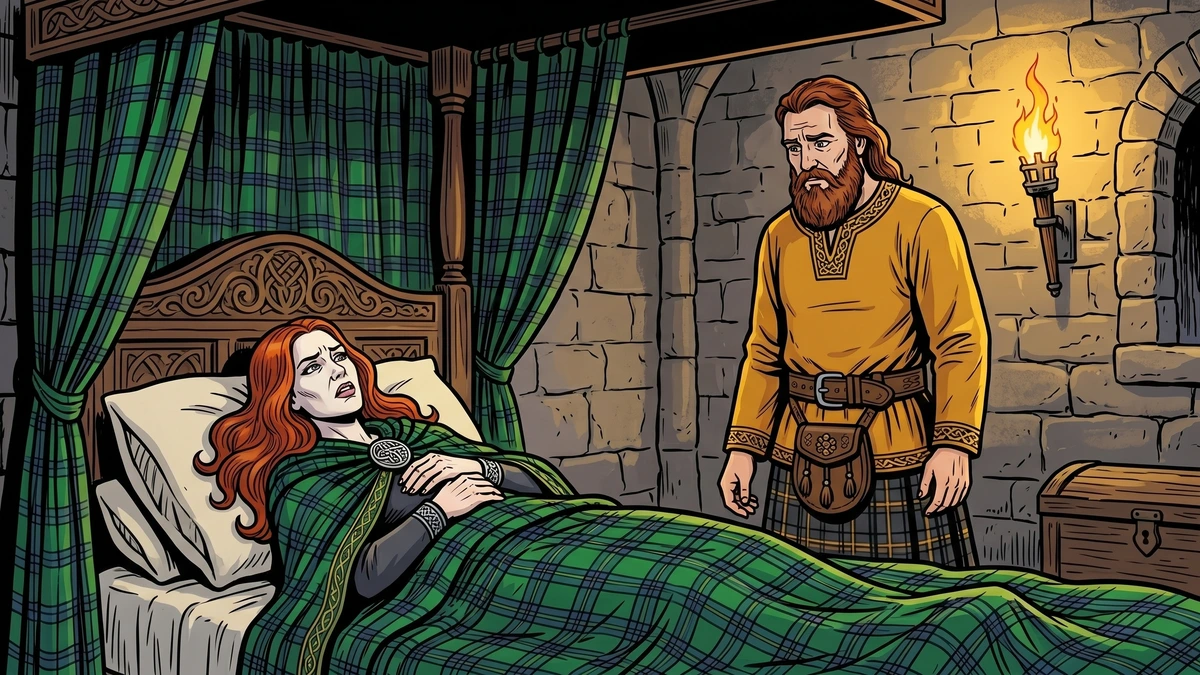
The story opens in a Highland kingdom where King and Queen Silver-Tree live with their only daughter, the princess Gold-Tree. Silver-Tree is famed throughout the glens for her beauty, and she has come to take that fame as a kind of property. One bright afternoon, mother and daughter walk together to a small mountain pool — in the Gaelic, a linn — set in a fold of the hills. In its clear water lives a magical trout whom Silver-Tree has consulted before, and to whom she now puts her favourite question.
“Troutie, bonny little fellow,” she calls down into the water, “am I not the most beautiful queen in the world?” The trout, true to its kind, cannot lie. It answers that no, the queen is not the most beautiful — the most beautiful in the world is her own daughter, Gold-Tree, walking right beside her. Silver-Tree feels the words like a blow. She turns away from the well in a cold rage, returns home, throws herself onto her bed, and refuses to rise. When the king, alarmed, asks what is wrong, she tells him she will not be well, will not eat, will not stand, until she has been brought the heart and the liver of her own daughter to swallow.
This first beat sets out the tale’s central engine with extraordinary economy. The trout is a recognisable Highland figure — the bradan feasa, the salmon (or trout) of wisdom that appears in many Gaelic stories as a truth-teller drawn from much older Celtic mythology. The mirror of the German tale has been replaced by an animal of the wild, and that small change roots the story firmly in the landscape: the queen’s vanity is judged not by an enchanted object made by human hands but by the natural world itself, which refuses to flatter her.
2. The Marriage Across the Sea
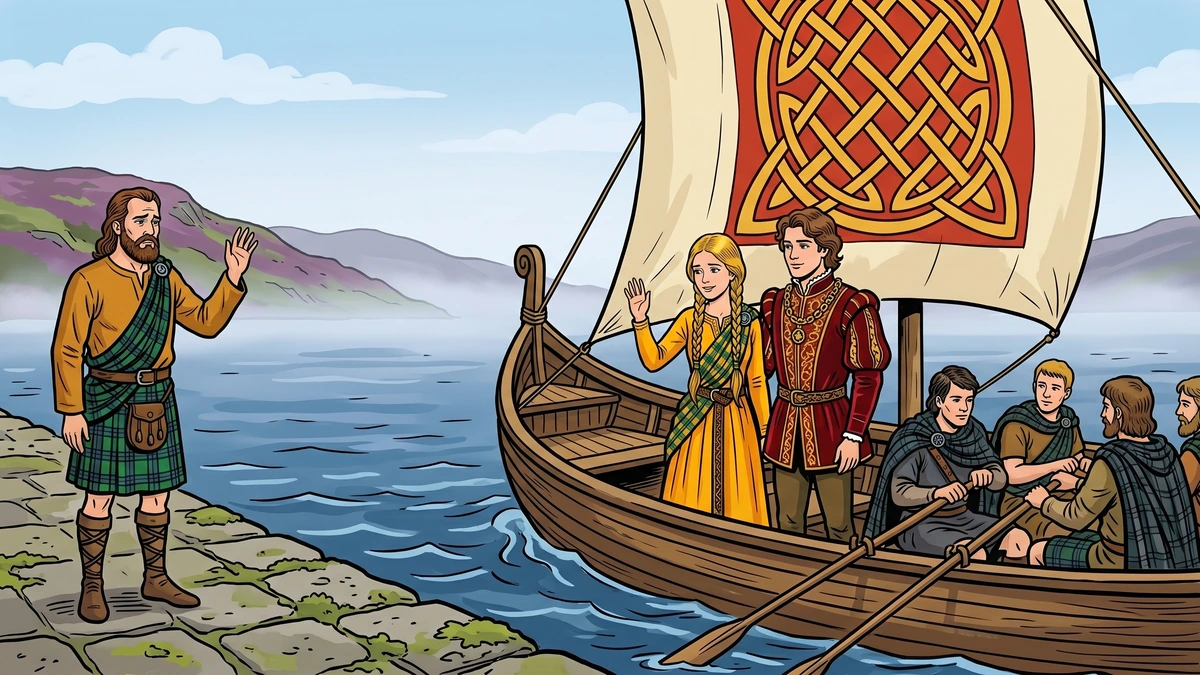
News of the queen’s strange illness travels quickly, and as it happens the timing is fortunate for Gold-Tree. The son of a great king from a country across the sea has come to the Highlands seeking a bride, and he has heard tell of the princess’s beauty. He asks for her hand, the king agrees, and Gold-Tree is sent abroad to her new husband — out of her father’s country, out of her mother’s reach, and into a far kingdom whose name the storyteller never gives, only that one must cross water to reach it.
Now the king must answer the queen’s terrible demand. He sends his hunters to the high deer-forest, the frith, with instructions to kill not a stag but a he-goat, and he brings home its heart and liver. He presents these to Silver-Tree, who eats them in the dim of her chamber and at once rises healthy, believing she has consumed her own daughter. The substitution works because the queen’s hunger is not really for flesh; it is for the satisfaction of having destroyed her rival. She does not look closely at what is on her plate, because she does not want to.
For a year, all is quiet. Gold-Tree learns the language of her husband’s court and the ways of his household. The king of the Highlands keeps his daughter’s survival secret. And then, twelve months after the first visit, Silver-Tree returns to the glen and to the trout. She asks her question again, certain now that the answer will please her — and the trout, again, refuses to lie. Gold-Tree is alive, and she lives across the sea, married to a great king. The whole substitution of the goat is laid bare. Silver-Tree does not collapse this time; instead she rises, calls for her ship, and tells her sailors to set the long oars in the rowlocks, for the queen herself is going abroad.
3. The Poisoned Finger
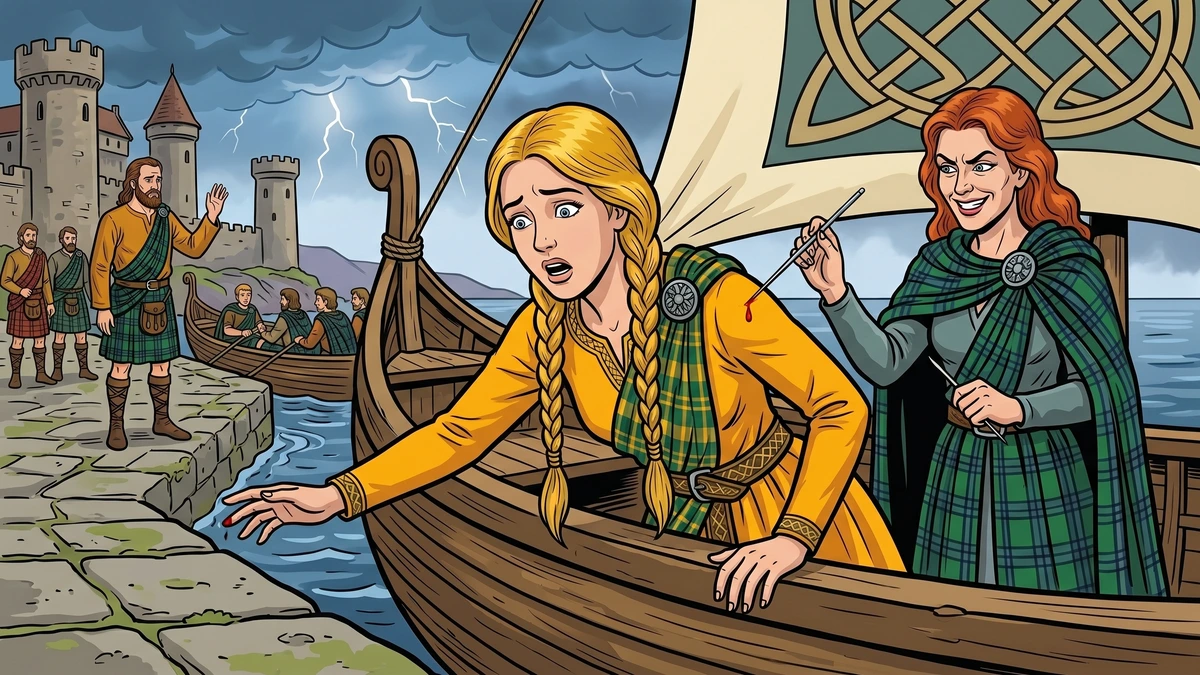
Silver-Tree’s voyage gives the storyteller one of the most evocative images in the entire Jacobs collection: a long, narrow Highland galley driven through grey northern water by silent rowers, with a vengeful queen sitting in the stern. When she lands at the foreign king’s harbour, she sends a quiet message ahead: would her daughter come down to greet her, mother to daughter, by the side of the ship?
The young king, who happens to be away hunting, has locked Gold-Tree in her chamber for safety, for he too has heard rumours. But Gold-Tree, looking down from her window, recognises her mother and is overjoyed. She begs her servants to let her out, insisting that the queen would never harm her own child. They unlock the door. Gold-Tree runs down to the harbour and, through the gunwale of the ship, reaches out her hand for her mother to take.
What Silver-Tree slips into her daughter’s outstretched finger is a long, thin poisoned thorn (in some tellings a needle, in others a sharp pin); the prick is small, but the venom on its point is enough to send Gold-Tree falling to the planks as if dead. Silver-Tree turns her ship and sails back to Scotland, satisfied at last. The young king, returning from the hunt to find his beloved wife stretched lifeless on the floor, cannot bring himself to bury her. He carries her to a locked chamber in a high tower, lays her on a bed, and takes the only key. From that day onward he keeps the room as a private shrine, visiting it alone, refusing to look upon any other woman.
This third beat is where the Highland tale departs most clearly from the Grimm pattern. There is no glass coffin set out in the forest for kindly dwarves to weep over. Instead, the heroine is concealed inside the very household that loves her, and the question of how she will ever be revived hangs in the air like the locked door itself.

4. The Second Wife’s Cleverness
Years pass in this strange half-mourning, and at length the king’s noblemen persuade him that he must marry again, if only for the sake of the kingdom. He does so reluctantly, and his second wife — a kind-hearted, observant woman whom the storyteller never names — comes to live in his castle. She notices at once that her husband always carries a single key on a cord around his neck, and that he goes alone, every day, to a tower room he never opens to anyone else.
One evening, while the king sleeps, the second wife gently removes the key, climbs the stair, and unlocks the door. There she finds Gold-Tree, lying on her bed, her body still as stone, beautiful as the day she fell. The second wife examines her carefully and notices the tiny black point of the poisoned thorn still buried in Gold-Tree’s finger. She draws it out — and Gold-Tree opens her eyes, sits up, and asks where she is.
The second wife’s response is the moral heart of the whole story. She does not run weeping to her husband; she does not demand to take Gold-Tree’s place; she does not even feel jealous. Instead she says simply, “He is your husband, not mine. I will go to him and tell him you live, and you and he will be together as before.” When the king learns the news, he is overcome with joy and at first refuses; he loves his second wife too. She insists, calmly: “Both of you cannot have him; let it be the one who came first.” From that day, the three live as friends within one household — a resolution that would have seemed strange in many European Snow-White tales but that fits the wider Gaelic world, where complex households of kin and co-wives were not unimaginable in story.
Silver-Tree, of course, does not give up. A year later she returns once more to the trout, hears once more that her daughter lives, and sails once more across the sea. This time, however, the second wife is waiting for her on the shore. She greets the old queen courteously and offers her, as a gesture of welcome, a cup of wine. Silver-Tree, suspicious, demands that her daughter drink first. The second wife — who has prepared the cup carefully — gently tilts it towards Silver-Tree’s mouth, and the queen, in her own greed, swallows the poison she had meant for Gold-Tree. So ends the long jealousy. Gold-Tree, her husband, and her clever co-queen live out their days in peace, and the trout in the Highland glen is troubled by no more vain questions.
The Moral
“Cha bhi soirbheachadh aig an fharmadach.”
“There is no prosperity for the envious.”
— traditional Scottish Gaelic proverb
Gold-Tree and Silver-Tree is a story about envy and the cost of envy, but it is also a story about the practical, generous wisdom that defeats envy. Silver-Tree is destroyed not by violence but by her own appetite. The second wife, by contrast, succeeds because she sees clearly, acts kindly, and refuses to compete with another woman over a man. The Highland storyteller seems to suggest that real intelligence in this world is not the cleverness that wins arguments; it is the steadiness of mind that knows what does not belong to you and lets it go.
The tale also quietly insists, in a way the Grimm version does not, that women can rescue one another. Snow White in the German tale is woken by a prince’s kiss and an accidental jolt. Gold-Tree is woken by another woman’s careful hand and her willingness to share a household honestly. That is a remarkably modern moral folded inside a very old story, and it is one of the reasons folklorists return to the Scottish version again and again.
Why This Story Has Lasted
Gold-Tree and Silver-Tree has endured for at least two reasons. First, because the basic Snow-White pattern — the jealous older woman, the poisoned object, the apparent death, the eventual revival — is one of the great archetypes of Indo-European folk narrative, found from Italy and Greece to Armenia and India. It speaks to a fear and a hope so old that almost every culture has produced its own version. Second, because the particular Scottish telling carries something distinct: the trout in the well, the long sea-voyage, the locked tower, the unselfish second queen. These local details give the story a flavour of place — the cold lochs and small harbours of the West Highlands — that makes it more than a generic fairy tale.
Modern readers, especially those who know the Grimm version well, often find that this Highland telling startles them awake. It is not a story about waiting passively for rescue. It is a story about practical women, about a kind co-wife who refuses jealousy, about a mother whose vanity destroys her, and about a daughter who survives because someone took the trouble to look closely at her finger. In a culture that has begun to ask harder questions about how women treat one another, Gold-Tree and Silver-Tree feels less like a quaint relic of the 1890s and more like a small piece of usable wisdom, carried down from the Gaelic-speaking households of nineteenth-century Skye and Lewis to the bedside tables of children today.
Cultural Context and Continuing Influence
The Scottish folk-tale tradition that produced Gold-Tree and Silver-Tree was already in danger of disappearing when J. F. Campbell of Islay began his great collecting tour in 1859. Campbell trained a small band of native Gaelic speakers — Hector Maclean, Hector Urquhart, John Dewar, and others — to take down stories word-for-word from old reciters in the islands and the mainland glens. By the time Joseph Jacobs assembled Celtic Fairy Tales three decades later, much of what those reciters knew had already faded. Jacobs’s editorial choice to include Kenneth MacLeod’s version of Gold-Tree and Silver-Tree was an act of preservation: it brought a living Highland tale into the standard library of English-language fairy tales beside Cinderella and Snow White, and it has kept the story alive for every reader since.
Today, the tale appears in scholarly editions of Jacobs (Folio Society, Penguin Classics), in modern children’s picture books, and in Scottish-language teaching materials produced by the Scottish Storytelling Centre in Edinburgh. It has been retold by writers such as Kenneth Macleod and Rachel Louise Lawrence in dual-language editions designed to support Gaelic revival. Folklorists continue to study it as an unusually pure example of how a single international story-type — Snow White, ATU 709 — adapts to local landscapes, local kinship structures, and local notions of female friendship. To read it today is to receive a small inheritance from the Highland storytellers of the late nineteenth century, and to discover that their idea of a happy ending is, perhaps, more generous than our own.
You May Also Like
 Celtic Folk Tales
Ages 9-12
Celtic Folk Tales
Ages 9-12
The Shee An Gannon And The Gruagach Gaire
The Shee An Gannon And The Gruagach Gaire: The Shee an Gannon was born in the morning, named at noon, and went in the evening to ask his daughter of the king
 Celtic Folk Tales
Ages 9-12
Celtic Folk Tales
Ages 9-12
Powel, Prince of Dyfed
Powel, Prince of Dyfed: owel, Prince of Dyfed, was lord of the seven Cantrevs of Dyfed; and once upon a time Powel was at Narberth, his chief palace, where a
![The House In The Lake.[2]](https://indianfolktales.com/wp-content/uploads/2026/05/p836_scene01-400x260.webp) Celtic Folk Tales
Ages 9-12
Celtic Folk Tales
Ages 9-12
The House In The Lake.[2]
The House In The Lake.[2]: A long, long time ago there lived in a little hut, in the midst of one of the inland lakes of Erin, an old fisherman and his son.