The Pied Piper of Hamelin: A German Legend of Promises Broken
The Pied Piper of Hamelin: A German Legend of Promises Broken: In the prosperous German town of Hamelin, where merchant ships once sailed down the Weser River
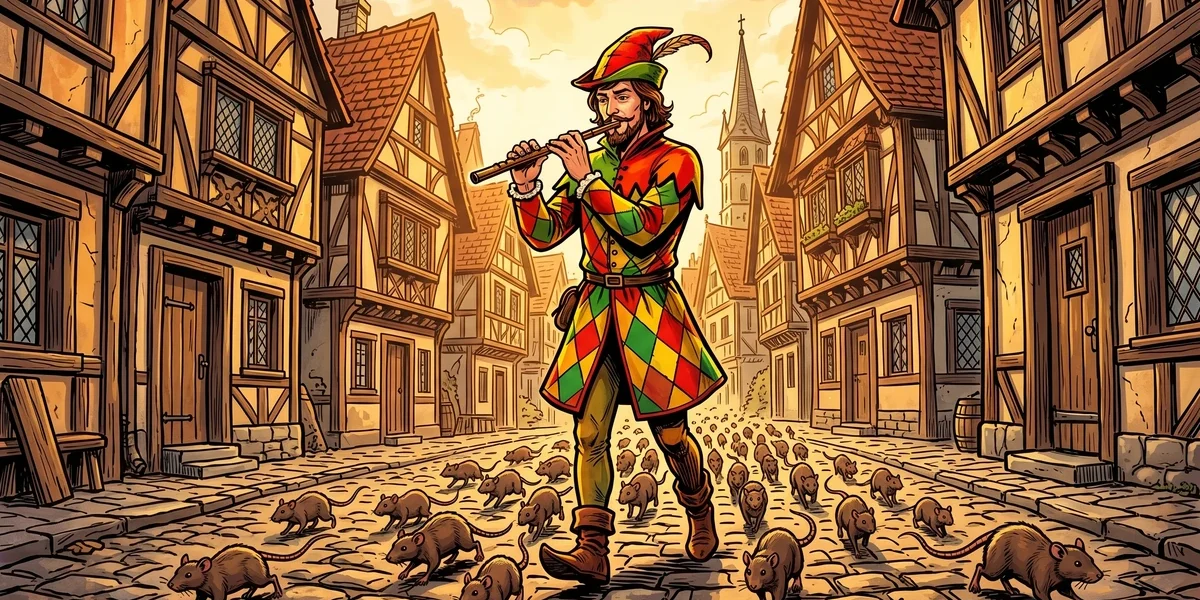
Few European legends carry the strange double weight of the Pied Piper of Hamelin — at once a children’s tale and a genuine medieval mystery. The Germans call him der Rattenfänger von Hameln, “the rat-catcher of Hamelin,” and his story is bound to a real town on the Weser River in Lower Saxony, to a real date, and to a loss that the townspeople of Hamelin recorded, mourned, and never quite explained. This is not a fairy tale invented for the nursery. It is a Sage — a local historical legend — that grew, layer by layer, around an event the town insisted had truly happened.
The oldest trace of the story is not a book at all but a window. Around the year 1300, a stained-glass window was installed in Hamelin’s Market Church (the Marktkirche), showing a brightly dressed piper leading a procession of children dressed in white. That window was destroyed in the seventeenth century, but descriptions and copies survive — most famously a 1592 watercolour by Augustin von Mörsperg. The earliest surviving text is a verse entry in the so-called Lüneburg manuscript, written around 1440, which states plainly: in the year 1284, on the feast of Saints John and Paul, the twenty-sixth of June, one hundred and thirty children born in Hamelin were led away by a piper clothed in many colours, toward a place called the Koppen, and lost. A Hamelin town record of 1384 adds the chilling, matter-of-fact line that it had been one hundred years since “our children left.”
What the early records do not mention is the rats. The plague of rats — now the most familiar part of the story — was a later addition, surfacing in the sixteenth century in the Zimmern Chronicle (around 1559–1565) and carried into the English-speaking world by Richard Verstegan’s Restitution of Decayed Intelligence in 1605. When Jacob and Wilhelm Grimm gathered the legend for their Deutsche Sagen (German Legends), it appeared in volume one as number 245, “Die Kinder zu Hameln” (The Children of Hamelin), assembled from eleven separate sources. Robert Browning’s beloved 1842 poem, The Pied Piper of Hamelin: A Child’s Story, fixed the version most readers know today. In folkloristic terms the tale resists a clean Aarne–Thompson–Uther tale-type number, because it is a localised legend rather than a wonder-tale; its engine is the old motif catalogued by Stith Thompson as D1427.1, “Magic music compels person to follow.” What follows is a faithful retelling of that legend, beat by beat.
A Town Besieged
Hamelin, in the legend’s telling, was a prosperous place. Merchant boats slid down the Weser with grain and cloth; the granaries stood full; the cobbled market squares rang with bargaining. It was the kind of town that believed, with the quiet confidence of the comfortable, that misfortune happened elsewhere.
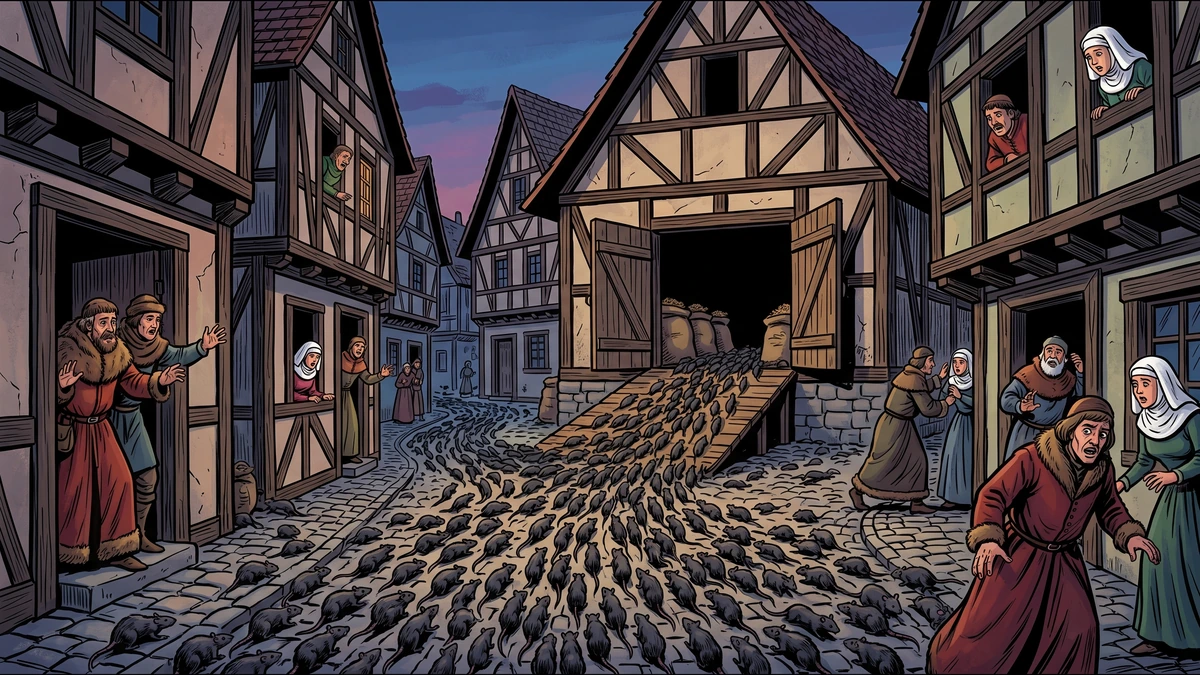
Then came the rats. They rose out of the river like an invading army — not a few household pests but thousands upon thousands, black and grey and unnaturally bold. They gnawed through the granary walls and spoiled whole harvests of wheat and barley. They swarmed the kitchens and the cradles, fouling food, frightening children, biting the cats that were supposed to hunt them. They bred faster than any trap or poison could keep pace with, and within weeks the wealth of Hamelin was being eaten alive from the inside.
The town council met and argued and met again. They offered bounties; they imported cats; they prayed. Nothing held the tide. The burghers who had once boasted of their full storehouses now lay awake listening to the dry rustle of claws inside the walls. Hamelin, the town that thought ruin belonged to other people, had become a place under siege — and it had no idea how to lift the siege itself.
The Stranger in Motley
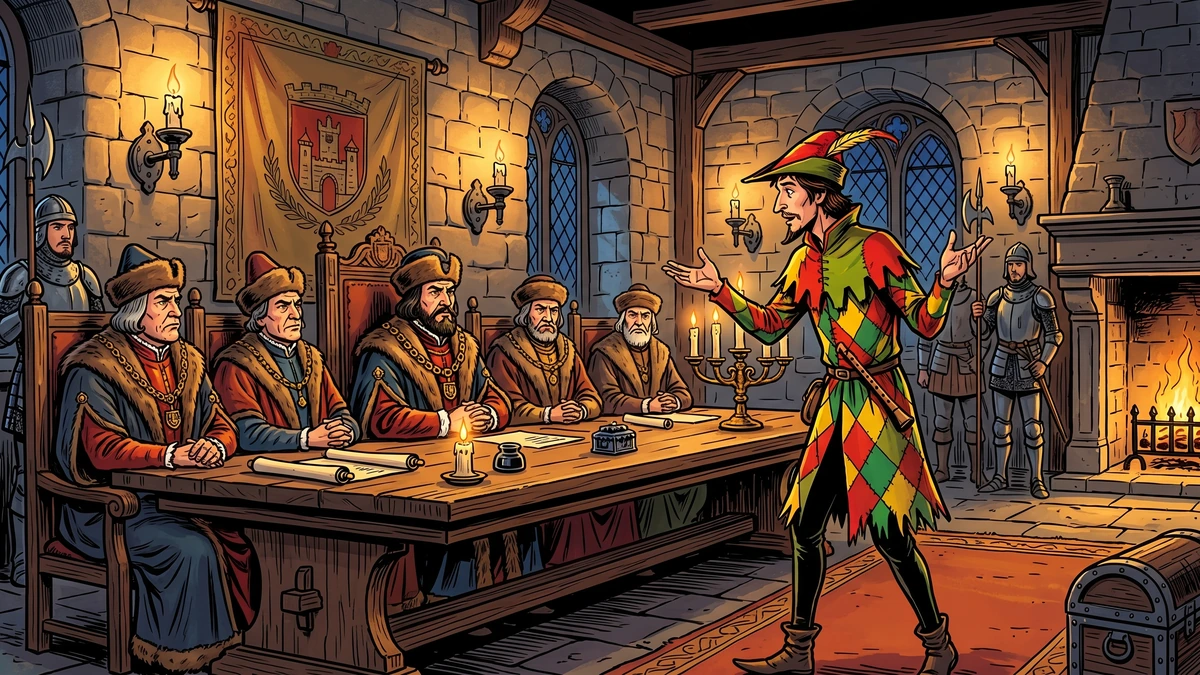
He arrived, the legend says, on an ordinary morning, and everyone who saw him remembered the coat. It was sewn of many colours — red and yellow, green and patchwork — the dress the medieval Germans called bunt or pied, and from it the stranger took his name. Tall and lean, he carried a single pipe, and he walked into the council chamber as though he had been expected.
He made the burghers a plain offer. For an agreed sum of money, he would rid Hamelin of every last rat. The councillors, desperate and seeing no risk in a promise that cost them nothing unless it worked, agreed at once. Some versions of the legend say they pledged a thousand guilders; all of them agree that the sum was generous, and that the bargain was struck openly, with witnesses, in the proper manner of a contract. The piper asked for nothing in advance. He simply nodded, stepped back into the street, and raised the pipe to his lips.
It is worth pausing on that bargain, because the whole legend turns on it. The stranger did nothing underhanded. He named his price, the town accepted his price, and both sides understood exactly what had been agreed. Whatever happened afterward, it did not happen because the piper had cheated anyone.
The River Takes the Rats
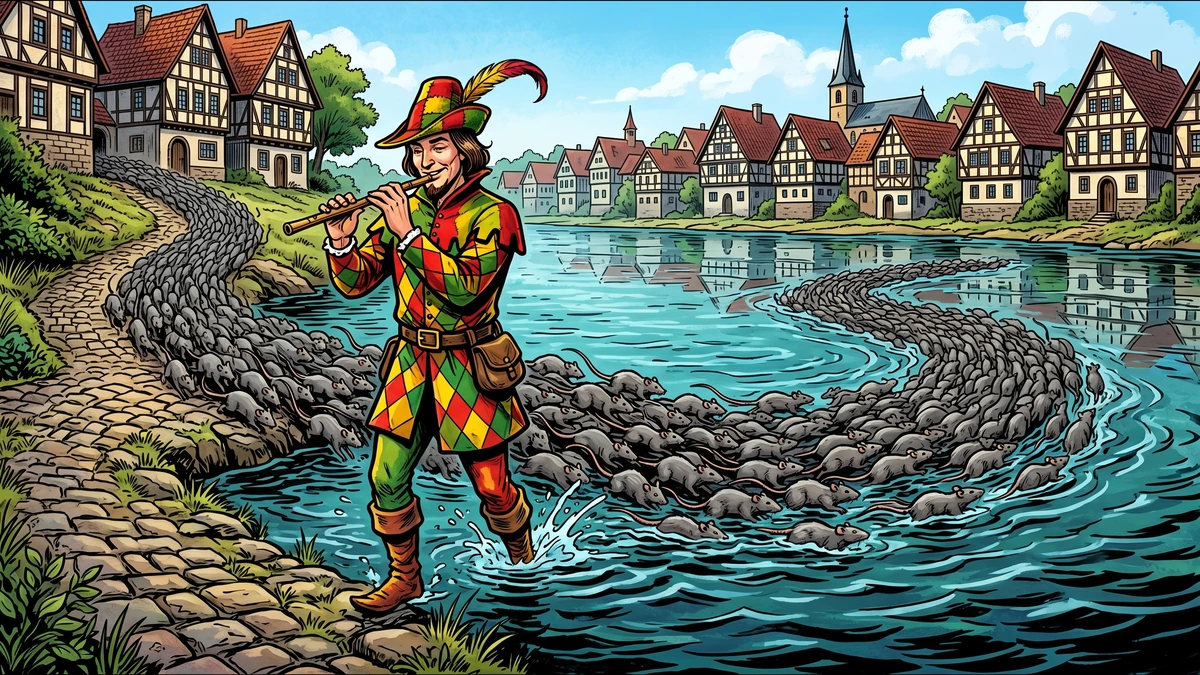
The first notes drifted thin and high over the rooftops, and the town fell silent to listen. Then the walls began to move. Out of every cellar and granary, every drain and rafter and rubbish heap, the rats came pouring — not fleeing in panic but flowing, ordered, drawn. They massed in the streets in a living grey river, and that river followed the piper as he walked, unhurried, toward the Weser.
He waded a few steps into the cold current and played on. The rats followed him into the water, rank upon rank, and the river carried them under and away. By the time the tune ended, Hamelin was clean. Not one rat remained in the granaries; not one stirred behind the walls. The townspeople came out of their houses into a silence they had almost forgotten, and they wept and laughed and embraced one another in the street.
And then, with the danger gone and the fear already fading, the bargain began to look different to them. A thousand guilders — for an afternoon’s whistling? The councillors gathered and talked themselves, by small reasonable steps, into a smaller sum. The rats were drowned; the piper could hardly put them back; what could he do if Hamelin simply paid him a fraction and called the matter closed? When the stranger returned for his fee, they offered him a handful of coins and told him to be grateful for it.
The Debt Unpaid
The piper did not argue. He did not raise his voice or call down a curse. He looked at the coins, and at the faces of the men who had broken their word, and he left the town without another sentence. That quiet was the most frightening thing about him.
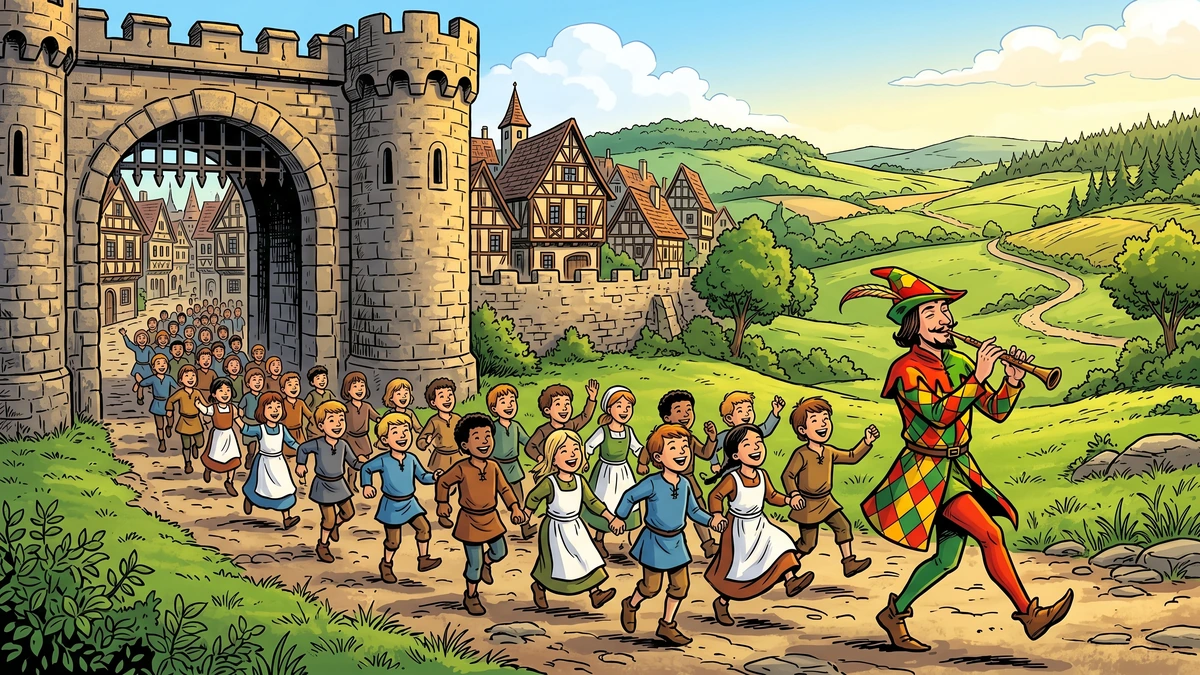
He came back on the twenty-sixth of June — the feast of Saints John and Paul — while the grown people of Hamelin were gathered in the churches. This time his coat was different, and the tune was different, and it was not written for rats. It was a bright, irresistible, joyful sound, and it was meant for the young. From every house in Hamelin the children came running — one hundred and thirty of them, the old records say — laughing, dancing, tumbling into the street to follow the music.
The piper led them out through the eastern gate, and the column of children wound up into the hills toward a place called the Koppen. There the legend closes its hand over them. Some tellings say a door opened in the hillside and swallowed the procession whole; some say the children were never seen in any land again; the Grimms’ version notes that two children lagged behind — one blind, who could not see where the others went, and one lame, who could not keep the pace — and that these two alone returned to tell Hamelin that its sons and daughters were gone. The parents came out of the churches into a town with no children in it. And Hamelin, which had haggled to save a few hundred guilders, had paid instead a price beyond any counting.
What Really Happened in 1284?
Because Hamelin treated the loss of its children as fact rather than fancy, the legend has always invited investigation, and for centuries scholars have tried to recover the history hidden inside the story. Their theories are worth knowing, because each one explains a different part of the legend.
The plague hypothesis reads the piper as a personification of death itself — the medieval figure of the dance of death, the Totentanz, who pipes the young out of the town and into the grave. An outbreak of disease that fell heavily on Hamelin’s children would account for a sudden, collective loss and for the procession of figures in white, the colour of burial shrouds, shown in the lost church window. A related theory points to the strange dancing manias of medieval Europe, in which crowds of people danced uncontrollably, sometimes to exhaustion or death; a piper leading children in an irresistible dance maps neatly onto that documented phenomenon.
The most widely favoured modern explanation, however, is gentler and in some ways sadder. During the thirteenth century, land-hungry German territories were actively recruiting young settlers to colonise the sparsely populated regions of eastern Europe — Moravia, Pomerania, the Baltic, and especially Transylvania. Recruiting agents, known as locators, travelled from town to town gathering young men and women willing to start new lives in the east. Such an agent, brightly dressed to attract attention, would have led a column of Hamelin’s youth out through the eastern gate, over the Koppen hills, and away forever — not to death, but to a distant frontier from which letters rarely returned. The Grimms themselves preserved the memory of this reading: their version ends by noting that the lost children became the founders of settlements in Transylvania. Surnames common in Hamelin do, in fact, appear in medieval records of those eastern colonies. On this reading the legend is true in its grief and only mistaken in its magic: Hamelin really did lose a generation, but to emigration rather than enchantment, and folk memory across three centuries slowly recast a recruiter’s bargain as a piper’s curse.
No single theory has won universal agreement, and perhaps none ever will. What every theory shares is the assumption the town of Hamelin made from the start — that something genuine and grievous happened, and that the legend, however it dressed itself, was the shape the town gave its mourning.
The Moral of the Tale
The Pied Piper is, at its core, a legend about the weight of a promise. The rats were never the true danger to Hamelin; the true danger was a town that believed an agreement could be quietly shaved dow
You May Also Like
 Celtic Folk Tales
Ages 9-12
Celtic Folk Tales
Ages 9-12
The Story of the McAndrew Family
The Story of the McAndrew Family: long time ago, in the County Mayo, there lived a rich man of the name of McAndrew. He owned cows and horses without number
 Celtic Folk Tales
Ages 9-12
Celtic Folk Tales
Ages 9-12
Jack And His Master
Jack And His Master: A poor woman had three sons. The eldest and second eldest were cunning clever fellows, but they called the youngest Jack the Fool, because
 Celtic Folk Tales
Ages 3-5
Celtic Folk Tales
Ages 3-5
Baba Dochia and the Coming of Spring: A Romanian Tale of Humility
Baba Dochia and the Coming of Spring: A Romanian Tale of Humility: High in the Carpathian Mountains of Romania, where snow fell thick and heavy for months on