King O’Toole And His Goose
King O'Toole And His Goose: Och, I thought all the world, far and near, had heerd o’ King O’Toole well, well, but the darkness of mankind is untellible! The
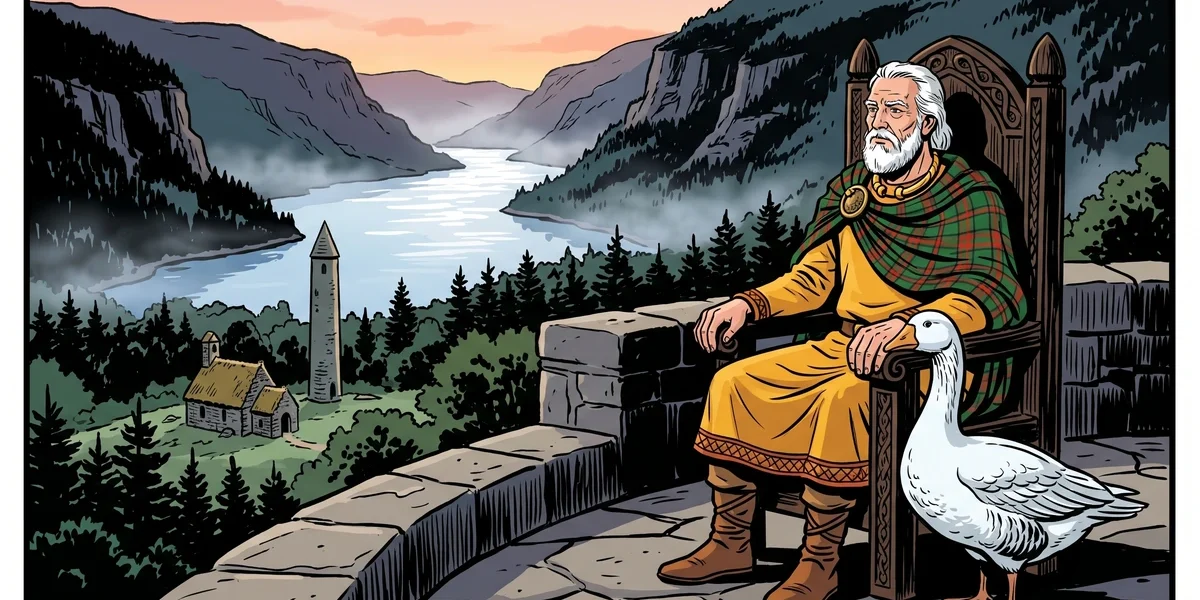

King O’Toole and His Goose — A Glendalough Foundation Legend in Hiberno-English
“King O’Toole and His Goose” is the most beloved of the so-called foundation legends of Glendalough — the chain of folk explanations that grew up around the seventh-century monastery of Saint Caoimhín (Anglicised as Kevin, d. 3 June 618) in the upper valley of County Wicklow. It explains, in the comic vernacular voice of a country fireside, how the saint came to acquire the great tract of pasture at the head of the valley on which the monastic city of Gleann Dá Loch — “the Glen of the Two Lakes” — was eventually built. The story was first put into print by the Dublin-born songwriter, painter, and novelist Samuel Lover (1797–1868), who recorded it in the spoken Wicklow English of an old man he met while sketching at the Seven Churches around 1827, and printed it as the third tale in his Legends and Stories of Ireland: First Series (Dublin: W.F. Wakeman, 1831), a small octavo volume illustrated with six etchings by the author. Two generations later Joseph Jacobs (1854–1916) reprinted it — with Lover’s narrative voice almost wholly preserved — as Tale XV of his Celtic Fairy Tales (London: David Nutt, 1892), the volume that gave the legend its global circulation and which remains the version most readers encounter today.
What gives the tale its enduring vitality is the texture of its telling. Lover’s anonymous narrator is a Wicklow countryman who learned the story at his own grandfather’s hearth, and the speech he uses — “Och, I thought all the world, far an’ near, had heerd o’ King O’Toole — well, well, but the darkness o’ mankind is untellible!” — preserves the cadences of pre-Famine Hiberno-English with a fidelity that few literary texts of the period equal. The legend itself belongs to an old and widespread family of saint-and-pagan-king foundation tales classified by the Norwegian folklorist Reidar Th. Christiansen as Migratory Legend type ML 7060 (“The Saint Outwits the Pagan”), the same template that generated the legends of Saint Patrick’s bargain with the chieftain of Cashel, Saint Brigid’s miraculous cloak that spread to cover the Curragh of Kildare, and Saint Senan’s island of Inis Cathaigh. In every case the saint’s apparently modest request — only as much land as a goose can fly over, only as much as a cloak will cover, only as much as a stone-throw will reach — is converted by miracle into a kingdom-sized endowment. The pattern is older than Christian Ireland; it appears in the Greek foundation legend of Carthage, where Queen Dido buys “as much land as an oxhide will cover” and proceeds to cut the hide into thread-fine strips that enclose the citadel of Byrsa.
Sources, Provenance, and Manuscript Tradition
The historical Saint Kevin of Glendalough is securely attested. He is named in the Annals of Tigernach and the Annals of Ulster under the year 618, and his cult is documented from the seventh century onward in the Félire Óengusso (the Martyrology of Oengus the Cúldée, c. 800), where he is celebrated on 3 June. The fullest hagiographic account is preserved in the Latin Vita Sancti Coemgeni, a late-medieval Life that survives in two principal recensions edited by Charles Plummer in Vitae Sanctorum Hiberniae (Oxford: Clarendon Press, 1910, vol. I, pp. 234–257) and in the Irish-language Bethu Coemgin, included by Plummer in Bethada Náem nÉrenn (Lives of Irish Saints, Oxford: Clarendon Press, 1922, vol. I, pp. 125–167). The Vita reports many of Kevin’s signature miracles — the blackbird that lays an egg in his outstretched palm during Lent, the otter that fetches him a fish each day, the cow that gives the milk of fifty cows after grazing on Kevin’s pastureland — but it does not contain the goose-and-the-pagan-king episode that anchors Lover’s tale. That episode is a folk accretion of the late medieval and early modern period, kept alive at the firesides of the Wicklow glens long after the monastery itself fell into ruin in the fifteenth and sixteenth centuries.

The historicity of King O’Toole himself is more equivocal. The dynasty of the Ui Tuathail (anglicised “O’Toole”) were the historical lords of southern Wicklow, but only from the twelfth century onward, after they were displaced from their ancestral seat in north Kildare by the Cambro-Norman invasions of 1169–1170. The seventh-century pagan king of Glendalough whom Kevin is supposed to have converted appears in no early source, and is almost certainly a back-projection — the local folk imagination grafting the familiar later-medieval clan name onto the half-remembered figure of an indigenous chieftain whose pagan grove the saint had Christianised. The same phenomenon — a later, prestigious clan-name attached to a much earlier mythical king — is documented across the Gaelic world by Daithi Ó hÓgáin in The Lore of Ireland: An Encyclopaedia of Myth, Legend and Romance (Boydell & Brewer, 2006). What matters for the tale is not whether O’Toole was historically real but that the audience knew the name as belonging to the great old families of Wicklow, whose tombs still stood in the abandoned cathedral at the time Lover heard the tale recited.
The Tale Begins: A Young King Who Loved the Hunt
In the long-ago time before the saints had walked Ireland, runs the narrator’s framing, there ruled at Glendalough a fine old king named O’Toole — “the real boy,” as the storyteller fondly puts it, “who loved sport as he loved his life, and hunting in particular.” From the rising of the sun the king was up and away over the mountains after the deer; he kept a stable of swift horses, a kennel of long-legged Irish hounds, and a court of hardy companions who could ride a stag from the high crags of Lugnaquilla down to the lake-shore at Glenealo without losing the chase. For decades the seasons passed in this round of glittering activity. The king’s bards composed songs of his kills, his fianna feasted nightly in the hall, and the sounds of horns and hounds woke the morning mists of the upper valley.
But time, the narrator reminds us with the sigh of every Irish storyteller, “is the greatest hunter of all, and brings down even the swiftest king at last.” O’Toole grew stiff in the limbs. The deer outran his horses; the hounds outpaced his calls; the long days in the saddle that had been his joy became an agony of bones and breath. He tried for a season to keep up the old life, but his huntsmen had to lift him down at evening, and at length he could no longer mount at all. The mountains he had ruled became, for him, a wall of green silence. The court grew quiet. The bards, finding no fresh exploits to celebrate, drifted off to the high-kings at Tara. The hounds grew old beside their master and one by one were buried in the kennel-yard. The king sat in his high-backed chair by the lake, looked out at the water that no longer carried his shadow on horseback, and felt the weight of all his years settle on him at once.
The Goose: A Companion for the Years of Stillness
It was at this point, the narrator tells us — with the kind of homely detail that betrays a tale told and retold for generations — that “the poor king was obleeged at last for to get a goose to divart him.” A grey-feathered gander was brought to him from a tenant’s farm at the foot of the valley, and from that day forward the bird became the constant companion of his ageing days. The goose followed the king on his slow walks down to the water; she sat on the flagstones beside his chair when he warmed himself at the fire; she ate from a dish at his elbow when he took his bread and milk in the morning. Most marvellous of all — and here Lover’s narrator pauses for emphasis, because this is the heart of the magic — the goose flew an hour each day across the upper lake while the king watched from the rampart, and her flight became, for him, the only motion in the valley that still seemed beautiful.
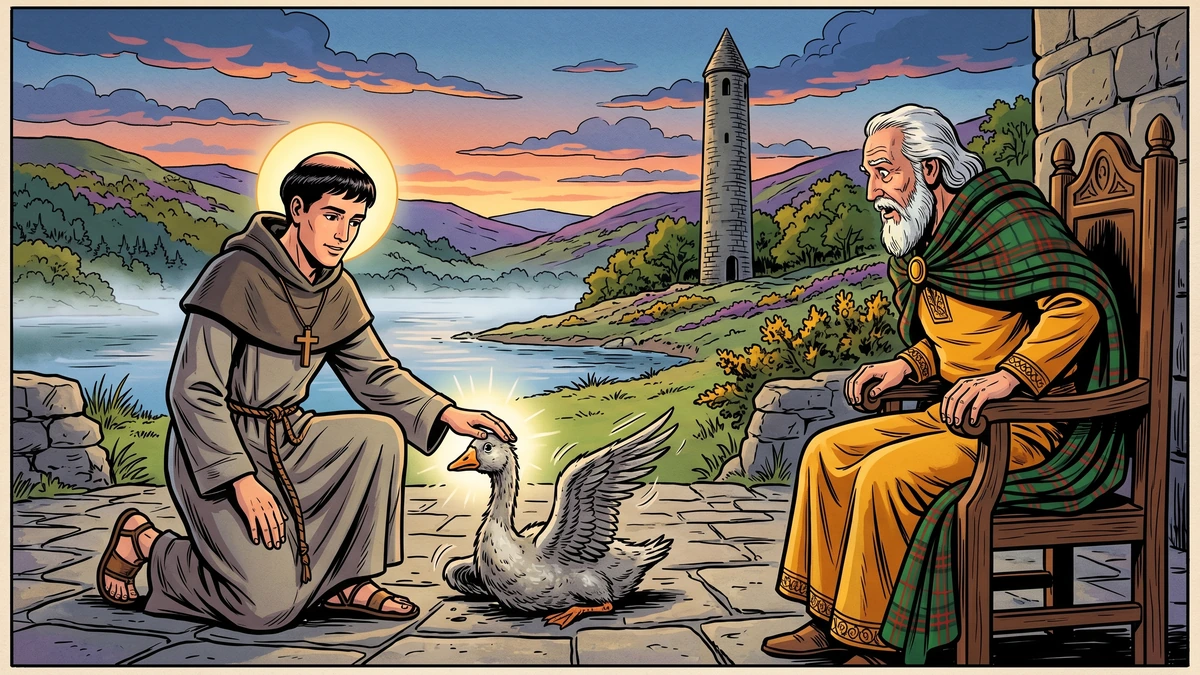
For thirteen years (the number is fixed in every version) the king and the goose lived this companionship of stillness. The bird grew old with her master. Her grey plumage turned white; her flight grew shorter and lower; at last there came a morning when she could not lift herself from the flagstone at all. The king, watching her flutter and fall, felt for the first time that his own life was about to end — for if the goose could no longer fly, what was there left in the world to look at? He would not eat. He would not speak. The court physicians could do nothing; the bards who returned for the funeral they thought imminent could find no song that consoled him. It was at this moment, when the king’s grief had become a public sorrow that the whole upper valley shared, that “a mighty dacent young man” appeared at the gate of the rath and asked to speak with the king.
Saint Kevin in Disguise: The Bargain of the Goose
The young man — who is, of course, Saint Kevin, though neither the king nor the narrator names him at first — offers a peculiar proposal. He has heard, he says, of the king’s grief; he can make the old goose “as good as new” if the king will agree to a fair bargain in exchange. The king, half-disbelieving but desperate, demands what the bargain is. The stranger answers with the line that is the comic and theological pivot of the entire legend: “All the ground the goose flies over, the first time after I make her young, that ground is to be mine.” The king, looking at his nearly-dead bird who has not been able to lift a wing for a fortnight, thinks the bargain a small and harmless one, and assents. The stranger reaches down, lays his hand on the goose’s grey head, and speaks a word of blessing. The bird’s plumage darkens; her wings stiffen; she rises from the flagstone with a great clap of feathers and launches herself out over the upper lake, climbs higher than she has flown in twenty years, and circles the whole rim of the valley — over the rath, over the hunting-grounds, over the deer-paths and the river-meadows and the forest skirts and the high pasture and the spring-wells — before settling, fresh as a yearling, at the king’s feet.
The king’s joy turns instantly to dismay. The young man, smiling, asks for what is now his by promise: every acre the goose has flown over — which is to say, the whole of Glendalough. He reveals himself as Caoimhín, servant of God, come to found a monastery at the head of the valley. The king, who has tried, in pagan rage, to turn the bargain back, finds that he cannot — for the saint has shown him a power greater than his pagan gods, and his oath has been freely given. He kneels (in some versions immediately, in others after a night’s bitter wakefulness), accepts baptism at the saint’s hands, and gives over the land to the new monastery, retaining only enough for himself and the goose to live out their final years in peace at the lower lake. The narrator, in his vernacular, sums up the moral with the brevity of an old farmer settling a dispute: “And Saint Kavin was a fair man, an’ a true; for though he got the king’s land by a bit o’ guile, he gave the king back his goose, an’ his goose flew till her time was come, an’ the king died in the true faith, an’ got to heaven, where his goose, no doubt, was waitin’ for him.”
Reading the Legend: Conversion, Hospitality, and the Comedy of the Bargain
To a casual modern reader, the saint’s bargain may look like a pious con. The king is grieving and credulous; the saint is shrewd and gets a kingdom for the price of a goose. But this misreads the tale as the Wicklow countrymen themselves understood it. In the moral grammar of the medieval Irish hagiographic tradition — the same grammar that generated the Vita of Brigid and the Vita of Patrick — the saint’s guile is precisely the proof of his sanctity. The pagan king’s old gods cannot heal a goose; the new God can. The saint’s apparent trickery is the gentle, comedic form of a power that could, if exercised in wrath, have annihilated the king and his court altogether. By choosing instead to ask for “only” the ground a goose flies over, the saint offers the king the dignity of a freely-given gift. The king’s land is not seized; it is given. The conversion is sealed not by force but by laughter — by the king’s recognition, in the moment of his dismay, that he has been outwitted by a love larger than his own.
The legend also encodes, in folk-comic form, a real economic memory. The historical monastery of Glendalough, at its height in the eighth and ninth centuries, held an immense estate — what the medieval Irish called the termonn lands — that included most of the upper Wicklow valleys and a band of pasture stretching toward the Slaney. By the seventeenth century, when the Lover narrator’s grandfather was a child, those lands had been confiscated, redistributed, planted with English settlers, lost back to native owners, lost again, and finally fragmented into the patchwork of small holdings that surrounded the abandoned cathedral in the early nineteenth century. The legend’s central image — a great pagan estate transferred entire to the saint by a single airborne miracle — preserved in folk memory the fact that this whole valley had once, demonstrably, belonged to a single religious foundation. The story explained, in the only way the country-people could explain such a thing, how an ecclesiastical estate of that scale had ever come into being.
The Moral: Power, Mercy, and the Honour of a King’s Word
“Bairiú agus bríatha ar n-rí — ba i sin a cóir, a shíth, agus a ainm go brách.”
“The bargain and the word of the king — that was his right, his peace, and his name forever.”
The deepest layer of the tale is not theological but ethical, and it sits squarely in the Brehon Law tradition that governed pre-Christian and early Christian Ireland alike. Under Brehon Law, recorded in the eighth-century Senchas Már, a king’s spoken bargain was the highest form of legal contract: it could not be broken without forfeiting honour-price (eníclann), the price of a man’s worth in cattle. King O’Toole, finding that his goose has flown over the whole valley and that he must therefore part with the whole valley, faces the temptation every grieving man knows: to revoke a promise made in better hope. That he honours the bargain — that he hands over the land, accepts baptism, and lives out his last years in dignified retirement — is the act that earns him the narrator’s blessing and a place in heaven beside his goose. The moral of the tale, then, is the moral of every Brehon proverb: a king’s word is his being. Take that away and there is no king and no kingdom, only a man unable to look at his own dying goose without grief. Honour the word and the kingdom is preserved — not the land, which passes to the saint, but the inward kingdom of integrity, which passes with the king into eternity.
Why the Tale Has Lasted

“King O’Toole and His Goose” has lasted nearly two centuries in print — and many centuries longer in oral transmission — because it does, with great economy, what the most durable folktales always do: it solves several problems of feeling at once. It explains, in narrative form, the existence of an enormous ecclesiastical estate where there is now only ruined cathedral and silent water. It dramatises, in comic form, the moment of religious conversion as something other than terror or coercion — as a gentle outwitting, freely accepted by a man who has been moved by mercy. It gives an old grieving king the consolation of his goose restored, and the dignity of a bargain honoured. And it offers, in the figure of the saint who heals a bird in order to acquire a kingdom, an image of holiness that is recognisably Irish — learned, kindly, slyly humorous, never solemn for solemnity’s sake. Children love the picture of the white-feathered goose flying over the whole valley while the king watches helplessly from the rampart; adults recognise, beneath the comedy, the ancient and tender truth that grief is more often healed by surprise than by argument. The tale belongs equally to the schoolroom at Laragh, the tour-bus at the Round Tower, and the hearth at home — and as long as the lakes of Glendalough hold their reflections of cliff and forest, it will go on being told.
You May Also Like
 Celtic Folk Tales
Ages 9-12
Celtic Folk Tales
Ages 9-12
Princess Finola And The Dwarf
Princess Finola And The Dwarf: A long, long time ago there lived in a little hut in the midst of a bare, brown, lonely moor an old woman and a young girl.
 Celtic Folk Tales
Ages 9-12
Celtic Folk Tales
Ages 9-12
Guleesh
Guleesh: There was once a boy in the County Mayo; Guleesh was his name. There was the finest rath a little way off from the gable of the house, and he was
 Celtic Folk Tales
Ages 9-12
Celtic Folk Tales
Ages 9-12
Beth Gellert
A loyal dog saves a prince from a wolf but is killed by his master's hasty judgment. A lesson on patience.