The Ridere of Riddles
The Ridere of Riddles: here was a king once, and he married a great lady, and she departed on the birth of her first son. And a little after this the king
“The Ridere of Riddles” is one of the richest surviving examples of the ATU 851 tale type in the Gaelic tradition — a narrative in which a young hero defeats a riddle-princess who has vowed to execute every suitor who fails her challenge. The tale appears in the Scottish Gaelic collection of John Francis Campbell (Popular Tales of the West Highlands, 1860–62), where it was recorded from oral tradition in the Hebrides, and it shares deep roots with analogous Irish traditions in which verbal cleverness and riddle-craft are not merely entertainments but markers of sovereignty, wisdom, and the right to rule. The tale belongs to the wider Celtic culture of imchomarc — the exchange of challenges between equals — and deploys the riddle not as a parlour puzzle but as a test of the quality of mind that separates the worthy from the unworthy claimant.
The hero known as the Ridere (from the Scots/Gaelic word for “knight” or “champion,” derived ultimately from the Latin miles) is not a figure of brute strength but of cunning intelligence, narrative resourcefulness, and an ability to encode lived experience into language that reveals more than it seems to say. His riddling is a form of storytelling in compressed form — each riddle is a precis of a remarkable event the princess has not witnessed and cannot reconstruct. The tale’s central argument is epistemological: the princess cannot solve the riddle because she was not there; the hero’s lived experience is, ultimately, insoluble to those who have not shared it. This is a specifically Celtic valorisation of experiential knowledge over mere cleverness, and it connects the tale to the broader tradition of the Irish senchas — the deep lore that belongs to those who have truly lived and suffered and witnessed.
Synopsis and Narrative Structure
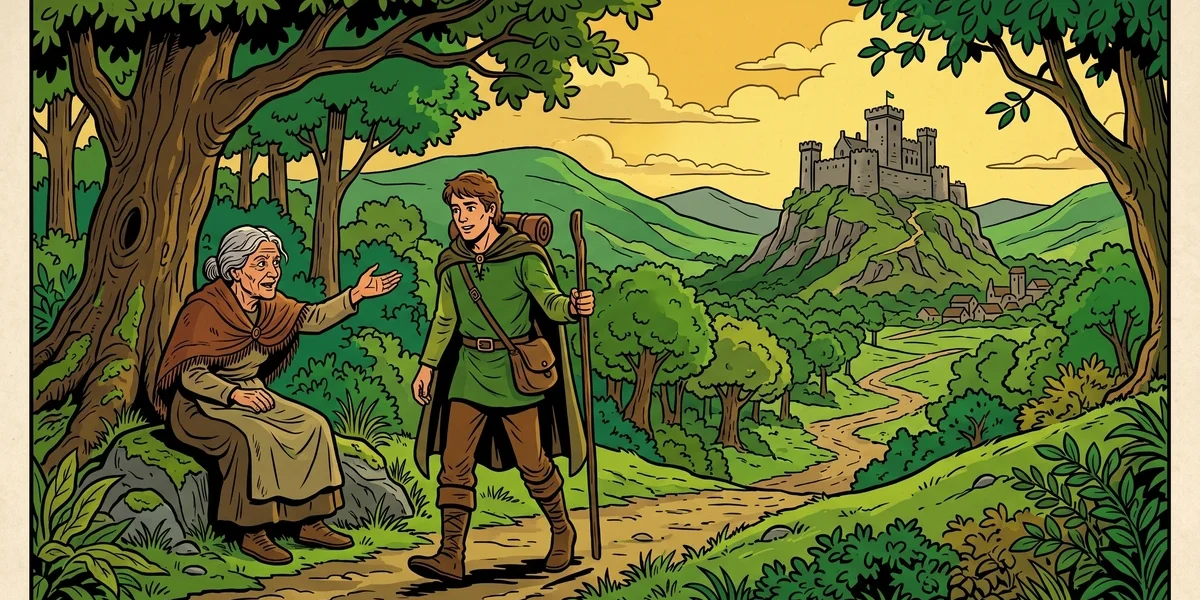
The tale opens with a young man of modest origins — typically the youngest son of a poor family, sometimes merely a wanderer of unspecified background — who hears of a princess renowned for her beauty and her terrible custom: she has set a riddle for all suitors, and those who fail to solve it are put to death. Many men of wealth and rank have already perished at her gate. The hero, rather than being deterred, is attracted precisely by the challenge, and he sets out to win the princess through the power of his wit rather than through wealth or military strength.
Before reaching the court, the hero undergoes a series of remarkable adventures — encounters with strange animals, miraculous deliverances, unusual companions, extraordinary events — that he stores as material for his riddles. In the richest versions, he meets an old woman or a supernatural guide who advises him on the danger and reveals a strategic truth: the riddle need not be insoluble, but it must be grounded in experiences so particular, so unrepeatable, that no external intelligence can crack it. The hero’s pre-riddle adventures are therefore not merely picaresque additions to the tale but the actual raw material from which his winning strategy is constructed.
At court, the hero presents himself and delivers his riddle to the princess. The riddle, rendered in heightened and often deliberately obscure language, encodes his adventures in a condensed form that is true but not transparent. The princess, despite her formidable reputation, cannot solve it — she lacks the experiential key. In many versions she attempts to extract the answer by sending a woman (sometimes a supernatural spy, sometimes a maidservant) to the hero’s chamber at night to charm or trick it out of him. The hero perceives the deception, pretends to be asleep, and gives misleading information. On the day of judgment, the princess’s proposed solution is wrong, and the hero claims his prize: marriage to the princess and whatever sovereignty accompanies her.
The Riddle Tradition in Celtic Culture
To appreciate “The Ridere of Riddles” fully, it is necessary to understand the centrality of riddling in Celtic cultural life. The Irish and Scottish Gaelic traditions preserve extensive evidence of the riddle — tomhas in Irish, tòimhseachan in Scottish Gaelic — as a form with deep roots in oral culture and a status considerably higher than mere entertainment. The riddling contest in Irish tradition could be a form of legal procedure, a mechanism for adjudicating difficult cases, and a marker of poetic and intellectual qualification: the fili (professional poet) was expected to be a master riddler, capable of encoding complex knowledge in deliberately obscure forms accessible only to the initiated.
In the Irish mythological tradition, riddling intersects with the sovereignty theme at multiple points. The test of the true king in early Irish narrative often involves the correct interpretation of symbolic events or the ability to resolve paradoxes. The Brehon legal tradition included provisions for riddle-like forensic questions, and the roscanna — the archaic verse-sayings attributed to legendary figures — frequently take the form of riddles whose answers require esoteric knowledge. The riddle-princess of ATU 851 is therefore not a mere narrative convenience but the embodiment of a cultural structure in which verbal intelligence, particularly the ability to encode and decode complex lived experience, is the primary qualification for partnership with sovereignty.
The particular form of riddle used in “The Ridere of Riddles” belongs to a subcategory of what scholars call the “experience riddle” — a riddle whose answer is not a thing or concept but a unique chain of events. Such riddles are, by definition, insoluble to anyone who was not present. Unlike the classical riddle (Sphinx’s riddle to Oedipus: “What walks on four legs in the morning, two at noon, three at night?”), which has a universal answer accessible to human reason, the experience riddle has an answer locked within personal biography. This makes it an impossible test unless the questioner can extract the biographical key — and it is precisely this extraction that drives the tale’s second movement, in which the princess attempts to spy out the hero’s secret.
The Hero and the Tradition of the Clever Youngest Son
The Ridere belongs to the extensive family of Celtic and pan-European tale heroes who succeed not through strength, wealth, or noble birth but through a quality of mind and character that social hierarchies fail to reward. In the Gaelic tradition, this figure connects to the youngest-son paradigm (the mac óg or “young son”) who appears across Irish and Scottish folktale as the true hero precisely because conventional social mechanisms have already dismissed him. Where his elder brothers rely on obvious advantages and conventional approaches, the youngest son is forced to develop interior resources — patience, observation, willingness to engage with the marginal and the unexpected — that prove decisive in the tale’s climax.
The Ridere’s specific quality, however, distinguishes him even within this category. He is not merely patient or humble; he is verbally gifted, with a capacity to transform raw experience into memorable language and to protect his linguistic creation against penetration. This verbal gift is explicitly associated in the Irish tradition with the poetic faculty — the ability to see beneath the surface of events to their significant form and to encode that significance in language that is both beautiful and strategically opaque. The hero is, in a real sense, a poet in the service of his own biographical narrative, and his victory over the princess is a victory of the oral artistic tradition over mere social power.
The hero’s interaction with the spy who comes to his chamber at night is one of the tale’s most dramatically charged moments and one of its most culturally revealing. The spy — sometimes a beautiful woman, sometimes a supernatural agent — represents the princess’s attempt to use social and erotic power to extract what intellectual power alone cannot reach. The hero’s ability to detect the deception and feed false information into it demonstrates a quality of vigilance and clear-sightedness that is the complement of his verbal creativity: he is not merely a maker of riddles but a reader of situations, a man who sees clearly even when circumstances are designed to cloud his vision.
The Princess as Sovereign: Riddle-Setting and the Right to Rule
The riddle-princess of ATU 851 is a complex figure whose characterisation in the Gaelic tradition diverges significantly from simpler Continental versions. In many European tellings, the riddle-setting princess is simply an obstacle to be overcome, a plot device whose function is to create the conditions for the hero’s cleverness to be displayed. In the Gaelic tradition, however, she is given more substance: she is a genuine intellectual force, a figure of real authority and formidable intelligence who has bested many capable men. Her defeat does not diminish her but selects the one man who deserves her — who has the intelligence to meet her on her own terms and the experience to generate what her intelligence alone cannot crack.
This reading connects to the sovereignty goddess tradition of Irish mythology. The princess who tests suitors and selects the worthy one is structurally identical to the sovereignty figure who chooses the true king by an act of recognition — not the recognition of rank or strength but of inner worth. When the riddle-princess loses the contest, she does not lose her authority; rather, she recognises that the hero possesses a quality of experienced wisdom that complements and exceeds her bookish cleverness. Her capitulation to his riddle is the sovereignty goddess’s acceptance of the true king: a choice, not a defeat.
Some Gaelic versions make this sovereignty dimension explicit by specifying that the princess has a kingdom to bestow — that marriage to her is marriage to the land, and that the hero’s victory in the riddle contest is the precondition of his becoming king. In these versions, the riddle is not merely an intellectual tournament but a mechanism for determining who is genuinely fit to rule: not the merely clever, not the merely strong, but the man who has lived deeply enough to have unrepeatable experiences and wisely enough to encode them in language that protects their secret.
The Riddle Itself: Structure and Content
The riddle at the centre of the tale takes different forms in different versions, but its logic is consistent: it refers to a chain of events so specific and so unrepeatable that no external intelligence can reconstruct it. In Campbell’s published version, the riddle encodes a sequence of adventures involving a dead man’s tooth (or bone), a horse, a supernatural encounter, and a series of transformations — each element making perfect sense once the hero’s biography is known, none making sense without it.
The formal structure of the riddle itself is typically one of paradox: it asserts something that appears impossible or contradictory on its face, but which resolves perfectly once the experiential key is provided. “I ate the flesh of one that had no flesh” is nonsensical until you know that the hero ate from an animal that had starved to the point of having no fat. “I sat in the chair of a man who never sat in it” makes no sense until you know that the hero sat in a chair made for a dead man who died before he could use it. Each element of the riddle functions as a compression of a story, and the full riddle is therefore a compression of the hero’s entire biography in the period before the contest — a life in miniature, encoded in a form only he can decode.
This structure connects the tale to a broader tradition of Celtic narrative poetics in which the most significant events of a life are encoded in lapidary, paradox-rich formulae. The Irish triad form — three-part wisdom sayings that compress complex knowledge into memorable paradox — operates on a similar principle, as do the roscanna attributed to legendary heroes. The Ridere’s riddling is not a departure from the Celtic poetic tradition but an application of it to the specific circumstances of the contest tale: he is doing in narrative what the fili does in verse, transforming lived experience into compressed, portable, resistant language.
The Spy Episode: Gender, Power, and Disclosure
The episode in which the princess sends a woman to extract the riddle’s answer from the hero at night is among the most culturally rich elements of the tale. It activates a set of anxieties about gender, knowledge, and social power that run deep in the Celtic narrative tradition. The woman sent as spy is usually depicted as beautiful and persuasive — she represents the use of erotic and social capital to obtain what intellectual power alone cannot reach. That this strategy fails is significant: the tale insists that the hero’s knowledge is genuinely protected by his own clear-sightedness and cannot be extracted by social manipulation.
In some versions the spy is explicitly connected to supernatural forces: she is a fairy woman, a shapeshifter, or a being with access to dream-penetration who can normally reach the secret thoughts of sleeping men. The hero’s ability to deceive her even in this context — to appear asleep while actually conscious, to give false information that appears to be genuine disclosure — marks him as a figure of unusual self-possession and perceptual clarity. He cannot be caught off guard, even by supernatural means, because he is always fully present to the realities of his situation.
The spy episode also introduces an ethical complexity that several Gaelic versions develop with some care. The hero may feel attraction to the woman sent to him; he may recognise that she is herself a victim of the princess’s scheme, used as a tool against her own better nature. In these versions, his response to her is characterised by courtesy and gentleness even as he defeats her purpose — he does not expose her, does not humiliate her, simply ensures that she returns with false information. This courtesy-in-adversity is another marker of the hero’s quality, distinguishing him from the merely clever who would triumph and gloat.
Regional Variation and Comparative Contexts
The ATU 851 tale type is pan-European, with close analogues in Danish, German, Italian, Russian, and Scandinavian traditions. The Gaelic versions are distinguished from their Continental parallels by several characteristic features. First, the riddle in Gaelic versions is typically an experience riddle rather than a logical or cosmological puzzle — it requires biography rather than cleverness to solve, which reflects the Celtic valorisation of experiential wisdom over abstract intelligence. Second, the princess in Gaelic versions is given more interior complexity; she is less a monster of cruelty than a genuine intellectual sovereign, and her defeat is rendered as recognition rather than conquest. Third, the hero’s pre-riddle adventures are given considerable narrative weight — they are not merely backstory but the epistemological preparation for the riddle itself.
Within the Gaelic tradition, Scottish and Irish versions show interesting divergences. Scottish Gaelic versions, particularly those from the Hebrides recorded by Campbell, tend to emphasise the maritime and island-world setting of the adventures, with episodes at sea, on strange islands, and in underwater kingdoms that reflect the specific geography of the west Scottish coastline. Irish versions, particularly those from Connacht and Munster, tend to situate the adventures in the inland landscape of hills, woods, and fairy mounds, and to connect the supernatural elements more explicitly to the síde — the fairy-mound dwellers of Irish mythology.
The tale’s international parallels include the Old Norse riddle contests preserved in the Hervararsaga and the Vafþrúðnismál, where Odin himself engages in riddle contests with giants whose lives are forfeit to the winner. The structural parallel is exact: a supernatural being sets riddles for a mortal or god, the winner lives, the loser dies. The Gaelic tale democratises this structure by removing the cosmic stakes and situating the contest within a specifically human and social frame of marriage and sovereignty — but the underlying logic of riddle as life-or-death contest retains its ancient power.
Legacy and Contemporary Resonance
Campbell’s publication of “The Ridere of Riddles” in the 1860s helped establish it as one of the canonical tales of the Scottish Gaelic tradition, and it has since been reprinted in numerous anthologies of Celtic and world folktales. In Ireland, analogous ATU 851 tales collected by the Irish Folklore Commission from the 1930s onwards attest to the tale’s vitality in oral tradition across Connacht and Munster, with distinctive local variants that emphasise different aspects of the riddle structure and the hero’s adventures.
The tale has attracted attention from comparative mythologists for its connections to the ancient riddle-contest traditions of Indo-European culture — the Vedic brahmodya, the Old Norse wisdom contests, the Greek riddling traditions represented by the Oedipus and Sphinx encounter. Across these traditions, the riddle contest functions as a compressed form of the initiatory ordeal: the candidate must demonstrate a quality of wisdom that goes beyond bookish knowledge to encompass experiential understanding of the paradoxes of existence. The Ridere, with his biography-embedded riddles, belongs to this ancient lineage while remaining firmly grounded in the specific cultural soil of the Gaelic world.
For contemporary readers, “The Ridere of Riddles” speaks powerfully to the irreducibility of lived experience — the fact that the deepest knowledge cannot be extracted by intelligence alone but belongs only to those who have been present at the significant moments of a life. In a cultural moment saturated with information but starved of genuine wisdom, the tale’s insistence on experience-grounded knowledge as the only reliable guide has a resonance that goes well beyond its narrative pleasures. The Ridere wins his princess not because he is clever but because he has lived, and has had the further wisdom to know that living is the only education that cannot be counterfeited.
“The Ridere of Riddles” endures because it understands that the most important knowledge is the kind that cannot be transferred — the knowledge written into a person by what they have undergone, witnessed, and survived. The princess cannot solve the riddle because she was not there; and no amount of spying or charm can give her access to a biography she has not lived. The hero who wins her is not the most powerful or the most handsome but the most genuinely present to his own experience, and the most capable of encoding that presence in language precise enough to be true and opaque enough to be safe. In the riddle tradition of the Gaelic world, this is not merely a clever trick but a form of wisdom — and wisdom, the tale insists, is what sovereignty most requires.
You May Also Like
 Celtic Folk Tales
Ages 9-12
Celtic Folk Tales
Ages 9-12
Sea-Maiden
Sea-Maiden: I have omitted the births of the animal comrades and transposed the carlin to the middle of the tale. Batten has considerately idealised the
 Celtic Folk Tales
Ages 9-12
Celtic Folk Tales
Ages 9-12
Notes And References
Notes And References: It may be as well to give the reader some account of the enormous extent of the Celtic folk-tales in existence. I reckon these to extend
 Celtic Folk Tales
Ages 9-12
Celtic Folk Tales
Ages 9-12
The Sprightly Tailor
The Sprightly Tailor: A sprightly tailor was employed by the great Macdonald, in his castle at Saddell, in order to make the laird a pair of trews, used in