Princess Finola And The Dwarf
Princess Finola And The Dwarf: A long, long time ago there lived in a little hut in the midst of a bare, brown, lonely moor an old woman and a young girl.
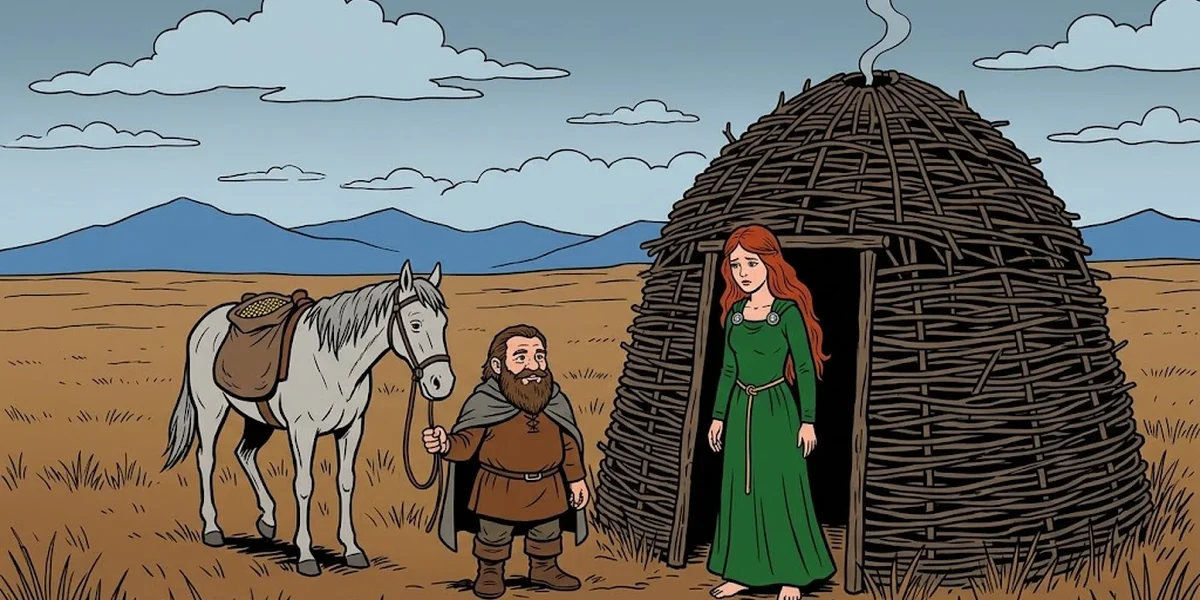
Princess Finola and the Dwarf is one of the most loved literary fairy tales of the late nineteenth-century Irish revival, written down by the Wexford-born nationalist barrister and journalist Edmund Leamy (1848-1904) and first collected in his Irish Fairy Tales (Dublin: M. H. Gill & Son / Sealy, Bryers & Walker, 1890), with later printings in The Golden Spears and Other Fairy Tales (London: David Nutt; New York: D. Fitzgerald, 1911) at pp. 55-72. Leamy was a friend of Charles Stewart Parnell, an MP for Waterford, and a member of the literary circle around the Irish Parliamentary Party; his fairy tales were written explicitly for the children of the Irish revival, weaving Old Irish lore – water-steeds, rejuvenating Western Cormorants, mystic lakes, otherworld-fairies – into a self-contained literary form that William Butler Yeats compared favourably to Hans Christian Andersen.

Tale Type, Manuscripts, and Comparative Position
Folklorists place Princess Finola and the Dwarf at the literary edge of ATU 401 (The Princess Transformed into a Deer) with strong contamination from ATU 530 (The Princess on the Glass Mountain) and ATU 302 (The Ogre’s / Devil’s Heart in the Egg); see Hans-Joerg Uther, The Types of International Folktales, FFC 284-286 (Helsinki: Academia Scientiarum Fennica, 2004) I.235-241. The motif of the hero who must purchase passage from a magical helper by giving up an organ – here the right eye, later the right arm, and finally a portion of his own future – is catalogued by Stith Thompson as S160.1 (Self-mutilation), S165 (Mutilation: putting out eyes), and D1855.2 (Death postponed: hero gives part of himself); Tom Peete Cross, Motif-Index of Early Irish Literature (Indiana University Publications, Folklore Series, no. 7; Bloomington: Indiana University Press, 1952), correlates these with the Old Irish hero-tales of Cu Roi and the Tochmarc Etaine. The water-steeds (each-uisce) that guard the Island of the Mystic Lake belong to motif B184.1.3 in Stith Thompson and to the wider Celtic each uisge tradition described by Patricia Lysaght and Gearoid Mac Eoin.
The Cormorants of the Western Seas who renew their youth by diving into the wine-red waters echo the Pliny / Mediterranean phoenix narrative (Naturalis Historia X.ii) and the older Welsh and Irish caladbolg lore of the Otherworld bird that lives many lifetimes – documented in Kuno Meyer and Alfred Nutt, The Voyage of Bran, Son of Febal, to the Land of the Living (London: David Nutt, 1895-1897), II.193-220, and in Whitley Stokes, The Adventure of Connla Cain Cain Bricc, Eriu 4 (1910). Leamy stitches these inheritances into a single literary tale whose plot-architecture is closer to Andrew Lang’s coloured fairy books than to a strictly oral Irish recitation – and yet whose furniture (silver shield, dark-blue spear-blade, the price paid in instalments, the rejuvenating wine-red waters) is unmistakably Gaelic.
The Story Retold
Beat One – The Beehive Hut on the Lonely Moor
On a bare brown moor that stretches without house or tree to the foot of a distant blue mountain range, an old cailleach – withered, sour-tempered and dumb – watches over a young girl as fresh as an opening rosebud and with a voice as musical as a stream in summer. Their hut is shaped like a beehive, woven of branches; in its centre a fire burns night and day, untended by any human hand, giving warmth in winter and only light in summer. The two sleeping-couches lie head to wall and feet to fire: the old woman’s of plain wood, the girl’s of polished bog-oak carved with flowers and birds that gleam in the firelight. The girl is Finola, a princess in fact though not in her own knowledge. The only visitor to the moor is a dumb dwarf on a broken-down horse, who comes once a month with a sack of corn and is given a cake from Finola’s white hands; he loves her in silence, and his heart grows heavy as he watches her pine in the stillness of the moor.
One day Finola does not come out, and the cailleach beats the dwarf away with a stick. As he rides off in misery, a small green-coated, red-capped fairy of the hills hails him from the foot of a green slope, leads him through a tiny opening into a diamond-roofed hall lit by silver lamps, touches him with the wand of speech, and gives him back his voice. Over a table of boiled snails, dormouse and wrens-in-nutshells, the fairy reveals what Finola does not know: she is the daughter of a king whom the present king murdered, and an old sorceress placed her under enchantment in the moor because the murderer was warned that to kill the princess would cost him his own life on the same day.
Beat Two – The Price of the Water-Steeds
The dwarf, learning who Finola truly is and discovering with a shock that he himself is the corn-bringer the murderer-king selected for his ignorance, vows to break the enchantment whatever the cost. The fairy of the hills tells him the only weapons that can shatter the spell are the spear of the shining haft and the dark-blue blade and the silver shield, lying on the far bank of the Mystic Lake on the Island of the Western Seas. To reach the island the dwarf must ride his horse through the herd of water-steeds that swim around the island night and day; to cross the lake he must wait until its waters turn wine-red, then swim across to where the spear and shield wait. But every passage has a price – and the price will be revealed only at the moment of crossing.
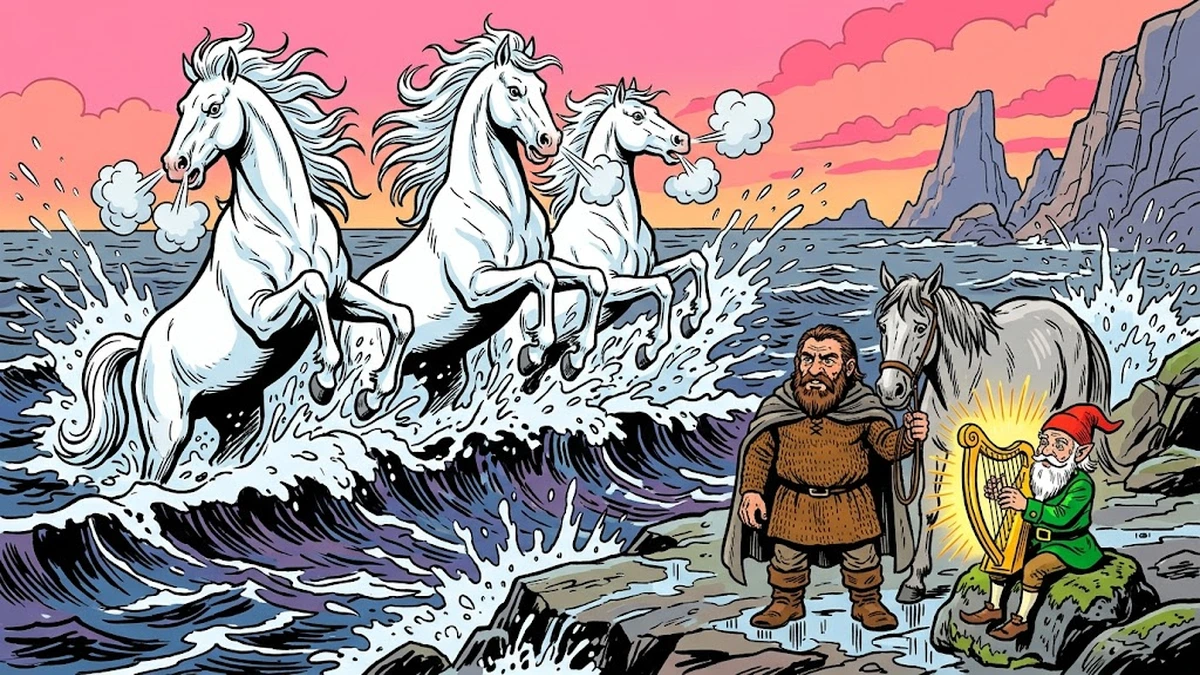
The dwarf gives his horse the head, climbs and descends until he stands at the edge of the sea. The water-steeds rear and snort, half out of the tide, churning the spray to the sky. The fairy appears with a golden harp; for the third time he asks, Are you ready to pay the price?; thinking of Finola in the lonely moor, the dwarf at last answers, Yes, I am ready. The fairy plucks out the dwarf’s right eye and pockets it, and then plays the Strains of Slumber upon his harp; the steeds lie still as foam, and the dwarf’s horse swims him safely across to the island.
Beat Three – The Cormorants and the Wine-Red Lake
On the island the dwarf rides up through golden furze to the Mystic Lake, which lies in a cup of green hills, as still as death and as bright as life can be. He waits a day; then a great old Cormorant – one of the legendary Cormorants of the Western Seas – flies in from the east bearing a tree larger than a full-grown oak, hung with clusters of ripe red berries. Two younger cormorants join him; they eat the berries and throw the stones into the lake until its waters turn red as wine. They preen the old bird’s decayed feathers, he dives beneath the surface, and rises young and joyous, flying off to the west.
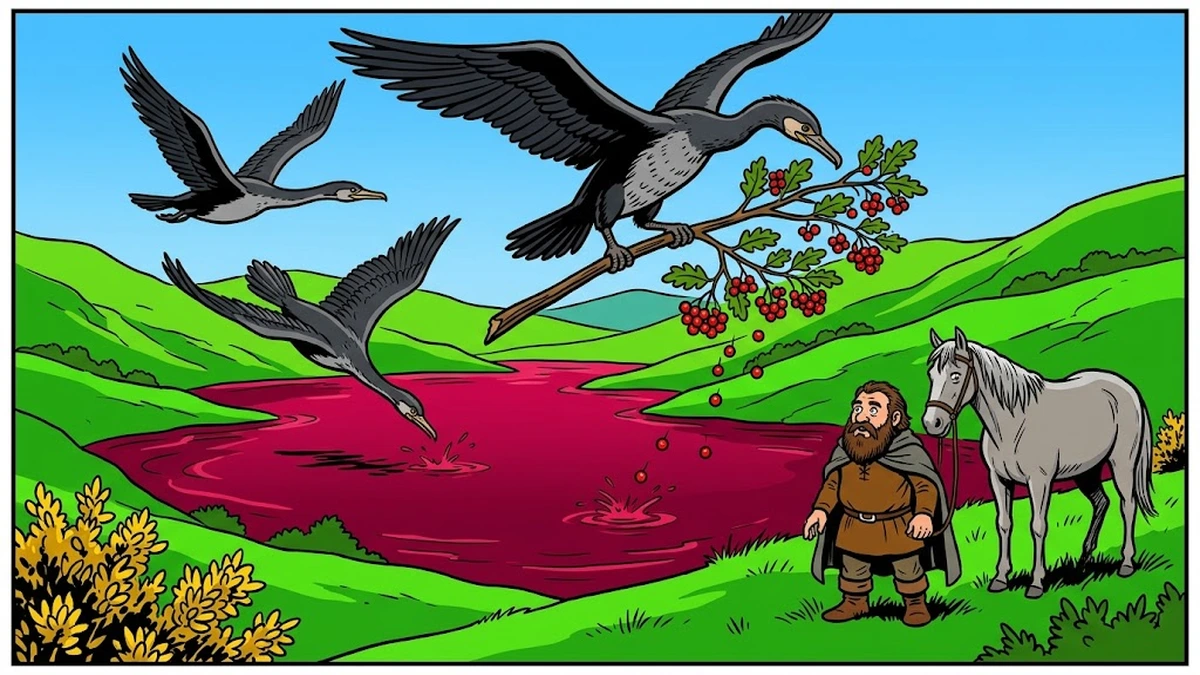
The dwarf moves to swim, but the three cormorants wheel back, screaming, and dash themselves down upon the lake like falling rocks, throwing wine-red spray over the hills. The fairy harper appears once more; the price for crossing the lake is the dwarf’s right arm, struck from his shoulder before he can refuse. Then the harper plays the Strains of Slumber, the cormorants fall asleep on the water, and the maimed dwarf swims his horse across the lake. On the far bank he finds the silver shield and the spear of the shining haft and dark-blue blade, takes them up in his single hand, and starts the long journey home to the moor.
Beat Four – The Three Strokes That Break the Spell
At the gate of the lonely moor the dwarf – one-eyed, one-armed, but bearing the silver shield and the bright-bladed spear – asks one last time what the final price will be. The fairy harper smiles and tells him: when the spell is broken, the dwarf will become himself again – he is in fact the lawful prince Owen Bawn, son of the murdered king and brother of Finola, transformed by the same sorceress to keep him hidden in the world. To restore Finola to her royal estate, he must give up the only home he has known: the dwarf-shape and the dwarf-name. The price for the spell’s breaking is therefore the self he has come to be.
The dwarf strikes the silver shield three times with the haft of the spear and three times with the dark-blue blade. The silence of the lonely moor breaks for the first time in twenty years; the cailleach, the beehive hut and the bog-oak couch fall away like a mist; the spell of enchantment lifts; and where the dwarf stood there stands a tall, fair Irish prince – Owen Bawn – with two clear eyes and two strong arms, his memory whole. He runs to Finola, who runs to meet him, and the brother and sister are restored to the kingdom that the murderer-king once stole. The murderer-king dies the same day, exactly as the sorceress had foretold; the new royal house rules in justice; and the old fairy of the green hill, whenever the wind crosses the moor, may still be heard playing the Strains of Slumber and the Foggy Dew on his small golden harp.

The Moral and Its Old Irish Voice
Edmund Leamy gives Princess Finola and the Dwarf the moral that runs through almost all the heroic Old Irish echtrai (otherworld-quests): love is measured by what you are willing to lose for it. The dwarf does not become a prince by being a prince – he becomes a prince by being willing to give up his eye, his arm and his very identity for someone he loves. The Old Irish proverb cited in Patrick Weston Joyce, A Social History of Ancient Ireland (London: Longmans, Green & Co., 1903), II.480, captures it exactly:
Is fearr beag ceart na mor eagcoir; is fearr aon-ghniomh croidhe na cead briathar.
(Better a small thing rightly done than a great thing wrongly done; better one act of the heart than a hundred fine words.)
The fairy of the green hill is therefore not cruel for taking the dwarf’s eye and arm; he is the keeper of an ancient law in the Irish folk-imagination – that what is taken from the brave is given back to them in another shape. This law underlies Audacht Morainn (the Old Irish wisdom-text on the duties of a king, c. 7th-8th century CE, edited by Fergus Kelly in A Guide to Early Irish Law, Dublin Institute for Advanced Studies, 1988), and it underlies the heroic biographies of Cu Chulainn, Conn of the Hundred Battles, and Cormac mac Airt. Leamy was steeped in this material; he wrote his fairy-tales while living in London as a barrister, but his prose is full of Wexford countryside and Donegal place-feeling, and his moral is straight from fir flatha, the Truth of the Prince.
Why This Story Still Matters
Princess Finola and the Dwarf is a touchstone of late-nineteenth-century Irish literary nationalism. Edmund Leamy was writing for the children of a country still recovering from the Great Famine, still under foreign rule, and still arguing about whether its native traditions had any literary dignity beside the canon of England and France. Leamy answered with a fairy tale set on a bare brown moor under a blue Irish mountain, with princesses and dwarfs whose names (Finola = Fionnghuala, white-shouldered; Owen Bawn = Eoghan Ban, Owen the fair) carry the Gaelic music of the country. Yeats, in his preface to Fairy and Folk Tales of the Irish Peasantry (London: Walter Scott, 1888) and again in The Celtic Twilight (London: A. H. Bullen, 1893), celebrated this moment – when the fairy of the green hill ceases to be a quaint country survival and becomes a literary figure equal to Hans Christian Andersen’s mermaid or the Brothers Grimm’s Hulda – as the beginning of a real Irish revival.
The story also belongs, more quietly, to the global pattern of maimed-hero quest tales that includes the Norse Tyr who loses a hand to bind the wolf Fenrir, the German Grimm KHM 31 Das Madchen ohne Hande (The Girl Without Hands), the Russian Bezruchka in Afanasyev’s Narodnye Russkie Skazki nos. 279-281 (1855-63), and the Japanese Tearai-Kannon tales of mutilation-and-restoration. In every version the wound is the proof of love, and the restoration is the proof that love is a force in the universe equal to fate. Leamy’s particular gift was to set this old pattern inside a child-friendly Irish frame – beehive hut, fairy harper, water-steeds, wine-red lake, dumb dwarf – and to let the reader feel, by the end, that the price the dwarf paid was the same price every parent pays, every friend pays, every brother and sister pay for one another.
Cultural Context and Continuing Influence
Beyond its primary place in the Irish revival, Princess Finola and the Dwarf has had a long literary afterlife. Padraic Colum included it in his anthology The Big Tree of Bunlahy (Macmillan, 1933) and credited Leamy as one of the two or three writers who taught him how an Irish fairy tale should sound on the page. Lady Augusta Gregory drew on the same water-steed and Cormorant material for Gods and Fighting Men (1904), and James Stephens borrowed Leamy’s beehive-hut on the lonely moor for his own Irish Fairy Tales (Macmillan, 1920). Patricia Lynch in the 1930s and 1940s, and more recently Marie Heaney in Over Nine Waves (Faber & Faber, 1994), continued the tradition. Today Princess Finola and the Dwarf still appears on the Junior Certificate Irish-literature reading list and is read aloud in primary schools across Ireland, England, the United States and Canada – one small late-Victorian fairy tale that has carried, for more than a hundred and thirty years, the music of a country older than the kingdom that wrote it down.
For modern readers – in Ireland, in India, anywhere a child has ever cared for a friend more than they care for themselves – the tale’s line is plain and useful: there is no real love that does not cost something, and the cost, when it has been paid, comes back as a different and larger life. That is the oldest moral in the human catalogue, and Edmund Leamy’s small Wexford-and-London masterpiece preserves it as freshly today as it did in 1890.
You May Also Like
![The House In The Lake.[2]](https://indianfolktales.com/wp-content/uploads/2026/05/p836_scene01-400x260.webp) Celtic Folk Tales
Ages 9-12
Celtic Folk Tales
Ages 9-12
The House In The Lake.[2]
The House In The Lake.[2]: A long, long time ago there lived in a little hut, in the midst of one of the inland lakes of Erin, an old fisherman and his son.
 Celtic Folk Tales
Ages 9-12
Celtic Folk Tales
Ages 9-12
Deirdre
Deirdre: _Celtic Magazine_, xiii. I have abridged somewhat, made the sons of Fergus all faithful instead of two traitors, and omitted an incident in the house
 Celtic Folk Tales
Ages 9-12
Celtic Folk Tales
Ages 9-12
The Story-Teller At Fault
The Story-Teller At Fault: At the time when the Tuatha De Dannan held the sovereignty of Ireland, there reigned in Leinster a king, who was remarkably fond of