Conal Yellowclaw
Conal Yellowclaw: Tales of West Highlands_, No. 105-8, “Conall Cra Bhuidhe.” I have softened the third episode, which is somewhat too ghastly in the original.
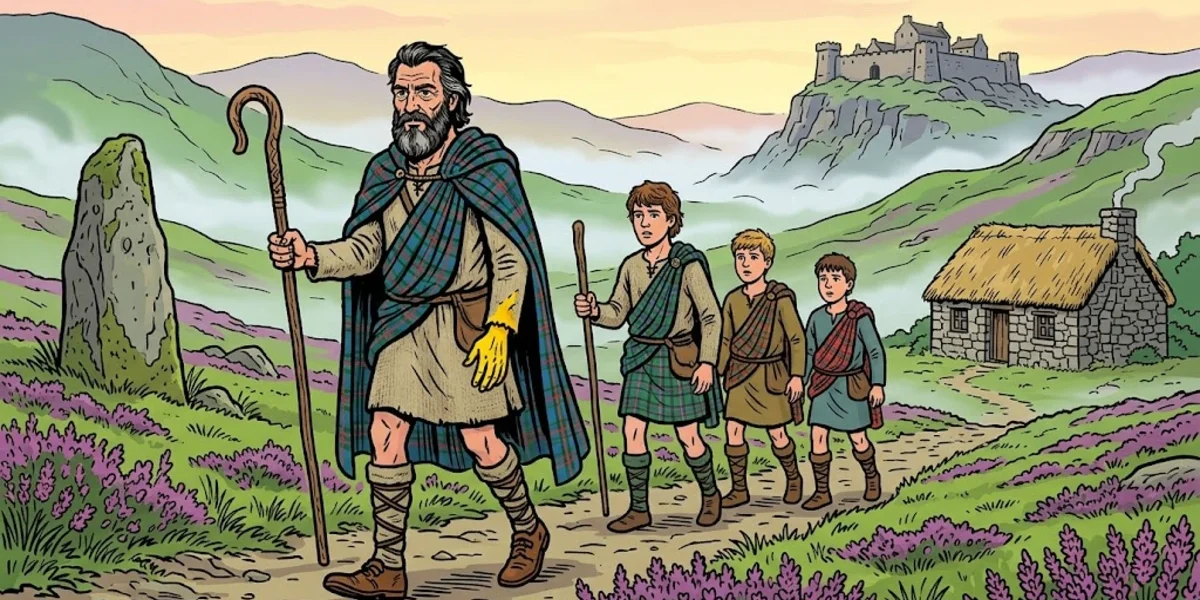
Origin: Celtic — West Highland Scottish-Gaelic, with widespread Irish-Gaelic variants. Gaelic title: Conall Cra-Bhuidhe (“Conall Yellowclaw”), where cra-bhuidhe derives, per Campbell, from crobh-buidhe (“yellow-handed/clawed”). Definitive print source: Joseph Jacobs, Celtic Fairy Tales, no. V (David Nutt, London, 1892), translated and softened from J. F. Campbell of Islay, Popular Tales of the West Highlands, vol. I, no. v, pp. 105–124 (Edmonston & Douglas, Edinburgh, 1860). Original narrator: James Wilson, a blind itinerant labourer from Islay, recited in Gaelic on 7 September 1859; written down by Hector MacLean. Irish chapbook cognate: “The Black Thief and the Knight of the Glen,” in Hibernian Tales (Belfast, c. 1825), reprinted by Andrew Lang in The Red Fairy Book (1890). Tale-type: ATU 953 The Old Robber Relates Three Adventures, embedding ATU 1137 The Ogre Blinded (the Polyphemus episode) and motifs from ATU 953A. Aarne–Thompson motifs: K1715 (weak overcomes strong by stratagem), G121.1 (one-eyed cannibal giant), R227.2 (escape under ram’s belly), Z18 (frame story). Scholarly notice: William Makepeace Thackeray, The Irish Sketch-Book, ch. xvi (1843), pronounced the tale “as wild and odd as an Eastern tale… worthy of the Arabian Nights.” Comparative dossier: Reidar Thoralf Christiansen, The Migratory Legends (FFC 175, Helsinki 1958); Alan Bruford, Gaelic Folk-Tales and Mediaeval Romances (Dublin 1969).
In the heather-quiet glens of Erin’s western edge, where peat-fires answered the rolling Atlantic and a man’s wealth was counted not in coin but in cattle, there lived a tall lean herdsman with three sons and a hand the colour of a beech-leaf in autumn — and so they called him Conal Yellowclaw. He was a man of few words, slow to anger and slower to forgive, and the king of the country had a long account against him. For Conal’s three sons, lithe and reckless as otters in spate, had crept by night into the king’s stables and taken the king’s three best horses; and the king had sworn upon his own grey beard that the four heads of the Yellowclaw clan would dress the gable of his hall before the next moon climbed full above the Mountain of the Wood.
I. The King’s Bargain — A Father Buys His Sons with Stories
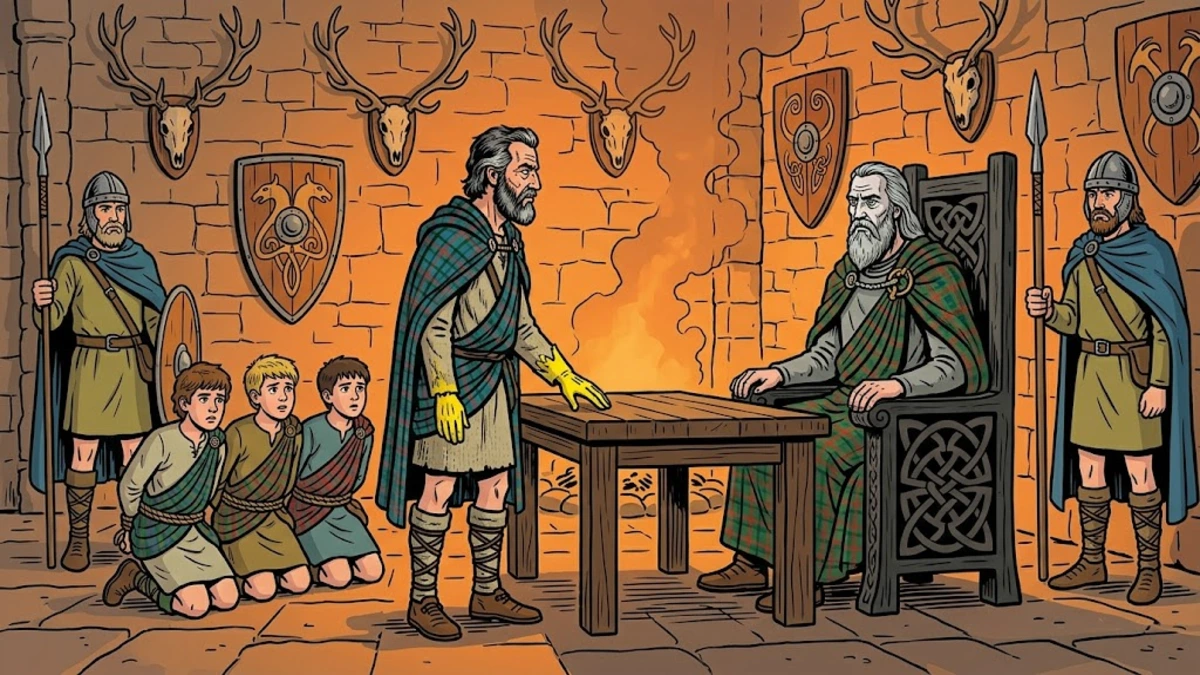
When the spearmen came at dawn, Conal did not run. He laid down his crook upon the hearth-stone, kissed his wife once on the brow, and walked between the soldiers with his three sons behind him, the youngest still rubbing sleep from his eyes. They were brought before the King of Erin in his high black hall, where the rafters were hung with the antlers of stags and the doorposts polished by ten thousand petitioners’ shoulders. The king sat in a chair of bog-oak; his face was the colour of curdled milk and his eyes were two pieces of struck flint.
“Conal,” said the king, “your sons are thieves and the gallows is greedy. But your name was a name in this country before mine was, and I will not hang the Yellowclaw without giving him a chance to live. You are famed for your travelled tongue and your terrible adventures. Tell me three tales — three true tales out of your own life — and if any one of them is more wonderful than the theft of my three horses, I will give you back the head of one of your sons. Three tales for three sons. Fail me in any, and the four of you swing together at the dun’s gate before the cock has crowed.”
Conal drew his cloak about him, looked once at his three white-faced boys, and bent his yellow-clawed hand upon the king’s table. “Hear, then, lord,” he said, “what the long road has shown me. And let your scribe mark whether I lie.”
II. The Tale of the Castle of the Black Knight
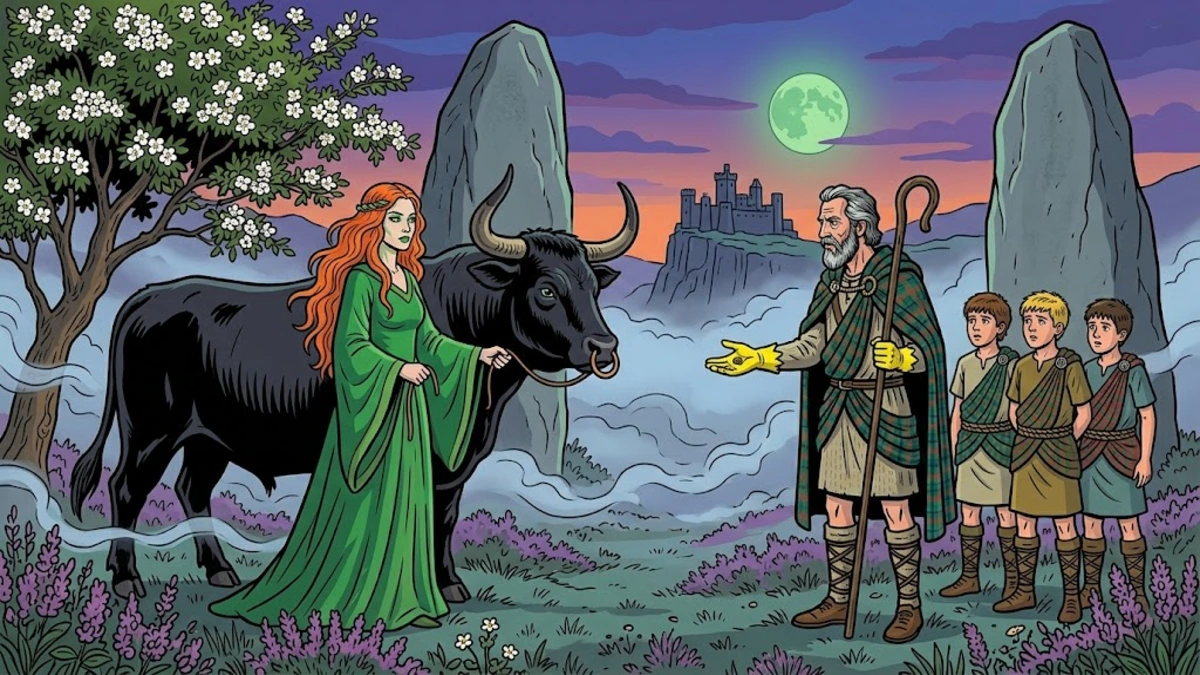
“In the days when I was no older than my own youngest, I went west into Lochlann to herd cattle for a black foreign lord. The country was a land of bog and basalt where the moon rose green between the standing-stones, and the lord’s castle was built of stone that wept water in the daylight and burned blue when the dark came down. I had not been a se’nnight in his service when I learned that of the seven herdsmen before me, none had ever come down again from the upper pasture; and the eighth — myself — was set to drive the black bull Tarbh Dubh up the same path at sunset.
“I drove him up. The bull went ahead and I went behind with my cromag stick, and as the path narrowed between two grey rocks the air went sweet and heavy as honey-mead, and out of a hawthorn that should have been only thorn there stepped a tall lady all in green, with hair the colour of a peat-flame and eyes that had no white in them at all. Cha tig thu sàbhailte às a’ ghleann seo, a Chonaill, said she — ‘You shall not come safely out of this glen, Conal, unless you give me what I ask.’ And what she asked was the black bull, hoof, hide, and horn.
“Now the bull was not mine to give, but I was a young man and her eyes had no white in them, and so I said yes. She took the bull by the ring of his nose and led him three steps under the hawthorn and there was no bull at all — only a great smooth stone, big as a cottage door. And she gave me, in exchange, a small dirty pebble no bigger than a hazelnut, and said: ‘When the black lord asks you for his bull, throw this on his floor and run, and do not look behind you for the length of seven heartbeats.’
“I came to the castle in the dusk. The black lord was waiting in his hall with his sword across his knees, and seven hounds at his feet, each as big as a heifer. I threw the pebble on the flagstones. Lord, the floor cracked open like a kicked egg. A wind came up from under the world that smelled of the old salt sea before the world was made. The seven hounds went up the chimney like rags of smoke and the black lord went up after them screaming a name in a language I did not know. I ran. For seven heartbeats I did not look behind me. When I looked, the castle was a hill of stones and the green lady was gone like dew off a hot griddle, and at my feet, lowing in the moonlight, stood the black bull Tarbh Dubh, the ring still in his nose, and not a hair on him singed.”
The King of Erin set down his cup. “Conal,” he said, “that is a tale and a half. Take the head of your eldest son and step back from the gallows by the breadth of a sword. But two stories yet remain.”
III. The Tale of the One-Eyed Giant — Polyphemus in the Highlands
“Many years from that, lord, when my beard was already in the salt-and-pepper stage and I had a wife in Erin and three small sons, the long road took me alone over the sea to the country of the Fomhóraich, the under-sea folk. There was a storm that broke my coracle on a black strand, and when I crawled up out of the wrack I found myself in a green glen ringed by cliffs taller than seven church-towers, and at the head of the glen a cave like the open mouth of a hill. I was hungry past speaking, and so I went in.
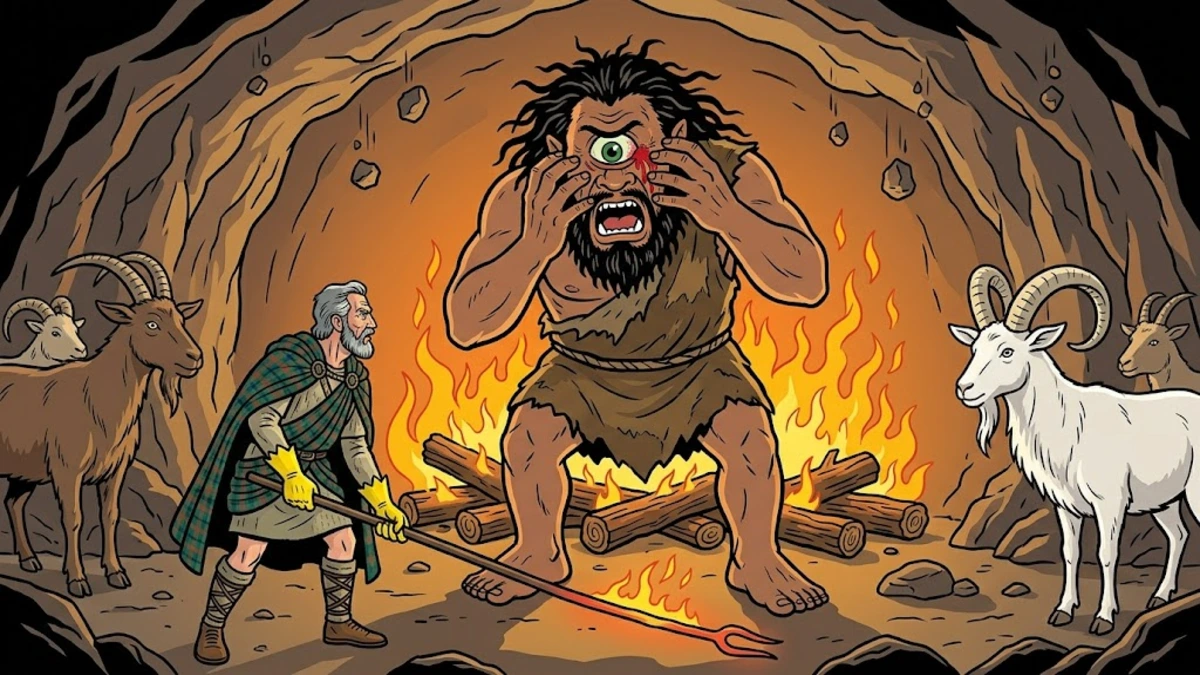
“The cave was full of goats. Pied goats, white goats, black goats, all of them the size of small horses; and at the back, by a fire of whole oak-trees, sat a giant with one eye in the middle of his forehead, and that eye was the size of a butter-dish and the colour of a sour apple. Cò às a thàinig thu, a dhaoine bhig? said he — ‘Whence have you come, little man?’ He had a voice like a millstone turning on bone.
“He took me by the leg as a man takes a hen, and he set me on a shelf above the fire, and he said he would eat me in the morning. He sat down to his own supper, which was a whole roast ram, and afterwards he rolled a stone the size of my father’s house in front of the cave-mouth and lay down to sleep. The cave shook with his snoring like a creel of mackerel in a gale.
“I waited. I took out the iron bior — the spit on which he had roasted the ram — and I laid the point of it in the embers until it glowed white as a star. Then I took it in both hands and I drove it deep into the giant’s one eye. He went up off the floor with a roar that brought the roof-rocks down in a black rain, and he rolled the stone away from the cave-mouth and sat across the gap with his hands spread, feeling for me as I passed.
“And then, lord, I did the thing which the blind narrator James Wilson, who learned this tale from his own father in Islay, would tell with such tenderness that grown men cried into their beards. The giant began to speak to his favourite goat — a great white buck with curling horns. A bhruic mo ghràidh, a bhruic mo chridhe, said he — ‘O buck of my love, O buck of my heart, is it thus you go out among the last of my flock and leave the master who fed thee from a kid? But go, then, go, for thy master is dark and his hour is upon him.’ And the giant let the buck pass between his hands.
“I had bound myself under the buck’s belly with strips of the giant’s own ram-hide. I went out clinging to the white buck’s wool, between the giant’s hands, and the giant was crying like a child at the loss of his eye and the loss of his sight. I came down to my coracle, which had washed itself whole in the cove, and I rowed away on the salt western tide, and the last thing I heard was the giant calling on his goats by name in a voice that broke.”
The King of Erin’s flint eyes were wet. “Conal,” he said, “you have told the second tale, and that is the tale of Odysseus which the monks of Clonmacnoise wrote down in our own tongue four hundred years before the Norman came. Take the head of your second son. But the third tale, Yellowclaw — the third tale must beat all.”
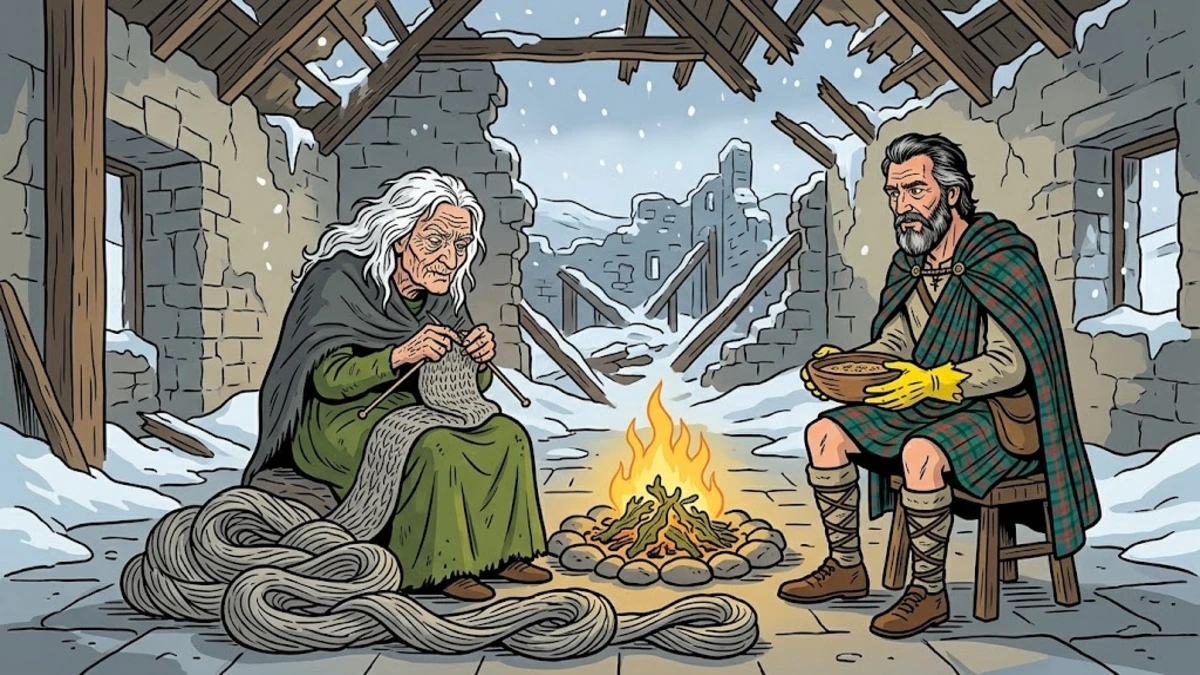
IV. The Tale of the Old Woman in the Castle — and the Frame Returns
“The third tale, lord, is shorter, and it is shorter because it is the truest. After the giant, after the buck, after the salt road home, I came one winter night to a ruined castle on a moor in the country of Lochlann, and there was no soul in it but one — an old woman, withered as a December leaf, who sat by a fire of seaweed in the great hall and was knitting a stocking that had no end. She gave me bread and barley-broth and a place at her hearth, and asked me by name what I had seen in my long going.
“I told her of the green lady and the pebble and the bull Tarbh Dubh. The old woman nodded and said, ‘Bha mi ann. I was there. I was the green lady’s serving-maid and I held the door of the hawthorn open while she took your bull.’ I told her of the one-eyed giant and the white buck. The old woman nodded again and said, ‘Bha mi ann. I was there. I was the giant’s housekeeper and I sharpened the spit on which he meant to roast you, and on the morning of his blinding I scoured his floor of his blood while he wept for the last of his flock.’
“And then the old woman looked at me with eyes that had seen the green hawthorn and the eye of the giant, and she said: ‘Eisd, a Chonaill Cra-Bhuidhe. Listen, Yellowclaw. The truth of a tale is the witness who survives it. I was the witness, and now thou art the witness, and presently thou wilt go and be witness for thy own three sons in the hall of the King of Erin. And the King of Erin will believe thee, because no man invents an old woman who knits a stocking that has no end.’
“And lord — that old woman is sitting at this moment by your own outer gate, in your own porter’s lodge, knitting still. Send to her, and ask her, and she will swear to you upon the iron of your own door-pin that every word I have spoken is true.”
The King of Erin sent. The porter came in pale as ash. “There is an old woman at the gate, lord, knitting a stocking that has no end. She bids me say to you, ‘Bha mi ann. Bha mi ann anns gach gleann a dh’innis e. I was there. I was there in every glen he has named.'”
The king rose from his chair of bog-oak and laid his sword sideways on the table, hilt towards Conal. “Yellowclaw,” he said, “the third tale is the best, and the witness at the gate is better than the tale. Take the heads of your three sons home upon your own three sons’ shoulders, and the three horses with them; for in this country the man who has lived such things and come back to tell them is worth more to the king than the king’s own stables.”
And so Conal Yellowclaw walked out of the black hall in the morning light, with his three sons behind him and three of the king’s best horses on the lead-rope, and the old woman with the endless stocking walked beside him three paces and then was a wisp of peat-smoke turning west over the moor. And the country called him from that day Conall nan Sgeul — Conall of the Tales — for he had bought his three sons’ lives with three true things he had seen with his own eye.
The Moral — and the Original Gaelic
“Is fheàrr aon sgeul fhìor na ceud sgeul brèige.“
— “One true tale is worth a hundred lies.” (West Highland proverb cited by Campbell, Popular Tales of the West Highlands, vol. I, p. 158, in his note to Conall Cra-Bhuidhe.)
The moral of Conal Yellowclaw is the moral of every framed-tale tradition from the Pañcatantra to the Decameron: that a story honestly told, anchored in a witness who can be summoned to the door, has saving power. Conal does not buy his sons with cunning, with bribe, or with strength of arm. He buys them with the truth of his own travel — three things he has seen with his own eye and one yellow-clawed hand — and with the integrity of a witness, the old woman with the endless stocking, who steps out of the tale and into the porter’s lodge so that the king may interrogate her himself. The Highland proverb that frames the story (“Is fheàrr aon sgeul fhìor na ceud sgeul brèige”) is the precise inverse of the modern temptation to embroider for effect: in this older ethic, a man who has truly walked a hard road is required only to remember it accurately, and the road itself does the rest of the work. Courage in Conal is not the cliff-edge defiance of the Battle of Birds nor the cunning of Andrew Coffey; it is the quieter, harder courage of a man who, with the gallows at his back, declines to invent. The yellow claw on his hand — Campbell’s crobh-buidhe, the colour of a beech-leaf in November — is the emblem of a life lived long in the open, marked by it, and unashamed of the marks.
Why This Tale Has Lasted
Three threads keep Conal Yellowclaw alive in the Celtic repertoire long after most tales of the West Highlands have faded. The first is its frame structure. As Joseph Jacobs noted in 1892 — and as Thackeray had felt fifty years earlier in the porter’s parlour of an Irish inn — Conal’s three-story-for-three-sons bargain is the same architecture that holds up The Thousand and One Nights, the Pañcatantra, the Kathāsaritsāgara, the Decameron, and the Canterbury Tales. To find this architecture at home in Gaelic Scotland, transmitted through an unlettered line of seanchaithe (story-tellers) on Islay, was for nineteenth-century folklorists a small earthquake: it suggested either an astonishingly early eastern import or — Jacobs’s preferred reading — that the frame-tale device is older and more universal than scholars had assumed. The second thread is the Polyphemus episode, central to the second story. The Irish text Merugud Uilix maic Leirtis (“The Wandering of Ulysses son of Laertes”), edited by Kuno Meyer (Anecdota Oxoniensia, 1886), shows that the Odyssey was known in Gaelic monastic circles by the tenth century, and the giant-and-the-buck scene survived into eighteenth- and nineteenth-century oral tradition in a form remarkably faithful to Homer — including the giant’s tender address to his favourite ram, which Campbell’s narrator James Wilson, blind from childhood, delivered with a weight of feeling that struck every collector who heard it. The third thread is the old woman at the gate: the witness who walks out of the tale and into the king’s porter’s lodge and there declares “bha mi ann”, “I was there.” It is the Gaelic answer to the Arabic “and Allah knows best” — a small ritual of accountability tucked inside a tall tale, and it is the reason the modern reader, like Thackeray, feels a sudden chill of plausibility in the very moment the story should be silliest. Together these three things — the frame, the Homer-fragment, the witness — make Conal Yellowclaw the Highlands’ great answer to the question, what is a story for; and the answer, like Conal’s hand, is the colour of long use.
You May Also Like
 Celtic Folk Tales
Ages 9-12
Celtic Folk Tales
Ages 9-12
Hudden And Dudden And Donald O’Neary
Hudden And Dudden And Donald O'Neary: There was once upon a time two farmers, and their names were Hudden and Dudden. They had poultry in their yards, sheep on
 Celtic Folk Tales
Ages 9-12
Celtic Folk Tales
Ages 9-12
Fair, Brown, And Trembling
Fair, Brown, And Trembling: King Hugh Curucha lived in Tir Conal, and he had three daughters, whose names were Fair, Brown, and Trembling. Fair and Brown had
![The Fairy Tree Of Dooros.[6]](https://indianfolktales.com/wp-content/uploads/2026/05/P-0829-the-fairy-tree-of-dooros-6-cover-400x260.webp) Celtic Folk Tales
Ages 9-12
Celtic Folk Tales
Ages 9-12
The Fairy Tree Of Dooros.[6]
The Fairy Tree Of Dooros.[6]: Once upon a time the fairies of the west, going home from a hurling-match with the fairies of the lakes, rested in Dooros Wood