The Fourth Voyage of Sinbad: Escape from the Cannibals
The Fourth Voyage of Sinbad: Escape from the Cannibals: I have told you of my three great voyages, my friends, but the fourth was perhaps the most terrible and

By the time Sinbad the Sailor sat down to tell the Fourth Voyage, his audience in Baghdad already knew the man: the spendthrift heir who became a merchant, the survivor of the living island, the rider of the Roc, the captive of the Old Man of the Sea. They had heard enough to expect monsters. What the Fourth Voyage gives them instead is something stranger and, in its own quiet way, more disturbing – a tale in which the real danger is not a giant beast but a custom of men, and in which Sinbad is saved not by miracles but by refusing to eat, by inventing a saddle, and finally by doing things in the dark that he never afterwards quite explained.
It is the harshest of the seven voyages and one of the most beautifully constructed. Three separate ordeals are joined into a single arc, each one tightening the screw: first the shipwreck and a cannibal feast, then a marriage and a kingdom, then a tomb. The reader who arrives expecting another Roc finds something closer to a long meditation on what a man will do to stay alive, and what cleverness is worth when it is set against custom, law and the open sea.
Origin & Canonical Attribution
Tradition: Arabian Nights / Alf Layla wa-Layla (The Thousand and One Nights) — the Sinbad cycle, fourth of the Seven Voyages.
Arabic title: al-Rihla al-Rabi‘a min Rihlat as-Sindibad al-Bahri (“The Fourth Voyage of Sinbad the Seaman”), narrated by Sinbad the Seaman to his namesake the porter, Sinbad the Landsman, in Baghdad during the reign of the caliph Harun al-Rashid.
Textual history: The Seven Voyages circulated as a self-contained Arabic work and were attached to the wider Nights comparatively late. The cycle is present in the Syrian Galland Manuscript (Bibliothèque nationale de France, MS arabe 3609–3611), the 14th–15th-century compilation that Antoine Galland used. Galland printed the voyages in his Les Mille et Une Nuits (1704–1717), making Sinbad known across Europe within a generation.
Arabic printed editions: Bulaq (Cairo, 1835); Calcutta II / Macnaghten (1839–1842); also Calcutta I and the Breslau text.
Major translations: Antoine Galland (French, 1704–1717); Edward William Lane (English, 1839–1841); John Payne (1882–1884); Sir Richard Francis Burton, The Book of the Thousand Nights and a Night (1885), where the Fourth Voyage appears in Volume V as part of “Sindbad the Seaman and Sindbad the Landsman.” Muhsin Mahdi’s critical Leiden edition (1984), based on the Galland Manuscript, was rendered into English by Husain Haddawy and published as Sindbad and Other Stories from the Arabian Nights (Norton, 1995).
Comparative folklore: The trance-inducing herb fed to the crew is identified by Burton, in a footnote, as bhang – that is, cannabis. The cannibal-by-fattening motif is widely paralleled in voyage literature (Homer’s Polyphemus and the Laestrygonians in the Odyssey are the obvious classical relatives), as is the device of refusing the host’s drugged food. The premature-burial-with-the-dead-spouse custom that closes the tale parallels the Scythian widow-burial described by Herodotus and noted by St Jerome, and is one of the bleakest motifs in the entire Nights.
Historical background: The voyages distil the real maritime trade of the early Abbasid period (8th–10th centuries), when merchants sailed from Basra and Siraf to India, the East Indies, China and the East African coast. They share their world of sailors’ wonder-lore with Buzurg ibn Shahriyar’s 10th-century Aja’ib al-Hind (“The Wonders of India”) and with the geographies of al-Mas‘udi and Ibn Khurradadhbih.
Public-domain status: The Thousand and One Nights and the Galland, Lane, Payne and Burton translations are all firmly in the public domain. The retelling below is an original composition for indianfolktales.com.
The Restlessness, the Storm and the Cannibal Coast

Sinbad began the Fourth Voyage exactly as he had begun the third: by being unable to stay home. His treasury was full, his Baghdad house was generous, his friends were many and his wife was kind. None of it answered the thing in him that the sea had put there. After some months ashore he found himself, as he put it, “weary of leisure as another man might be weary of work,” and he sold a part of his goods, packed bales of fine cloth, and went down once more to Basra. There he took ship in a strong vessel with a cautious captain and a small company of merchants, and they sailed out into the eastern sea.
For a time the voyage was prosperous. They put in at islands and trading towns; Sinbad sold and bought, sold and bought, and the small books he kept showed the merchant’s old, slow growth of capital. Then, far from any known coast, the wind changed. A storm rose more suddenly than the captain had ever seen one rise, and for three days and three nights it threw the ship like a chip of bark. On the fourth morning the sea quieted, but the ship had been carried into a stretch of water none of them recognised. Before they could take their bearings a second squall came up from the opposite quarter, and this one drove them straight onto an uncharted reef.
The ship struck and broke. Many of the crew were drowned at once. Sinbad and a small handful of merchants reached a stretch of beach on a plank apiece, half-conscious from the cold of the sea, and lay on the sand until the strength to crawl returned to them. When they had eaten a little of the fruit that grew above the high-tide line and drunk from a small stream, they walked inland, hoping for a village from which they might at last send word home.
The village they found was unlike any they had seen. Naked men of strange bearing, with eyes that did not move quite as the eyes of merchants and sailors moved, came out to greet them with food. The food was abundant and strange – a particular herb prepared in a bowl, with coconut milk and a little salt. The merchants, famished from the wreck, ate without questioning. Sinbad watched them eat and, with an instinct he could not afterwards explain, did not eat himself. He pretended to put the herb to his mouth and let it fall away. He drank only a swallow of the coconut milk.
Within a short time the truth showed itself. His companions’ faces grew slack, their speech blurred, their laughter became too loud. The villagers ushered them, smiling, to a great open kitchen where they were given more food still, and richer food – oils and butters and meats – and where the merchants ate without pause, no longer counting mouthfuls, no longer counting anything. Sinbad understood. The herb had taken the men’s reason, and the rich food was for fattening; and the kitchen was a kitchen for a reason the merchants would never live to see. The naked men were cannibals, and his shipmates were now no more than living larder.
Refusal, the Pepper Pickers and a Saddle for the King

From that morning Sinbad became a model of grief. He sat apart. He laid his hand to his cheek. He let the food the villagers brought him cool and harden and be carried away. When they urged him, he wept and said his heart was broken with the loss of his ship and his fortune and he could not eat. They thought him a poor prospect; the others, who ate everything set before them, were so much better. So they left Sinbad alone, and bit by bit the watch on him slackened. Every day a few of his companions were taken to the cooking place and did not come back. Every day Sinbad refused another meal.
One afternoon, when the villagers had drifted off to the kitchen for their own concerns, he slipped out of the settlement and ran. The forest was thick; the ground rose into hills. For seven days, by his count, he travelled inland, eating the fruits he could trust and drinking from streams, sleeping in trees by night. On the seventh day he came out of the forest onto an open shore where men were gathering pepper from low bushes – brown-skinned, clothed in linen, plainly civilised. They saw him; one of them spoke to him in Arabic; and Sinbad, who had not heard his own tongue in many weeks, sat down on the sand and put his face in his hands.
The pepper-gatherers heard his story, gave him food (this time food he could eat with both hands) and carried him in their boat to their own country. There he was brought before the king. The king received him kindly, as the kings in Sinbad’s tales so often do, listened with a thoughtful frown to the account of the herb and the kitchen and the lost companions, and lodged the stranger at his own court.
The country was a settled, prosperous one, but it had one peculiarity that struck Sinbad at once: the great men of the kingdom, the king included, rode their horses bare-backed. There were no saddles in the land; there were no stirrups; the riders simply sat on a cloth on the horse’s spine and gripped with their knees. To Sinbad, who had grown up among the saddle-makers of Iraq, this was as strange as a man trying to write without an alphabet.
He asked the king’s leave, found a good craftsman in wood and a good worker in leather, and set the two of them to making a saddle – a true saddle with a tree, a pommel, a deep seat, leather skirts and proper girths. He showed them how to forge stirrups and fix them to the saddle by leathers. He had a fine fringed saddle-cloth made for the underside. Then he presented the whole assembly to the king and asked permission to try it on the king’s own horse. The king mounted, sat as he had never sat before, and rode laughing. By that afternoon every officer of the court wanted one. Within a month Sinbad had set up a small industry of saddle-makers and harness-fitters; within three months no man of rank in the kingdom rode bareback any more, and Sinbad was rich with the gifts they pressed on him.
A Wife, a Custom and the Mouth of the Cavern

The king grew fond of him – fond in the dangerous way kings sometimes do. He told Sinbad he must not return to Baghdad; he was too useful, too pleasant, too valued. To bind him to the country, the king gave him in marriage one of the noblest ladies of the court: beautiful, well-spoken, kind, and of a great family. Sinbad, who liked her at once and who had despaired of seeing Iraq again, accepted; and for a time he lived in that strange land as a man may live anywhere, doing his work, loving his wife, slowly putting the cannibal forest out of his mind.
Then his neighbour’s wife died. Sinbad went to console his friend and found the man in such grief that his words could scarcely be understood. “It is not the death,” the neighbour said. “It is the law of our country. You did not know? When a husband or a wife dies here, the survivor is buried with them – alive, in the same tomb, dressed in their finest robes and adorned with their best jewels – so that the love that began in this world may continue in the next. Tomorrow I go down into the cavern with her. There is no help for it. It is our way.”
Sinbad went home and could not eat. He went to the king and pleaded with him – surely a foreigner married into the land might be excused such a custom – and the king, with great courtesy, said no. The custom was the custom. Sinbad was now of the country; he had eaten its salt, taken its honour, married into its first family; he could not refuse its law. And then, as Sinbad’s tale tells with merciless brevity, his own wife fell ill and died.
The funeral procession formed in the cool of the morning. The dead wife in her best clothes was placed on the bier; Sinbad walked behind her dressed as a bridegroom. They went out of the city to a hill at the edge of the sea, where a great rock had been rolled aside to show the mouth of a deep cavern. Down into this cavern, by ropes, they lowered first the body of his wife, then a small jar of water and seven flat loaves of bread, and then Sinbad himself, who came down in his bridegroom’s clothes and stood at last on a floor of stone among the laid-out dead of a hundred earlier marriages. The ropes were drawn up. The great rock was rolled back into the mouth of the cavern, blocking out the daylight. He was alone, by the rules of that country, with the dead.
What Was Done in the Dark, and the Long Road Home
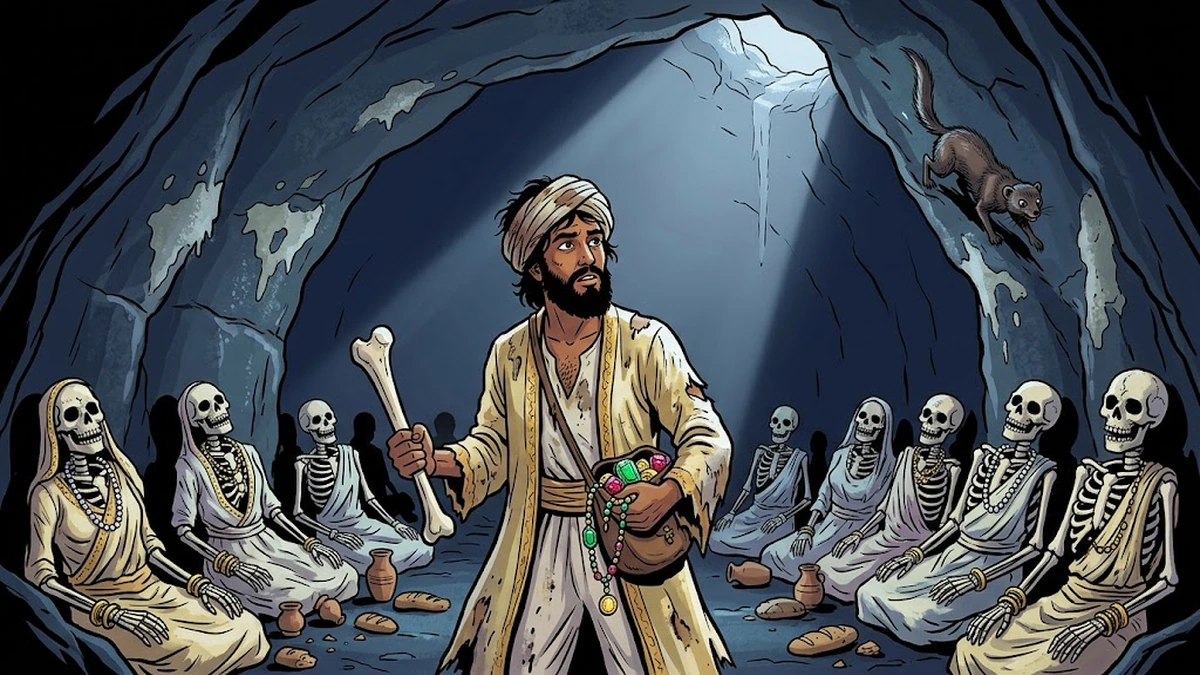
For some days Sinbad sat in the dark of the cavern and tried to die quietly. He drank from his jar very sparingly. He broke and ate the small loaves at the longest intervals he could bear. He wept for his wife and, after the wife, for himself, and then for the hundred ranks of skeletons he had glimpsed in the moment before the rock was rolled into place. Then the day came when he had only a swallow of water and a corner of the last loaf left, and he understood that whatever happened next he must do, because no one was coming for him.
It was while he was sitting in this state that the rock was suddenly rolled aside above his head. Light fell into the cavern; a body was lowered – a man’s body, dressed for burial – and then a living woman in her bride’s clothes, with a small jar of water and seven loaves of bread of her own. The rock thundered back into place; the light shut off; and the new widow began to weep in the dark, not yet knowing where she was.
What Sinbad did then is described in his own voice in the original tale with a quietness that is almost worse than horror. He felt for the great thigh-bone of one of the older corpses on the floor of the cavern. He went to where the new widow was weeping. He struck her down. He took her bread and her water. The tale, in Burton, in Lane, in Galland alike, does not soften this and does not excuse it. Sinbad says only: “I did this thing because I did not wish to die, and may God forgive me; for I knew well that whoever came next into the cavern would do the same to me.” Several times more, as the days passed and other newly-widowed wives and husbands were lowered into the dark, Sinbad did the same. He took their bread; he took their water; he gathered, from the laid-out dead, the gold and jewels they had been buried in. He became, in that cavern, a man he had never expected to be, and never afterwards spoke of without lowering his voice.
What at last saved him was, of all things, a small wild animal. Wandering one day along the back of the cavern, his bare foot brushed a moving thing that fled. He chased it, following the sound, and saw, at the far end of a long crevice, a faint white spot of daylight. He squeezed through after the creature and came out, ragged, bloodied and stinking, on the wall of a tall cliff above the sea – a place where wild beasts came in by night to scavenge the dead. The animal that had led him out had been one of them.
For some days Sinbad lived on that ledge above the sea, going back into the cavern only by day, only to gather more jewels and more bread, and bringing out at last the great heap of treasure he had collected. Then a ship came round the headland. He hailed her from his ledge with the cloth of his bridegroom’s coat, and the captain – astonished to find a man, alive, on a cliff over an unknown sea – sent a boat for him. Sinbad came aboard with his jewels and an explanation: that he had been wrecked on this coast and had survived by his wits. He did not, then or later, tell the sailors precisely what those wits had done. The ship turned westward; the long road home began; and at last, by stages and trade and second ships, Sinbad of Baghdad came back to his own city, embraced his living family, and sat down to tell his Fourth Voyage to the porter and to the friends and, in the end, through Galland and Burton and the printed page, to all of us.
The Moral of the Fourth Voyage
The Fourth Voyage is the darkest of the seven and the most morally uneasy, and it is so on purpose. The First Voyage rewards work; the Second rewards quick wits with a Roc; the Third rewards courage against the giant. The Fourth refuses any such tidy reward. It asks instead a much harder question: what is a person willing to do to remain alive, and what does that doing cost? Sinbad’s first survival – the refusal of the herb – is admirable; it is a model of restraint under pressure, and a child can be told it without flinching. His second – the invention of the saddle – is admirable too, and shows how a single piece of practical knowledge, brought into a country that does not have it, can rebuild a man’s life. But the cavern survival is something else. It saves him. It returns him to Baghdad. And it is, by any decent reckoning, terrible.
The tale tells it without comment, and that silence is the point. Sinbad in the cavern is neither a hero nor a villain; he is a frightened man in the worst position the story can put him in, doing the worst thing he can think of, because the alternative is to die. The Arabic tradition gives this an old, painful proverb that the tale almost speaks aloud:
“الضرورات تبيح المحظورات” — al-dururat tubih al-mahzurat — “Necessities make the forbidden permitted.”
The proverb is not an excuse and the tale does not use it as one. It is simply a name for the moral ground on which the Fourth Voyage stands – the country, dimly visible to all of us, in which an ordinary person is reduced by extremity to acts an ordinary person would never imagine doing. Sinbad escapes, but the tale never lets us see him entirely the same. His later wealth, his later voyages, his later piety are all, quietly, the wealth and piety of a man who once held a thigh-bone in the dark. The Fourth Voyage rewards survival; it does not pretend that survival is the same thing as innocence.
Why the Tale Has Lasted
The Fourth Voyage has outlived most of its companions in the Nights because it is the only one of the seven that admits, in the open, what every shipwreck story is privately about. The Roc is a marvel and the Old Man of the Sea is a riddle, but the cavern of the dead is something closer to the bone – a place each reader recognises without ever having been there, a metaphor for the worst rooms our circumstances can lock us into. The medieval Arabic listener already knew the desert version of it (a caravan lost in the Empty Quarter, the water gone) and the Mediterranean version (Odysseus and the cattle of Helios). The Fourth Voyage gives both, fused, in a single image: a man, alive, in a tomb, with bread for a week.
It is also one of the few Nights tales whose three episodes can be read as a single ethical argument. Refuse the unjust feast (the cannibals). Build something useful for a country that needs it (the saddle). And know that even so, even with the right refusals and the right inventions, a settled life in a foreign country is always, in the end, settled on the terms of that country – a custom you did not make can still drop the rock over your head. Three of the most enduring themes of Arab-Islamic seafaring literature – the trickery of strange hospitality, the dignity of useful craft, and the helplessness of even the cleverest stranger before a custom he did not consent to – are here in one tale. Read by an adult, the Fourth Voyage is the Arabian Nights’ answer to the Odyssey, and at one stark moment it is grimmer than the Odyssey. That is why, a thousand years on, we are still talking about it.
Frequently Asked Questions
Is the Fourth Voyage of Sinbad part of the original Arabian Nights?
The Seven Voyages of Sinbad circulated as a self-contained Arabic work – the Hikayat as-Sindibad al-Bahri – and were attached to the wider Thousand and One Nights comparatively late. The cycle is present in the Syrian Galland Manuscript (Bibliothèque nationale de France, MS arabe 3609–3611), the 14th–15th-century compilation that Antoine Galland used. Through Galland’s Les Mille et Une Nuits (1704–1717) the voyages, the Fourth among them, became inseparable from the European idea of the Nights.
What is the herb that the cannibals feed Sinbad’s crew?
The tale describes it as a herb prepared with coconut oil that robs those who eat it of their reason. Sir Richard Burton, in his 1885 translation, identified the herb in a footnote as bhang – that is, cannabis. The motif of a drug-laced feast offered as false hospitality is widely paralleled in voyage literature, from Homer’s lotus-eaters and Circe’s enchanted meal in the Odyssey to medieval European tales of poisoned banquets.
Why does the king’s country bury survivors alive with their dead spouses?
The custom in the tale is an extreme form of the wider folkloric motif of widow- or widower-burial, in which the surviving partner is interred with the deceased so that the marriage may continue in the next world. Real-world parallels include the Scythian widow-burial described in Herodotus (Book IV) and noted by St Jerome, and certain pre-modern Indian sati traditions. The Nights uses the motif to put Sinbad – a foreigner who has married into the country – in a moral and physical trap from which no clever invention can extract him.
What does Sinbad actually do to survive inside the cavern?
The original tale tells it plainly and without softening: when newly-widowed wives and husbands are lowered alive into the cavern with their dead spouses’ rations of bread and water, Sinbad strikes them down with a heavy bone from the cavern floor and takes their food. He also gathers the jewels and gold with which the long-dead were buried. He escapes only after weeks underground, when a wild animal – almost certainly a scavenger that has been entering the cavern through a crevice – shows him a narrow opening onto a cliff above the sea.
What is the moral of the Fourth Voyage?
The tale offers three layered lessons. First, refuse the feast that is meant to enslave you – restraint can save a life where appetite cannot. Second, useful knowledge travels: the man who carries a real craft (Sinbad’s saddle-making) into a country that lacks it becomes valuable, and that value buys him a place. Third – and most uncomfortably – the tale concedes that survival in extremity can require acts that the same person would not contemplate in ordinary life, and it offers the old Arabic legal maxim al-dururat tubih al-mahzurat, “necessities make the forbidden permitted,” not as an excuse but as a sober description of the ground the Fourth Voyage walks on.
You May Also Like
 Arabian Nights
All Ages
Arabian Nights
All Ages
The Barber’s Story of Himself
The comic Arabian Nights tale of the self-styled Silent Barber - the busybody who climbs uninvited into a stranger's boat, lands in chains before the Caliph, and still cannot hear how he sounds.
 Arabian Nights
All Ages
Arabian Nights
All Ages
The Tale of the Three Apples
The Tale of the Three Apples from the Arabian Nights - one of the earliest murder mysteries ever told. A locked chest pulled from the Tigris, a three-day deadline, and a husband undone by his own haste.
 Arabian Nights
Sinbad the Sailor: The Second Voyage
The voyage of the Roc and the Valley of Diamonds. Marooned on a deserted island, Sinbad ties himself to a giant bird, survives a ravine of serpents and gem-strewn rock, and rides a slab of meat back to freedom and fortune.