Prince Camaralzaman and Princess Badoura
The Arabian Nights romance of Qamar al-Zaman and Budur: a fairy and an ifrit wager over two sleeping royals, kindling a dream-love that survives oceans, a stolen carnelian talisman, and a princess who rules a kingdom disguised as a king.

Few romances in world literature open with a quarrel between spirits of the air. The tale of Prince Camaralzaman and Princess Badoura begins precisely there — with a fairy and a demon arguing, in the dark over a sleeping youth, about which of two strangers is the more beautiful. From that strange wager unfolds one of the longest and most beloved love stories in the Arabian Nights: a story of a prince who would not marry, a princess who would not be married, and a fate that carried them across the sea to find one another whether they wished it or not.
The prince’s name, Qamar al-Zaman, means “the Moon of the Age” — a boy so radiant that the storyteller insists the moon itself was named after him, and not the other way around. His beloved is Budur, whose name is the plural of badr, the full moon. Two moons, then, kept apart by oceans and by their own stubborn hearts, and drawn together by a contest no mortal ever knew was fought.
Origin & Canonical Attribution
Source collection: Alf Layla wa-Layla — the Thousand and One Nights, the great Middle Eastern frame-tale anthology in which the vizier’s daughter Shahrazad postpones her own execution by telling King Shahriyar an unfinished story each night.
Arabic title: Hikayat Qamar al-Zaman wa-Budur (“The Tale of Qamar al-Zaman and Budur”). Qamar al-Zaman = “Moon of the Age”; Budur = “full moons.”
Place in the cycle: One of the longest single romances in the collection, occupying roughly Nights 170–249 in the Calcutta II (Macnaghten) numbering. It is among the older tales of the corpus: a version appears in the fourteenth-century Galland Manuscript (Bibliothèque nationale de France, MS arabe 3609–3611), the oldest substantial witness of the Nights.
Principal editions: Bulaq (1835); Calcutta II / Macnaghten (1839–42); Calcutta I; Breslau (Habicht). Translators: Antoine Galland (Les Mille et Une Nuits, 1704–1717), Edward William Lane, John Payne, and Sir Richard Francis Burton.
Tale type & motifs: The story braids several international motifs — love kindled by the sight of a sleeper (Thompson T11.3, “love through sight of sleeping person”), the supernatural transport of a sleeping bride, the recognizing talisman (a carnelian charm), and the heroine who governs a kingdom disguised as a man (motif K1837, “disguise of woman in man’s clothes”). Its long sequel, the adventures of the sons Amjad and As’ad, carries the chaste-calumniated-wife pattern (ATU 712).
The Prince in the Tower
In the islands of Khalidan, far out in the eastern seas, there reigned a powerful king named Shahriman. He had grown old without an heir, and when at last a son was born to him, the child was so beautiful that the court could scarcely look at him without wonder. The king named him Qamar al-Zaman — Camaralzaman — the Moon of the Age, and raised him in every art a prince should know: horsemanship and the bow, the reading of poetry, the weighing of justice.
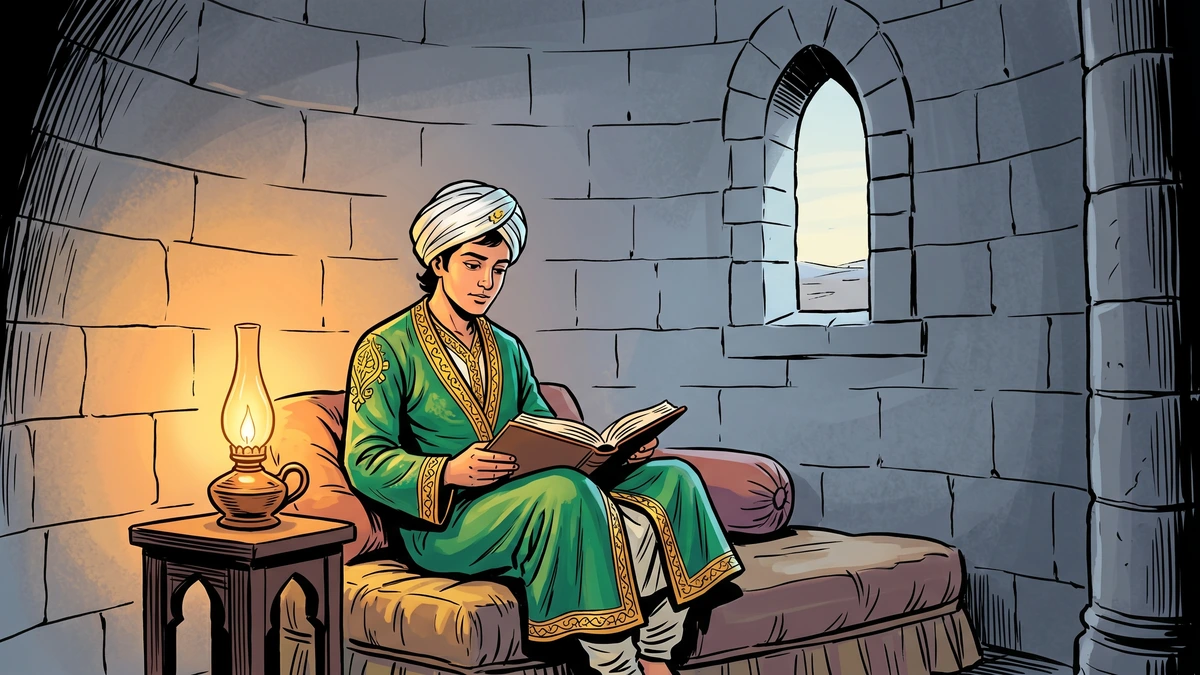
But when Camaralzaman came of age, the king’s joy turned to frustration. Shahriman wished to see his line secured and his son settled, and so he spoke of marriage. The prince refused. He had read too many books, he said, in which men were ruined by faithless or foolish wives; he would keep his freedom. A second time the king asked, more gravely, before the assembled court — and a second time, gently but immovably, the prince declined. The king’s patience broke. He ordered Camaralzaman confined in a disused tower of an old fortress, alone with a single servant, until obedience cooled his pride.
The prince did not rage. He took his confinement quietly, read by the narrow window, and slept at last beneath the high vault of the tower — not knowing that the ruined well at the tower’s foot was a doorway used by the unseen folk, and that his lamp-lit chamber had drawn the attention of a being far older than the fortress itself.
The Wager of the Jinn
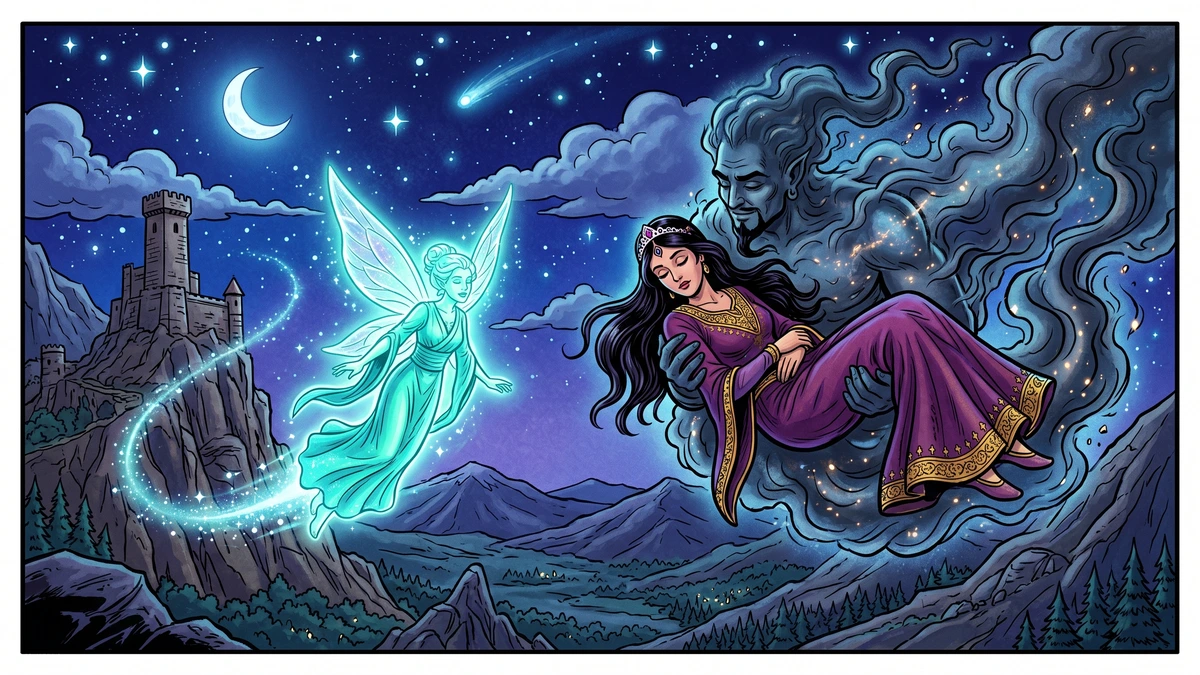
That night a fairy rose out of the old well — Maimunah, a daughter of the jinn-king Dimiryat, a spirit who had embraced the faith and meant no harm to sleeping men. She drifted up through the dark to see who had lit a lamp in her forgotten tower, and there she found Camaralzaman asleep. Maimunah, who had looked on the beautiful and the terrible across centuries, stood still. She had never seen a mortal so fair.
As she hovered in wonder, a second spirit came beating up out of the lower air — an ifrit named Dahnash, a wilder and unconverted jinn, hurrying home from the far kingdoms of the inland sea. Maimunah seized him as he passed and demanded to know what errand carried him so fast through her sky. Dahnash, to win his freedom, told her: he had come from the realm of King Ghayur, whose daughter, the Princess Budur, was the most beautiful creature in all the world. Her father had pressed her to marry; she had refused so fiercely, and shamed her suitors so sharply, that the king had shut her away under guard. Dahnash had been circling her chamber half the night, unable to leave.
Maimunah laughed. No mortal woman, she said, could rival the sleeper in her tower. The two spirits fell at once into the argument that sets the whole tale in motion: which face is the fairer? They could not agree by words, and so they agreed by proof. Dahnash flew to the distant kingdom and bore the sleeping Budur through the night air, laying her down beside Camaralzaman on the same couch, that the two jinn might judge them side by side.
But laid together, the two sleepers were so evenly matched — moon answering moon — that no judgment could be made. So the spirits summoned an arbiter, a third jinn, who proposed a fairer test: let each sleeper be woken in turn, alone, while the other slept on. Whichever of them showed the greater longing, the greater helpless love at the sight of the other, would be declared the less beautiful — for love humbles the lover. The jinn would do the rest.
Two Awakenings, and a Ring Exchanged
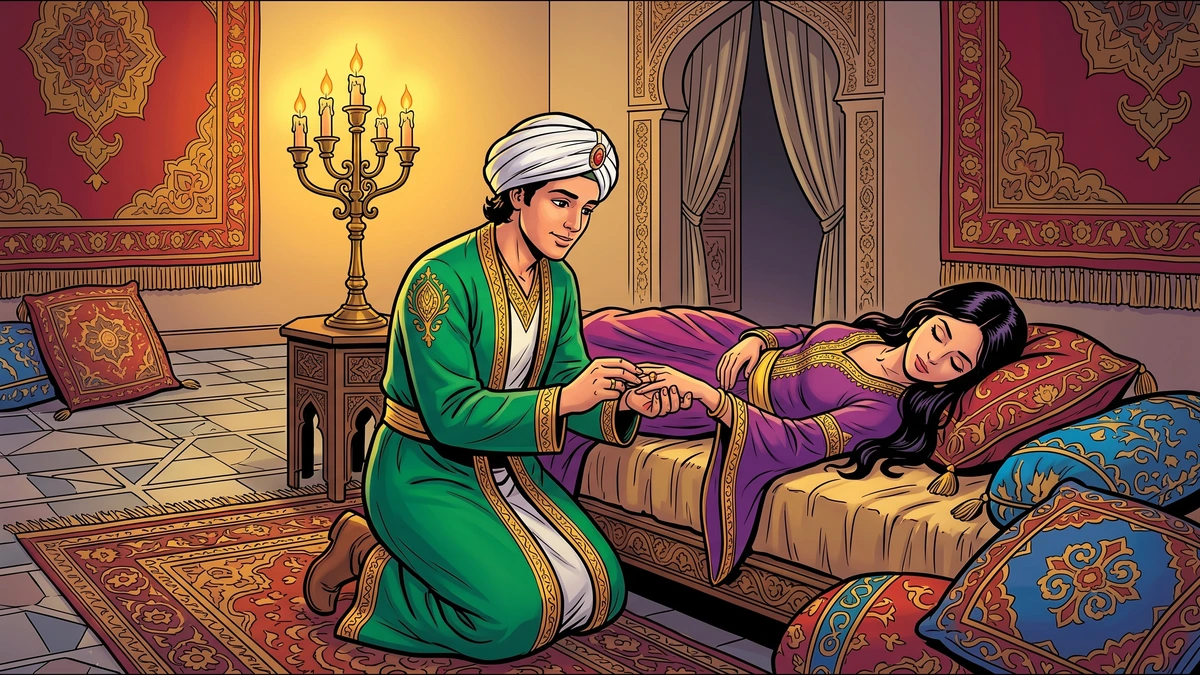
Camaralzaman was woken first. He opened his eyes and found a girl of impossible beauty asleep at his side, and every resolution he had ever made against marriage dissolved in an instant. He believed his father had relented — had set this bride beside him to soften his pride — and he loved her at once, wholly and without defense. He drew a ring from her finger and placed his own ring upon it, a quiet vow, and then a heaviness took him and he sank back into enchanted sleep.
Then Budur was woken. She found the prince beside her and was no less overcome; she too loved at first sight, and tried in vain to rouse him, and wept over him, and at last slept again. The jinn had their answer — the contest, in truth, ended in a tie, two hearts equally undone — and before dawn Dahnash carried Budur home, and Maimunah laid the prince as she had found him. Each of the two woke in the morning in a separate kingdom, an ocean apart, certain that the night’s beloved had been real, and that the world had been emptied of meaning by their absence.
Camaralzaman demanded of his servant and his father the name of the girl who had lain beside him. They knew nothing; they thought him ill, or mad, or willful, and the more he insisted, the more his father despaired. Far away, Budur fell into the same fever. She named the prince she had seen; she could describe him to the last detail; she would have no other and could not be comforted. Her family, fearing for her reason, chained her and called every physician and exorcist in the kingdom, and one by one they failed, and one by one — for the king had rashly promised punishment for failure — they paid for that failure with their lives.
Her rescue, when it came, came through love of a different kind. Budur’s foster-brother, a young man named Marzawan who had been raised at her side, returned from his travels, heard of her affliction, and contrived to reach her. She told him everything. Marzawan believed her — and, being a great traveler, he set out across the world to find the living man who matched her dream. His search led him at last to the islands of Khalidan and to the tower, and to a prince dying of exactly the same wound. Marzawan brought the two stories together, and with them a plan.
The Carnelian, the Bird, and the Princess Who Ruled as King
Marzawan smuggled Camaralzaman out of his father’s reach, and the two crossed the sea to King Ghayur’s country. There the prince presented himself as a physician — the one healer who could cure the princess no other had cured — and when at last Camaralzaman and Budur stood face to face, awake, in daylight, there was no enchantment left to doubt. The dream had told the truth. Their families, overjoyed and astonished, gave them in marriage, and for a season the two moons shone together.
But the tale was not done with them. As the couple journeyed toward Camaralzaman’s homeland, they halted to rest, and the prince noticed a charm bound to his sleeping wife: a carnelian stone, engraved with figures, that Budur’s mother had given her at birth as a talisman against harm. Curious, he carried it into the light to study it — and a bird swooped down, snatched the stone from his hand, and flew off. Camaralzaman followed it, and followed it, drawn from valley to valley and from day to day, until he was hopelessly lost and his wife’s camp lay far behind him. So the lovers, reunited by a dream, were parted again by a bird and a bright stone.
Budur woke alone. And here the princess of the tale shows the steel that had made her refuse a hall of suitors. She did not wait, and she did not weep herself helpless. She cut her hair, dressed in her husband’s clothes — for she resembled him closely — and traveled on under his name. Arriving in a foreign kingdom whose old king had just died leaving only a daughter, Budur was taken for a worthy prince and offered the throne and the princess’s hand. She accepted, governed wisely and justly, took the king’s daughter into her confidence rather than deceive her, and ruled a realm as a woman in a man’s crown — all the while keeping watch for the husband she had lost.
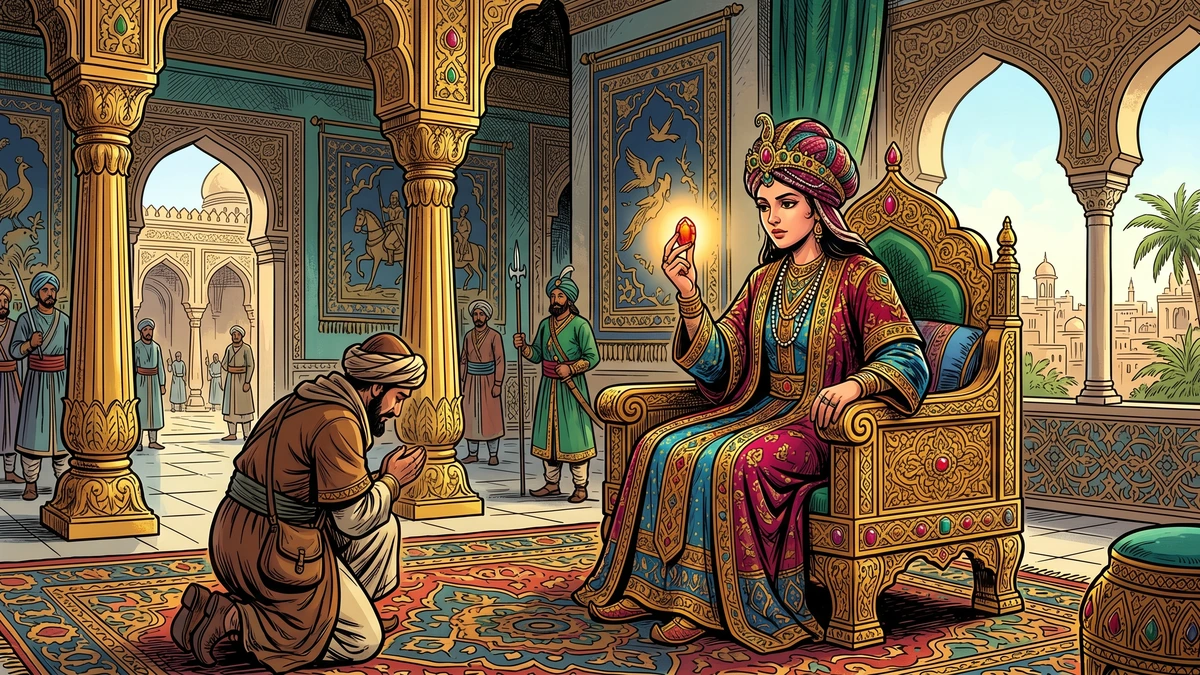
Camaralzaman, meanwhile, recovered the carnelian by chance in a far-off orchard, hidden among the goods of a gardener who had befriended him, and took ship at last for home. The vessel’s course carried it into the very harbor of the kingdom Budur now ruled. The talisman did the rest: the disguised “king” recognized her own birth-charm among a merchant’s wares, summoned its owner — and so wife and husband were restored to each other, the reunion sealed by the small engraved stone that had first divided them. Budur revealed herself, the borrowed crown was set right, and the long romance, which would run on into the adventures of their sons, found its still center: the two moons, after every distance, in one sky again.
Moral
The tale of Camaralzaman and Budur is, on its surface, about destiny — a love arranged by spirits and confirmed by a dream. Yet the storyteller is careful to show that destiny only opens the door; the lovers themselves must walk through it, again and again, at real cost. Camaralzaman defies his father, crosses an ocean, and chases a bird into the wilderness. Budur breaks her own chains of grief, takes up a man’s name and a stranger’s crown, and holds a kingdom together by her wits until fortune turns. What is fated still has to be earned, by patience, courage, and refusal to despair.
The Arabic tradition has a proverb that the tale seems written to illustrate:
المكتوب ما منه مهروب
“Al-maktub ma minhu mahrub” — “From what is written, there is no escaping.” But the Nights add a quiet second clause of their own: what is written must still be lived. The lovers do not escape their fate — and they do not receive it idle, either.
Why the Tale Has Lasted
Few stories in the Nights have traveled as widely as this one. Galland’s early-eighteenth-century French translation carried Camaralzaman into European drawing rooms, and from there the romance was reworked into stage plays, pantomimes, operas, and ballets across more than two centuries. Its appeal is easy to understand. It opens with one of literature’s most arresting images — two spirits weighing two sleeping faces in the dark — and then grounds that fantasy in a remarkably human pair: a young man and a young woman who both, for their own reasons, will not be told whom to love.
Modern readers are often struck most by Budur. Long before the contemporary heroine, this medieval Arabic tale gave its princess a man’s clothes, a man’s name, a throne, and a kingdom to govern — and let her keep all of it through competence rather than rescue. The storytellers of the Nights knew that audiences love a clever woman, and Budur is among the cleverest. Together with the dream that crosses oceans and the small carnelian that loses and finds a marriage, she has kept this eight-hundred-year-old romance alive: proof that the oldest tales survive because they still say something true about longing, loyalty, and the long work of staying found.
Frequently Asked Questions
What does the name “Camaralzaman” mean?
Camaralzaman is the French-influenced spelling Antoine Galland used for the Arabic Qamar al-Zaman, which means “the Moon of the Age” or “Moon of the Time.” His beloved’s name, Budur, is the plural of the Arabic badr, “full moon.” The pairing is deliberate: the tale is a romance of two “moons” whose light is only complete when they are together, and the storyteller plays on the imagery throughout.
Where does the story come from, and how old is it?
It belongs to Alf Layla wa-Layla, the Thousand and One Nights, told within the frame in which Shahrazad keeps King Shahriyar listening night after night. The tale of Qamar al-Zaman is one of the older layers of the collection: a version survives in the fourteenth-century Galland Manuscript (BnF, MS arabe 3609–3611), the earliest major manuscript of the Nights. It later appeared in all the great printed editions — Bulaq 1835, Calcutta II, Calcutta I, and Breslau — and runs across roughly eighty nights of the cycle.
Why do a fairy and a demon argue at the start of the tale?
The fairy Maimunah and the ifrit Dahnash each insist that the sleeper they have discovered — Camaralzaman in his tower, Budur in her guarded chamber — is the most beautiful being alive. Unable to settle it by words, they carry the two sleepers together to compare them. The quarrel is a storyteller’s device: it explains how a prince and princess who live an ocean apart come to lie side by side for a single night, fall in love, and wake unable to forget a face that “cannot” have been real.
How does Princess Badoura rescue herself after the second separation?
When a bird steals her carnelian talisman and her husband vanishes chasing it, Budur does not wait to be found. She cuts her hair, dresses in Camaralzaman’s clothes — whom she closely resembles — and travels under his name. Mistaken for a prince in a kingdom that has just lost its king, she is given the throne and rules justly and capably until fate brings her husband’s ship into her harbor. It is one of the most striking portraits of a self-reliant woman in medieval storytelling.
What part does the carnelian talisman play?
The carnelian is an engraved birth-charm given to Budur by her mother to protect her from harm. When Camaralzaman takes it to examine it, a bird snatches it away, and chasing the bird is what separates the couple a second time. The same stone later reunites them: Budur, ruling in disguise, recognizes her own talisman among a visiting merchant’s goods and summons its owner — who proves to be her lost husband. The talisman is the tale’s hinge, dividing the lovers and then restoring them.
You May Also Like
 Arabian Nights
All Ages
Arabian Nights
All Ages
The Story of Ghanim ibn Ayyub, the Slave of Love
Locked out of Baghdad at nightfall, the young Damascus merchant Ghanim finds a living woman sealed in a chest among the tombs - and loves her so honourably he will not touch her. One of the great romances of the Arabian Nights.
 Arabian Nights
Ages 9-12
Arabian Nights
Ages 9-12
The Fourth Voyage of Sinbad: Escape from the Cannibals
The Fourth Voyage of Sinbad: Escape from the Cannibals: I have told you of my three great voyages, my friends, but the fourth was perhaps the most terrible and
 Arabian Nights
The Tale of Prince Agib
The Third Kalandar's Tale from the Arabian Nights: Prince Agib survives a ship-eating magnetic mountain, a brazen horseman and a boatman of brass, only to lose an eye to the one forbidden golden door he was begged to leave shut.