Hassan of Basra and the Bird Maiden
Hassan of Basra and the Bird Maiden: In the city of Basra, there lived a young merchant named Hassan ibn Ibrahim, known throughout the marketplace for his

In the great markets of Basra, where the Tigris and Euphrates meet the warm tides of the Persian Gulf, the storytellers of medieval Iraq once spun a tale that runs for fifty‑four consecutive nights in the great recension of the Alf Layla wa‑Layla. It is the long, dreamlike romance of Hassan of Basra and the Bird Maiden — a goldsmith who is tricked by a Persian alchemist, who falls in love with a winged jinn‑princess bathing in a forbidden pool, and who must journey to the impossible Islands of Wáq Wáq at the edge of the world to win his wife and children back. It is the Arabic world’s grandest variant of the universal Swan Maiden story (Aarne–Thompson–Uther type ATU 400 – The Man on a Quest for the Lost Wife), and it sits at the heart of one of the most enduring story cycles ever recorded.
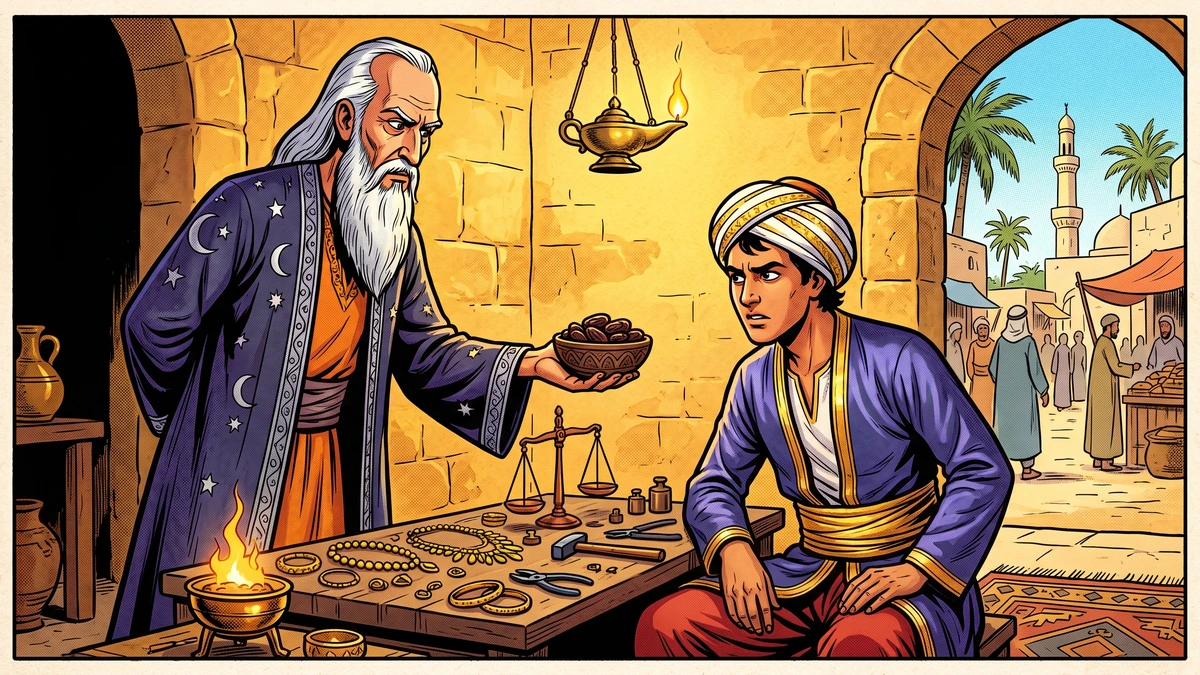
The Goldsmith of Basra and the Persian Stranger
Hassan ibn Ibrahim was the only son of a wealthy merchant of Basra. When his father died, he inherited the family compound, the silver and copper of the storeroom, and a small shop in the goldsmiths’ row. Hassan was gentle, generous, and easily moved — qualities that earned him the affection of his neighbours and, eventually, the attention of a stranger.
The stranger was a tall, narrow‑faced Majusi — a Persian fire‑worshipper in the framing of the Nights — named Bahram. He wore an indigo robe stitched with silver charms and carried a brazier in which the coals never seemed to die. He stopped before Hassan’s stall one afternoon, watched the young man at his bench, and smiled the slow smile of a man who has been looking for something a long time.
“O my son,” said Bahram, “you have a generous hand and a steady eye. I am old and childless, and I know a single secret worth more than this whole bazaar. I know the science of turning base metal into pure gold. Give me a son’s love and a year of your patience, and I will set this knowledge upon your tongue.”
Hassan’s old nurse Zainab, who had raised him since infancy, begged him not to follow the stranger. “The Persian smells of fire and copper sulphate,” she said. “Greed is a cloak that hides a thousand knives.” But Hassan, dreaming of restoring his father’s waning fortune, accepted the gift of dates Bahram offered him — dates laced with banj, the legendary sleeping drug of the Nights. He woke far from Basra, bound hand and foot on the back of a swift dromedary, and discovered that he had been carried into the desert by an alchemist who needed not a student but a sacrifice.
The Mountain of the Cloud and the Bird Maidens
Bahram’s scheme was older and stranger than any boy of Basra could have guessed. On a green, treeless mountain whose summit was always wrapped in cloud, there grew the rare ‘ud al‑hindi, an aloeswood whose ash, mixed with a virgin’s liver, was said to transmute lead into gold. To reach the summit one needed a young man, a freshly slaughtered horse, and a vulture. The vulture, sewn into the horse’s belly, would carry the human heart of the corpse up to the peak. Bahram had used six youths already; Hassan was the seventh.
But Hassan escaped — first by feigning death and then by hurling Bahram’s own knife into the magician’s chest. He climbed down the mountain along a half‑forgotten path and found, in a hidden valley, a high‑walled pavilion of marble and lapis. Within stood a deep, still pool fed by a spring of melted snow.
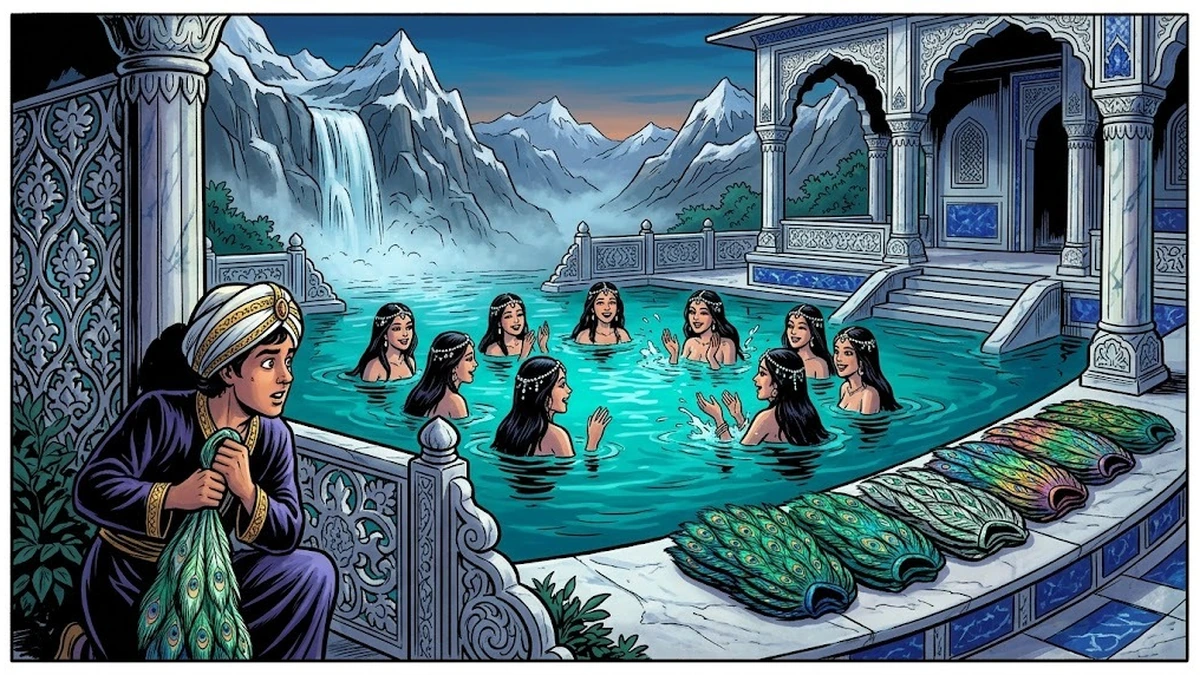
At the hour the storytellers call al‑asr al‑akhir, “the last afternoon,” ten figures of light glided down out of the upper sky and alighted on the rim of the pool. Each carried, folded over her arm, a robe of green and silver feathers, woven so finely it shimmered like the inside of a peacock’s eye. These were the daughters of the Jinn‑King of the Sea, the queens of the Islands of Wáq Wáq, beings who lived between the human realm and the realm of al‑ghayb, the Unseen. They laid down their feather robes, stepped naked into the water, and laughed like running silver.
One of the ten was lovelier than the rest. Her name was Manar al-Sana — “Light of the Craft.” Hassan, hidden behind the marble screen, did what every hero of the great Swan‑Maiden cycle has always done: he stole her robe and hid it in a cleft of the rock. The other nine bird‑maidens dressed and rose into the air, but Manar al‑Sana remained behind, naked and weeping. Hassan stepped from his hiding place, wrapped her in his own cloak, and brought her, half‑willing and half‑grieving, home to his mother’s house in Basra.
The Marriage, the Children, and the Feather Robe
For seven years Hassan and Manar al‑Sana lived as husband and wife. She bore him two sons, Nasir and Mansur, and grew gradually to love the man who had taken her from the sky. Hassan, terrified of losing her, sewed her feather robe into a leather bag, locked the bag in an iron coffer, and buried the coffer beneath the floor of an inner storeroom. Then, one summer, news came that the Caliph in Baghdad required Hassan to accompany a caravan to the trading posts of the south. He kissed his wife, charged his mother with her safety, and set out on the long road.
Within days, Manar al‑Sana found the coffer. She wept and she begged Hassan’s mother — “Only let me feel the feathers against my skin once more. I am dying of homesickness.” The old woman, pitying her, opened the coffer. The bird‑maiden slipped on her robe in a single fluid motion, gathered her two sons under her wings, and rose through the smoke‑hole of the kitchen. As she vanished into the upper air, she called down: “Tell my lord that if he loves me still, let him seek me in the Islands of Wáq Wáq.”
The Quest to the Islands of Wáq Wáq

So began the most famous geographic adventure in the Arabian Nights. Hassan returned to a silent house and a weeping mother, and set out almost immediately on a journey that the medieval Arab cartographers themselves placed at the eastern limit of the world. Wáq Wáq — the name supposedly imitates the sound made by a fabulous tree whose fruit are women’s heads — appears in the Hudud al‑‘Alam (c. 982 CE), in al‑Mas‘udi’s Muruj al‑Dhahab, and in the geographies of Ibn Khordadbeh and al‑Idrisi. Sometimes the islands are placed near Sumatra, sometimes off Madagascar, sometimes at the eastern edge of the known sea. In the Nights, they are a real place that is also an impossible one.
Hassan’s road was the road of every quest hero. He crossed seven valleys, met a wise old shaykh who gave him a magic copper rod and a hat of invisibility, rode a flying cloud‑horse, and bargained with a jinn‑gatekeeper for safe passage. At the gate of the first island he met one of the seven sister‑queens of Wáq Wáq — the eldest sister of his own wife — and she, recognising the love that had brought him so far, hid him beneath her own throne when the Queen of the Islands rode out in fury to punish the human who dared trespass her dominion.
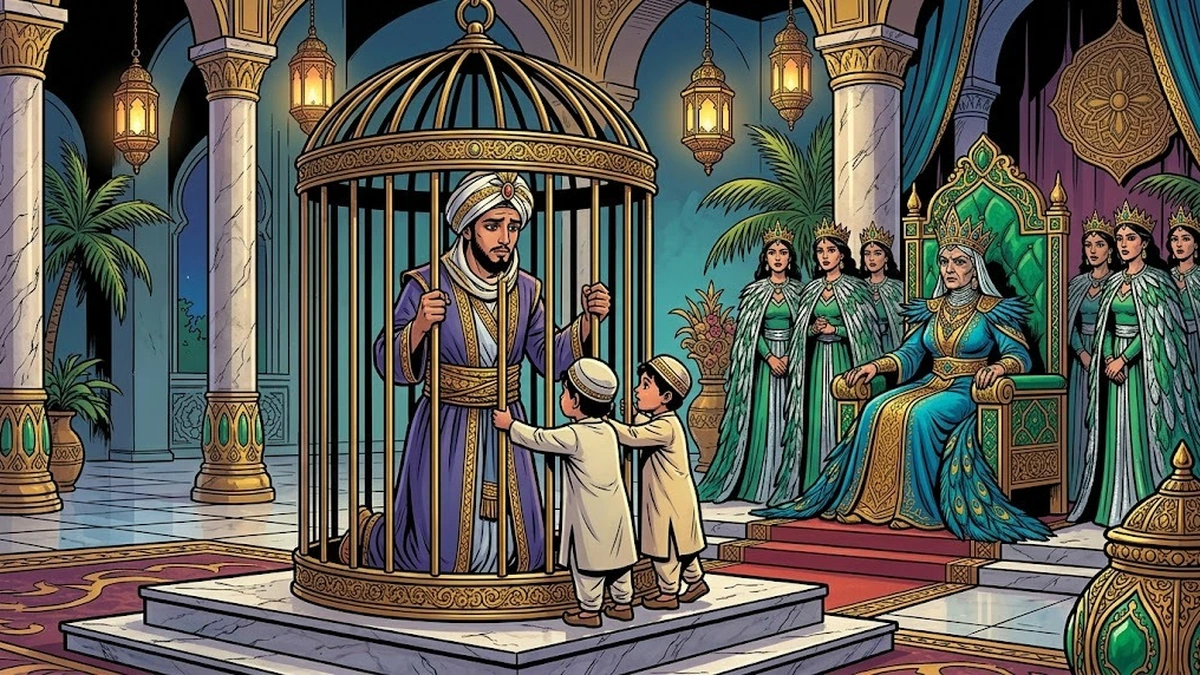
The ordeal climaxes in a courtroom scene of unforgettable strangeness. The Queen of Wáq Wáq, mother to all the bird‑maidens, places Hassan in a great brass cage. There he is fed and watered like a singing bird while his trial is debated by the council of jinn. Only when his eldest sister‑in‑law offers her own life in exchange for his, and only when his two small sons run weeping into the cage to embrace him, does the Queen relent. Hassan is restored to Manar al‑Sana, the family returns by way of the same cloud‑horse to Basra, and the city wakes one morning to find its goldsmith’s house full of bird‑maidens singing in the courtyard.
The Moral and the Original Quote
The tale’s moral, repeated by Shahrazad at its close, is one of the most quoted lines of the Arabian Nights. The Arabic reads:
« مَنْ صَدَقَ في طَلَبِهِ نالَ مُنَاهُ وَلَوْ كانَ في وَاقِ الوَاقِ. »
— Alf Layla wa-Layla, Night 826 (Calcutta II / Macnaghten edition)
“Whoever is true in his seeking shall attain his desire, even if it be in the Islands of Wáq Wáq.”
The proverb has migrated far beyond the Nights into Persian and Ottoman Turkish literature, where Wáq Wáq became shorthand for “the impossible faraway.” In modern Arabic the phrase waq al‑waq still means “the very ends of the earth.”
Why This Tale Has Endured
The Swan‑Maiden pattern is one of the oldest narrative shapes in the world. Folklorists trace it to the Eurasian Bronze Age, with cognate tales running from the Indian Urvashi story in the Rig Veda and the Mahabharata, through the Greek nymph cycles, the Volsunga Saga’s Valkyrie‑brides, the Japanese Hagoromo (Feather Robe) No play, and the Inuit Goose‑Wife of Greenland. Hassan of Basra is the Arabic world’s grandest, most elaborate variant: it combines the Swan‑Maiden marriage with the Persian alchemist plot (ATU 325 — The Magician and his Pupil), the geographic romance of medieval Arab travel literature, and the matriarchal jinn‑queendom of the Wak‑Wak cosmology.
It has endured because it speaks at once to the homesickness of the migrant and to the universal terror of loving someone whose true home is not yours. The bird‑maiden does not run away because she does not love her husband; she runs away because she cannot live forever without the sky. The moral is therefore not simply about persistence in the face of difficulty — it is about the willingness to follow love into territory utterly unfamiliar, and to learn to live there as a guest.
Canonical Attribution & Scholarly Context
Arabic title: Hikayat Hasan al-Basri (حكاية حسن البصري). Also rendered “Hasan of Bassorah” in Burton.
Position in the Nights: Nights 778–831 in the Calcutta II (Macnaghten) text, 1839–1842. The tale occupies fifty‑four consecutive nights, making it one of the four or five longest single stories in the entire Alf Layla wa-Layla.
Major translations: Edward Lane omitted the tale entirely as “not suitable” (1840). The complete English version is Sir Richard Francis Burton’s The Book of the Thousand Nights and a Night, Volume VIII (Benares, 1885), pp. 7–113. J. C. Mardrus translated it as Histoire de Hassan al‑Bassri in Mille et Une Nuits, Vol. VIII (1903), and E. Powys Mathers turned Mardrus’s French into English in 1923. Husain Haddawy and Malcolm Lyons each retranslated portions in 1990 and 2008 respectively.
Tale‑type classification: ATU 400 (The Man on a Quest for his Lost Wife) combined with ATU 465 (The Man Persecuted Because of his Beautiful Wife) and ATU 325 (The Magician and his Pupil). Hans‑Jorg Uther, The Types of International Folktales (2004), lists the conjunction explicitly.
Reference work: Ulrich Marzolph & Richard van Leeuwen, The Arabian Nights Encyclopedia (ABC‑CLIO, 2004), entry “Hasan of Basra,” Vol. I, pp. 218–220. See also Robert Irwin, The Arabian Nights: A Companion (Penguin, 1994), Ch. 6, “The Marvellous.”
Geography: The Islands of Wáq Wáq appear in the Hudud al‑‘Alam (982 CE), al‑Mas‘udi’s Muruj al‑Dhahab (947 CE), Ibn Khordadbeh’s Kitab al‑Masalik wa’l‑Mamalik (885 CE), and the Nuzhat al‑Mushtaq of al‑Idrisi (1154 CE). Scholarly consensus identifies them tentatively with Sumatra/Java or with parts of the Malay archipelago, though al‑Idrisi places them off the East African coast near Madagascar.
Cognate tales: The Indian Urvashi/Pururavas episode of the Rig Veda X.95 and Mahabharata I.75; the Japanese Hagoromo No play (15th c.); the Volsunga Saga (Volundr’s swan‑maiden wife); the Inuit Goose‑Wife (Boas, 1888); and the Manchurian Tale of the Heavenly Maiden recorded by Hibino in 1936.
For the Modern Reader
What lifts the Hassan tale above ordinary romance is its insistence that love is a journey that crosses ontological borders. Hassan does not just lose his wife; he loses her to a different order of being. To win her back he must learn the rules of that other order, accept its sovereignty, and even submit to its judgment. The story’s greatest tenderness lies in the small detail of his two sons running into the brass cage to embrace him — the human father is reclaimed by jinn children who, having known both worlds, refuse to choose between them.
Read at any age, Hassan of Basra and the Bird Maiden is a tale about marriage as the practice of becoming foreign together. That is why, twelve centuries after the storytellers of Basra first whispered it under the sail‑lamps of the Tigris quays, it still moves us.
You May Also Like
 Arabian Nights
Sinbad the Sailor: The Second Voyage
The voyage of the Roc and the Valley of Diamonds. Marooned on a deserted island, Sinbad ties himself to a giant bird, survives a ravine of serpents and gem-strewn rock, and rides a slab of meat back to freedom and fortune.
 Arabian Nights
Ages 9-12
Arabian Nights
Ages 9-12
The City of Brass: A Lesson in the Vanity of Power
The City of Brass: A Lesson in the Vanity of Power: In the great halls of Damascus, Caliph Muawiyah sat upon his throne, disturbed by troubling dreams. joins a
 Arabian Nights
Ages 9-12
Arabian Nights
Ages 9-12
Aladdin and the Wonderful Lamp
A scholarly retelling of Aladdin and the Wonderful Lamp, the famous orphan tale of the Arabian Nights told to Antoine Galland in 1709 by Hanna Diyab of Aleppo, and the story of how a poor, idle boy grows worthy of the power he finds.