The City of Brass: A Lesson in the Vanity of Power
The City of Brass: A Lesson in the Vanity of Power: In the great halls of Damascus, Caliph Muawiyah sat upon his throne, disturbed by troubling dreams. joins a

Of all the tales in the Thousand and One Nights, few are so unlike their neighbours as The City of Brass. The collection is famous for love stories, clever thieves, fishermen and genies, princes who marry far-off princesses. This tale has none of these. It is a long, slow, awestruck pilgrimage across a desert, led by a real Umayyad governor and an aged scholar, towards a city that no one alive has seen – and that, when the travellers at last walk through its gates, turns out to be a city of the magnificent dead.
Its mood is unmistakable: the silence of ruins, the glitter of treasure that no hand will ever spend again, walls of yellow brass blazing in the desert sun. Where most of the Nights are propelled by appetite – for love, for gold, for revenge – this one is propelled by a question. The Caliph in Damascus has heard of brass vessels in which the prophet Solomon once imprisoned rebellious jinn, and he wishes to see one. The expedition that goes to look for those vessels meets, on the way, the relics of every kind of worldly power, and reads on every wall a single warning: where are the kings, where are the conquerors, where are those who once owned all this? The tale’s subject is not adventure. It is the vanity of power itself.
Origin & Canonical Attribution
Source & collection: The City of Brass belongs to Alf Layla wa-Layla, the Thousand and One Nights. Its Arabic title is Madīnat al-Naḥās (also given as Madīnat al-Ṣufr, the City of Yellow Brass). In the standard Calcutta II / Macnaghten Arabic recension it occupies roughly Nights 566–578. Sir Richard Francis Burton, who included it complete in his ten-volume translation of 1885, places it across those same nights of the “Plain and Literal Translation.”
Tale type & folklore index: The story is not a domestic fairy tale and sits awkwardly in the international Aarne–Thompson–Uther catalogue; folklorists treat it as a legendary ʿajāʾib (“marvels”) narrative in the family of Stith Thompson motif F771.4.4, “city entirely of brass / copper,” with the related motifs F771.1.6 (“city of the dead”), D1980 (“magic invisibility”) and D1413 (“objects which compel one to remain”). The Marzolph and van Leeuwen Arabian Nights Encyclopedia (2004) catalogues it as a free-standing legendary cycle rather than as an ATU type.
Textual history: The tale exists in all the great Arabic recensions of the Nights – the Būlāq edition (Cairo, 1835), the Calcutta II / Macnaghten edition (1839–42), and the Breslau text edited by Maximilian Habicht – and in the major European translations by Edward William Lane (who included an abridged version in his 1840 translation), John Payne (1882), Sir Richard F. Burton (1885) and later Husain Haddawy from the Mahdi Arabic edition. A self-contained early version of the story is also preserved outside the Nights, in the geographical encyclopaedia of Abū Ḥāmid al-Gharnāṭī (twelfth century), and in fragments cited by al-Masʿūdī in his Murūj al-Dhahab (Meadows of Gold, c. 947 CE) and by Yāqūt al-Ḥamawī in his thirteenth-century geographical dictionary.
Older roots: The legend grew out of the Arab tradition of ʿajāʾib al-makhlūqāt (“marvels of created things”) and the parallel cycle of legends attaching to the prophet Sulaymān (Solomon) and his power over the jinn, found already in Qurʾān 27 (Sūrat al-Naml) and 34 (Sūrat Sabaʾ), and in the early Islamic qiṣaṣ al-anbiyāʾ (“tales of the prophets”) literature of al-Thaʿlabī and al-Kisāʾī. The expedition framework – an Umayyad governor of Ifrīqiya searching for the brass jars of Solomon – is attested as early as the ninth-century historian Ibn ʿAbd al-Ḥakam, in his Futūḥ Miṣr wa-al-Maghrib. The motif of a buried or petrified city ruled long ago by a tyrant is older still and connects the tale to the Qurʾānic legends of ʿĀd, Iram dhāt al-ʿImād (Iram of the Pillars), and the lost peoples destroyed for their pride.
Setting & names: The journey begins in Damascus, in the reign of the Umayyad Caliph ʿAbd al-Malik ibn Marwān (r. 685–705 CE), and is led by his real governor of North Africa, the conqueror of al-Andalus, Mūsā ibn Nuṣayr. His guide is the aged sage Shaykh ʿAbd al-Ṣamad, and his vizier is Ṭālib ibn Sahl. The petrified city is identified in the tale as the work of Kūsh ibn Shaddād ibn ʿĀd, an heir of the legendary giant-king Shaddād whose pride brought down the lost city of Iram. The dead queen preserved upon her throne is called Tadmura – a name that echoes Palmyra, the desert ruin every Arab traveller knew. The journey itself runs from Damascus through Cairo, into the Sahara beyond the Maghreb, and along the western coasts of Africa.
The Caliph’s Question and the Westward March
The tale opens in the marble council-chamber of the Umayyad palace in Damascus. The Caliph ʿAbd al-Malik ibn Marwān was discoursing with his courtiers about the wonders of the prophet Sulaymān, and how that great king had bound the rebellious of the jinn into vessels of brass, sealed each with the lead of his signet ring, and cast them into the sea. An old book or an old man – the texts differ – reported that fishermen along the western shores of the Maghreb sometimes drew up such vessels in their nets, and that when they were opened a column of smoke rose out of them and took the shape of an ifrit. The Caliph, struck with wonder, declared that he would not be at peace until he had seen one of those vessels with his own eyes. He sent letters at once to his governor of Ifrīqiya, the great Mūsā ibn Nuṣayr, commanding him to ride west and bring back, if he could, a single sealed brass bottle from the unknown country where Solomon’s jinn lay imprisoned.
Mūsā received the command at his court in Egypt, and at once summoned the wisest man he knew – the venerable Shaykh ʿAbd al-Ṣamad, who, in his long life of wandering, had read every old book in the Arabic and the Greek and had crossed every desert from the Hijaz to the western ocean. The shaykh bowed, and said that he had indeed heard of those vessels, and of the city beyond the deserts where their road began. He warned that the journey would take more than a year, that they would cross places where no caravan had ever passed, and that not all who set out with them would return. Mūsā accepted the warning, gathered a great host of horsemen with his vizier Ṭālib ibn Sahl, packed his camels with provisions, water-skins and gifts for whatever kings or sages they might meet, and set his face westward into the rising heat of the desert.

For many months the expedition rode through country that grew steadily emptier. They passed villages whose people fled at the sight of armed strangers; they passed the white salt-pans of the Maghreb; they passed cliffs over which no bird flew. Mūsā ibn Nuṣayr was not a man given to fear, and the shaykh kept the spirits of the soldiers up with tales of the marvels they would see; but every man on the march felt the steady pressure of the silence, the sense of moving away from every road they had ever known, and at night they kept their fires high and slept close together.
The Black Castle of Kūsh ibn Shaddād
One evening they came to a vast plain of black stone, polished smooth by ages of wind, and at the heart of it stood a castle, very tall, built also of polished black stone, with gates of bronze open wide and not a single living thing in sight. They entered cautiously. Within, they found a great hall, and in the middle of it a long marble slab, and upon the slab letters of gold deeply cut. Shaykh ʿAbd al-Ṣamad bent over them and read aloud, and as he read his voice shook, for they were the testament of a king. The inscription declared that the castle had belonged to Kūsh ibn Shaddād ibn ʿĀd, who had ruled a thousand cities and a thousand thousand soldiers, who had broken kings and put crowns on his own kinsmen, who had owned slaves beyond counting and treasure beyond weighing – and who in the end had been carried away from all of it by death, and his palaces left empty, and his children dispersed, and his very name forgotten by those who walked over his bones.
The travellers stood in silence, and the shaykh translated the closing lines of the inscription – lines that Mūsā ordered to be copied down on a tablet and carried with the expedition. O thou who comest after me, beware, the dead king said, I owned what thou ownest and went where thou goest. Let my fate be thy mirror. Mūsā wept, and so did the shaykh, and many of the soldiers wept also. They spent the night in the castle, and as they rode out at dawn the rising sun set the black stone burning, and they understood for the first time why the shaykh had warned them that not every traveller returns whole from such a journey: the things they were going to see would change what they thought of their own lives.

Beyond the black castle the country grew still stranger. They came to a tall pillar of black stone in the middle of nowhere, and chained to the pillar, half buried in it, was the body of an ifrit so huge that his head reached the height of the pillar’s top, and an inscription beneath him said that Sulaymān had bound him there for his disobedience and that he was to remain so until the Last Day. They came to a brass horseman, mounted on a brass pillar, with one outstretched arm pointing into the empty distance, and writing on the breast of the horseman that warned: O thou who seekest the City of Brass, follow my arm; and may God preserve thee from what is therein. They followed.
The Walls of Brass and the Death of Ṭālib
And so at last, after weeks of riding by the brass horseman’s arm, they came at sunset to the City of Brass. The shaykh saw it first, and reined in his camel and said no word. Before them, rising out of the level desert, stood walls of bright yellow brass, polished by the wind so that the setting sun ran along them in a single bar of fire from horizon to horizon. There were no banners on the walls, no smoke from within, no sentries upon the towers. The travellers rode up to the gates – gates of brass forty cubits high, fitted so closely that not even a knife-blade could have been pushed between them – and beat upon them and called, and no voice answered. The gates would not open. There were no hinges visible on the outside, nor any lock, nor any rope to pull. The city of brass refused to know that they had come.
For three days the expedition camped under the walls and tried by every craft they knew to find a way in. They could find none. At last Ṭālib ibn Sahl, the vizier, declared that he would climb over. The carpenters of the host built him a tall ladder of cedar planks lashed together, set it against the wall, and Ṭālib mounted it eagerly. When he reached the top he looked over and stood transfixed; then he clapped his hands and laughed, like a man who has seen a marvel. He called down that within the wall ten golden maidens were beckoning to him to come and live among them, and before the shaykh below could shout a warning Ṭālib threw himself joyfully down inside – and the men beneath the wall heard the sound of his body striking the brass paving stones. The shaykh covered his face. It is the first deception of the city, he said. Within these walls dwell no living maidens, only the air of a place where pride lingers and lures. They tried no more climbing.

In the morning the shaykh studied the carvings above the gate, and there, half hidden in an arabesque, he made out an inscription in the oldest Kūfic letters: The hand that would unbar this gate must turn three rings of brass set in the cheek of the gate; and the voice that would open it must call upon the Most Merciful, who alone outlasts walls. The shaykh climbed up himself, slowly and stiffly, found the three brass rings half buried under sand, turned them in the proper order, and pronounced over them the names of God. There came from inside the city a long groan, as of metal turning upon metal that had not been moved in centuries, and the great gates of the City of Brass swung silently inward.
The Petrified Queen and the Inscription of the Throne
What the expedition saw within the walls was the strangest sight any of them had ever beheld. The City of Brass was perfect. Its streets were clean. Its markets were stocked. Its houses stood with their doors open. Its fountains still held water. And in every street, in every doorway, behind every market-stall, the inhabitants stood – men, women, children, dogs – all of them perfectly preserved and absolutely motionless, struck where they had stood at the moment when whatever had ended the city had passed over it. A merchant stood weighing brass coins in his pan. A woman knelt at her oven. A guard leaned upon his spear in a gateway. None breathed; none ever would. The travellers walked the streets in awed silence, and the shaykh forbade his soldiers to touch any object in the markets, for, he said, the goods of the dead belong to the dead.
At the heart of the city they found the royal palace, and within it a throne-room of brass, and upon the throne a young queen exquisitely beautiful, in robes that had not faded, with two enormous pearls in her ears and her hands folded in her lap. They came closer and saw that her eyes shone – eyes of polished quicksilver, set in their sockets after death so that she should always seem to be looking out from her throne over her city. Beneath the throne, on a tablet of gold, the queen’s testament was carved. The shaykh, his voice unsteady, read it aloud. Her name was Tadmura, daughter of the kings of the Amalekites. The tablet described the wealth and the gardens and the armies of the city, and then it described the year of the drought, when the rivers failed and the wells went dry and no rain fell and no harvest grew. It described the merchants offering all their gold for one measure of wheat, and not finding any to buy. It described the people lying down in the streets, and the queen lying down upon her throne, and the silence that came afterwards. And then, beneath all of that, in larger letters, came the final line of the inscription – the line that the whole tale has been moving towards:

Ayna al-mulūk, wa-ayna al-jabābira? Where are the kings? Where are the conquerors? The shaykh let his hand drop from the tablet and looked at Mūsā ibn Nuṣayr; and Mūsā, who had conquered al-Andalus, who had brought the standard of the Caliph farther west than any Muslim general before him, sat down on the steps of the throne and wept. He gave orders that no man should touch the queen, that no man should lay a hand on the treasures of her hall, that the city should be left as they had found it. They took up only two things from the palace – the tablets of gold engraved with the testaments – and they bore them out through the gates, and Shaykh ʿAbd al-Ṣamad turned the three brass rings backwards in their sockets, and the gates of the City of Brass closed again upon all its perfect, motionless dead.
From there the expedition rode on to the western sea, and at the shore they were met by a tribe of black fishermen who, when they understood what the Caliph wanted, brought from their huts twelve sealed brass vessels – the very jars in which Sulaymān had bound the rebellious jinn. The fishermen drew them from the ocean in their nets when the storms were high. Mūsā loaded the brass jars onto his camels, and the long expedition turned and began the still longer ride back to Damascus. When at last he laid the twelve sealed jars at the feet of ʿAbd al-Malik, the Caliph commanded that one be opened, only one. A vast pillar of smoke poured from the loosened lead, climbed the marble of the palace, and at last folded itself into the shape of a kneeling ifrit who cried out the praise of God and Sulaymān, and swore he would trouble the world no more. The other eleven were left sealed. And Mūsā ibn Nuṣayr, when the Caliph offered him province after province in reward, asked for none of them. He set the tablet of Queen Tadmura in his own chamber, and spent what remained of his life in the worship of God, and never spoke of the City of Brass to anyone who had not been with him to see it.
The Moral of The City of Brass
Almost every other tale in the Nights ends in a wedding or a treasure or a clever escape; this one ends in renunciation. Mūsā ibn Nuṣayr, who in the historical chronicles really was governor of Ifrīqiya, really did conquer al-Andalus, really did stand at the height of Umayyad power, walks out of the City of Brass with all his ambition burned out of him. The story is structured to make us understand exactly why. We are shown the testament of Kūsh ibn Shaddād – a king who owned the world and lost it. We are shown the body of Ṭālib ibn Sahl, broken on the brass pavement because he reached for a vision of women and gold. We are shown a city in which every shop is still stocked and every doorway is still occupied, and not one of those preserved figures will ever stand up again. And on the throne at the heart of it, we are shown a queen with eyes of quicksilver and the line carved beneath her feet: Where are the kings? Where are the conquerors?
This is the classical Arabic theme of fanāʾ – passing away, the perishability of all created things – and behind it stands a verse the tale’s audience would have known by heart, from the Qurʾān’s twenty-eight short, hammering lines of Sūrat al-Raḥmān:
كُلُّ مَنْ عَلَيْهَا فَانٍ – وَيَبْقَىٰ وَجْهُ رَبِّكَ ذُو الْجَلَالِ وَالْإِكْرَامِ
Kullu man ʿalayhā fān – wa-yabqā wajhu rabbika dhū al-jalāli wa-l-ikrām
“All that is upon the earth shall perish – and there remaineth only the Face of thy Lord, possessor of majesty and honour.” (Qurʾān 55:26–27)
The City of Brass is that verse rendered as architecture. Every wall, every empty market, every uncrowned queen is a way of saying: kullu man ʿalayhā fān. The lesson is not anti-ambition in some narrow worldly sense – Mūsā ibn Nuṣayr does not abandon his post or denounce the Caliph; the tale is not a tract against governance. The lesson is one of perspective. A great king who works knowing that his throne will outlast him by an hour, and his name by a generation, builds differently from one who acts as if his power were eternal. The brass city is built by people who forgot that. The expedition that walks out of it has been given a permanent reminder.
Why the Tale Has Lasted
One reason this strange story has outlived its empire is the haunting precision of its imagery. Other tales in the Nights rely on shimmering palaces, magical lamps and laughing genies; this one trades in objects so specific and so concrete that they feel almost reported – the polished black-stone castle in the middle of nothing, the ifrit chained to a pillar, the brass horseman pointing across the desert, the three rings hidden in the cheek of the gate, the dead queen with her two enormous pearls and her staring quicksilver eyes. Once read, the City of Brass is impossible to unsee, and that visual permanence is one reason that the tale has been retold and translated, illustrated and reset, for more than a thousand years.
The other reason is its philosophical seriousness. The City of Brass is the closest the Nights ever come to ubi sunt, the medieval European motif – where are they now, those who once ruled here? – and it gives that motif a more pitiless answer than European poetry usually dared to give. Where François Villon’s famous ballad asks where the snows of yesteryear are gone, this tale answers: they are gone exactly as you will be gone; come and look at the bodies. The eighteenth-century English orientalist Antoine Galland, who first brought parts of the Nights into a European language, did not include this story, perhaps because its tone was too sombre for a salon audience. It came into English only with Edward Lane (in abridgement) and then in its full, terrible majesty with Sir Richard Burton in 1885, and from him passed into modern Arabic-literature reading lists and into the work of writers as different as Jorge Luis Borges (who praised the tale’s economy in his lectures), Ítalo Calvino (whose Invisible Cities echoes its mood) and the science-fiction writer Lord Dunsany, who borrowed its desert-city visuals for his own work.
And it has lasted, finally, because its message is needed in every century. Every age, with every new technology and every new empire, persuades itself that this time the power will not pass – that these walls will not weather, that this city will not fall silent. The tale’s twelve centuries of brass walls and quicksilver-eyed queens are simply the polite Arabic way of disagreeing. The reader of the Nights who comes out of this one tale and goes back to the rest of the collection finds that even the gold and the genies and the marriages glitter a little differently afterwards, because the City of Brass has taught the eye to see them as things that, however bright, must end.
Frequently Asked Questions
What is The City of Brass about?
The City of Brass is a tale from the Thousand and One Nights in which the Umayyad Caliph ʿAbd al-Malik ibn Marwān in Damascus, hearing of brass vessels in which the prophet Solomon once imprisoned rebellious jinn, sends his governor of North Africa, Mūsā ibn Nuṣayr, with the aged sage Shaykh ʿAbd al-Ṣamad, on an expedition across the Sahara to bring one back. Along the way they pass the inscribed castle of a forgotten tyrant-king, a brass horseman pointing the way, and at last reach the City of Brass itself – a perfectly preserved city in which every inhabitant has been struck dead at the moment of his daily work, and on whose throne a queen sits with quicksilver eyes beneath the inscription Where are the kings? Where are the conquerors? The expedition returns to Damascus with twelve sealed jars and a transformed sense of the worth of worldly power.
Where does the tale come from?
It belongs to Alf Layla wa-Layla, the Thousand and One Nights, where in Arabic it is called Madīnat al-Naḥās (the “City of Brass”) or Madīnat al-Ṣufr (the “Yellow City”). It occupies roughly Nights 566 to 578 of the standard Calcutta II / Macnaghten Arabic text and appears in the Būlāq, Calcutta II and Breslau printed editions. In English it is most fully translated by Sir Richard F. Burton (1885) and John Payne (1882). Versions and fragments of the legend appear earlier in al-Masʿūdī’s tenth-century Murūj al-Dhahab, in al-Gharnāṭī’s twelfth-century geographical encyclopaedia, and in the historian Ibn ʿAbd al-Ḥakam’s ninth-century Futūḥ Miṣr, where Mūsā ibn Nuṣayr’s North African expedition is already attached to the search for the brass vessels.
Who are Mūsā ibn Nuṣayr and Shaykh ʿAbd al-Ṣamad?
Mūsā ibn Nuṣayr (c. 640–716 CE) was a real Umayyad general who served the Caliph ʿAbd al-Malik ibn Marwān as governor of Ifrīqiya – the Maghreb – and who, with his client Ṭāriq ibn Ziyād, led the Muslim conquest of the Iberian Peninsula in 711. Shaykh ʿAbd al-Ṣamad, the wise old guide who interprets every inscription the expedition meets, is a legendary figure rather than a historical one; his name (literally “Servant of the Eternal”) marks him as a personification of pious wisdom. The vizier Ṭālib ibn Sahl, who climbs the wall of the brass city and dies, is unique to the tale. By weaving a real conqueror and a legendary sage together, the story tells its readers that even the historical heroes of their own time are subject to the same lesson the brass city teaches.
What is the moral of The City of Brass?
The moral is the perishability of all worldly power – what Arabic theology calls fanāʾ. Every monument the expedition encounters is the testament of someone who once thought himself permanent: Kūsh ibn Shaddād’s black castle, the bound ifrit at the desert pillar, Queen Tadmura on her preserved throne. Beneath the queen, the tale carves its central question: Ayna al-mulūk, wa-ayna al-jabābira? – Where are the kings, and where are the conquerors? The expected answer is the Qurʾānic verse the listener carries in his ear: Kullu man ʿalayhā fān, “All that is upon the earth shall perish.” The tale does not condemn ambition; it condemns the forgetting of fanāʾ. A wise ruler, knowing his throne is temporary, governs better than one who imagines himself eternal.
Why is it called the City of Brass?
Because brass – al-naḥās – was, in classical Arabic and Hellenistic legend, the metal of Solomon. The prophet Sulaymān, in the Qurʾānic tradition, was given dominion over the jinn and used to seal them into vessels of brass marked with his signet ring. Brass therefore stood in the Arab imagination for binding, for sealing, for keeping something inside that wishes to be free. A whole city of brass – walls, gates, throne, even the queen’s burial chamber – is the perfect image for a place whose inhabitants are still inside although their lives are not. The metal is the meaning. The yellow brass that blazes in the desert sun on the tale’s opening sight is also the metal that has bound a whole civilisation inside its walls forever.
You May Also Like
 Arabian Nights
Ages 9-12
Arabian Nights
Ages 9-12
The Enchanted Horse
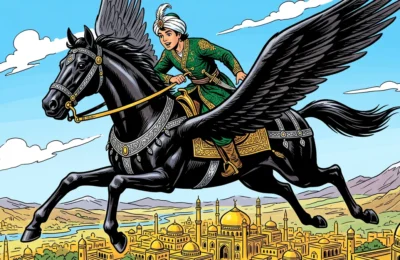
The Enchanted Horse, or Ebony Horse, from the Thousand and One Nights - a Persian prince masters a flying mechanical horse, wins a princess, and outwits the inventor who steals her away.
 Arabian Nights
The Tale of Prince Agib
The Third Kalandar's Tale from the Arabian Nights: Prince Agib survives a ship-eating magnetic mountain, a brazen horseman and a boatman of brass, only to lose an eye to the one forbidden golden door he was begged to leave shut.
 Arabian Nights
Prince Camaralzaman and Princess Badoura
The Arabian Nights romance of Qamar al-Zaman and Budur: a fairy and an ifrit wager over two sleeping royals, kindling a dream-love that survives oceans, a stolen carnelian talisman, and a princess who rules a kingdom disguised as a king.