The Ebony Horse: A Tale of Love and Deception
The Ebony Horse, the canonical Arabian Nights tale of al-Faras al-Abnus (Nights 357-371), retold as a study of love and deception: a Persian prince, the princess of Sanaa, an old Indian sage who lies to steal her, a Kashmiri king who calls coercion love, and a feigned madness that wins her freedom back.
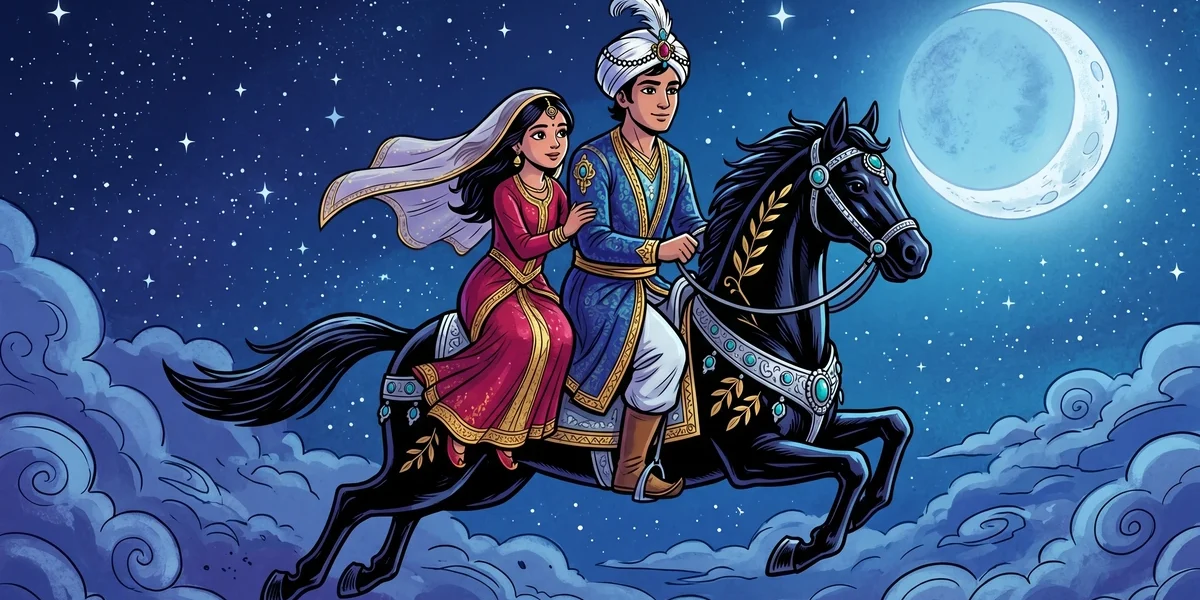
Most of the famous wonders of the Thousand and One Nights – the lamp, the ring, the carpet, the cave that opens at a word – are things a person simply finds and owns. The Ebony Horse is different. The marvel at the centre of this tale is bargained for, and the price set upon it is a living woman. From that first bargain onward the story becomes what its title promises: a tale of love, and a tale of deception, with the two so closely braided that the reader is asked, scene by scene, to tell an honest heart from a false one.
It is, on its bright surface, a romance – a prince who crosses the sky in a single night, a princess asleep in a far palace, a love declared before dawn and carried home through the clouds. But beneath the romance the tale is built almost entirely out of deceptions. A withered sage tries to buy a bride with a machine. That same sage, freed and resentful, lures the princess away with a smooth lie. A foreign king courts her with the threat of force dressed up as devotion. And against all of these the princess and the prince set one last deception of their own – and the tale watches carefully to see which kinds of cunning it is willing to forgive.
Origin & Canonical Attribution
Source & collection: The Ebony Horse belongs to Alf Layla wa-Layla, the Thousand and One Nights. Its Arabic title is al-Faras al-Abnūs, “the horse of ebony.” It is one of the tales Shahrazād tells the king Shahriyār; in the standard Calcutta II (Macnaghten) Arabic recension it runs across roughly Nights 357–371.
Tale type: Folklorists catalogue the story as ATU 575, “The Prince’s Wings,” in the Aarne–Thompson–Uther index – the international type of the artificial flying device, wooden horse, mechanical bird or feathered wings, that carries a hero to a sheltered princess.
Textual history: The tale is found in the great printed Arabic recensions of the Nights – the Būlāq edition (1835), the Calcutta II / Macnaghten edition (1839–42) and the Breslau text edited by Maximilian Habicht – and in the major European translations by Antoine Galland, Edward William Lane, John Payne and Sir Richard Francis Burton. A version of it also belonged to the oral repertoire of Ḥannā Diyāb, the Maronite storyteller of Aleppo who fed Galland several of his most famous tales; Galland’s diary records the telling on 13 May 1709. Older still, an Arabic manuscript of the lost second volume of Tales of the Marvellous and News of the Strange is reported to have carried a “Faras al-abnūs” centuries before Diyāb.
Older roots: The flying-machine motif predates the Nights. An eleventh-century Jain retelling of the Indian Pañcatantra contains “The Weaver as Vishnu,” in which a poor craftsman builds an artificial Garuḍa to reach a princess’s tower. The nineteenth-century mythologist Thomas Keightley argued that the Nights version preserves a genuinely Persian story, since it carries no Islamic religious colouring at all; scholars generally treat Persia and India as the homeland of the type.
Setting & names: The action begins in Persia, at Shīrāz, in the reign of King Sābūr (Shāpūr). His son is named Qamar al-Aqmar, “Moon of Moons.” The maker of the horse is an aged Indian sage. The princess the prince first reaches is, in Burton’s Calcutta II text, the daughter of the King of Ṣanʿāʾ in Yemen; Galland’s French version makes her a Princess of Bengal. The ruler who afterwards seizes her is the King of Kashmir.
A Bride Demanded as a Price
The tale opens on a day of celebration. It was Nowruz, the Persian New Year, and King Sābūr of Persia – a ruler famous through every neighbouring land for his open hand – held festival court at Shīrāz. On such days the ingenious of all nations came to lay their inventions before him, certain of a generous reward. That year three sages approached the throne, and each carried a wonder. The first set down a peacock of beaten gold that spread its wings and cried the hours of the day and night. The second offered a brazen trumpet, to be fixed above the city gate, that sounded of itself the instant an enemy crossed into the town.
The third sage was an Indian, very old, bent and unlovely to look upon, and the marvel he led forward was a horse – a horse carved of the blackest ebony, saddled, bridled, chased with silver and gold, and so faithfully wrought that the eye refused to believe it was not flesh. “This horse,” the old man said, “will bear its rider in one day over a distance no caravan could cross in a year – above mountains, above seas, through the clouds themselves.” The king, delighted, asked each sage to name his price. The first two were paid in gold and honour. But the Indian sage asked for something else. The price of the ebony horse, he said, was the hand of the king’s own daughter in marriage.

Here is the first deception of the tale, and it wears no disguise at all: a man who has nothing to offer a young woman but a clever machine, attempting to purchase her as he might purchase a slave. The king, dazzled by the wonder and careless of his daughter’s heart, was ready to agree. It was the prince, Qamar al-Aqmar, standing beside the throne, who could not bear it. The thought of his sister handed to so withered and graceless a husband filled him with anger, and he begged his father’s leave to test the horse first, that the court might judge whether any price could be too great for it. The king consented gladly. The prince mounted, found a peg set in the right side of the horse’s neck, and turned it – and at once the ebony horse sprang from the ground, climbed the air in a long rushing curve, and carried him up and up until horse and rider had dwindled to nothing and the court below could see them no more. The prince, exhilarated and then frightened, searched the horse over and over for some means of coming down, and found none. He had been given the secret of rising. He had not been given the secret of return.
Carried to the Rooftop of Ṣanʿāʾ
Alone in the cold heights, mastering his fear, the prince ran his hands across every inch of the ebony horse, and at last, on the left side of its neck, his fingers closed on a second, smaller peg. He turned it, gently, and the horse began to sink – slowly, obediently – through the thinning air. By working the two pegs together, easing one and pressing the other, he found that he could govern the horse exactly as a rider governs a living mount: climb, glide, hover, and at last come softly down. The marvel that had nearly killed him was now his to command. But the day was nearly spent and the country beneath him was wholly strange, so he let the horse settle on the broad flat roof of a great white palace, in a city he did not know – the city of Ṣanʿāʾ.

Hungry and weary, the prince found a stairway down from the roof and stepped quietly into the sleeping palace. In a chamber soft with lamplight he came upon a princess asleep among her women, and her beauty held him still in the doorway. She was the daughter of the king of that land. When she woke and found a courteous stranger before her, her first fright gave way to wonder as he told her – plainly and without a single false word – how he had come there through the air upon a horse of wood. They talked the whole night through, and in that one honest night each came to love the other. This is the tale’s test case for true feeling: a love built not on machinery or bargains but on open speech between two people who hide nothing. By morning the palace guards had found the intruder and the king of Ṣanʿāʾ, enraged, ordered him seized; but the prince defended himself so bravely, and bore himself so nobly, that the king’s anger cooled into respect. The prince declared himself openly – a prince of Persia, son of King Sābūr – and asked, as an honest suitor should, for the princess’s hand with her own free consent.
The Sage’s Revenge
The princess consented, and at first light the two of them mounted the ebony horse together. The prince turned the climbing peg, and the horse lifted them above the towers of Ṣanʿāʾ and bore them swiftly homeward across the breadth of the world. By evening the domes of Shīrāz rose before them. Not wishing to bring his bride to court unheralded, like something carried in by night, the prince set the horse down in a royal pleasure-garden outside the city walls. He left the princess to rest among the fountains and the roses and went on alone to carry the joyful news to his father and to prepare a welcome worthy of a future queen.

King Sābūr wept with happiness to see the son he had given up for lost. And in the warmth of that happiness he did a generous thing that proved a grievous error: he ordered the Indian sage – whom he had flung into prison on the day the prince first vanished – to be set free. The sage walked out of his cell with no gratitude in him, only the cold, patient malice of a man who has been nursing a wound. He soon learned that the prince had returned upon the ebony horse, and that a foreign princess waited, unguarded, in the garden beyond the walls. Here comes the tale’s sharpest deception. The sage hurried to the garden, bowed low before the princess, and told her smoothly that the prince himself had sent him to bring her in honour to the palace. She had no reason to doubt a messenger who knew so much, and she let the old man hand her up onto the horse she already trusted. He mounted behind her, turned the peg – and the ebony horse leapt into the darkening sky and carried the stolen princess away, while the prince, coming back in festal procession with his father’s court, found nothing in the garden but trampled roses and empty air.
The Feigned Madness and the False Physician
The sage flew the princess far off to the kingdom of Kashmir, and there his own deception turned upon him. The King of Kashmir, riding out to hunt, came upon the strange pair – an old man and a weeping girl – and read the cruelty of the one and the terror of the other at a glance. He had the sage seized and put to death. Yet the king was no true rescuer. He had fallen in love with the princess on sight, and he resolved to wed her himself the very next day, asking nothing of her wishes. This is the third false love of the tale: desire that calls itself devotion while it tramples consent. The princess stood friendless, far from home, with no machine and no ally. She found her one weapon where the powerless of these tales so often find it – in her own wits. She feigned madness. She raved, she struck at all who came near, she behaved so wildly that no wedding could decently be held. Physician after physician was summoned to cure her, and one after another failed, for there was no sickness in her body for medicine to reach.

Meanwhile the prince, half mad in earnest with grief, had laid aside his royal robes and gone wandering from kingdom to kingdom, asking at every gate and in every market for word of a stolen princess and an old man on a horse of wood. The search brought him at last to Kashmir, where the whole city was speaking of the foreign princess struck mad on the eve of her wedding, and of the marvellous ebony horse the king now kept among his treasures. The prince understood it all in an instant. He presented himself at the palace dressed as a travelled physician, and the moment he was admitted to the princess and they were alone, she knew him, and her madness fell from her like a dropped veil. Together they shaped their plan. The prince told the King of Kashmir that the lady’s affliction had passed into her from the enchanted horse on which she had been carried, and that to draw the sickness out she must be mounted upon the horse once more, in the open, with perfumes burning around her. The eager king had the ebony horse carried out and the princess set upon it, and the perfumes lit. The prince climbed up behind her as though to complete the cure – and turned the peg. The horse rose over the heads of the astonished court and carried the two lovers home to Persia at last. There King Sābūr received the princess as a daughter, and the wedding was kept with forty days of feasting. As for the ebony horse, the story says it was never flown again, lest its power should ever again fall into hands that did not deserve it.
The Moral of The Ebony Horse
For a tale so full of trickery, The Ebony Horse is not, in the end, a story that condemns cunning. It is a story that asks what cunning is for. Look at the deceptions in order. The sage’s bargain and the sage’s lie both serve a single appetite – to possess a woman who has not chosen him. The King of Kashmir’s haste serves the same appetite, merely crowned and made lawful. Every one of those deceptions is aimed at taking a person’s freedom away, and the tale punishes each of them: the sage dies, the king is cheated, the bargain comes to nothing. Set against them is the cunning of the princess and the prince – the feigned madness, the false physician, the false cure. Their deception is aimed at exactly the opposite end: not at seizing a freedom but at restoring one. That is the line the story draws, and it draws it cleanly. A lie that steals a person’s will from them is the worst thing in the tale; a lie that gives a trapped person their will back is the thing the tale most admires.
And love, in this story, is measured by the same rule. The false loves – the sage’s, the Kashmiri king’s – all begin with a decision to take, and they ask the woman nothing. The true love begins with a whole night of honest talk and ends with the words her own free consent. The princess, given no power of any other kind, endures with a patience that is itself a quiet courage, and the Persian poets have a proverb for exactly that endurance:
صبر تلخ است ولیکن بَرِ شیرین دارد
Ṣabr talkh ast, va-līkan bar-e shīrīn dārad
“Patience is bitter – yet it bears sweet fruit.”
The princess swallows the bitterness – the abduction, the friendless court, the long pretence of madness – and the sweet fruit is the moment the ebony horse rises and carries her home with the man she chose freely. The tale’s deepest lesson is that love and freedom are the same thing wearing two names: a love that respects a person’s will is true, and a love that overrides it is only deception with a softer face.
Why the Tale Has Lasted
One reason The Ebony Horse has flown undamaged across more than a thousand years is the sheer reach of its imagination. Centuries before the balloon or the aeroplane, this tale gave the oldest human daydream – the wish to leave the ground – a precise and almost mechanical shape: a saddled horse of black wood, governed by pegs that work like the controls of a craft, one to rise and one to descend. Its first flight, the prince soaring upward with no notion how to come back, is a fear every learner of every machine has known since.
But machinery alone does not keep a story alive for a millennium. The Ebony Horse lasted because it is, underneath the wonder, a clear-eyed study of how people use and misuse one another. It sets four deceptions side by side and quietly invites every listener to sort them – to feel the difference between the sage’s lie and the princess’s, between a king’s coercive desire and a prince’s honest one. That sorting is a moral exercise that never goes out of date, because every generation must learn again to tell devotion from possessiveness, and self-defence from cruelty.
It lasted, too, because it travelled so well. Catalogued as international tale type ATU 575, it has been collected across Persia, India, the Caucasus and the length of Europe, the flying horse becoming by turns a wooden eagle, a mechanical dove, even a flying trunk. Carried into medieval Europe it bred a whole family of romances of the mechanical steed – Adenet le Roi’s Cléomadès, Girart d’Amiens’ Méliacin, the unfinished Squire’s Tale of Chaucer. Each retelling kept the same beating heart: a marvel, a runaway flight, a love found far away, a love stolen by deceit, and a patient, clever recovery. The wonder is what makes an audience lean forward; the people, and the honesty or falseness of their hearts, are what make the audience remember.
Frequently Asked Questions
What is The Ebony Horse about?
The Ebony Horse is a tale from the Thousand and One Nights. An aged Indian sage gives King Sābūr of Persia a flying horse carved of black wood, governed by hidden pegs, and demands a princess as its price. The king’s son, Prince Qamar al-Aqmar, tests the horse, is carried off because he has not learned how to land it, and eventually masters it. He descends on a far palace, meets and comes to love its princess, and brings her home. The freed and resentful sage then deceives the princess and abducts her to Kashmir, where a second king tries to force her into marriage. The prince, disguised as a physician, frees her by a clever ruse, and the two return to Persia to marry.
Why is it called “a tale of love and deception”?
Because the story braids the two together at every turn. The genuine love between the prince and the princess begins with a night of completely honest conversation and is sealed only with her free consent. Against it the tale sets three false loves built on deception: the sage who tries to buy a bride with a machine, the same sage who lures the princess away with a lie, and the King of Kashmir who calls coercion devotion. The story uses the contrast to define what real love is – a feeling that respects the other person’s will rather than overriding it.
What are the deceptions in the story, and how does it judge them?
There are four. The sage’s bargain and the sage’s lie both aim to seize a woman who has not chosen him; the King of Kashmir’s rushed courtship is coercion dressed as love. The tale punishes all three – the sage dies, the king is outwitted, the bargain fails. The fourth deception is the princess’s feigned madness and the prince’s disguise as a physician, and the tale rewards it, because that deception is used not to take someone’s freedom but to give it back. The story’s moral line is drawn precisely there: a lie that steals a person’s will is condemned; a lie that restores it is admired.
How does the princess save herself?
Stranded in Kashmir with no ally and no means of escape, the princess defends herself with her intelligence. She pretends to have lost her reason – raving and striking at anyone who approaches – so that no marriage can decently be performed, and she keeps up the pretence through a procession of baffled physicians. Her feigned madness buys the time the prince needs to find her. When he arrives disguised as a physician, the two stage a false “cure” that requires her to be mounted on the ebony horse, and the prince flies them both to safety. The princess’s patience and quick wit, not the machine, are what truly rescue her.
Where does the tale come from, and how old is it?
It belongs to Alf Layla wa-Layla, the Thousand and One Nights, where in Arabic it is al-Faras al-Abnūs, and it occupies roughly Nights 357–371 of the standard Calcutta II text. It appears in the Būlāq, Calcutta II and Breslau editions and in the translations of Galland, Lane, Payne and Burton; a version belonged to the storyteller Ḥannā Diyāb, who told it to Galland in 1709. The flying-machine motif is older still – an eleventh-century Jain version of the Indian Pañcatantra describes an artificial flying Garuḍa – and the tale is classified internationally as type ATU 575, “The Prince’s Wings.”
You May Also Like
 Arabian Nights
Ages 9-12
Arabian Nights
Ages 9-12
Joha and the Donkey
The famous tale of Joha, his son and their donkey. On the road to market, every passer-by criticises how they use the animal, and Joha keeps changing to please each new critic until he has pleased no one and lost the donkey: the classic story of why you cannot satisfy everyone.
 Arabian Nights
Ages 9-12
Arabian Nights
Ages 9-12
The Fisherman and the Genie
A poor old fisherman draws a sealed copper jar from the sea and frees a furious ifrit who vows to kill him - then must use his wits alone to survive. A classic tale of the Thousand and One Nights, retold with full scholarly attribution.
 Arabian Nights
Ages 9-12
Arabian Nights
Ages 9-12
Sinbad the Sailor – The First Voyage
Sinbad the Sailor - The First Voyage: In the ancient city of Baghdad, where palaces rose like mountains and the markets overflowed with the riches of the known