Sinbad the Sailor: The Second Voyage
The voyage of the Roc and the Valley of Diamonds. Marooned on a deserted island, Sinbad ties himself to a giant bird, survives a ravine of serpents and gem-strewn rock, and rides a slab of meat back to freedom and fortune.
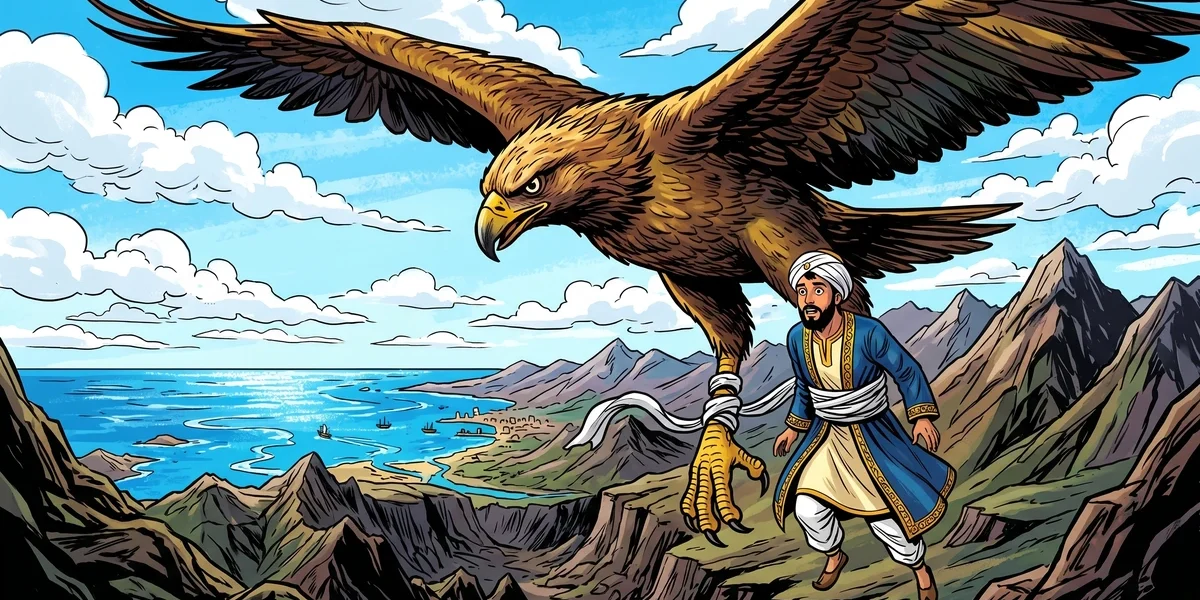
The First Voyage of Sinbad ended the way every prudent reader would wish a sea-story to end: the spendthrift heir came home wealthier than his father, bought houses and land in Baghdad, and settled down among friends. By every reasonable measure the adventure was over. The Second Voyage opens by asking a quieter and more uncomfortable question – why a man with everything he needs would ever go back. The answer the tale gives is honest, and a little unsettling. Sinbad goes back because rest, after a while, begins to feel like rust.
This is the voyage of the Roc and the Valley of Diamonds – two of the most famous images the Arabian Nights ever sent into the world. But it is worth noticing, before the giant bird darkens the sky, that the marvels of the Second Voyage are framed by a very ordinary human failing. Sinbad is not carried off by fate. He is left behind because he wandered away from his companions and fell asleep. The grandeur of what follows – the egg like a white dome, the diamond-strewn ravine, the serpents that can swallow an elephant – all of it begins with one careless afternoon nap.
Origin & Canonical Attribution
Tradition: Arabian Nights / Alf Layla wa-Layla (The Thousand and One Nights) — the Sinbad cycle, second of the Seven Voyages.
Arabic title: Hikayat as-Sindibad al-Bahri (“The Story of Sinbad the Seaman”). The Second Voyage is the second instalment recited by Sinbad the Seaman to his namesake, the poor porter Sinbad the Landsman, across the seven banquet-days of the frame story set in Abbasid Baghdad.
Textual history: The Seven Voyages circulated as a self-contained Arabic work and were a comparatively late attachment to the larger Nights. The cycle appears in the Syrian Galland Manuscript (Bibliothèque nationale de France, MS arabe 3609–3611), the source Antoine Galland used when he published the voyages in his Les Mille et Une Nuits (1704–1717) and introduced Sinbad to Europe.
Arabic printed editions: Bulaq (Cairo, 1835); Calcutta II / Macnaghten (1839–1842); also Calcutta I and the Breslau text.
Major translations: Antoine Galland (French, 1704–1717); Edward William Lane (English, 1839–1841); John Payne (1882–1884); Richard Francis Burton, “Sindbad the Seaman and Sindbad the Landsman” (1885–1888).
Tale motifs: The Valley of Diamonds and its meat-and-eagles harvest is one of the oldest travelling legends in the tale. It was recorded as early as the 4th century by the bishop Epiphanius of Salamis, retold by the 13th-century Persian cosmographer Zakariya al-Qazwini, noted by Marco Polo, and echoed in Tang- and Song-era Chinese accounts. The Roc (Arabic rukh) is the giant bird of Indian Ocean sailors’ lore, mentioned by the traveller Ibn Battuta and reported to feed elephants to its young.
Historical background: The diamonds of the legend are usually traced to the mines of Golconda in the Deccan, the world’s principal source of diamonds before the 18th century, and the voyages as a whole distil the real maritime trade of the early Abbasid period (8th–10th centuries) between Basra, India and the farther East.
Public-domain status: The Thousand and One Nights and all the translations cited above are firmly in the public domain. The retelling below is an original composition.
The Sea Calls a Second Time
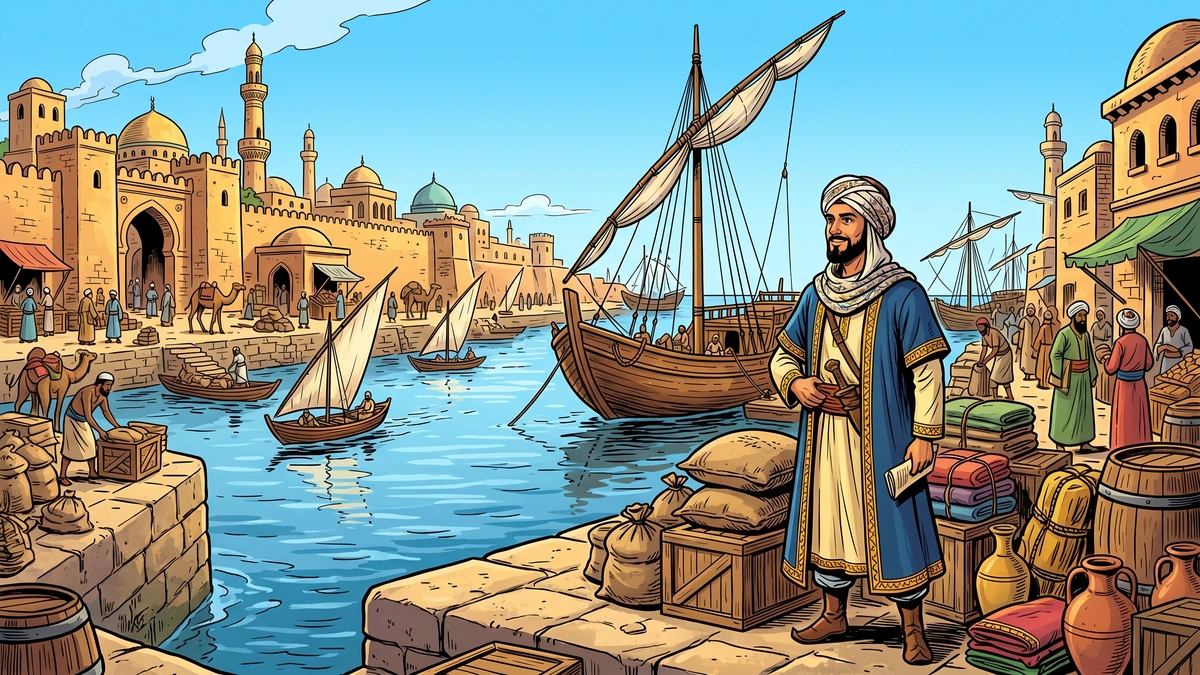
For a while the homecoming was enough. Sinbad lived in Baghdad in the comfortable, generous way he had always loved, surrounded by good company and good food, the terror of the living island fading into a story he told well at table. He had sworn, on the beach of King Mihrjan’s island, that he would never trust the sea again. He meant it. Most men would have kept the promise without effort, for the promise asked nothing of them but to stay where they already were.
Yet the very ease that had once ruined him began, slowly, to weigh on him. He found himself listening too closely when a returned traveller spoke of far ports. He found the ordered days of a settled merchant strangely flat. The longing he felt was not for money – he had money – and it was not quite for adventure either. It was something harder to name: a restlessness, a sense that a life entirely without risk had stopped feeling like a life. Sinbad himself, telling the tale years afterward, does not excuse it. He simply admits that the wish to see foreign countries, to trade in distant islands and walk unfamiliar shores, rose in him until he could not put it down.
So he did again what he had done the first time, but now with a full purse and a clear head. He bought a fine stock of trade goods, finer and better chosen than before, and carried them down the river road to Basra. There he found a new ship, large and newly fitted, with a sound captain and a company of merchants whose talk he liked. He went aboard, and the ship dropped down the Gulf and out into the open sea. For many days the voyage was a merchant’s quiet dream: fair winds, calm water, island after island where the company went ashore to buy and sell. Sinbad traded shrewdly, as a man does who has been poor and remembers it. He was, in every visible way, a wiser sailor than the idler who had sailed the first time. What he had not yet learned was that wisdom in trade is not the same thing as wisdom on land.
Marooned, and the Great White Dome
One day the ship anchored off an island of extraordinary beauty – uninhabited, but green and bright, with clear streams running down through groves of fruit trees and flowers open to the sun. The whole company went ashore to rest and refresh themselves. Some walked, some ate, some sat by the running water. Sinbad took food and a little wine and found a pleasant, shaded spot a short way off from the others, and there, lulled by the stream and the soft air, he fell asleep.
He woke to silence. The pleasant voices of his companions were gone. The sun had moved. He got up and hurried to the shore – and saw, far out on the bright water, the white sails of his ship already small with distance. The captain had given the order to weigh anchor; the company had counted heads carelessly or not at all; and one sleeping passenger, tucked out of sight in his shaded hollow, had simply been forgotten. Sinbad stood on the empty beach and watched the ship shrink to a fleck and vanish, carrying his goods, his money and every other human being out of his world.
The despair that took him was, he admitted afterward, complete. He reproached himself bitterly – for he had done this to himself, had sworn off the sea and broken the oath, had wandered from safety and slept. There was, he said, no profit in regret, and yet for a time he could feel nothing else. When at last he made himself move, he climbed the tallest tree he could find and looked out in every direction, hoping for a roof, a boat, a sail, any sign of another living soul. He saw none. But far off, across the island, he saw something else – a vast white shape, smooth and rounded, rising from the ground like the dome of some enormous building.
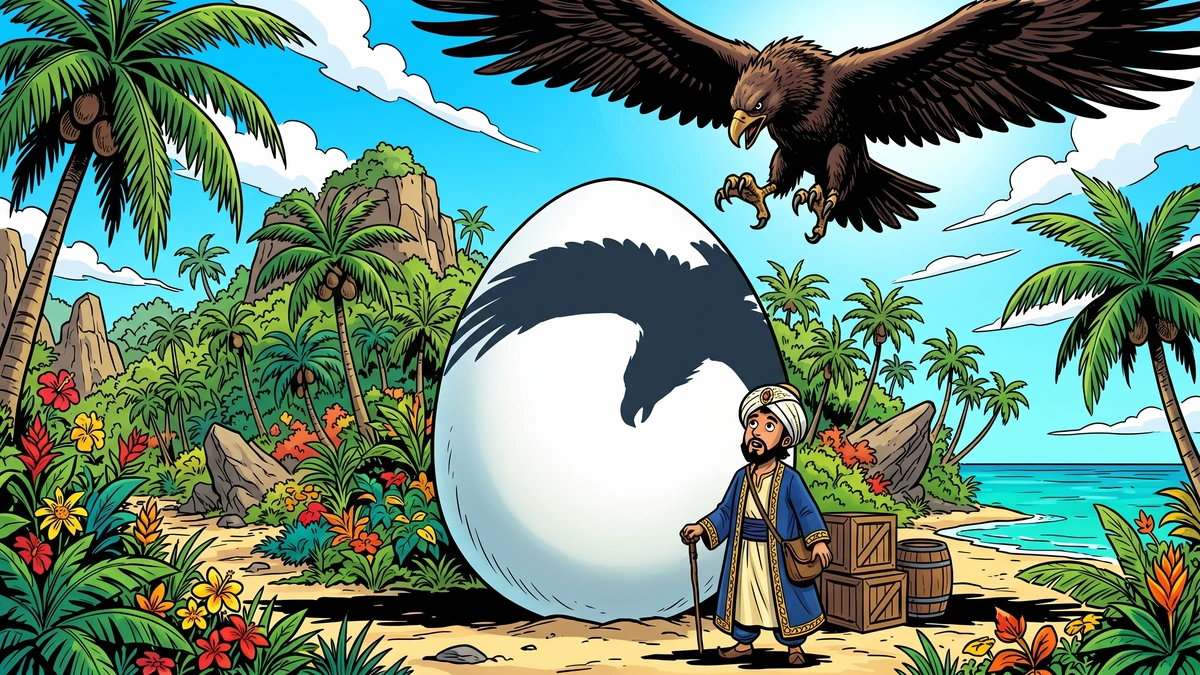
He came down and walked toward it, and when he stood at its foot the thing only grew stranger. It was perfectly smooth, immensely tall, without door or window or any mark of tools. He paced its circumference and found it measured some fifty full paces around. It was, he slowly understood, no building at all. It was an egg. And as the truth of that settled on him, he remembered the talk of seasoned travellers in Baghdad – their stories of the Roc, the bird so vast that it fed its young on elephants caught up whole in its talons. This white dome was a Roc’s egg, which meant the Roc itself was near, and Sinbad was a small soft creature standing in its nest.
Even as he thought it, the daylight failed. He looked up and saw the sky itself blotted out by a pair of wings, and the Roc came down upon its egg to brood it through the night, settling its huge body without ever noticing the man frozen at the egg’s base. Sinbad, pressed close against the shell, did the boldest and most calculated thing of his life. He unwound the long turban-cloth from his head, twisted it into a stout rope, and bound himself tightly by the middle to one of the Roc’s great legs, which stood beside him like the trunk of a tree. “In the morning,” he reasoned, “the bird will rise and fly, and carry me off this prison of an island to some place – any place – where there are people.” Then he held still, and waited out the longest night of his life lashed to the ankle of a sleeping monster.
The Valley of Diamonds and the Serpents
At first light the Roc woke, gave a cry that shook the air, and rose from its nest with a thunder of wings – and Sinbad rose with it, bound to its leg, climbing through the cold morning sky until the island and then the sea itself dwindled to nothing below him. The bird flew high and far. Then it began to descend, sinking toward the earth in long sweeps, and at last it came to rest on high ground. Sinbad, with quick and shaking fingers, untied the turban-cloth before the Roc could feel his weight, and pulled himself free, and crouched out of sight. Almost at once the Roc struck down with its beak, seized something enormous from the ground – a serpent of monstrous length, writhing in its grip – and climbed away into the sky with its prey. Sinbad was alone again, and when he looked about him he saw that his rescue had carried him into a trap far worse than the island.
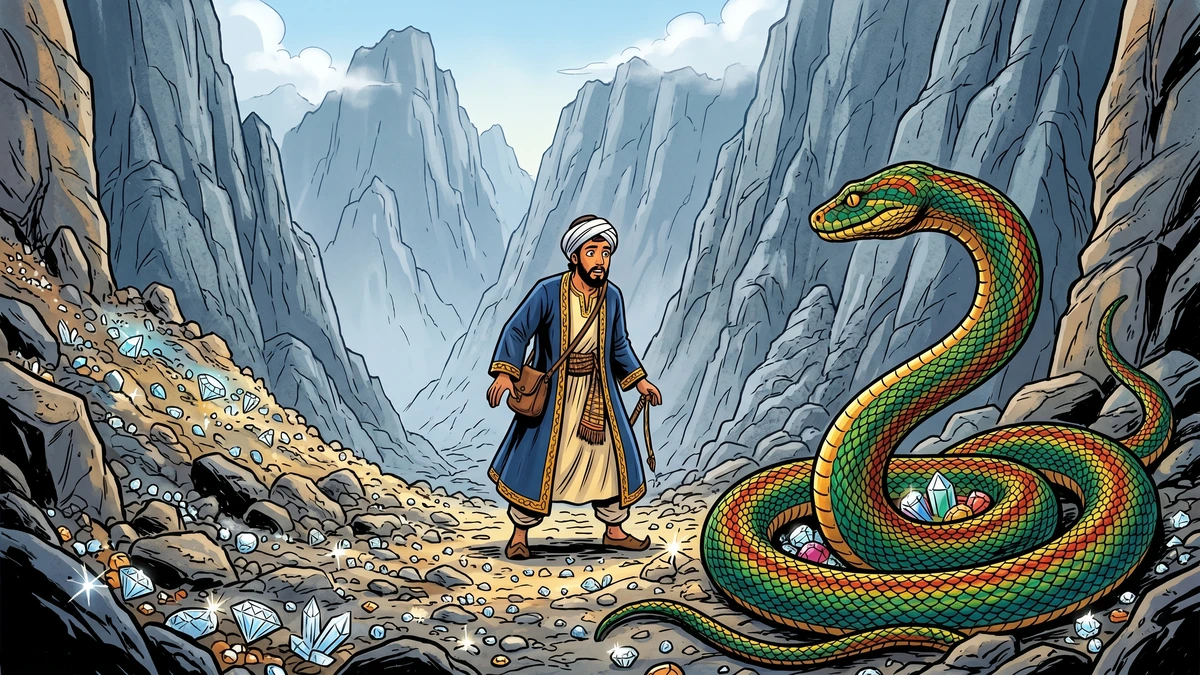
He stood at the bottom of a deep valley, a long ravine walled on every side by mountains so high and so sheer that their tops were lost in haze. There was no path up them; he walked the valley floor and found no break, no slope a man could climb, no way out at all. And the valley floor itself was a wonder and a horror together. It was strewn, everywhere he looked, with diamonds – loose stones of astonishing size, more wealth scattered carelessly on the ground than all the treasuries of Baghdad could hold. And it was the home of the serpents. They were vast, thick as palm trunks, long enough – the tale says – to swallow an elephant whole; and they hid by day in clefts and caves, for the Roc and the great birds hunted them, and came abroad only by night.
When dusk came Sinbad understood the full shape of his danger. He needed a refuge the serpents could not enter, and he found a narrow cave, and crept into it, and rolled a stone across the mouth as far as his strength would push it. He had barely done so when, in the dimness, he saw that the cave was not empty: a great serpent lay coiled there, brooding over her eggs. Sinbad spent that whole night pressed against the wall in terror, the stone at the entrance and the serpent within, and did not close his eyes until the sky greyed and the creature, with the dawn, withdrew. He came out into the valley sick with sleeplessness and fear, walking among a king’s ransom in diamonds, and so certain that he would die there that the stones at his feet meant nothing to him at all. He had begun, he confessed afterward, to long for a clean death rather than another night in that place.
And then, while he stood despairing, a great slab of fresh meat came tumbling down the mountainside and struck the valley floor not far from him. A second followed, and a third, falling from the unclimbable heights above. Sinbad stared at them – and memory, which had served him so well on the living island, served him again. He had heard this. In Baghdad, among the tales of far countries, he had heard of the valley where no man can descend and no man who descends can climb out, and of the cunning way its diamonds are gathered. He was standing inside that very story, and he suddenly knew exactly what to do.
The Merchants’ Meat and the Road Home
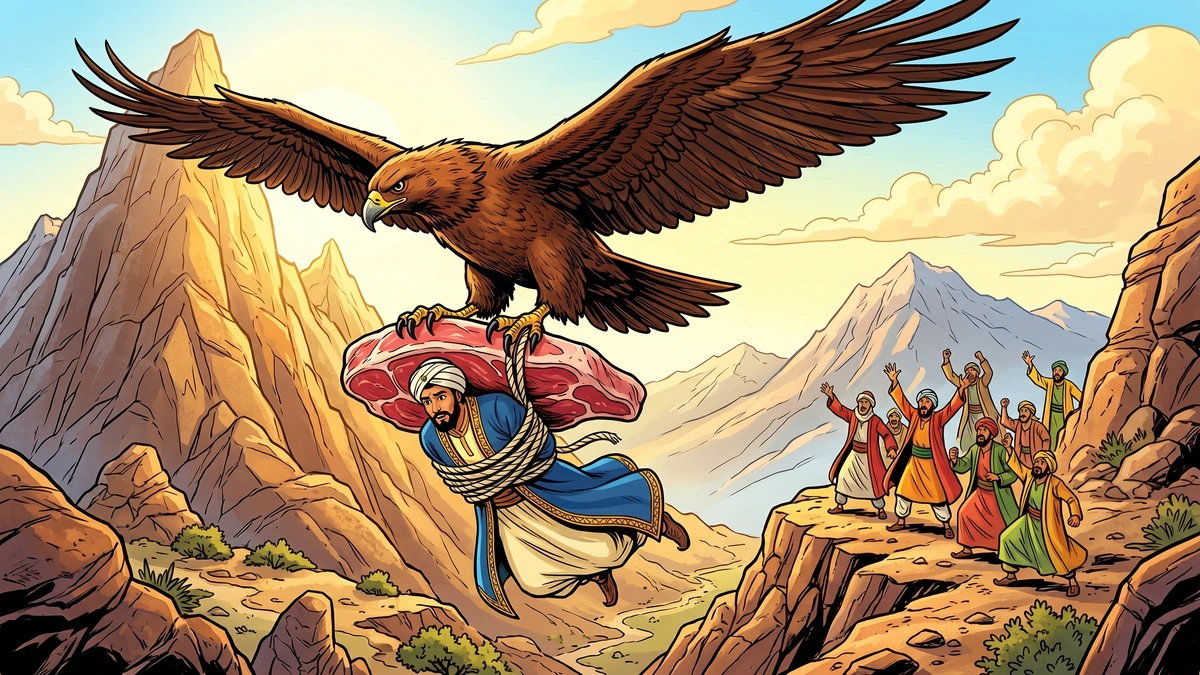
The method was an old one, and ingenious. Far above, on the rim of the mountains, stood merchants who could see the diamonds glittering in the valley but could no more reach them than Sinbad could reach the merchants. So they cut large joints of meat and flung them down into the ravine. The meat struck the diamond-littered floor hard, and the loose stones, sharp and faceted, drove into it and stuck fast. Then the great birds of the heights – eagles and their kind, that nested on the peaks – swooped into the valley, seized the meat in their talons, and carried it up to their nests on the mountaintops. And there the watching merchants rushed at the birds, shouting and beating to frighten them off the meat, and picked the diamonds out of the joints the birds abandoned. It was the only way the wealth of that valley ever left it.
Sinbad set to work with the cold, careful speed that had saved him before. He gathered the largest and finest diamonds he could carry, filling the leather bag at his belt and the folds of his clothing until he was heavy with them. He chose the biggest piece of fallen meat. He took the unwound turban-cloth that had bound him to the Roc, and with it he bound himself, back downward, firmly beneath the slab of meat, so that he lay hidden under it like a man under a roof. Then he waited. Before long an eagle larger than the rest stooped on his joint of meat, closed its talons on it, and bore meat and hidden man together up the dizzy face of the mountain to its nest on the heights.
The merchant whose meat it was came running and shouting to drive the bird away – and recoiled in plain astonishment when, instead of diamonds, he found a man unknotting himself from beneath the joint. He thought at first that Sinbad was a demon of the valley. But Sinbad spoke to him gently, told him in plain words the whole strange road that had brought him there, from the forgotten nap on the beautiful island to the Roc and the night in the serpent’s cave – and then, before the merchant could grieve over a joint of meat that had carried up no stones, Sinbad opened his bag and gave him a generous handful of the finest diamonds in it, freely, as the price of a rescue the merchant had performed without ever meaning to. The merchant’s dismay turned to delight; he blessed his new companion; and the other merchants gathered round, marvelling that any living man had come up out of the Valley of Diamonds.
Sinbad travelled on now in good company and growing comfort. He saw, on the homeward road, the great Island of Camphor, where the camphor trees grew so vast that whole companies could shelter beneath one, and the sap was drawn off to harden into the precious gum. There he saw the karkadann, the mighty horned beast that could lift an elephant upon its single horn and carry it; and the Roc, the tale says, would stoop even on the karkadann and bear it off to feed its young. Marvel by marvel, port by port, Sinbad traded his diamonds and the goods he gathered, until his wealth was past counting. At last a ship brought him again to Basra, and from Basra he went up to Baghdad, to his own house, richer by far than he had left it. He gave generously to his family and to the poor, and he rested – and put the sea, once more, firmly out of his mind.
The Moral of the Second Voyage
The Second Voyage is, on its surface, a story about being trapped, and about the wit that finds the single narrow way out. But its deeper subject is the gap between fear and despair. Twice in this voyage Sinbad is certain he will die – on the forgotten island and again on the floor of the diamond valley – and twice the certainty is wrong. What carries him through is not that he is braver than other men. It is that he keeps observing when observation seems pointless: he paces the white dome until he understands what it is; he remembers, in the valley, a half-heard tale told years ago at a Baghdad table. The Arabic tradition has a proverb that names this exactly:
“الصبر مفتاح الفرج” — as-sabr miftah al-faraj — “Patience is the key to relief.”
Yet the tale is honest enough not to make Sinbad a flawless hero. He is in the valley at all because he broke a solemn oath against the sea and then wandered off and slept – the marooning is his own doing, and he says so plainly. The Second Voyage holds two truths together without flinching. A man may bring his troubles on himself through restlessness and carelessness; and that same man may still deserve rescue, if in the depth of the trouble he keeps his head, watches, remembers, and acts. And there is a third, quieter note at the end. When the eagle sets him down, Sinbad does not hoard. He gives the bewildered merchant a fistful of diamonds at once, freely, naming the man his rescuer though the rescue was an accident. Fortune clutched too tightly, the voyage suggests, is barely worth the having; fortune shared is the only kind that brings a man home easy in his mind.
Why the Tale Has Lasted
Few episodes in world storytelling have proved as durable as the Second Voyage. The Roc flew straight out of the Nights into the common imagination of the planet – into ships’ lore, into European romance, into the modern word “roc” itself. The Valley of Diamonds is older still: the bishop Epiphanius described its meat-and-eagles harvest in the 4th century, the Persian cosmographer al-Qazwini retold it, Marco Polo carried a version of it home, and Chinese chroniclers wrote it down – a single travelling legend that the Second Voyage gathered up and gave its most famous form.
But the reason the tale survives is not only its monsters. It is the precision of its predicament. A locked valley you cannot climb out of; a treasure you cannot use; a rescue you must trust to a wild bird and a stranger’s joint of meat – it is, underneath the marvels, one of the cleanest “impossible escape” puzzles ever told, and its solution is satisfying because Sinbad earns it by paying attention. A child reads the Second Voyage for the giant egg and the diamond floor and the serpents that swallow elephants. An older reader recognises something sterner and more useful: a portrait of a clever, fallible man in the worst place of his life, refusing both to lie to himself and to give up – and finding, in a half-remembered story, the key that fits the lock.
Frequently Asked Questions
How does Sinbad escape from the deserted island in the Second Voyage?
After his ship sails without him, Sinbad discovers a Roc’s egg the size of a great white dome. When the Roc comes down to brood at night, he unwinds his turban, twists it into a rope, and binds himself to the giant bird’s leg. At dawn the Roc flies off and carries him away from the island – though it sets him down not in safety but in the Valley of Diamonds.
What is the Roc in Sinbad’s voyages?
The Roc (Arabic rukh) is a colossal bird from the lore of Indian Ocean sailors, said to be powerful enough to carry off elephants to feed its young. It appears in real travel writing too – the 14th-century traveller Ibn Battuta reported a Roc sighting – and through the Arabian Nights it became one of the most famous mythical birds in the world.
How are the diamonds gathered from the Valley of Diamonds?
Merchants standing on the unclimbable mountain rim throw down large joints of meat. The meat strikes the valley floor and loose diamonds stick to it. Great birds then carry the meat up to their mountaintop nests, where the merchants frighten the birds away and collect the stones. Sinbad escapes by tying himself beneath a piece of meat and being carried up the same way.
How old is the legend of the Valley of Diamonds?
It is far older than the Arabian Nights. The meat-and-eagles method of gathering diamonds was described in the 4th century by the bishop Epiphanius of Salamis, retold by the 13th-century Persian cosmographer al-Qazwini, noted by Marco Polo, and recorded in Tang- and Song-era Chinese accounts. The diamonds themselves are usually associated with the famous mines of Golconda in India.
What is the moral of Sinbad’s Second Voyage?
Sinbad is marooned through his own restlessness and carelessness, yet he survives because he keeps observing and remembering instead of surrendering to despair, and because he recalls a tale that shows him the way out. The voyage teaches patience and presence of mind in disaster – captured in the Arabic proverb as-sabr miftah al-faraj, “patience is the key to relief” – and closes on generosity, as Sinbad freely shares his diamonds with the merchant whose meat carried him to safety.
You May Also Like
 Arabian Nights
Ages 9-12
Arabian Nights
Ages 9-12
The Tale of the Merchant and the Genie
The first tale Shahrazad ever tells: a merchant condemned to die for an accidental killing is ransomed from a demon's wrath by three strangers who pay with nothing but wondrous stories.
 Arabian Nights
Ages 9-12
Arabian Nights
Ages 9-12
The Barber’s Tale of His Sixth Brother
Shakashik the starving beggar of Baghdad accepts an imaginary feast from a Barmecide nobleman, plays through the cruel charade with patience, and wins both real food and a place in the great house - the Arabian Nights tale that gave English the word 'Barmecide.'
 Arabian Nights
Ages 9-12
Arabian Nights
Ages 9-12
Nasreddin Hodja and the Smell of Soup
Nasreddin Hodja and the Smell of Soup: In the bustling streets of Aksehir, a small town in Anatolia, there lived a man of great wit and humble wisdom named