The Barber’s Story of His Fifth Brother
The barber's fifth brother, Al-Nashshar, invested his whole inheritance in glassware and, lost in a daydream of the fortune it would bring, kicked over the tray and shattered everything - the Arabian Nights tale that gave English the word 'Alnaschar'.
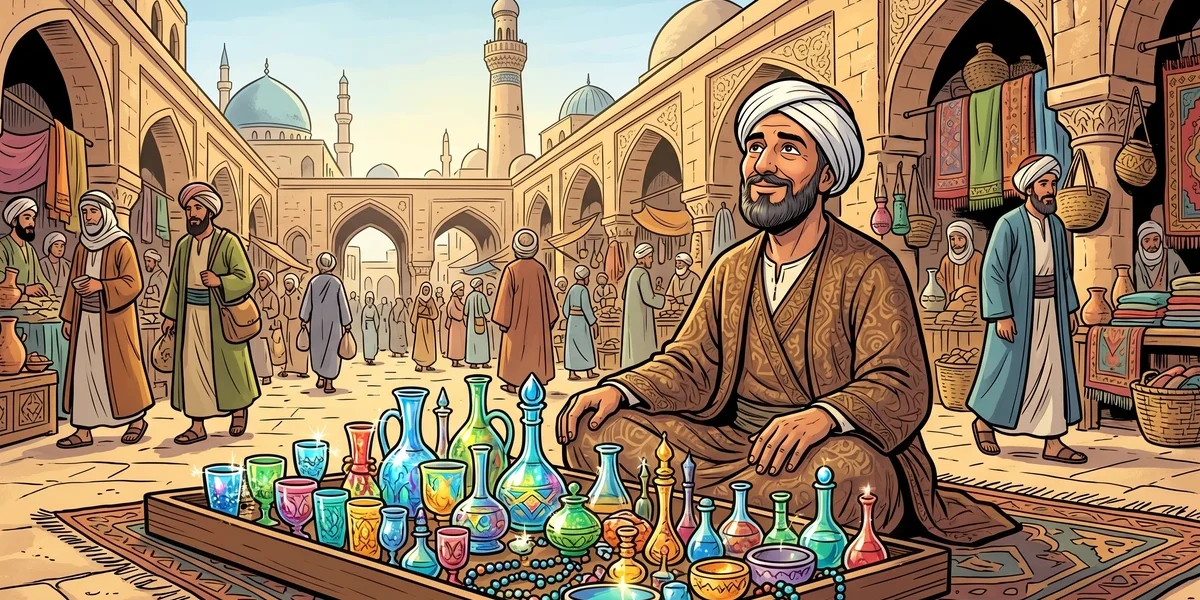
Of the seven brothers the talkative barber claims to have buried, the fifth is the one whose name slipped out of the Thousand and One Nights and into everyday speech. In English a man who counts a fortune he has not yet earned, who furnishes a mansion he will never own and quarrels with a wife he has not met, is still occasionally called an Alnaschar — after Al-Nashshar, the barber’s fifth brother, the cropped-eared dreamer who smashed his whole livelihood with a single triumphant kick.
This is the tale the barber tells of him: a small, exact, almost cruel little comedy about the distance between what we plan in our heads and what our hands actually hold. It is one of the most quietly famous stories in the whole collection, and it has cousins in nearly every storytelling tradition on earth.
Origin & Canonical Attribution
Collection: Alf Layla wa-Layla (“The Thousand and One Nights” / “The Arabian Nights’ Entertainments”).
Position in the cycle: One of the seven “Tales of the Barber’s Brothers” embedded inside The Hunchback’s Tale, the long frame-cycle Shahrazad narrates across roughly the twenty-fifth to thirty-fourth nights. The barber — ironically nicknamed al-Samit, “the Silent” — recounts the misfortunes of all six of his brothers; this is the fifth, Al-Nashshar (Alnaschar, Alnaschár).
Arabic textual sources: The Bulaq edition (Cairo, 1835) and the Calcutta II / Macnaghten edition (1839–1842) are the standard Arabic texts; the cycle also appears in Calcutta I and the Breslau text.
Major translations: Antoine Galland’s French Les Mille et Une Nuits (1704–1717), which first carried the brother into Europe as “Alnaschar”; Edward William Lane (1839–1841); John Payne (1882–1884); and Richard Francis Burton’s The Book of the Thousand Nights and a Night (1885), which gives the name as Al-Nashshar.
Deeper root: The Nights grew from a lost Persian story-book, the Hazar Afsana (“A Thousand Tales”), itself fed by Indian narrative material.
Tale type: Aarne–Thompson–Uther ATU 1430, “Air Castles” (also “The Man and Wife Build Air-Castles”); Thompson motif J2060, “Absurd plans — air-castles”. Al-Nashshar’s reverie is the single most quoted example of the type.
Public-domain status: The Nights and all the translations named above are long out of copyright. The retelling below is an original scholarly paraphrase.
The Inheritance and the Tray of Glass
When the brothers’ father died — so the barber begins — he left seven hundred silver dirhams to be shared equally among his seven sons. Each man took his hundred dirhams and went his own way. Al-Nashshar, the fifth, sat a long while with the little stack of coins in his lap and decided he would not fritter it away on bread and rent. He would trade.
He spent the whole hundred on glassware: cups, flasks, bottles, beads and lamps, a glittering, fragile cargo that caught the light. He arranged it all upon a wide shallow tray, carried the tray to a busy quarter of the market, and set it down on a low bench in front of him with his back against a wall. There he sat, a modest vendor with a modest stock, waiting for buyers.
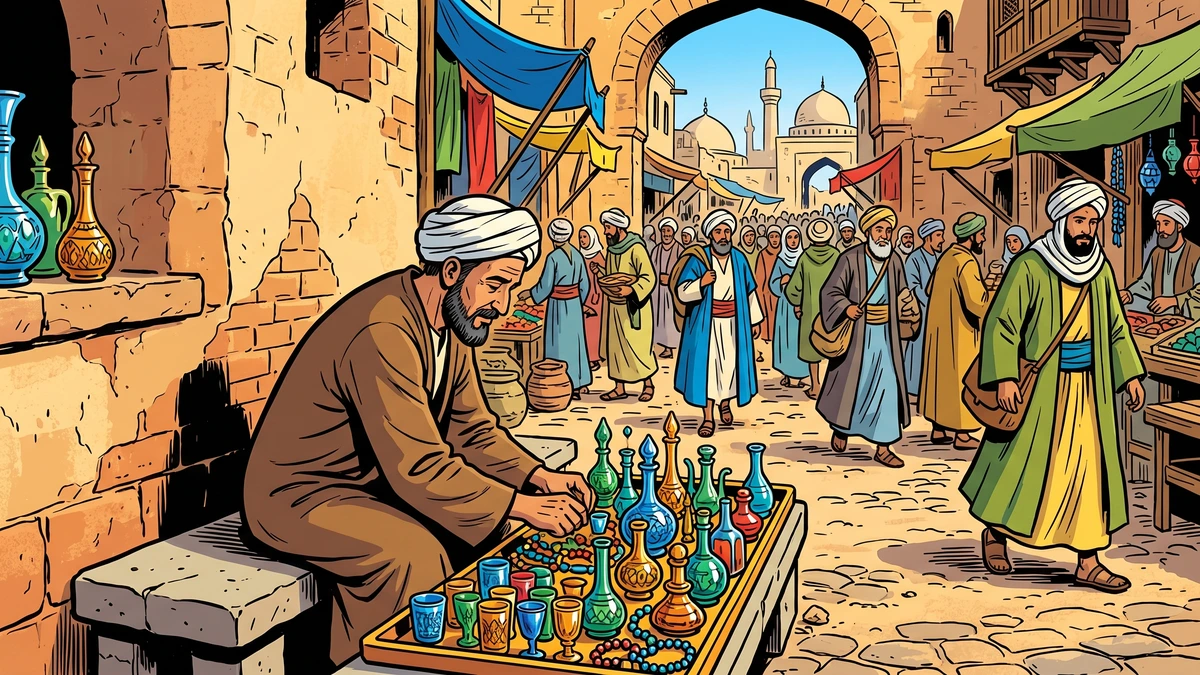
And while he waited, with nothing to do but watch the glass throw coloured light onto the dust, Al-Nashshar began to think. He was not a lazy man, exactly; he was something more dangerous — a man with a single coin’s worth of capital and an unbounded imagination. The arithmetic started gently. A hundred dirhams of glass, sold with care, might fetch two hundred. That was the seed. From that seed the whole forest grew.
The Castle in the Air
Sitting cross-legged behind his tray, Al-Nashshar built his fortune in his head, and he built it fast.
With two hundred dirhams, he reasoned, he would buy more glass and more goods besides, and sell those for four hundred. He would keep doubling and doubling until he had a great heap of money. Then he would deal in jewels and perfumes and precious essences, and his profit would swell into the thousands. He would buy a fine house, slaves, horses, and a kitchen full of cooks. He would become, in his mind’s eye, one of the richest merchants in the city.
Nor did his ambition stop at money. Once he was wealthy enough, he decided, he would send a formal request to the Grand Vizier himself and ask for the hand of the Vizier’s own daughter, having heard that she was extraordinarily beautiful. He pictured the wedding: the gifts he would send, the feast, the musicians, the envious crowd. He pictured the bride brought to him in her finery on the wedding night.
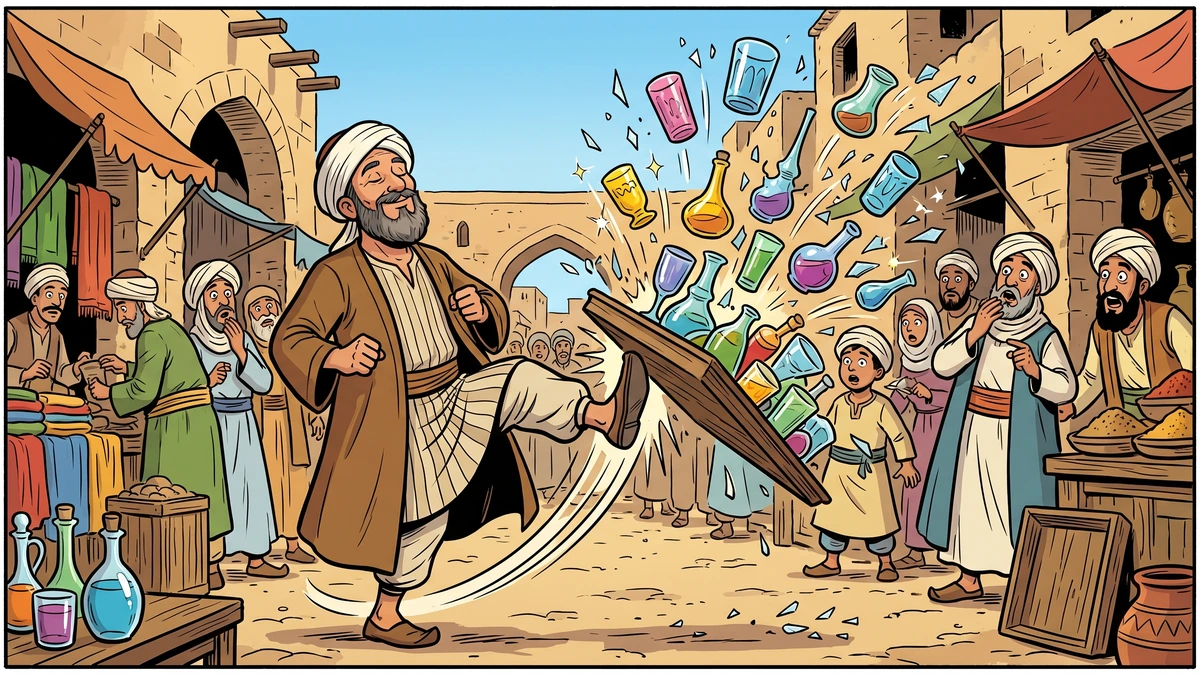
And here the daydream curdled, as such daydreams do, into vanity. When the Vizier’s daughter was led before him, Al-Nashshar imagined, he would not be eager. He would be magnificent. He would lounge in dignity and refuse so much as to glance at her, so that she and her mother and her great father would all understand exactly how proud and important a man she had married. The women would plead with him to look up. He would keep his eyes lowered a while longer. And if the bride dared to come close and coax him — if she presumed — he would draw back his foot and give her a contemptuous kick, like this.
Lost entirely inside the picture, Al-Nashshar kicked.
His foot, real and heavy and in the real market, struck the tray. The tray tipped from the bench. Every cup, every flask, every bead and bottle and lamp slid off and burst on the stones, and the whole hundred dirhams — the seed, the forest, the merchant’s house, the slaves, the Vizier’s daughter, the wedding feast — lay in front of him in a spray of bright, useless splinters.
The Pious Old Woman and the House of Salt
Al-Nashshar sat in the wreckage and wept, and passers-by stopped to pity or to mock him. While he grieved, an old woman came along the street — respectable in appearance, soft in speech, with the manner of someone on her way home from prayer. She looked at the broken glass and the broken man and asked, kindly, what had happened.
He told her. The old woman clucked her sympathy and then leaned closer with what sounded like a remedy. She knew, she said, a great lady — rich, generous, fond of helping the unfortunate. If Al-Nashshar would come with her, this lady would surely make good his loss and more. Hope, which had cost him everything once already that day, rose in him again at once. He got up and followed her.
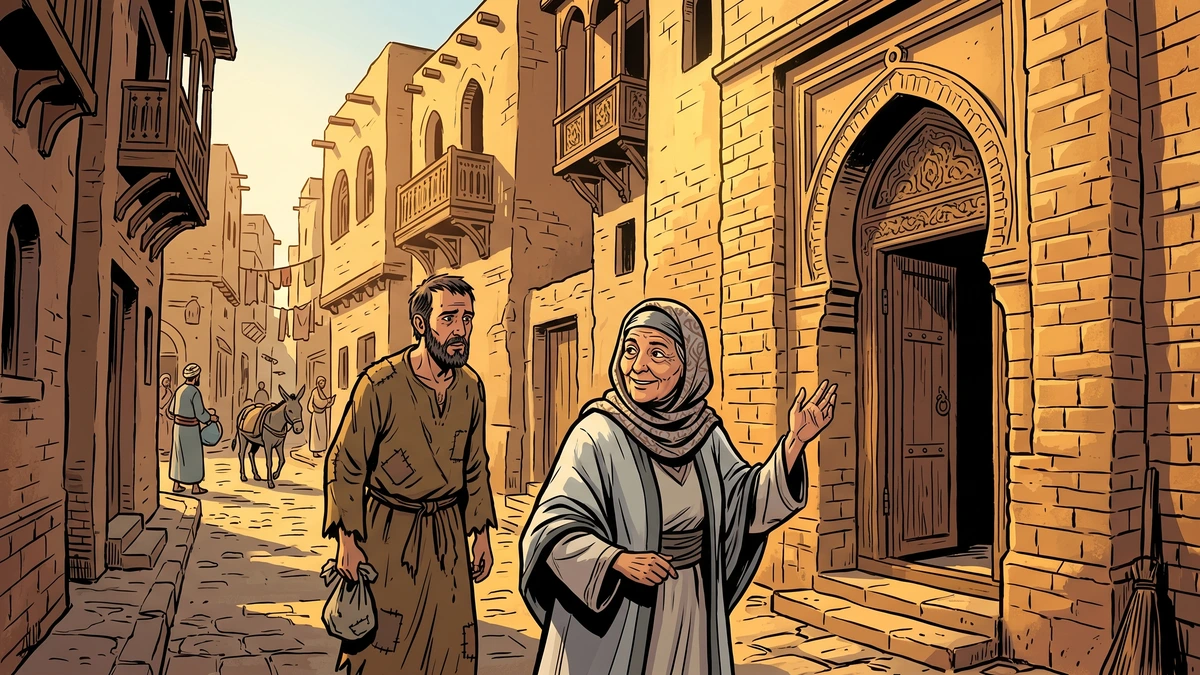
The old woman led him through street after street to a tall and handsome house and brought him inside. But the house was not what its doorway promised. Once the gate had shut behind him, Al-Nashshar was set upon by the household’s slaves, who beat him without mercy, stripped him of what little he had, and — lest the lesson be too gentle — rubbed salt into his cuts so the pain would not let him faint. They flung him down into a dark cellar, and in the dark he understood that the soft old woman was a lure, the generous lady a fiction, and the fine house a trap that fed on trusting, desperate men. By a single unguarded door he managed, at last, to drag himself out and away.
The Reckoning and the Long Road Home
A wiser man might have crept home and stayed there. Al-Nashshar did not. Once his wounds had closed he came back, in disguise this time, watching the streets until he found the same pious old woman pacing them for her next victim. He let her believe he was a stranger with money to lose, and he let her lead him once more to the house of salt.
This time he was ready, and this time the tale turns hard: when the trap closed, Al-Nashshar fought, and in the fighting the slaves who had tortured him and the old woman who had baited the hook were killed, and the mistress of the house fled into the night, abandoning the place and the gold heaped inside it.

So Al-Nashshar at last had money in his hands — not glass, not a daydream, but real coin. It did him no good at all. Carrying the gold away through the dark, he was caught by a band of robbers, who took every coin from him as easily as the slaves had taken his shirt. When he raised an outcry the city watch arrived; but instead of rescuing him they arrested him, and the governor, unwilling to untangle so strange a story, simply ordered him banished from the city. On the road out, fresh thieves stripped him again, and to mark him for the failure he had become they cut off both his ears. He came limping back to the gates of the city he had been thrown out of, a beggar now in earnest, his ears cropped, asking alms by night and living on them by day — which, says the barber, is exactly how you find him still.
The Moral: The Kick That Breaks the Tray
The fifth brother’s tale is short and its point is sharp. Al-Nashshar is not ruined by laziness, nor by bad luck in trade, nor even, at first, by the cruelty of others. He is ruined by the kick — and the kick belongs entirely to a future that did not exist. He performed, with a real foot in a real market, an act of contempt toward an imaginary wife at an imaginary wedding paid for by imaginary profits. The fantasy did not merely distract him from his livelihood. It reached out and destroyed it.
That is the precise warning the storytellers built into the type: it is not dreaming that breaks the glass, but acting out the dream while the small real thing it depends on is still in your hands. Plans are free; the tray is not. The brothers’ later misfortunes — the false old woman, the house of salt, the robbers, the cropped ears — only carry forward the same lesson. Each time, it is hope racing ahead of evidence that walks Al-Nashshar into the next disaster.
مَنْ تَعَجَّلَ شَيْئًا قَبْلَ أَوَانِهِ عُوقِبَ بِحِرْمَانِهِ
“Whoever rushes toward a thing before its proper time is punished by being denied it.” — classical Arabic proverb
The proverb names Al-Nashshar’s exact crime. He tried to spend the wedding before he had earned the glass.
Why the Tale Has Lasted
The barber’s fifth brother has outlived almost everyone else in the Hunchback cycle because his mistake is the most ordinary mistake there is. Few of us will ever be lured into a house of salt; all of us have, at some point, sat behind a small real thing and quietly spent a fortune that had not arrived.
This is why the story belongs to a vast family. Folklorists file it as tale type ATU 1430, “Air Castles”, and the relatives are everywhere. One of the oldest sits in the Indian Panchatantra: a Brahman dozes beside a pot of barter-meal, dreams his way from that pot to herds, a house, a wife and a son, and kicks the pot to pieces disciplining the imaginary child. Aesop’s milkmaid does the same with a pail of milk on her head, tossing her chin at suitors she has invented until the pail comes down. Jean de La Fontaine retold her in French as La Laitière et le pot au lait. The cores of Sanskrit, Greek, Arabic and French versions are so alike that the daydream-and-kick has become a kind of universal proverb about human nature.
And of them all, it is the Arabian Nights’ version that gave the English language a word. To “dream Alnaschar’s dream,” or simply to be called an Alnaschar, has meant for three centuries to build a confident castle on a foundation you have not yet laid — a small, kind, exact piece of mockery, aimed not at fools but at the hopeful, which is to say at everyone. The fifth brother smashed one tray of glass in a Baghdad market more than a thousand years ago, and we are still, very gently, being told not to kick.
Frequently Asked Questions
Who was the barber’s fifth brother?
He was Al-Nashshar (also spelled Alnaschar or Alnaschár), the fifth of the seven brothers whose misfortunes the talkative barber describes in the Thousand and One Nights. He inherited one hundred dirhams, invested the whole sum in glassware to sell in the market, and lost everything in a single careless instant. He ends the tale as a cropped-eared beggar.
What is the famous “castle in the air” scene?
While sitting behind his tray of glass waiting for buyers, Al-Nashshar daydreams an entire fortune: doubling his money over and over, becoming a great merchant, marrying the Vizier’s daughter. In the daydream he imagines proudly kicking his new bride to show his importance — and, acting the kick out for real, he strikes the tray and shatters all his glass, destroying his actual capital because of an imaginary future.
Where does this story come from?
It is part of Alf Layla wa-Layla, the Arabic Thousand and One Nights, embedded within The Hunchback’s Tale as one of the seven Tales of the Barber’s Brothers. The standard Arabic texts are the Bulaq (1835) and Calcutta II (1839–1842) editions; it reached Europe through Antoine Galland’s French translation and was later rendered by Lane, Payne and Richard Burton.
What does the word “Alnaschar” mean in English?
Because of this tale, “Alnaschar” entered English as a byword for a person who builds elaborate hopes on an unsecured foundation — counting profits not yet made and enjoying a success not yet won. “An Alnaschar dream” is a vivid, detailed fantasy of wealth that collapses the moment reality is touched.
Are there similar stories in other cultures?
Yes — many. Folklorists classify the tale as type ATU 1430, “Air Castles.” The Indian Panchatantra tells of a Brahman who dreams beside a pot of meal and kicks it over; Aesop’s “The Milkmaid and Her Pail” and La Fontaine’s La Laitière et le pot au lait repeat the same daydream-and-kick. The pattern of fantasising wealth and then destroying the small real thing the dream rests upon is one of the most widespread comic motifs in world folklore.
You May Also Like
 Arabian Nights
Ages 9-12
Arabian Nights
Ages 9-12
The City of Brass: A Lesson in the Vanity of Power
The City of Brass: A Lesson in the Vanity of Power: In the great halls of Damascus, Caliph Muawiyah sat upon his throne, disturbed by troubling dreams. joins a
 Arabian Nights
Ages 9-12
Arabian Nights
Ages 9-12
The Seven Voyages of Sinbad: The Fifth Voyage
Sinbad outfits his own ship and sails to an uninhabited isle where his crew breaks the egg of the roc. The parent birds destroy the ship with boulders. Shipwrecked alone, Sinbad meets the Old Man of the Sea and escapes only by patient cunning; in the City of Apes he refills his fortune with coconuts and returns to Baghdad.
 Arabian Nights
The Story of the Three Apples
The Story of the Three Apples: In the golden city of Baghdad, during the reign of the great Caliph Harun al-Rashid, a mystery unfolded that would test the