The Story of Ghanim ibn Ayyub, the Slave of Love
Locked out of Baghdad at nightfall, the young Damascus merchant Ghanim finds a living woman sealed in a chest among the tombs - and loves her so honourably he will not touch her. One of the great romances of the Arabian Nights.
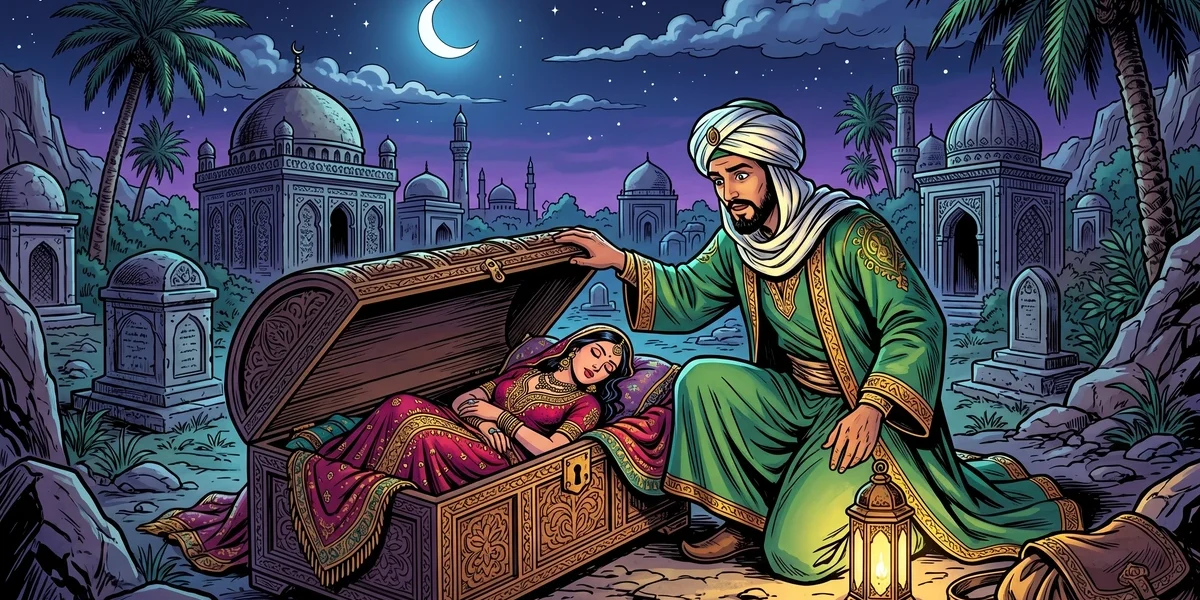
Of all the love stories Shahrazad unfolds across the thousand nights and the one night, few are remembered as tenderly as the tale of a young merchant from Damascus who, by the simple misfortune of arriving late at a city gate, found a living woman locked inside a chest among the tombs — and chose, for the sake of her honour, never once to touch her. The old Arabic chapters head this story plainly as Ghánim the Son of Eiyoob, the Distracted Slave of Love. Behind that long, archaic title stands one of the gentlest romances in world storytelling: a tale not about conquest but about restraint, and about a love so careful it would rather suffer than presume.
Origin & Canonical Attribution
- Collection: Alf Layla wa-Layla (الف ليلة وليلة) — the Thousand and One Nights, known in English as the Arabian Nights.
- This tale: The Story of Ghánim the Son of Eiyoob, the Distracted Slave of Love (Edward William Lane); Tale of Ghánim bin Ayyúb, the Distraught, the Thrall o’ Love (Richard Burton).
- Cycle & Nights: belongs to the Hárún al-Rashíd cycle; narrated by Shahrazád across roughly the 34th–44th Nights.
- Arabic editions: Bulaq (Cairo, 1835); Calcutta II / Macnaghten (1839–42); Calcutta I (1814–18); Breslau / Habicht (1825–43).
- Translators: Antoine Galland (French, 1704–17); Edward William Lane (1838–40); John Payne (1882–84); Sir Richard Francis Burton (1885–88).
- Older roots: the lost Persian Hazár Afsána (“A Thousand Tales”), the seed-collection from which the Arabic Nights grew.
- Motifs: the continent or chaste lover (Stith Thompson motif T310–T320); the persecuted royal favourite; concealment in and rescue from a buried chest; the destitute hero recognised and restored at court.
- Public-domain status: the Nights and all four named translations are long out of copyright and free to retell.
The Merchant’s Son Who Came to Baghdad
In the old time, in Damascus, there lived a merchant of great wealth whose son was called Ghánim, the son of Eiyoob. The young man was famed for an eloquent tongue and a face, the storytellers say, like the moon at the full; and he had a sister named Fitneh, so named for a beauty thought almost dangerous to look upon. When their father died he left them a large estate, and among it a hundred camel-loads of silk and brocade and bags of musk, each bale stamped with a single line of writing: This is intended for Baghdád. The father had meant to carry his goods to the City of Peace and had not lived to do it. So Ghánim, taking leave of his mother and his townsfolk, set out to finish the journey his father had only dreamed.
He came safely to Baghdad in the days of the Caliph Hárún al-Rashíd, hired a handsome house, spread it with carpets and cushions, and began to sell. Fortune favoured him: he doubled his gold on every piece of cloth, and for a full year he traded prudently and well, respected by the great merchants of the bazaar. He was no reckless adventurer but a careful, courteous youth — and it is worth noticing, because everything that follows turns on that very carefulness. It was prudence, not greed, that undid his quiet life.
On the first morning of his second year he found the gate of the merchants’ market shut. A trader had died, he was told, and the whole guild had gone to walk in the funeral procession; would he earn a blessing by joining them? Ghánim, being a stranger and unwilling to seem proud, went along. He performed the ablution, prayed over the dead with the others, and followed the bier out through the city to the burial-ground beyond the walls, where the family had pitched a tent over the tomb and lit candles and lamps, and reciters sat chanting the Qur’an into the dusk. Out of bashfulness Ghánim could not bring himself to leave before his companions. But as full night came on, his thoughts ran anxiously back to his unguarded bales of silk and his fear of thieves; and at last he slipped away alone and hurried back toward the city — only to find the great gate already barred for the night. A careful man, locked out by his own care.

The Chest Among the Tombs
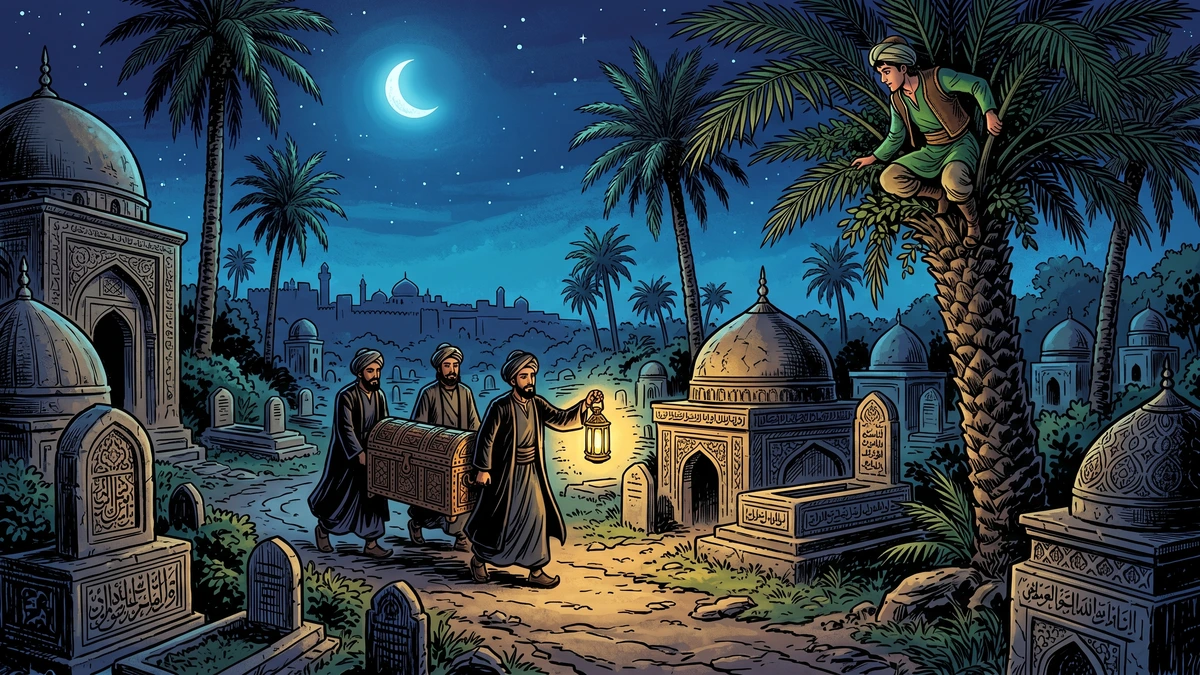
There was nothing for it but to pass the night where he was, among the tombs. Ghánim returned to a domed sepulchre, wrapped himself in his cloak, and tried to sleep — but sleep would not come, and the loneliness of the place pressed on him. Then, far off, he saw a moving light. Three figures were crossing the burial-ground toward him, carrying a lantern and, between them, a long chest. Frightened, Ghánim climbed a tall date-palm that grew beside the tomb and hid himself in its crown, looking down through the fronds.
The three were slaves of the Caliph’s household. They came directly to the tomb beneath him, dug, lowered the chest into the earth, covered it, and went away talking idly of the palace. When their light had faded, Ghánim climbed down. Curiosity and a strange foreboding moved him; he uncovered the chest, lifted its lid — and found inside it a young woman, richly dressed and adorned with jewels, lying still as the dead. She was not dead. She had been drugged with a sleeping draught, and beneath the perfume of the henbane she still breathed.
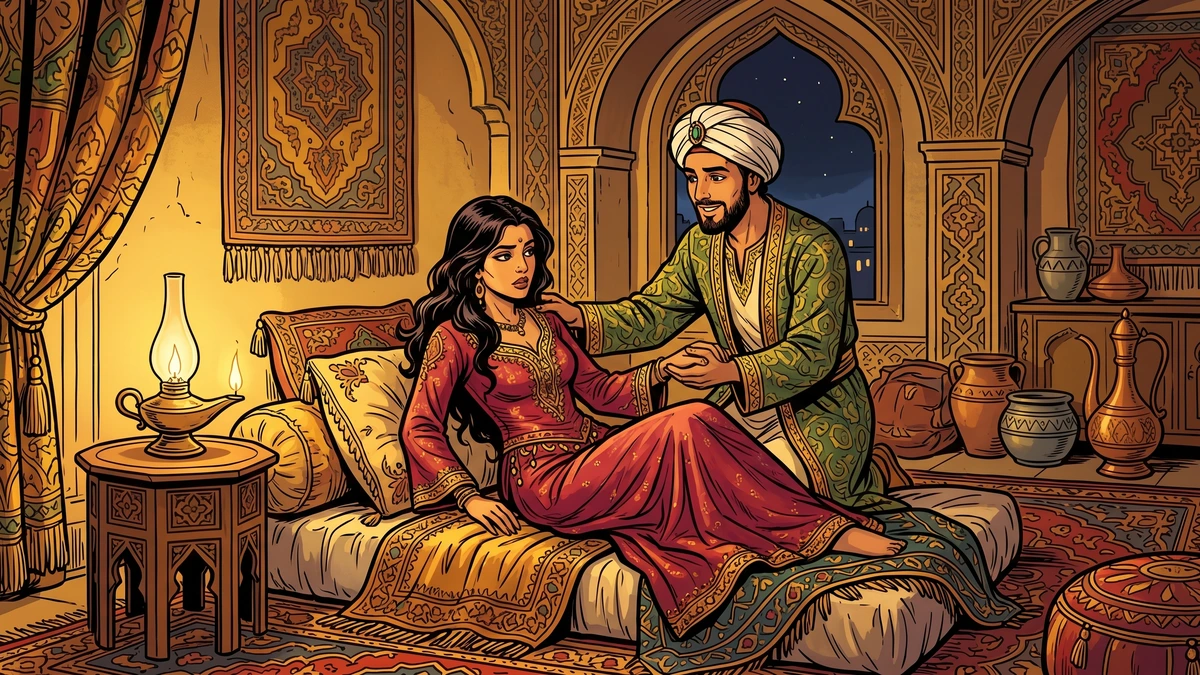
Ghánim carried her gently out of that place of graves, bore her to his own house, laid her on his bed, and worked over her until the drug released its hold. When she woke and saw a strange young man bending above her, her first words were fear; but his were all reassurance. Little by little she told him who she was. Her name was Qút al-Qulúb — “the Food of Hearts” — and she was the best-loved of all the favourites of the Caliph Hárún al-Rashíd himself. And here the tale sets its quiet, exacting test. Ghánim loved her at once and completely; the storytellers do not pretend otherwise. But because she belonged, in the law of that world, to the Commander of the Faithful, he resolved that he would shelter her, feed her, honour her, and never lay a finger on her. He would be, as the title says, the slave of his love and not its master. Night after night he kept that vow, and it is the moral spine of the whole romance.
The Jealousy of a Queen and the Wrath of a Caliph
Why had a living woman been sealed in a chest and buried? The answer lay inside the palace. The Lady Zubaydah, Hárún al-Rashíd’s royal wife and cousin, had grown bitterly jealous of the Caliph’s tenderness toward Qút al-Qulúb. While the Caliph was away on a journey, Zubaydah had the favourite drugged, then gave out word that the girl had suddenly died — even, in some tellings, building a sham tomb and grieving over it for the Caliph’s benefit. The chest in the burial-ground was meant to make the lie permanent. When Hárún returned and was shown the false grave, he mourned the woman he believed lost.
But truth in these tales has a way of surfacing. Word at last reached the Caliph that Qút al-Qulúb was alive — and living in the house of a young Damascus merchant named Ghánim. The Caliph did not pause to ask how she came to be there, nor whether the merchant had wronged her. He heard only that another man sheltered the woman he had wept for, and his grief turned to fury. He commanded that Ghánim be seized and his house plundered. Qút al-Qulúb, who understood the danger far better than the innocent Ghánim did, warned him in time; and the young man fled the city in a borrowed disguise, leaving everything — his goods, his fine house, his good name — behind him. His home was stripped bare. Qút al-Qulúb herself was carried back to the palace and shut away in a dark room while the Caliph’s anger cooled.
The cruelty did not stop at Baghdad. The Caliph’s officers carried the quarrel all the way to Damascus, where Ghánim’s mother and his sister Fitneh were turned out of their own house, their property seized, and the two women left to wander as beggars. So a tale that began with a careful, fortunate young man arrives at its darkest hour: Ghánim a hunted fugitive, his beloved a prisoner, his family homeless on the roads — and not one of them guilty of anything but innocence and ill luck. The Nights lingers here deliberately. It wants the reader to feel how heavily the powerful can lean on the powerless before it allows the scales to swing back.
The Almshouse, the Recognition, and the Fourfold Wedding
Ghánim’s wandering brought him low indeed. Hungry, sick, and unrecognised, the once-prosperous merchant ended at last among the poor of Baghdad itself, sheltered by charity in an almshouse, so wasted by fever and want that no one would have known him. Meanwhile his mother and sister, begging their way across the same country, came by chance to the very door of the place where he lay — and a tale built on a hundred unlucky accidents now begins to spend its luck the other way. They are brought together; the sister’s care begins to mend the brother.
Inside the palace, the knot was loosening too. Qút al-Qulúb, freed at last from her dark room, never wavered in clearing Ghánim’s name. She told the Caliph plainly and repeatedly what the young merchant had done and, more importantly, what he had not done: that he had saved her life, sheltered her at deadly risk, and guarded her honour as scrupulously as any guardian could, never claiming the smallest reward. The Caliph, a fair man once his jealousy had burned itself out, set himself to find Ghánim and make amends. When the search at last uncovered the broken, half-starved figure in the almshouse and proved him to be the very merchant, Hárún al-Rashíd ordered him nursed, clothed, and restored.
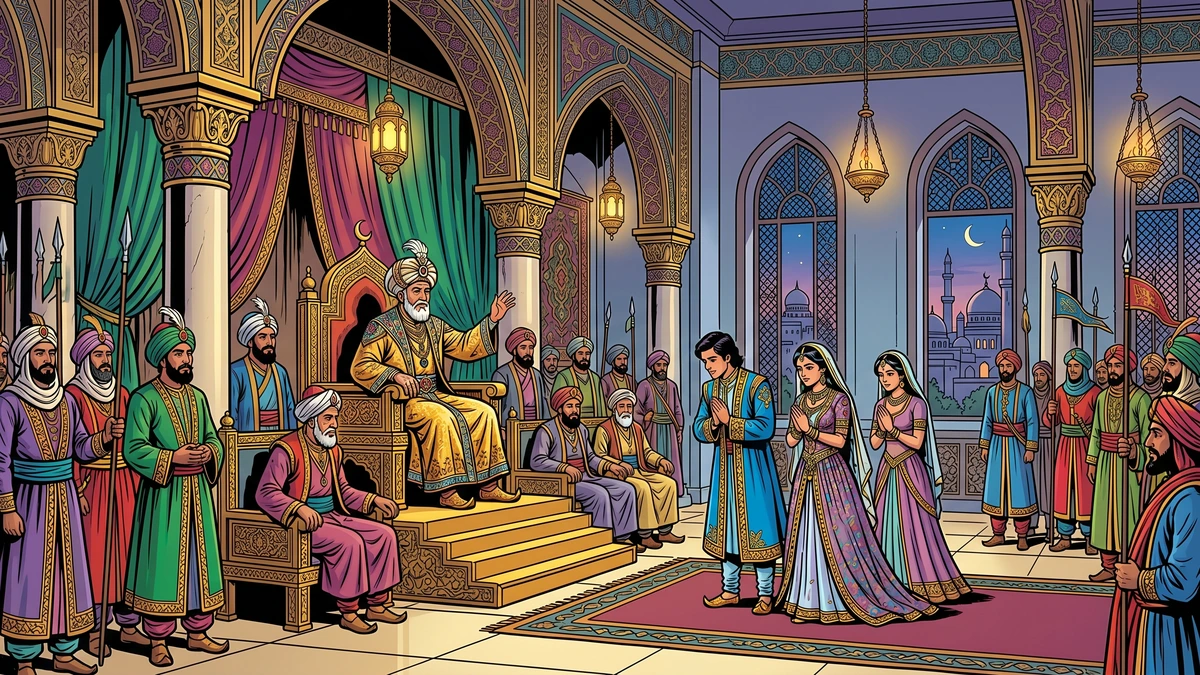
The ending the Nights gives is famous for its open-handedness. The Caliph does not merely pardon Ghánim; he gives him a palace, his goods restored many times over, and — the gift that crowns the romance — the hand of Qút al-Qulúb herself in lawful marriage, releasing her freely to the man who had loved her without ever presuming on her. And, struck by the beauty and goodness of Ghánim’s sister Fitneh, the Caliph asked for her hand and married her himself. A tale that opened with a single funeral closes with a wedding feast: two couples joined, two families lifted, one long injustice undone. The patient lover is repaid in the only coin that could possibly answer his patience.
The Moral: Love That Guards Rather Than Grasps
For all its palaces and caliphs, the tale of Ghánim turns on a small, hard, private decision made in a quiet house on a Baghdad night. A man finds, helpless and unconscious in his care, the one person in the world he most desires — and decides that desire gives him no rights at all. The whole moral architecture of the story rests on that restraint. Ghánim is called the slave of love precisely because real love, as the Nights understands it, serves its object instead of seizing it. His reward is delayed, his suffering is real and undeserved, and yet the story insists that the patient, honourable course is also, in the end, the fortunate one.
The Arabic tradition has a proverb that the tellers of the Nights might have written into Ghánim’s margin:
الصَبْرُ مفتاحُ الفَرَج
“Aṣ-ṣabru miftáḥu al-faraj” — Patience is the key to relief.
Ghánim loses his fortune, his freedom, his health, and very nearly his life, and at no point does he try to force the door of his own deliverance. He endures, he stays honest, he keeps faith with the woman entrusted to him — and the door opens of itself. The story sets that patience against the impatience of the powerful: Zubaydah cannot bear to share, and the Caliph cannot bear to ask before he punishes. Their haste makes the suffering; Ghánim’s patience unmakes it.
Why the Tale Has Lasted
Within the vast architecture of the Thousand and One Nights, the story of Ghánim is one of the purest examples of its romance strand — the strand that runs alongside the adventures, the trickster comedies, and the framed wonder-tales, and that gave the Nights its lasting reputation as a great book of love. It belongs to the cycle gathered around the historical Caliph Hárún al-Rashíd (reigned 786–809 CE), whose Baghdad the storytellers turned into a kind of golden stage where merchants and slaves could brush against caliphs and the whole social order could be, briefly, rearranged by fortune.
Two of its character-types travelled far beyond Arabic. The faithful, self-denying lover who proves his worth through suffering became a fixture of medieval and Renaissance romance across Europe; the innocent, persecuted heroine — slandered, hidden, presumed dead, and at last vindicated — is one of the most widely distributed figures in all of world folklore. Audiences from Galland’s eighteenth-century Paris to Lane’s and Burton’s Victorian readerships responded to the same things in Ghánim’s story: the suspense of the buried chest, the ache of a love that will not allow itself satisfaction, the satisfying justice of the recognition scene. It has lasted because it is, beneath the brocade and the moonlit tombs, a story about how a person behaves when no one is watching and nothing compels them to be good — and about a world generous enough, in the end, to notice.
You May Also Like
 Arabian Nights
Sinbad the Sailor: The Second Voyage
The voyage of the Roc and the Valley of Diamonds. Marooned on a deserted island, Sinbad ties himself to a giant bird, survives a ravine of serpents and gem-strewn rock, and rides a slab of meat back to freedom and fortune.
 Arabian Nights
Sinbad the Sailor: The Third Voyage
The darkest of Sinbad's seven voyages: a storm strands the merchants on the Mountain of the Apes, a man-eating giant pens them in his house, and Sinbad must blind the monster and outwit a giant serpent to win his way home — the Arabian Nights' famous Polyphemus tale.
 Arabian Nights
Ages 9-12
Arabian Nights
Ages 9-12
The Fisherman and the Genie
A poor old fisherman draws a sealed copper jar from the sea and frees a furious ifrit who vows to kill him - then must use his wits alone to survive. A classic tale of the Thousand and One Nights, retold with full scholarly attribution.