The Bremen Town Musicians: The Strength of Friendship and Kindness
The Bremen Town Musicians: The Strength of Friendship and Kindness: There was once a farmer who owned four animals: a donkey, a dog, a cat, and a rooster. True
Four old animals, cast off by the masters they had served all their lives, set out on a road they had never travelled before. They never reached the city they had aimed for — and that, the Brothers Grimm seem to say, is exactly the point. The Bremen Town Musicians is a story about what happens when a society quietly decides that some lives are no longer profitable, and what those lives do next. Recorded in 1819 in the second edition of the Kinder- und Hausmärchen as tale number 27 (KHM 27, Die Bremer Stadtmusikanten), the story has become so beloved that the bronze statue of the donkey, dog, cat and rooster — stacked one on top of the other — stands today outside the Bremen town hall as a kind of municipal motto: nobody is too old, too tired, or too inconvenient to deserve a future.
1. The Four Who Were No Longer Wanted
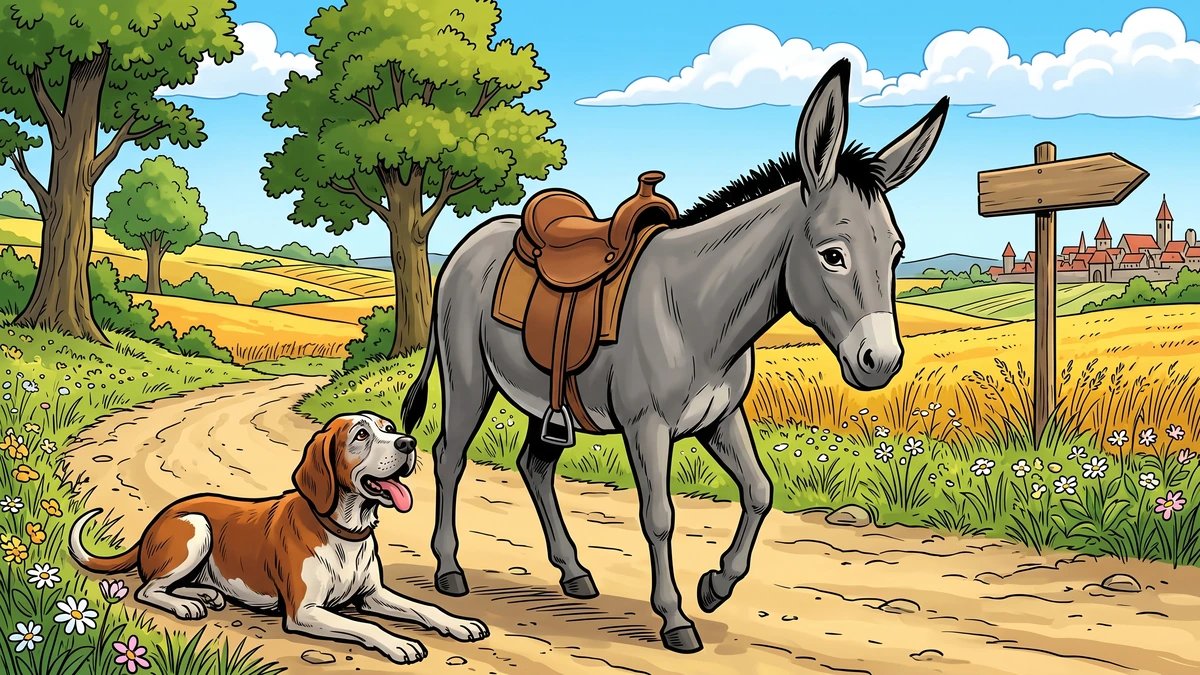
The story opens, as so many Grimm tales do, with a small private cruelty dressed up as common sense. “Es hatte ein Mann einen Esel,” the Brothers Grimm begin — “A certain man had a donkey.” The donkey had carried sacks of grain to the mill for many years, faithfully, without complaint. But his strength was failing, and the man began to think the donkey was eating more than he earned. So the master decided to be rid of him. The donkey, in the way of folk-tale animals who happen to overhear what they are not supposed to hear, understood every word; and that night, before the morning could come for him, he ran away. He had heard that the town of Bremen — the great Hanseatic port on the Weser, famed for its trade and its musicians — was always glad of a strong voice. He would go there, he decided, and become a town musician.
It is worth pausing on this opening, because the Grimms have done something quietly radical in just two paragraphs. They have given us a working animal — a labourer — whose entire value, in the eyes of his master, is the work he can perform. The moment that work ends, the master begins to calculate the cost of his keep against the price of his hide. The donkey is not just running from death; he is running from the logic by which the master sees him. To go to Bremen and become a musician is, for an animal who has only ever been a beast of burden, an act of self-reinvention so audacious that we can hardly believe it is happening on the first page of a children’s tale.
On the road he meets a hunting dog, lying in the dust and panting wretchedly. “Nun, was keuchst du so, Packan?” the donkey asks — “Why are you puffing so, Packan?” The dog explains that he is old, that his teeth no longer hold the boar, that his master had wanted to club him to death, and that he too had run for his life. The donkey’s answer is the kind of practical kindness that turns this tale into something bigger than itself: “I am going to Bremen, and shall there become town-musician. Come with me — you can play the kettledrum, and I will play the lute.”
2. A Cat With Worn Teeth and a Cock On the Pot
Soon after, the two come upon a cat sitting by the roadside with a face like three rainy days. The Brothers Grimm linger over the small comedy of her grievance: “How can anyone be merry when his neck is in danger?” The cat, now old, prefers sitting by the warm stove and purring to chasing mice across cold floors. Her mistress, finding her useless, had tried to drown her. “Komm mit uns nach Bremen,” the donkey says — come with us to Bremen, you understand night-music. And so the cat falls in beside them, the third recruit to a band of refugees from a culture that thought their working life was their entire life.
The fourth, of course, is the rooster. They find him perched on a farmyard gate, crowing with all his might into the dusk. He has just learned that company is coming on Sunday and that the cook intends to put him into the soup. “Da krähe ich, so lange ich kann” — “I crow as long as I can.” The donkey laughs and offers him the only invitation he is capable of giving: come to Bremen, you have a fine voice, the four of us shall make music together. By dusk there are four of them on the road — donkey, dog, cat and rooster — each one too old or too weak or too stubborn to be useful any more, each one walking away from a master who had decided to file him under cost.

It is here that the symbolism of Bremen begins to do its work. Folklorists like Maria Tatar and Jack Zipes have long noted that the Grimms placed the story in the Free Imperial City of Bremen with care. Bremen was a chartered Stadt — a town — with the medieval Saxon principle of Stadtluft macht frei, “town air makes you free”: a serf who lived inside the city walls for a year and a day became a free person, beyond the reach of the lord he had escaped. The four animals are not heading to a generic city. They are heading to a place whose very air is a legal promise of freedom from the master who used to own you.
3. The Lit Window in the Robbers’ Forest
They cannot reach Bremen in a day. As night falls, the woods grow black around them, and they prepare to sleep at the foot of a great tree — the donkey and the dog underneath, the cat in the lower branches, the rooster at the very top. Before settling, the rooster looks out from his high perch and sees, far off through the trees, a single warm light. “There must be a house not far off,” he calls down, “for I see a light.” The donkey’s instinct is immediate: “Then we had better go on, for it is not very comfortable here.” The animals creep through the undergrowth toward the glow.
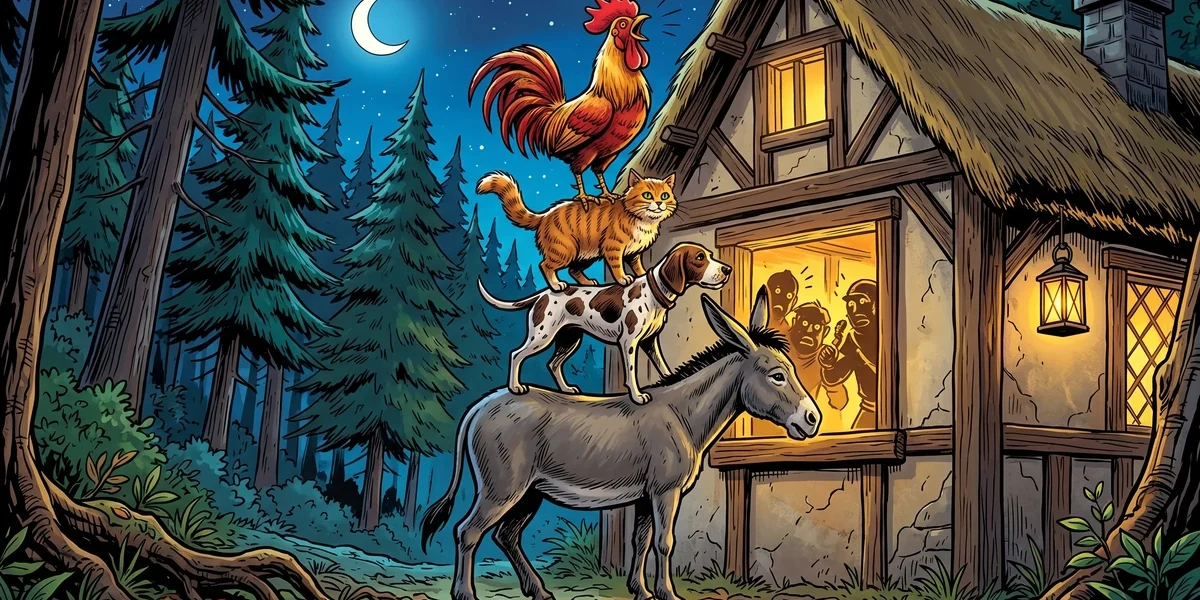
What they find is a robbers’ cottage. Through the window they see the band of thieves seated around a long table groaning with food and drink, dividing their plunder. The donkey, who has thought about this longer than anyone realises, proposes a plan that has delighted children for two centuries: he will rest his front hooves on the windowsill, the dog will jump on the donkey’s back, the cat on the dog’s shoulders, and the rooster on the cat’s head. “And then,” says the donkey, “let us begin our music together.”
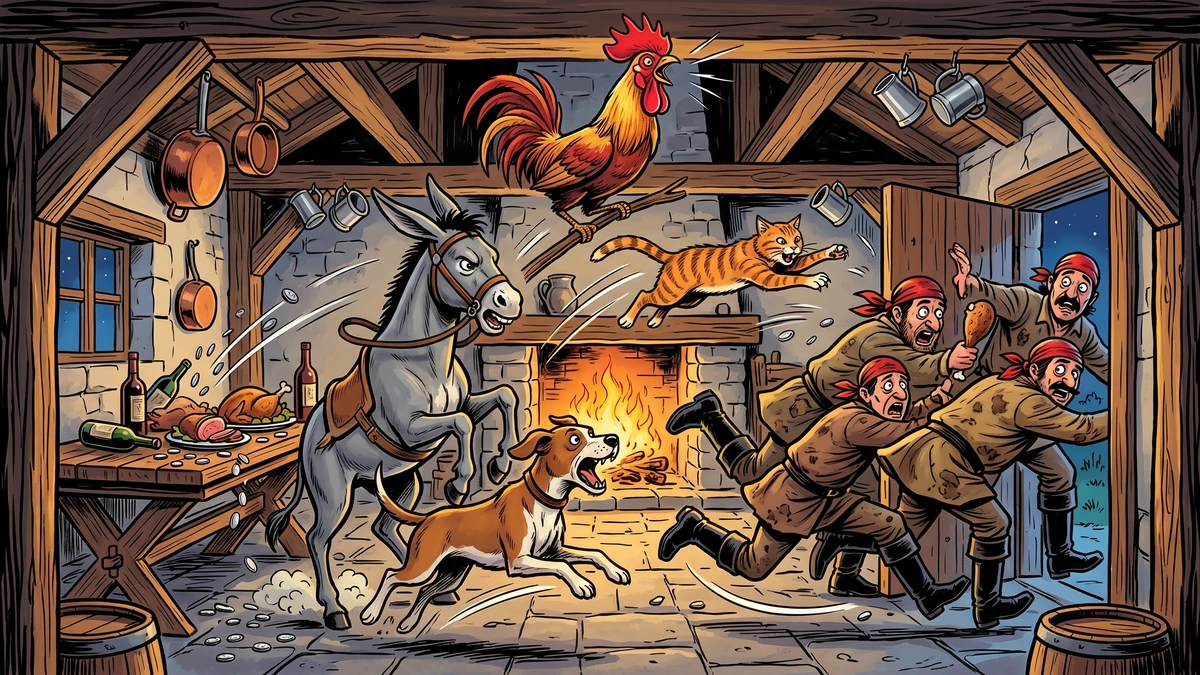
What follows is one of the most joyful comic moments in all of European fairy tale. At a signal the donkey brays, the dog barks, the cat yowls, the rooster crows — all at once, with all the strength of four creatures who have been told they are no longer useful. The combined sound is so unearthly — the Grimms describe it as “ein entsetzliches Konzert”, a frightful concert — that the robbers leap up from their table convinced a host of demons has come for them, and bolt headlong into the dark forest. The four musicians, who had not even reached Bremen, sit down at the abandoned table and eat as if they had not eaten in a year, “as if they were going to fast for the next four weeks.”
4. The Long Night and the Captain’s Mistake
Night settles, the candles are blown out, and each of the four animals chooses the bed that suits him best. The donkey lies down on the dunghill outside; the dog curls up behind the door; the cat takes the warm hearth ashes; the rooster flies up to the highest crossbeam in the rafters. They are all soon asleep — and that, the Grimms point out, is when the trouble starts. From his hideout in the forest, the captain of the robbers watches his old house. The light has gone out. There is no shouting, no movement. Perhaps, he thinks, they were too quick to run; perhaps they have abandoned their stolen gold to a band of nothing. He sends one of his men back to investigate.
The robber creeps in through the kitchen, sees the cat’s glowing eyes in the embers and mistakes them for two coals, and reaches out with a match to take a light from them. The cat, naturally, springs at his face, claws out, hissing furiously. The robber, terrified, runs to the back door — where the dog, woken in his bed, leaps up and bites him in the leg. He flees across the yard — where the donkey, half-asleep on the dunghill, gives him a great kick. And the rooster, woken by all this commotion, crows from the rafters with all the power of his lungs: “Kikeriki!”
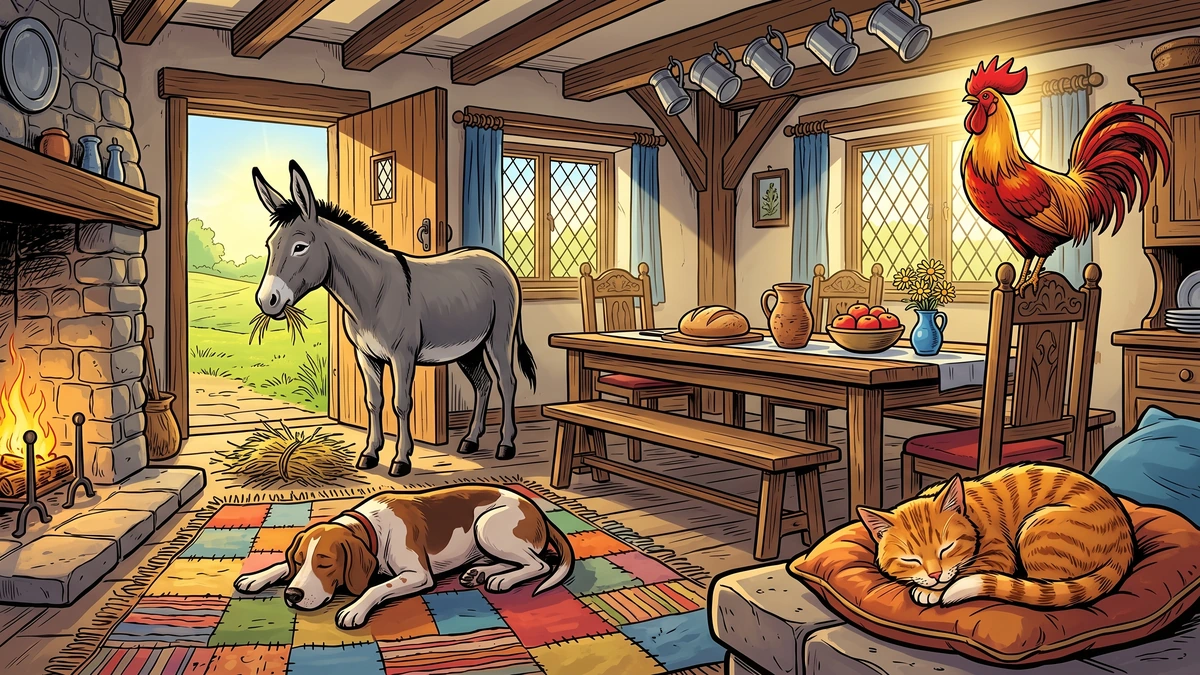
The robber stumbles back to his captain in the forest, wild-eyed. The Grimms give us his confession in his own breathless words, and it is a small masterpiece of comic terror: “In the house there sits a horrible witch, who spat at me and scratched my face with her long claws; and by the door stands a man with a knife, who stabbed me in the leg; and in the yard there lies a black monster, who beat me with a wooden club; and above, upon the roof, sits the judge, who called out, ‘Bring the rogue here to me!’ So I got away as quickly as I could.” The witch is the cat. The man with the knife is the dog. The black monster is the donkey. The judge in the rafters is the rooster, whose kikeriki the robber has misheard as a German legal summons. After this report the robbers never dare go near the house again, and the four musicians, who never did reach Bremen at all, find that they like the cottage so well that they decide to stay, and live there happily for the rest of their days.
The Moral: A New Life Is Not Always Where You Were Going
“Etwas Besseres als den Tod findest du überall.”
“You will find something better than death everywhere.” — the donkey’s line to the dog, KHM 27 (Brothers Grimm, 1819)
This is the moral the Grimms quietly stitch through the tale, and it is a remarkable one to find in a story for children. Read literally, it tells the dog — and the cat, and the rooster, and any reader who has ever felt themselves to be on the verge of being thrown away — that running is permitted; that the road is open; that the world is wider than the master’s yard. The four animals do not become musicians in Bremen. They never even arrive. What they find on the way is something better than the future they had imagined: a household of their own, made by their own courage, in a place that nobody has the legal right to evict them from. The tale is one of folklore’s rare working-class utopias — a story in which old labourers, by their own wits and the loud joyful noise of solidarity, take a roof for themselves and keep it.
There is a second moral, gentler than the first, and the Grimms let it speak through the structure of the story rather than any one line: none of the four could have done it alone. The donkey’s strength alone would have been a beast of burden in a different yard. The dog’s teeth alone would have rotted by a different door. The cat alone would have been drowned. The rooster alone would have been soup. It is only when the four stack themselves up — literally, comically, hoof-on-back-on-shoulder-on-head — that they become a single creature loud enough to scatter the men with knives. The Grimms had a word for this: Genossenschaft, a fellowship of equals, an old guild idea. The Bremen Town Musicians is a fellowship tale dressed up as a fairy tale, and that is the second reason its statue still stands in the marketplace of a real German city.
Why It Lasted
Among the more than two hundred tales the Brothers Grimm collected and published between 1812 and 1857, only a handful have travelled outside the German-speaking world quite as completely as Die Bremer Stadtmusikanten. The story is classified as Aarne–Thompson–Uther tale type ATU 130 (The Animals in Night Quarters), an international folk-tale type with cousins in Russia, France, England, and the Indian subcontinent — the basic shape of “old animals run away, frighten thieves out of a house, take it for themselves” turning up wherever village storytellers have wanted to make a wry point about masters and servants. The Grimms’ particular genius was to localise it in a real, named, free city — Bremen — and to make the four refugees specifically the kind of working animals their nineteenth-century German readers would have known intimately: the mill donkey, the hunting dog, the kitchen cat, the dawn-crowing rooster.
The textual history of the tale is itself instructive. It does not appear in the very first edition of the Kinder- und Hausmärchen in 1812, the volume that opened with The Frog Prince. The Grimms added it in the second edition of 1819, having received a version from the storyteller Dorothea Viehmann of Niederzwehren near Kassel and another from the family of Dortchen Wild — Wilhelm Grimm’s future wife — whose household preserved oral folk-tales the Grimms regarded as exceptionally pure. They cross-checked these against an earlier seventeenth-century literary version that had circulated in Low German broadsides, and against the old Russian fox tales in which a fox, a cat, and a cock take a similar woodland house. By the time the seventh and final edition of 1857 was set in type, the Grimms had polished the four animals’ voices, sharpened the donkey’s line about etwas Besseres als den Tod, and given the rooster the high-comedy kikeriki that any German child today still recognises as the bird’s native shout.
The story has lasted, finally, because it is one of the few children’s tales that takes seriously the dignity of being old. The four musicians are not heroes because they are young or beautiful or brave in a battlefield sense; they are heroes because, having spent their best years in someone else’s service, they refuse to let the end of that service be the end of their lives. To this day, the bronze monument in front of the Rathaus in Bremen — sculpted by Gerhard Marcks in 1953 — shows the donkey on the bottom, the dog on his back, the cat on the dog’s shoulders, and the rooster on top of the cat: a small four-storey statue of fellowship, of escape, and of the surprising places to which a wide-open road can take four creatures who decide they would rather sing than die. Etwas Besseres als den Tod findest du überall.
You May Also Like
 Grimm's Fairy Tales
Ages 9-12
Grimm's Fairy Tales
Ages 9-12
Hansel And Gretel
Hansel And Gretel: Hard by a great forest dwelt a poor wood-cutter with his wife and his two children. The boy was called Hansel and the girl Gretel. He had
 Grimm's Fairy Tales
Ages 9-12
Grimm's Fairy Tales
Ages 9-12
Snow-White And Rose-Red
Snow-White And Rose-Red: There was once a poor widow who lived in a lonely cottage. In front of the cottage was a garden wherein stood two rose-trees, one of
 Grimm's Fairy Tales
Ages 9-12
Grimm's Fairy Tales
Ages 9-12
The King Of The Golden Mountain
The King Of The Golden Mountain: There was once a merchant who had only one child, a son, that was very young, and barely able to run alone. He had two richly