The Travelling Musicians
The Travelling Musicians: An honest farmer had once an ass that had been a faithful servant to him a great many years, but was now growing old and every day
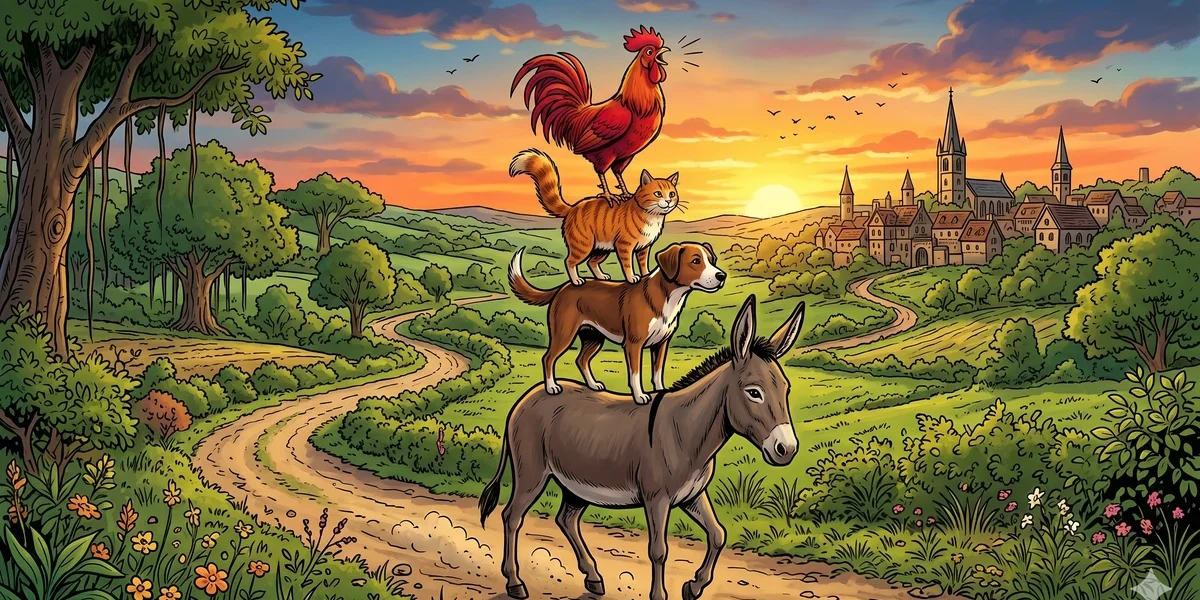
Origin: Germany · Source: Kinder- und Hausmärchen (KHM 27, “Die Bremer Stadtmusikanten”), Brothers Grimm, 1st edition 1812, expanded 1819 · English title: “The Travelling Musicians” (Edgar Taylor, German Popular Stories, 1823) · Tale-type: ATU 130 — The Animals in Night Quarters (also called Animals in the House of Robbers) · Collected from: the Hassenpflug and Wild families of Hesse, c. 1810 · Read time: 10 min
An honest farmer in northern Germany once kept a donkey who had carried his sacks of grain to the mill faithfully for many a long year. But the donkey was now old; his back was bent, his ears drooped, and every morning the climb to the mill grew harder. The farmer began to grumble that the beast ate more than he earned, and one evening, while the donkey listened from beyond the barn door, he overheard his master sharpening a knife and saying that tomorrow the old fellow had better not wake up at all.
The donkey did not wait for tomorrow. He slipped his halter, nosed open the latch, and trotted out into the cold blue dusk of the road. He had heard, as donkeys sometimes do, that in the free city of Bremen, where the cobblestones rang under merchant carts and the Weser curled past the cathedral, there lived a town band who paid musicians to play at fairs. If I cannot pull a sack any longer, he thought, perhaps I can still make a noise. Off to Bremen, then, and I shall be a town musician.
The Four Outcasts on the Bremen Road
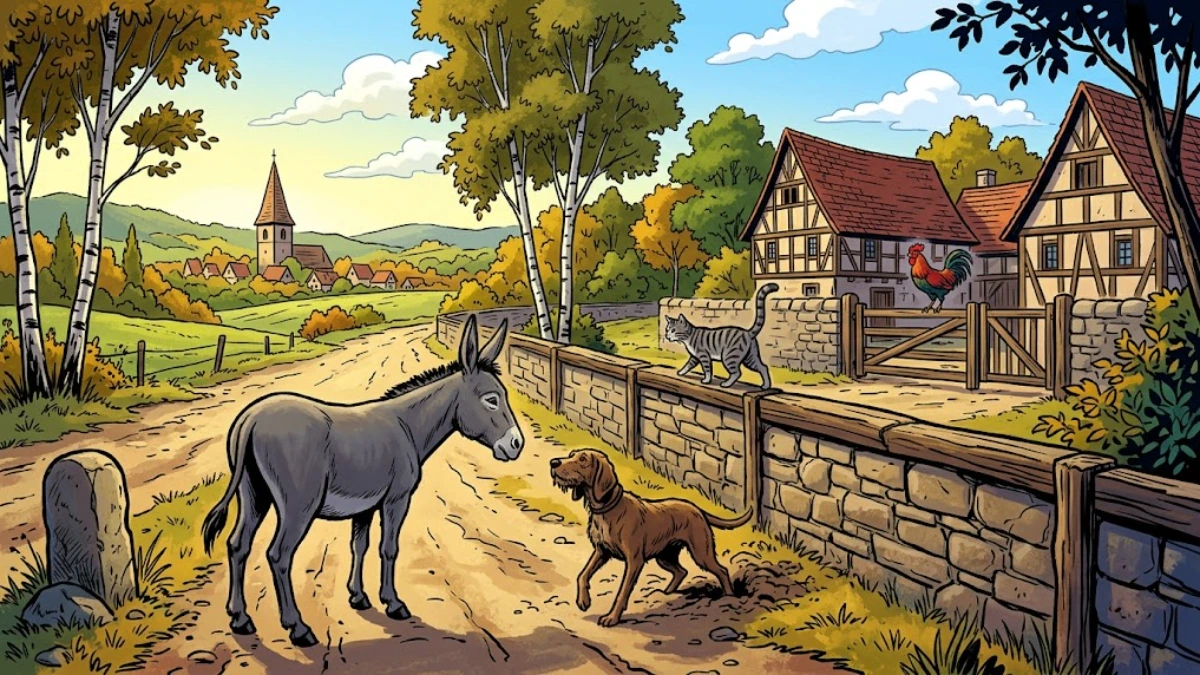
The donkey had not gone half a league before he came upon a hunting hound lying in the dust beside a milestone, panting as if every breath were his last. “Friend,” said the donkey, “why do you puff so?” The dog answered that he was old, that his nose had lost the scent and his legs the speed, and his master had raised a stick to finish him so this morning he had run for his life. “A poor lookout,” said the donkey, “but here is a better one: come with me to Bremen and be a town musician. I shall thump the great drum, and you, with that deep voice of yours, shall beat the kettle-drum.” The dog wagged his tail and rose at once, and the two went on together.
A little farther down the lane they met a cat sitting on a wall with a face as long as a wet Sunday. “Now then, old whiskers,” said the donkey, “what sours your cream?” The cat told them that her teeth were dull, her claws blunted, and that she would rather doze beside the fire than chase mice; whereupon her mistress had tried to drown her in the rain-barrel, and only by the luck of cats had she escaped. “Excellent,” said the donkey, “you sing all night with the moon for an audience — come and join the Bremen band. You shall have first soprano.” The cat purred and fell into step.
At the next farmstead, perched upon the gatepost, a rooster was crowing as if his lungs would burst. “Good Master Chanticleer,” called the donkey, “why such a rumpus?” The cock cried that the housewife meant to drop him into the soup-pot for Sunday dinner because guests were expected, and that this very crowing was, perhaps, his last. “Out of the pot and into music!” said the donkey. “Anyone who can wake the sun has lungs for the chorus. Off to Bremen with the rest of us.” The cock flapped down, and now there were four: a donkey, a hound, a cat, and a cock, walking the hard, frosted road together — four creatures whom usefulness had cast out, marching toward a city in which they had no friend.
Such an opening would not be out of place in any folk tradition that imagines mercy as something the world owes to its old and its tired. But the Grimms’ particular touch is to make these animals self-aware. They are not merely thrown out; they leave on their own terms, and they re-imagine themselves as artists. Each one carries an instrument-of-the-body — bray, bark, mew, and crow — and dignity is restored not by going home but by going forward.
The Lighted Window in the Forest
Bremen, however, lies many days’ walking from a Hessian field. When dusk thickened into proper night, the four travellers were still in the deep wood, hungry, foot-sore, and cold. The donkey and the dog laid themselves down under a broad oak; the cat climbed into the lower branches; the cock flew up to the top to keep watch, for he said that the higher he sat the safer he should be. From his perch, before sleep, he turned his head four ways — north, south, east, west — and on the western side he saw a small steady light winking through the trees.
“Friends,” he called down, “there is a light yonder; perhaps a house, perhaps even a kitchen.” The donkey answered that a kitchen was a great deal better than an oak tree, and so they roused themselves and moved toward the spark. The wood grew thicker; the spark grew brighter; and presently they came to a low cottage hidden among brambles, with the shutters open and a fire blazing inside. The donkey, being the tallest, crept up to the window and looked in.
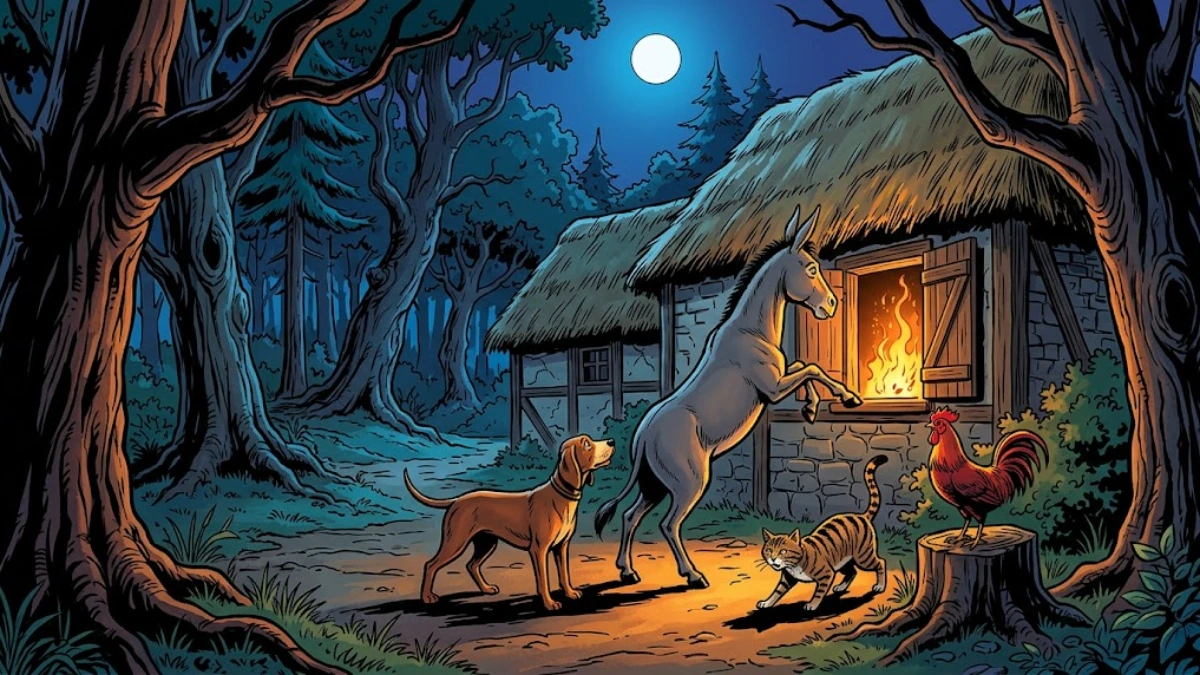
What he saw he reported in a hoarse whisper: a long table groaning with food and wine, and round it four robbers eating their fill, their pistols and cutlasses laid down beside their plates. The donkey’s mouth watered. The dog’s nose twitched. The cat licked her chops. The cock fluffed his neck-feathers and announced that he would not sleep cold tonight while bread sat warm on a robber’s table.
So the four held council under the eaves, and they hatched a plan that has delighted listeners for two centuries because it is the simplest plan in the world: they would make their music. The donkey reared up and placed his forefeet on the windowsill; the dog sprang on the donkey’s back; the cat clambered on the dog; and the cock flew up and perched on the cat’s head. At a sign — one, two, three — they began. The donkey hee-hawed, the dog bayed, the cat yowled, and the cock crowed at the top of his lungs, and the whole tower of animals burst in through the window-glass at once.
The Concert at the Cottage Window
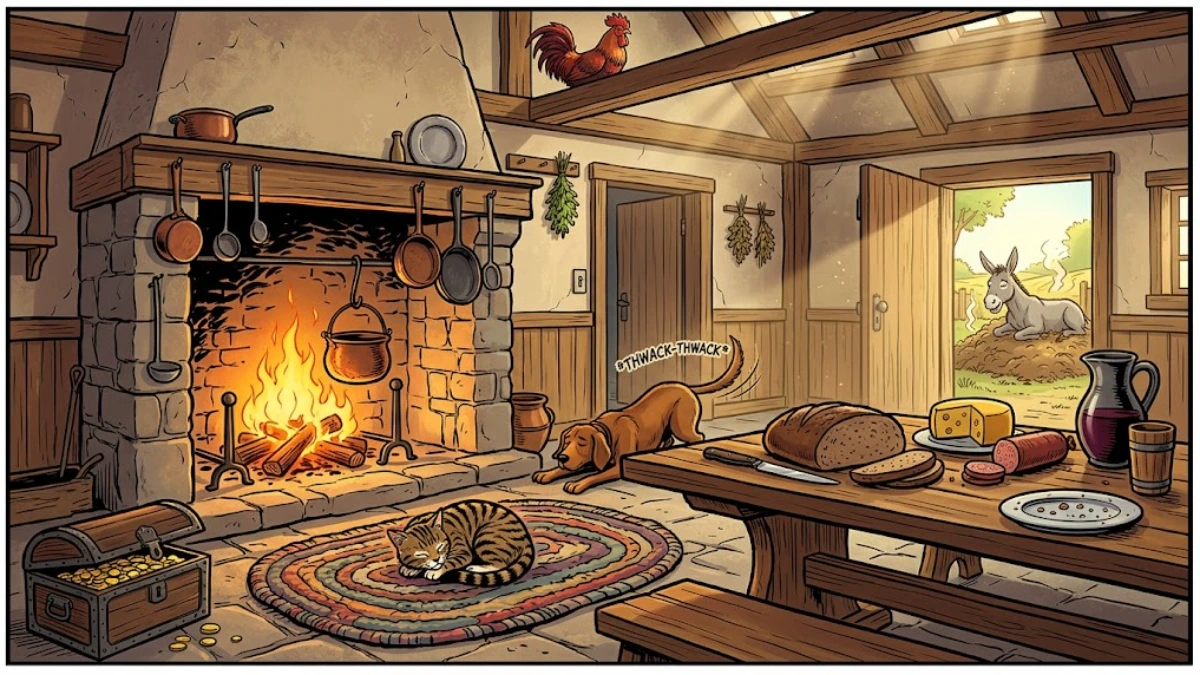
To the robbers it was as if the devil himself had fallen in among the soup-bowls. They saw, in the firelight, four wild shapes piled to the ceiling, and the noise of all the demons of the wood. They flung down their knives, leapt back from the table, and ran headlong into the night, sure that some witch or fiend had been called down upon their hideout. The four travellers stepped delicately over the broken crockery, sat themselves down, and ate as much as their stomachs would hold — bread, sausage, cheese, an entire roast goose, and the contents of the wine-jug.
When supper was over and the fire burned low, each animal arranged a sleeping-place to suit himself. The donkey lay in the muck-heap by the back door, where the warm dung steamed against his old bones. The dog stretched out behind the kitchen door, where any draught would bring him news. The cat curled up among the warm ashes by the hearth. The cock flew up to a beam in the rafters and tucked his head under his wing. They blew out the lamp, and the cottage fell silent.
But night is long, and robbers are stubborn. After an hour or two, the captain of the band, peering from the wood, saw that the lamp was out and the noise had ceased. Ashamed of having run from a sound, he sent the youngest robber back to scout the cottage. “Slip in,” he said, “and if all is quiet, light a candle and call the rest of us back.” The young robber crept through the brambles, pushed open the door, and tip-toed into the dark kitchen.
The Robber’s Second Mistake
It was very dark, and the young robber, wishing for a light, saw what he took to be two glowing coals among the ashes — the cat’s eyes. He bent down and held out a sulphur-match to take a flame from them. The cat, unwilling to be lit like a lamp, sprang at him with claws spread and spat and scratched his face. The robber screamed and ran for the back door — where the dog, lying behind it, leapt up and bit him in the leg. He stumbled out into the yard, where the donkey, woken by the racket, gave him a great kick that sent him tumbling across the muck-heap. And from the rafters above, the cock crowed his loudest crow into the night: Kikeriki!
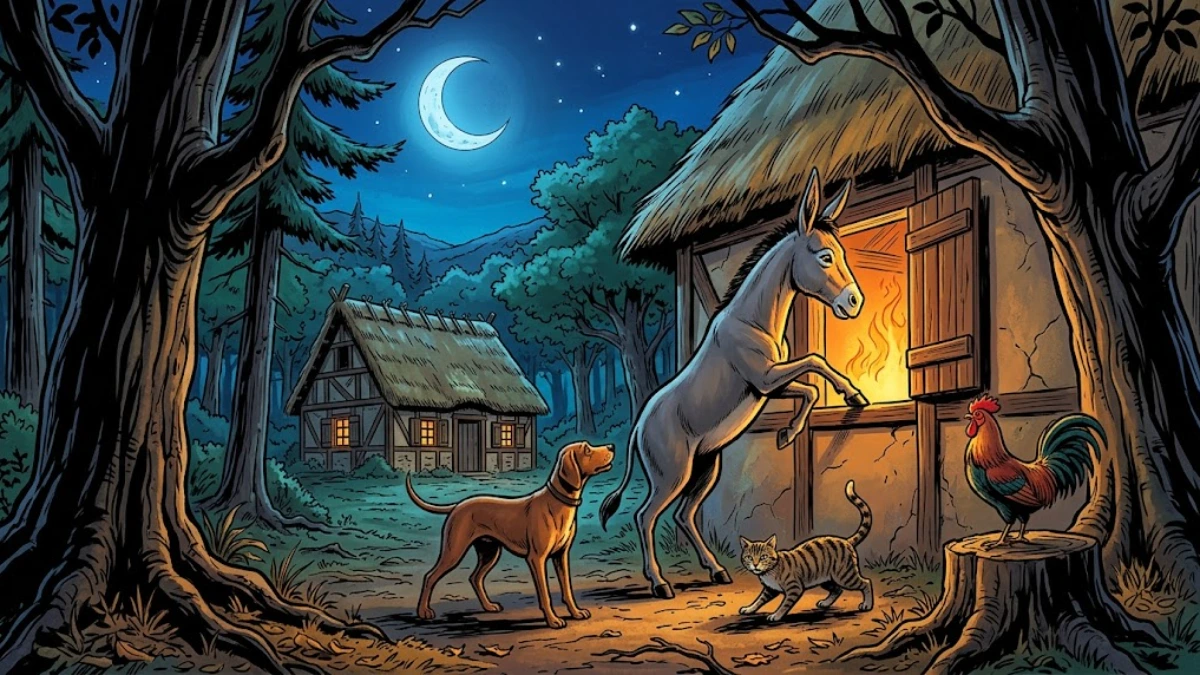
The young robber fled back through the wood to where his comrades waited and gasped out his report. “Captain,” he said, trembling, “the place is bewitched. There is a horrible witch in the kitchen who scratched my face with her long nails. There is a man behind the door who stabbed me with a knife. There is a black monster in the yard who beat me with a wooden club. And on the roof sits a judge who shouts ‘Bring the rascal up to me! Bring the rascal up to me!’” (for that is what kikeriki sounded like to him in his fright). The robbers heard him out, looked at one another, and decided that no purse in any wood was worth a witch, a knifeman, a club-monster and a judge all in one cottage. They left the place forever.
And the four travellers, when morning came, found the robbers’ gold under a loose floorboard, the larder full, and the chimney drawing well. They liked the cottage so much that they never went on to Bremen at all. “The road can wait,” said the donkey. “Music is a fine trade, but a warm hearth is finer.” And there, the Grimms tell us, they are living still, if no one has come along to fetch them away.
The Moral — Stadtmusikanten und das gestohlene Glück
The Brothers Grimm were not in the habit of nailing morals to the ends of their tales like brass plates on doors; they trusted the tale to do its own teaching. But the closing line of the German original carries a moral inside its ribcage:
„Und sie gefiel ihnen so gut, daß sie nicht wieder heraus wollten. Und wer das zuletzt erzählt hat, dem ist der Mund noch warm.“
— “And it pleased them so well that they would not come out again. And whoever told this last has a warm mouth still.”
The proverb hidden in the punchline is older than the tale: worth is not retired by age but reassembled by company. A cracked donkey is no orchestra; a winded hound is no sentinel; a slow cat is no hunter; a doomed rooster is no alarm-clock. But stack them on top of one another at a robbers’ window and they are the loudest band in Lower Saxony. The lesson of the Bremen Town Musicians is that what looks like uselessness in isolation is often only loneliness, and that the so-called “rejects” of any household — old, slow, awkward, expensive — can together form a household of their own that no robber dares burgle.
It is also a tale, very quietly, about ageing without bitterness. None of the four animals tries to become young again. The donkey does not pretend he can still pull a millstone; the dog does not pretend he can still hunt the hare. They simply walk forward into a new vocation — Stadtmusikanten, town musicians — and they walk together. That, in eight hundred German words, is one of the gentlest doctrines of dignity in European folklore.
Why This Tale Has Lasted
The tale we know as “The Travelling Musicians” or “The Bremen Town Musicians” is catalogued in the Aarne-Thompson-Uther index as ATU 130, “The Animals in Night Quarters,” and versions of it have been told from Iceland to Iran. There is a Norwegian variant in Asbjørnsen and Moe (1841) in which the heroes are an ox, a sheep, a goose, a cock, and a cat. There is a Russian variant collected by Afanasyev in which the band is led by a bull and includes a ram, a pig, and a goose. There is an Italian Tuscan version in which the team is a donkey, a dog, a wolf and a fox. The Grimms’ genius was not invention — the tale is far older than 1812 — but compression: they reduced the cast to four, settled the geography on the Hanseatic city of Bremen (already famous in the 19th century for its rich merchants and noisy fairs), and gave the climactic concert that single irresistible image of the animal-tower at the cottage window.
The story’s endurance comes from three layers stacked, like the animals themselves, one upon another. First, the moral structure: the wronged are reconciled, the wrongdoers (both the cruel masters at home and the robbers in the wood) are punished, but no animal kills anyone — the violence is comic, and that comedy is what makes the justice feel earned rather than vengeful. Second, the visual icon: the donkey-dog-cat-rooster pyramid is one of the most reproduced images in German civic art. Gerhard Marcks’s bronze statue, cast in 1953, stands beside the western flank of the Bremen Rathaus and is rubbed shiny on the donkey’s forelegs by tourists who believe a wish made with both hands on those forelegs will come true. Third, the deeper meaning: in a Europe that, at the time of the Grimms, was building railways and dismissing horses, hounds, and house-cats as obsolete, the tale offered a counter-doctrine — that the obsolete band together, run away to a freer life, and find that the new household they make for themselves is happier than the one that tried to discard them.
That is why this tale is told to children when they are very young (it is a slapstick romp about animals frightening robbers) and re-told to them when they are older (it is a parable about ageing, dismissal, and re-invention) and re-told yet again to old people in retirement halls in Lower Saxony today (it is a private joke about themselves). Few folk tales hold up under three different age-readings. The Bremen musicians do because their music is, in the end, the music of continuing.
And so, when you hear someone in a German-speaking country call a ramshackle quartet a Bremer Stadtmusikanten — an off-key band of misfits playing on regardless — you can smile, and remember the donkey, the hound, the cat and the cock who walked out of every kitchen that wanted them dead, sang one terrible song at one robber’s window, and never went home again.
You May Also Like
 Grimm's Fairy Tales
Ages 6-8
Grimm's Fairy Tales
Ages 6-8
Rapunzel: Love, Freedom, and the Power of Truth
Rapunzel: Love, Freedom, and the Power of Truth: The Forbidden Garden Near a great castle, there grew a garden so beautiful that it was said to contain every
 Grimm's Fairy Tales
Ages 9-12
Grimm's Fairy Tales
Ages 9-12
Lily And The Lion
Lily And The Lion: A merchant, who had three daughters, was once setting out upon a journey; but before he went he asked each daughter what gift he should
 Grimm's Fairy Tales
Ages 9-12
Grimm's Fairy Tales
Ages 9-12
Fundevogel
Fundevogel: There was once a forester who went into the forest to hunt, and as he entered it he heard a sound of screaming as if a little child were there.