Old Sultan
Old Sultan: A shepherd had a faithful dog, called Sultan, who was grown very old, and had lost all his teeth. And one day when the shepherd and his wife were
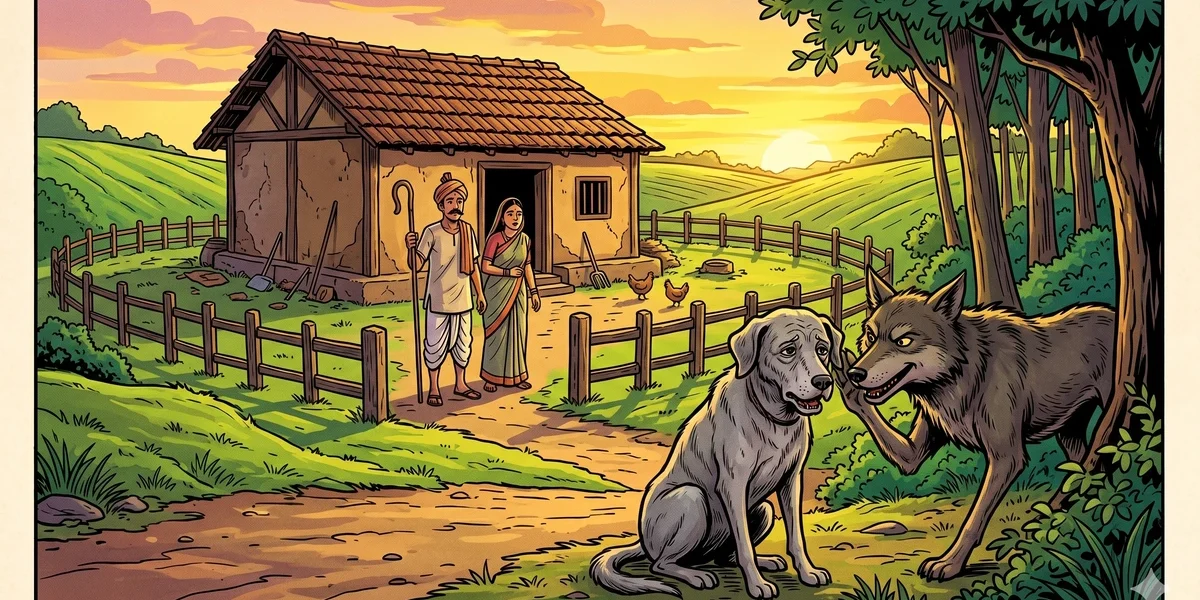
Old Sultan — a Grimm tale of a loyal old dog, a pragmatic wolf-alliance, and the ethics of gratitude tested across time — explores one of the most challenging questions in Indian moral philosophy: what is owed to those who have served faithfully, and what happens when those debts are negotiated away for convenience? The tale traces the arc of kṛtajñatā (gratitude, the quality of knowing one’s debts) from its violation by the farmer, through its complex negotiation by Sultan, to its ultimate vindication, offering a nuanced map of loyalty’s terrain.
The Tradition: Kṛtajñatā and the Dharma of the Faithful Servant
The faithful old animal who has served long and is now deemed useless appears across Indian narrative traditions with remarkable regularity and always carries the same moral charge: the betrayal of kṛtajñatā (gratitude) is among the most serious moral failures in Indian ethics. The Mahābhārata‘s treatment of dogs — culminating in Yudhiṣṭhira’s refusal to enter svarga without his faithful dog — places canine loyalty at the apex of dharmic relationship. The Jātaka tales repeatedly feature animals whose devotion shames their human masters, and the consistent lesson is that those who forget their debts to faithful servants are diminished by the forgetting while those who honor them are elevated.
The Manusmṛti and the Arthaśāstra both address the obligations of a householder toward those who have served the household: retirement from service does not dissolve the bond of obligation. The farmer who plans to kill Sultan because he can no longer hunt is committing what the Hitopadeśa would call kṛtagna-doṣa (the fault of the ungrateful) — a moral failure that corrupts the entire household’s dharmic fabric.
Plot and Philosophical Analysis: Sultan’s Pragmatic Alliance and Its Consequences
Sultan, overhearing his death sentence, makes an alliance with a wolf: the wolf will carry away the farmer’s baby; Sultan will appear to rescue it, re-establishing his value. The plan succeeds — Sultan is saved, valued, even given a cushioned place by the fire. Later, the wolf calls in the debt: Sultan must look the other way while the wolf steals a sheep. Sultan instead alerts the farmer, the wolf is beaten, and the wolf’s companion (a wild boar) challenges Sultan. Sultan wins through bluff (he holds his ear for a sword) and the matter ends.
The Arthaśāstra’s analysis of mitra (ally) relationships is precisely applicable here: an alliance entered under mutual obligation but which requires one party to compromise their fundamental dharma (Sultan’s loyalty to the farmer) is not a valid mitra-relationship but a form of sandhi (accommodation) that must eventually be renegotiated. Sultan’s refusal to honor the wolf’s debt-call is not ingratitude but dharmic priority: his primary obligation — to the farmer and household — supersedes the secondary obligation to a wolf with whom he made a situational alliance.
The Mīmāṃsā school’s analysis of dharma-saṃkara (conflict of duties) is relevant: when two dharmic obligations conflict, the more fundamental must take precedence. Sultan’s gratitude to the farmer (who ultimately chose to keep him) is more fundamental than his situational debt to the wolf. The wolf’s inability to understand this — his expectation that situational alliance creates the same binding obligation as fundamental relationship — reveals his category error: he mistakes vyavahāra-mitra (practical ally) for suhṛd (true friend whose interests are one’s own).
Scholarly Synthesis: The Bluff as Upāya
Sultan’s final victory — holding his ear as if drawing a sword, making the boar believe he has a weapon — is a perfect instance of upāya-kauśalya (skillful means): the intelligent use of the opponent’s assumptions against him without actual deception of harmful intent. The Pañcatantra‘s most celebrated heroes routinely employ upāya of this kind — the seemingly weak overcoming the objectively stronger through the strategic deployment of appearance. Sultan cannot fight the boar; he can make the boar believe fighting him would be costly. This is śakti (power) expressed through intelligence rather than force.
The tale’s resolution — the wolf and Sultan make an uneasy peace — is also philosophically precise. The Arthaśāstra observes that former enemies who share a common sphere of existence must eventually arrive at accommodation (sandhi) even without resolution of the underlying conflict. Sultan and the wolf cannot eliminate each other; they coexist by mutual tacit acknowledgment that further conflict serves neither. This is not friendship but the pragmatic recognition of mutual dependence that undergirds all durable social arrangements.
“The old dog who overhears his death sentence and finds a way to make himself useful again is not being cunning — he is practicing the oldest dharma of the faithful: the refusal to give up on those who have given up on you, until they remember why they needed you.”
Why This Story Lasted
Old Sultan endures because it maps one of life’s most uncomfortable territories: the experience of being deemed no longer useful by those one has served, and the complex choices available in response. Sultan’s blend of pragmatic self-preservation (the wolf alliance) and restored fundamental loyalty (refusing the wolf’s sheep-stealing demand) is not simple — it shows a moral intelligence that can hold multiple obligations simultaneously and prioritize them correctly under pressure. The tale survives because it takes loyalty seriously without sentimentalizing it, and because Sultan’s victory through bluff is enormously satisfying.
Frequently Asked Questions
What is the moral of Old Sultan the Grimm tale?
The tale teaches kṛtajñatā (gratitude) as the fundamental obligation of those who have benefited from faithful service. The farmer’s plan to kill the old dog Sultan represents kṛtagna-doṣa (the fault of ingratitude) — a moral failure the Hitopadeśa identifies as corrupting a household’s dharmic fabric. Sultan’s resourcefulness in restoring his value demonstrates that faithful service ultimately vindicates itself.
Is Sultan’s alliance with the wolf ethical in Old Sultan?
The Arthaśāstra would classify it as a situational sandhi (accommodation) between parties with temporarily aligned interests — not a genuine mitra (ally) relationship. Its ethical complexity lies in Sultan’s subsequent refusal to honor the wolf’s debt-call: the Mīmāṃsā analysis of dharma-saṃkara (conflict of duties) supports Sultan’s choice — his primary obligation to the farmer outweighs his secondary obligation to the wolf.
Are there Indian parallels to Old Sultan’s story of faithful animal service?
Yudhiṣṭhira’s refusal to enter svarga without his faithful dog in the Mahābhārata places canine loyalty at the apex of dharmic relationship. Numerous Jātaka tales feature animals whose devotion shames their human masters. The Hitopadeśa and Pañcatantra both contain tales of faithful servants unjustly discarded who restore their value through intelligence — precise structural parallels to Sultan’s predicament.
How does Sultan defeat the boar at the end of Old Sultan?
Sultan holds his ear as if drawing a sword, making the boar believe he is armed. This is upāya-kauśalya (skillful means) — the Pañcatantra tradition of the seemingly weak overcoming the objectively stronger through intelligent deployment of appearance. Sultan cannot fight the boar; he can make the boar calculate that fighting would be costly. This is śakti (power) expressed through intelligence rather than force.
Why do Sultan and the wolf make peace at the end despite their conflict?
The Arthaśāstra notes that former enemies sharing a common sphere of existence must eventually arrive at sandhi (accommodation) even without resolving the underlying conflict. Sultan and the wolf cannot eliminate each other; coexistence by mutual tacit acknowledgment serves both better than ongoing conflict. This is not friendship but the pragmatic recognition of mutual dependence that undergirds all durable social arrangements in a shared world.
You May Also Like
 Grimm's Fairy Tales
Ages 9-12
Grimm's Fairy Tales
Ages 9-12
The Fisherman And His Wife
The Fisherman And His Wife: There was once a fisherman who lived with his wife in a pigsty, close by the seaside. The fisherman used to go out all day long
 Grimm's Fairy Tales
Ages 9-12
Grimm's Fairy Tales
Ages 9-12
Lily And The Lion
Lily And The Lion: A merchant, who had three daughters, was once setting out upon a journey; but before he went he asked each daughter what gift he should
 Grimm's Fairy Tales
Ages 9-12
Grimm's Fairy Tales
Ages 9-12
Sweetheart Roland
Sweetheart Roland: There was once upon a time a woman who was a real witch and had two daughters, one ugly and wicked, and this one she loved because she was