The Water Of Life
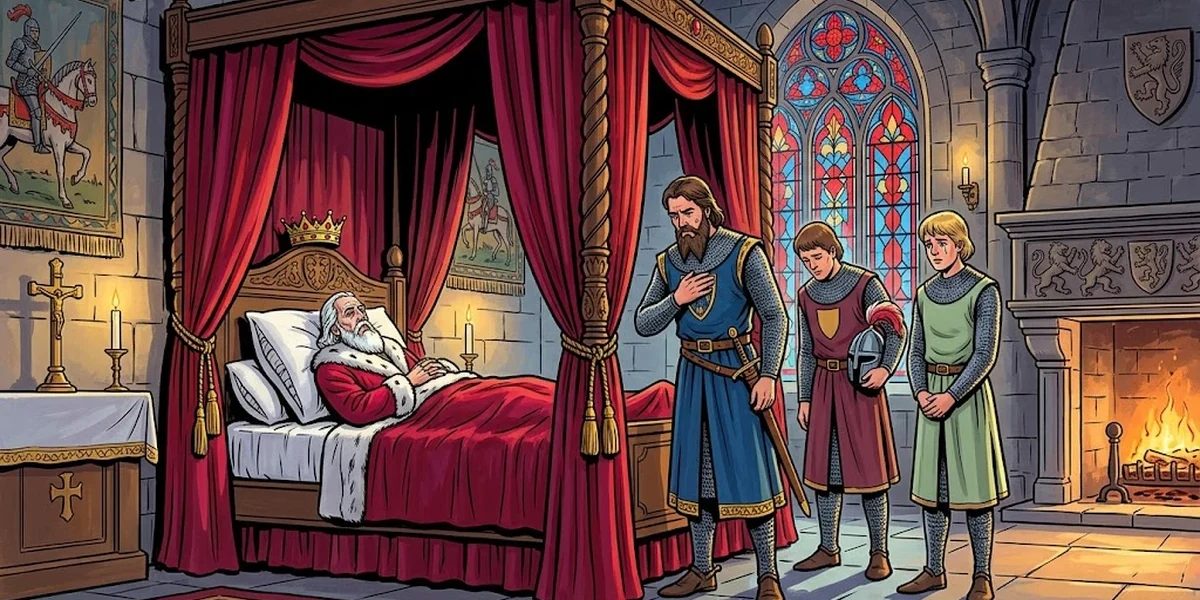
The Water Of Life: Long before you or I were born, there reigned, in a country a great way off, a king who had three sons. This king once fell very ill so ill
Origin: Germany — Kinder- und Hausmärchen, Brothers Grimm, KHM 97 (“Das Wasser des Lebens”), first published in volume 1 (Berlin: Realschulbuchhandlung, 1815) and revised through the 1857 final edition. Tale type: ATU 551 “Water of Life” (formerly AT 551 “The Sons on a Quest for a Wonderful Remedy for their Father”), often crossed with ATU 550 “Bird, Horse and Princess.” Oral source: the von Haxthausen family of Westphalia, who supplied the Grimms with several courtly variants from the Paderborn district. Translators: Edgar Taylor (London, 1826, German Popular Stories) and Margaret Hunt (London, 1884, Grimm’s Household Tales). Read time: 11 minutes.
The Story Behind the Story: An Ancient Elixir Wearing Medieval Armor
“The Water of Life” is one of the oldest narrative motifs the Grimm brothers ever recorded. The quest for an immortal draught reaches back through more than four thousand years of recorded story-telling: the Sumerian Epic of Gilgamesh (c. 2100 BC) sends its hero to the bottom of a cosmic ocean to pluck the plant that restores youth; the Greek philosophers wrote of ambrosia, the food that kept the gods immortal on Olympus; the medieval Arabic Iskandarnâma, the great Romance of Alexander the Great, has the conqueror searching the Land of Darkness with the prophet al-Khidr for a fountain of perpetual life; the Christian Gospel of John (4:14) speaks of “living water” that keeps the drinker from thirsting forever; and the European Grail romances of the twelfth and thirteenth centuries built an entire literature around the cup that heals the wounded king. When the Grimms collected KHM 97 from the von Haxthausen sisters in Westphalia early in the 1810s, they were preserving the late German edition of a story-cycle older than writing itself.
Within the Aarne–Thompson–Uther index, the international catalogue of folk tales, “The Water of Life” carries the type number ATU 551, defined as “The Sons on a Quest for a Wonderful Remedy for their Father.” The cardinal features of the type — the dying king, the three sons, the failure of the proud, the success of the humble, the helpful dwarf or hermit, the enchanted castle of a sleeping princess, the brothers’ theft of credit, the salt-water substitute, and the truth revealed at the wedding — are common to versions collected in Germany, Russia (Afanasyev’s Skazka o trekh tsarstvakh), Italy (Pitrè), Hungary, Greece, Lithuania, India and Iran, although in each region the magical specifics drift to fit the local soil. The Grimms’ German version was annotated in detail by Johannes Bolte and Georg Polívka in their five-volume Anmerkungen zu den Kinder- und Hausmärchen (Leipzig, 1913–1932), volume 2 §97, where they list more than forty European cousins.
The figure of the small grey dwarf with the sugar-loaf cap who tests the brothers at the mouth of the valley is older than Christian Germany. He is a descendant of the Erdmann — the earth-spirit who guards mountain passes and treasure-paths in the Alpine and Westphalian folk imagination — and he plays exactly the same gate-keeping role as the gnome in the Norwegian “Soria Moria Castle,” the hairy Russian leshy, and the fox in the Grimms’ own KHM 57 (“The Golden Bird”). His test is not strength but courtesy: only the youngest brother, who answers his questions civilly, is told the secret of the iron rod, the two loaves, and the lions that guard the castle gate.
The Three Princes and the Dying King
The tale opens in a country “a great way off,” in an age when kings still walked their own gardens. A king has three sons, all of fighting age, and he has fallen so ill that his physicians shake their heads and his courtiers begin to whisper of a successor. The princes walk together in the palace garden in great sorrow, for whatever quarrels they may have among themselves, they all love the old man on the bed. As they pace beneath the espaliered apple-trees, a little old man steps out from behind a hedge — the kind of figure that appears in fairy tales when the plot requires a key — and asks them why they are weeping. They tell him; and he answers, very simply: there is one cure, and one only. It is the Water of Life. A single draught will restore the king. But the spring lies very far away, the road is dangerous, and the gate to it is guarded.
The eldest brother, who has the proud blood of his lineage, declares at once that he will fetch it. He thinks privately, as he saddles his horse: If I bring my father this water, he will make me sole heir to his kingdom and pass over my brothers entirely. Already in this first moment the tale has separated him from his quieter sibling: he hears the old man’s words and translates them into a calculation. The king at first refuses to send him, saying he would rather die than place a son in such peril; but the eldest insists, and out of the gate he rides, fully armed and full of himself.
The Two Elder Brothers: Pride Stops Up the Way
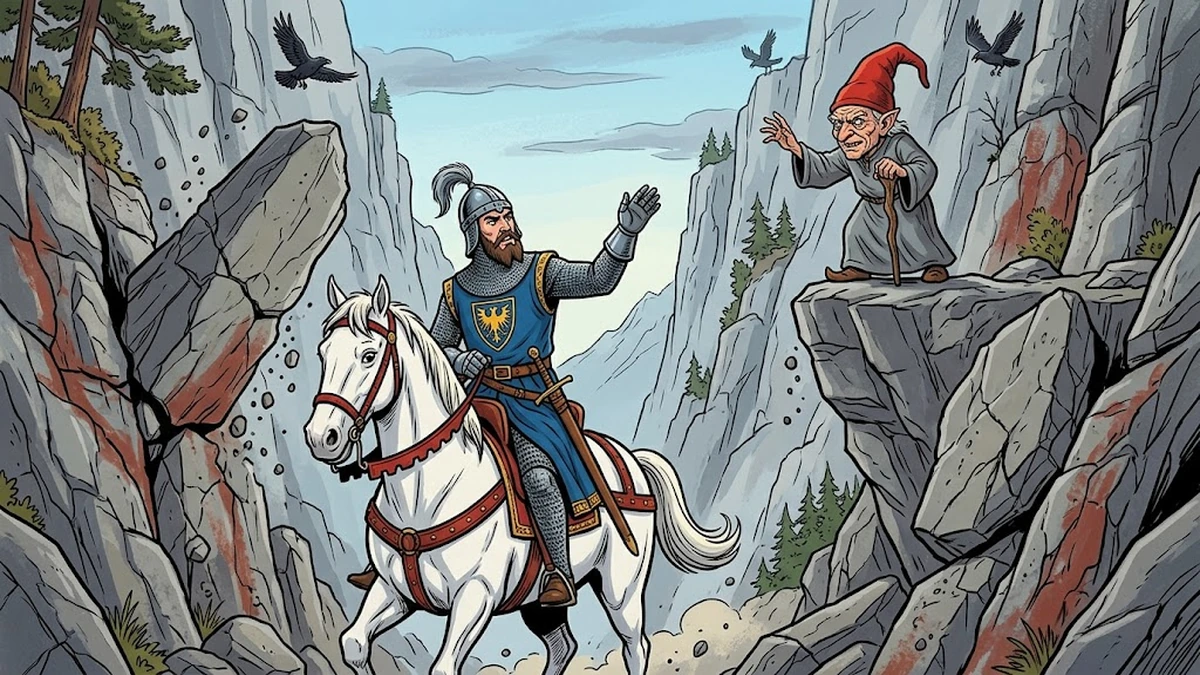
The eldest prince rides for many days through fair country and foul, and at last he comes to a deep valley overhung with rocks and woods. As he looks about, a little ugly dwarf in a sugar-loaf cap and a scarlet cloak appears on a high crag and calls down to him: “Prince, whither so fast?” The prince, in the high tone of a man unused to being questioned, snaps back: “What is that to thee, you ugly imp?” — and rides on without giving the dwarf so much as a nod. The dwarf says nothing more, but lifts his thin grey hand. At once the rocks on either side of the valley begin to slide together; the road, which was wide enough for a wagon, becomes narrow as a footpath; the footpath becomes the merest crack between two cliffs; and the prince’s fine horse is wedged so tightly that it cannot move forward or backward, while the cliff walls press the prince so hard that he cannot draw his sword. He is held in stone like a fly in amber, alive but powerless, while the king lies dying at home and no Water of Life flows.
The middle brother, when months pass and no word comes, sets out in turn. He, too, is brave; he, too, is ambitious. He, too, encounters the dwarf at the same crag, and he, too, gives the same haughty answer. The same hand is lifted; the same cliffs slide together; the same horseman is held fast in the same crack of stone. The tale will not let the audience miss the symmetry. Pride is not a single failure of one bad heart; it is a structural defect, a thing that snaps shut on the proud as predictably as a trap.
The Grimms, in their final 1857 redaction, allowed themselves a brief moralizing line at this point in the German text — “So bekommen die Hochmütigen ihren Lohn” (“Thus do the proud receive their reward”) — which Hunt translated rather more dryly as “such is the wage of pride.” Edgar Taylor’s earlier English version had quietly omitted the gloss, preferring to let the picture do its own work.
The Youngest Brother, the Dwarf, and the Enchanted Castle
At last the youngest prince rides out. He has neither the dignity nor the swagger of his brothers; he does not even tell himself that he will be made heir. He simply asks his father’s blessing and goes. When he reaches the deep valley and the dwarf calls down to him, he reins his horse in, lifts his cap, and answers honestly: “I am seeking the Water of Life, for my father is sick to death.” The dwarf studies him a moment with bright old eyes; then he tells him the secret of the spring.
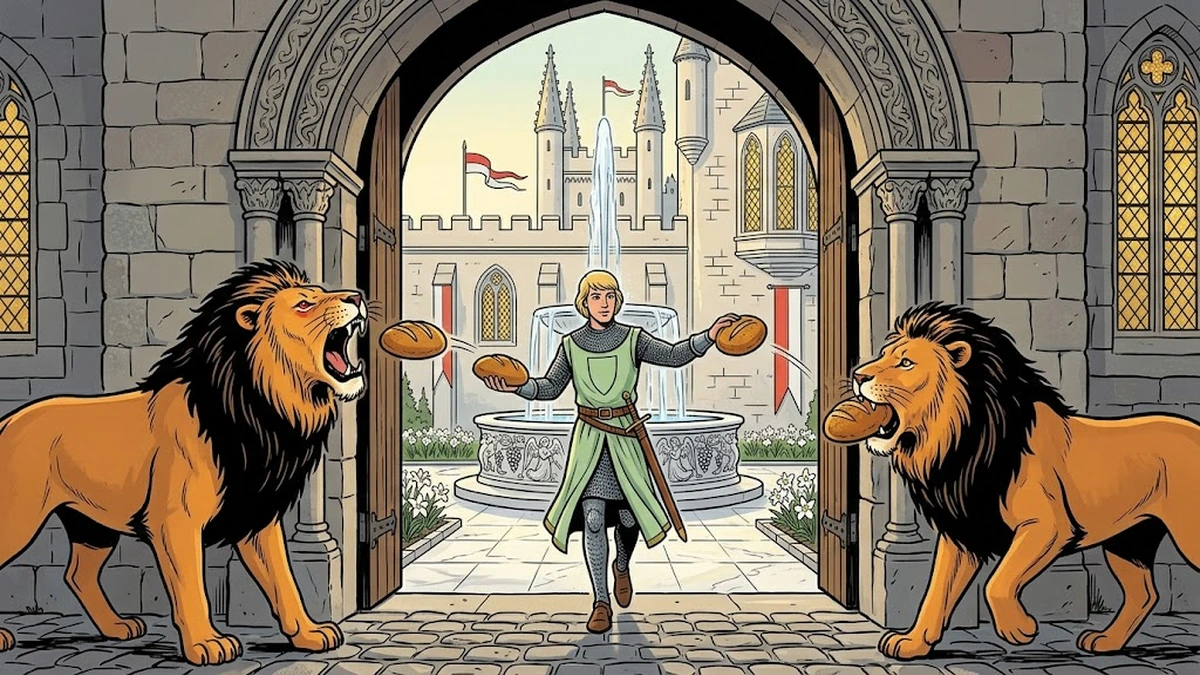
The water, the dwarf explains, lies in the courtyard of an enchanted castle, in a marble fountain. The castle gate is guarded by two great lions whose mouths gape open and whose eyes glow red like coals. To pass them, the prince must throw each lion a loaf of bread — the dwarf gives him two loaves, one in each hand. Once the gate is open he must hurry, for the spell on the castle has a clock: at noon all the doors will swing shut and crush whoever stands between them. Inside the courtyard he will find the marble fountain. He must fill his cup before noon and run for the gate. And, the dwarf adds, in a side hall of the castle there hangs a sword on the wall and there stands a loaf of bread on a table. He may take both, for the sword can fell whole armies and the loaf will never grow smaller no matter how much is sliced from it. And in another hall there sleeps a princess; he may speak to her, but he must not linger.
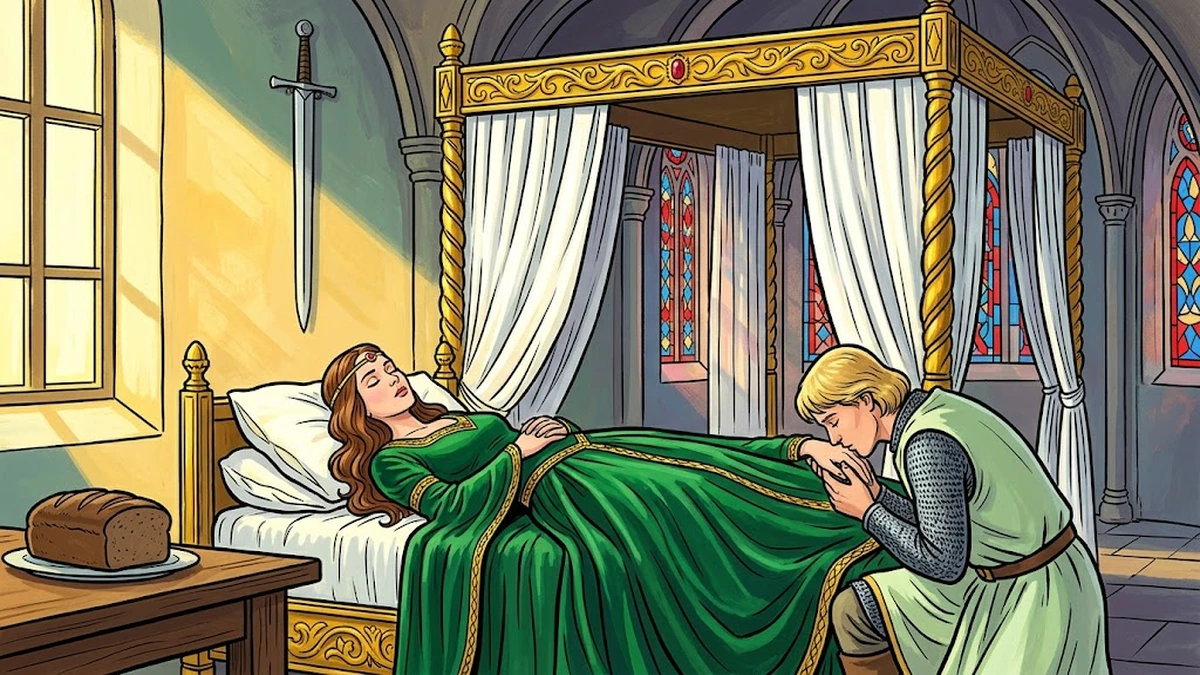
The prince goes on. The lions step aside for the loaves; the doors hold open while he runs. In the inner hall he finds the sword and the never-failing loaf and slips them into his pack; in another hall he finds the princess asleep on a great gold bed, beautiful as the morning. He kneels and kisses her hand; she stirs in her sleep and smiles, and her sleeping voice tells him to come back in a year and a day, when she shall be free of the spell, and they shall be married. He does not stay; he runs to the courtyard, fills his flask at the fountain, runs again. The doors of the castle slam behind him at the last possible heartbeat — one strikes off the heel of his boot — and he is out, with the Water of Life sealed in his flask and the cock just crowing at noon.
The Brothers’ Treachery and the Road Paved with Gold
On his way home the youngest prince passes through three kingdoms in distress — one ravaged by famine, one by war, one by plague — and to each ruler he gives a gift. To the famine-king he lends the loaf that never grows smaller, and the kingdom is fed. To the war-king he lends the sword that fells armies, and the war ends in a day. To the plague-king he gives a single drop from the flask of the Water of Life, and the dying are healed. In each city he is treated as a saviour; bells ring; flowers are strewn in his path. But in his pack the flask still glints full, for the Water of Life replenishes itself, drop for drop, the same way the loaf renews itself slice for slice.
At the same crag in the same valley he meets his elder brothers, freed at last from the cliffs that the dwarf has by now (out of pity for the youngest) released. He greets them with joy, tells them all that has happened, shares his food and his fire. They listen with wooden faces and with envy in their stomachs. That night, while their brother sleeps, the eldest pours the Water of Life from his flask into a smaller bottle of his own, and replaces it with bitter salt water from the sea. The middle brother holds the lantern. They tie up the prince’s pack, they tie up their lips, and at dawn they ride home together, three brothers who left as one and return as one, and only two of them know what is in which flask.
At the palace gate the youngest prince, joyful, hands the flask to his father. The king drinks; the salt water burns his throat; he gasps, accuses his son of trying to poison him, and calls for the executioner. The eldest brother, prepared for this moment, then steps forward with a flask of his own — the stolen flask — and pours the true Water of Life into his father’s mouth. The king is restored on the spot. He embraces his elder son, swears that this is his true heir, and orders the youngest banished to the forest to be killed in secret by a huntsman. The huntsman, however, cannot bring himself to do murder; he sets the prince free in the deep wood, kills a deer, and presents its heart to the king as a token. The youngest is alive but exiled, lost in the forest of his own kingdom, with no name and no Water of Life.
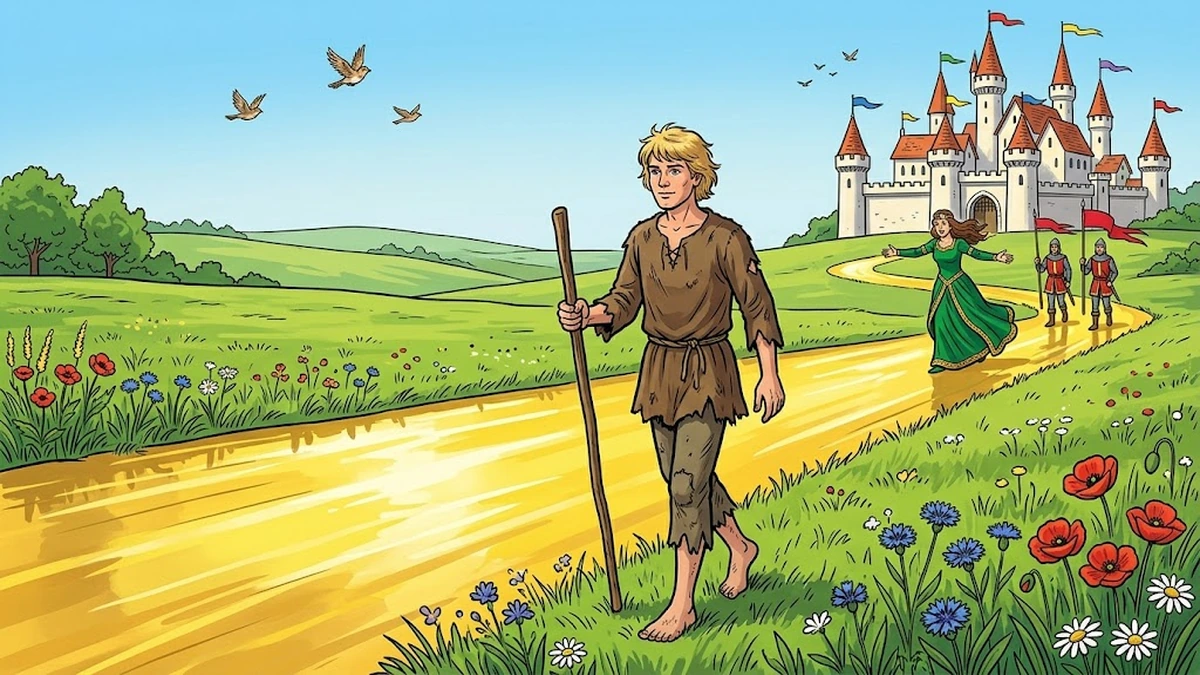
A year and a day pass. The princess of the enchanted castle, freed at last of her spell, comes out into the world to seek the prince who once kissed her hand. She paves a road of pure gold all the way from the castle gate to the country where the dying king has lately been healed, and she sends out heralds to declare that whoever rides up the gold road truly to her shall be her husband. The eldest brother, hearing of the gold, climbs onto his horse and gallops up the road, scattering the gold in his greed. Halfway he sees a beggar by the roadside — a young man in rags — and rides past him without a glance. The middle brother does the same, and is turned back at the castle gate by the watchman, for the princess can read greed in a man’s spurs. At last, sent for by the huntsman, the youngest brother is found in the forest and brought home; he, in his rags, walks the road of gold beside it on the verge, that he may not soil it; the princess sees him from her tower and knows him at once; she runs out, takes his hand, and leads him to the castle, and the truth of the salt water and the substituted flask comes out at last. The king, weeping, restores his youngest son to favor. The eldest brothers flee to sea and are never seen again. The youngest marries the princess. The Water of Life flows on.
The Moral the Grimms Set Down
“So bekommen die Hochmütigen ihren Lohn, und die Demuth wird belohnt.“
(“Thus do the proud receive their reward, and humility is recompensed.”) — closing line, KHM 97, Brothers Grimm, edition of 1857.
The Grimms’ moral is exact and old: pride locks a man in stone, humility opens castle gates. But the deeper moral of “The Water of Life” is sharper than the proverb the brothers wrote underneath it. Pride is a misreading of the world; it interprets every encounter as a transaction. The eldest brother hears the old man in the garden and immediately calculates inheritance; the middle brother hears the dwarf and calculates contempt; both read the universe as ledger, and the universe answers them with stone. The youngest does not calculate. He answers a question with the truth, and the truth is what the dwarf was waiting for. The water that heals the king is not a substance; it is a kind of attention — the willingness to take the world as it actually is, and to say so, even to a stranger in a sugar-loaf cap.
The same logic governs the road of gold. The proud brothers look at the road and see metal; the humble brother looks at the road and sees a woman waiting at the end of it. He walks along the verge so that he will not soil the gift. The road, like the dwarf, is a test of seeing.
Why “The Water of Life” Has Lasted
Of the two hundred tales the Grimms collected, “The Water of Life” is among the dozen or so that almost every European culture preserves in some form — precisely because the questions it asks are basic. Every family discovers, at some point, that one of its members is dying and that the cure is not nearby. Every adolescent discovers that older siblings sometimes get the credit for what the younger ones did. Every reader of the Bible recognizes the living water of the Samaritan well; every reader of Gilgamesh recognizes the underwater plant of immortality; every reader of medieval romance recognizes the Grail. The Grimms’ KHM 97 is the German peasant’s-eye-view of an archetype that runs from Sumer to Strasbourg and is still running.
The tale’s psychological gravity is the reason the Swiss analyst Marie-Louise von Franz returned to it again and again in her lectures on fairy tales (collected in The Interpretation of Fairy Tales, 1970, and Shadow and Evil in Fairy Tales, 1974). For von Franz, the Water of Life is the unconscious itself; the dwarf at the valley mouth is the inner guide; the elder brothers are the parts of the self that try to grasp wisdom by force; the youngest is the part that arrives only by listening. Bruno Bettelheim, in The Uses of Enchantment (1976), used the same tale to argue that the youngest-son motif is essential nourishment for children, who need to believe that the smallest and least respected member of a family can still come back with the prize.
What older readers also find in “The Water of Life” is its quietness. The most famous lines in the tale are not battles or speeches; they are the kiss on the sleeping princess’s hand, the dwarf’s first soft question in the valley, the prince walking beside the gold road instead of on it. These are images of restraint — of a hero whose strength is shown not in what he takes but in what he refuses to take. In an age that often equates strength with grasping, the German fairy tale insists, with old peasant patience, that the truer power is the capacity to leave a road of gold untouched until you are sure of the gift at the end of it.
Across two centuries of children’s editions, of operas (Pfitzner, 1903), of Rackham and Wanda Gág illustrations, of Disney-era cartoons and modern film adaptations, the bones of KHM 97 have not shifted: the dying king, the three sons, the dwarf at the valley, the lions at the gate, the sleeping princess, the salt water in the flask, the road of gold. The motifs hold because they say something true about how people inherit the things that matter — not by fighting for them, but by deserving them. That, in a single sentence, is the moral the Grimms heard in Westphalia and that countless storytellers had heard before them, in countries a great way off, when they were not even yet born.
You May Also Like
 Grimm's Fairy Tales
Ages 9-12
Grimm's Fairy Tales
Ages 9-12
Hans In Luck
Hans In Luck: Some men are born to good luck: all they do or try to do comes right all that falls to them is so much gain all their geese are swans all their
 Grimm's Fairy Tales
Ages 9-12
Grimm's Fairy Tales
Ages 9-12
Sweetheart Roland
Sweetheart Roland: There was once upon a time a woman who was a real witch and had two daughters, one ugly and wicked, and this one she loved because she was
 Grimm's Fairy Tales
Ages 9-12
Grimm's Fairy Tales
Ages 9-12
The King Of The Golden Mountain
The King Of The Golden Mountain: There was once a merchant who had only one child, a son, that was very young, and barely able to run alone. He had two richly