Sleeping Beauty (Briar Rose)
Sleeping Beauty (Briar Rose): On the morning that the princess was christened, the entire kingdom gathered in the grand cathedral of the castle to celebrate
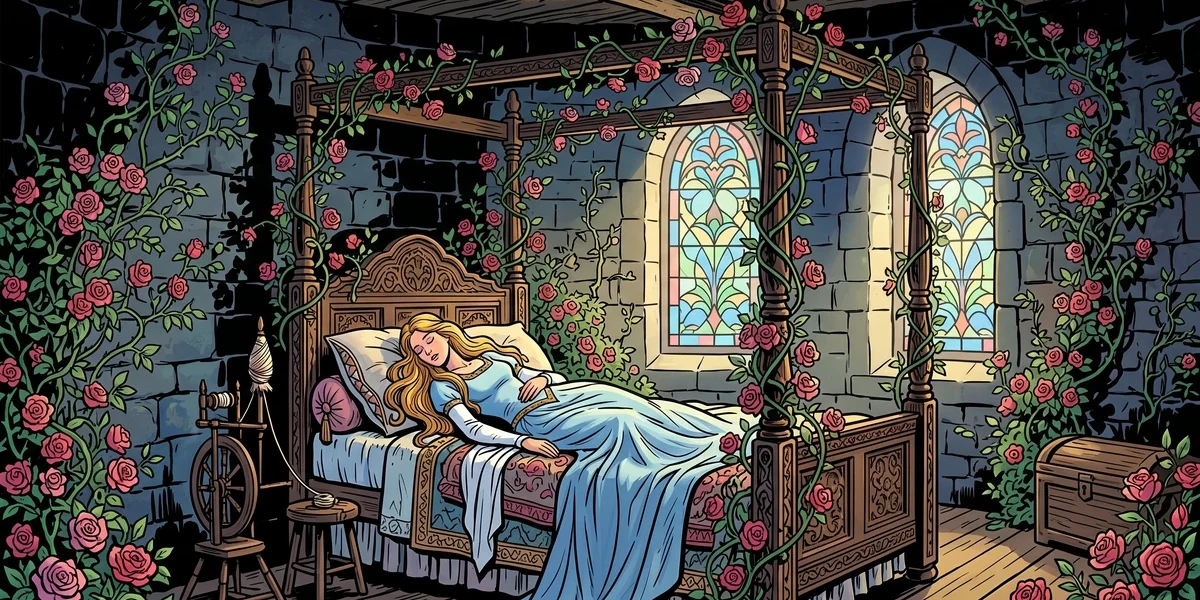
Few European wonder-tales have travelled as far, or sunk as deeply into the imagination of the Christian West, as the story the Brothers Grimm published in the very first edition of the Kinder- und Hausmärchen (Berlin, Realschulbuchhandlung, 1812) under the title Dornröschen — “Little Briar-Rose.” It stands at KHM 50 in their numbering and at ATU 410 “Sleeping Beauty” in the international Aarne–Thompson–Uther tale-type index. Charles Perrault had retold the story more than a century earlier, in his Histoires ou contes du temps passé (Paris, 1697), as La Belle au bois dormant, “The Beauty of the Sleeping Wood.” Earlier still, Giambattista Basile gave the story its first fully literary form in Lo cunto de li cunti, the so-called Pentamerone (Naples, 1634–36), as Sole, Luna e Talia, “Sun, Moon, and Talia.” And the underlying motif — a maiden enchanted into long sleep, guarded by a hedge of thorns, and awakened by a stranger — surfaces still earlier in the Old Norse Völsunga Saga‘s account of the valkyrie Brynhild ringed by Odin’s fire, and in the medieval Provençal romance Perceforest (c. 1340), where a princess named Zellandine is awakened from a comparable slumber.

The Grimms collected their version primarily from Marie Hassenpflug of Cassel in Hesse, a young woman whose Huguenot family had crossed into German lands carrying French nursery culture with them. Heinz Rölleke and Ruth B. Bottigheimer have shown that several of the most “classical” Grimm tales — Dornröschen, Rotkäppchen, Aschenputtel — owe at least some of their shape to this Franco-German salon transmission, in which Perrault’s Contes of 1697 had been reread, retold, and gently redrawn into the Hessian voice. Wilhelm Grimm tightened the wording across seven editions between 1812 and the definitive 1857 Grosse Ausgabe, settling the number of wise women at thirteen — twelve invited, one uninvited because the king possessed only twelve gold plates — where Perrault has eight fairies in all and Basile only three. The instrument of the curse becomes a spindle in Grimm and Perrault, where Basile gives a splinter of flax. The hundred-year sleep, the hedge of thorns that opens of itself when the right hour comes, the kiss that breaks the enchantment — all of this is Grimm’s distillation of an inheritance many centuries old.
The kingdom without a child
The story opens, as so many of the great wonder-tales do, with a long absence. A king and queen sit in their castle and long for a child; year after year their wish is not granted. One day, while the queen is bathing in a forest pool, a frog crawls out of the water and tells her that within a year she will bear a daughter. The prophecy is fulfilled. The girl is born so beautiful that the king cannot contain his joy, and he summons all the wise women of the realm to a great feast — for in those days such women bestowed gifts upon a newborn, gifts of beauty, of virtue, of wisdom, of grace. There were thirteen wise women in the kingdom, but the king possessed only twelve gold plates from which the wise women might eat. So the thirteenth was not invited.
The Grimms understood, as every storyteller before them had understood, that the heart of the tale is this small, almost mathematical injury — a question of plates, a missing place at the table. The thirteenth wise woman is no abstract personification of evil; she is the unloved guest, the one whose gift was not asked for, and her arrival at the feast halfway through the giving is a moment of absolute social cold. Eleven of her sisters have given their gifts. She steps forward without greeting and pronounces her curse: “In the princess’s fifteenth year she shall prick herself with a spindle, and shall fall down dead.” Then she turns and leaves the hall, and the twelfth wise woman, who has not yet given her gift, comes forward and softens what she cannot undo. The princess shall not die — but she shall fall into a sleep of a hundred years.

The forbidden chamber and the spindle
The king, hearing the curse, gives the order that every spindle in the kingdom is to be burnt. Every wheel and distaff in every cottage is gathered up and destroyed; the realm is to grow flax-less, woolless, threadless, rather than risk the prophecy. And here the Grimm version touches one of the deepest patterns of the European folk imagination: the forbidden room, the locked door, the one place in the house where the child has been told never to go. The princess grows up in a kingdom where every spindle has been forbidden because of her — a child raised inside the negative shape of her own danger, her own difference at the centre of a household that has been rearranged around what must not happen to her.
On the morning of her fifteenth birthday the king and queen are away from the palace. The princess wanders alone through the great rooms, opens doors at random for the pleasure of it, and at last comes to an old tower at the corner of the castle she has never entered. She climbs the narrow winding staircase, finds a small door at the top with a rusty key still in the lock, turns the key, and walks into a small bright room. There an old woman sits at a spinning wheel, busily spinning her flax. “Good day, old mother,” says the princess, “what are you doing there?” — “I am spinning,” says the old woman, and nods her head. — “What sort of thing is that, that turns about so merrily?” says the princess, and reaches out her hand to take hold of the spindle. In the moment her fingers close on it, the prophecy is fulfilled. She pricks herself, falls back upon the bed that stands beside the wheel, and the long sleep begins.

The hedge of thorns and the hundred years
The sleep falls upon the whole castle. The king and queen, returning at that moment, sink down where they stand in the great hall. The horses fall asleep in the stable, the dogs in the yard, the doves on the roof, the flies on the wall; the fire that was leaping on the hearth grows quiet and still; the cook, who was about to seize the kitchen-boy by the hair, lets her hand drop and sleeps; the wind dies away, and not a leaf moves on the trees outside the castle window. And around the walls there grows up a hedge of thorns, year by year thicker, year by year higher, until at last the castle is wholly hidden, and only the topmost vane of the highest tower can be glimpsed by anyone who knows where to look.
For a hundred years the story of the sleeping princess in the briar-castle passes through the country. From time to time a king’s son comes who has heard the tale and who tries to push his way through the hedge to her; but the thorns hold fast as if they had hands, and the young men are caught and die miserably. Then at last the hundred years are fulfilled. On the very day the prince arrives, an old man is sitting beside the road who tells him the tale, and the prince says, “I am not afraid; I will go and see the beautiful Briar-Rose.” The thorns part of themselves; they have become a hedge of great roses, soft and fragrant, and the prince walks through unhindered, into the silent courtyard where the doves sleep on the roof, into the kitchen where the cook still holds her hand above the kitchen-boy’s head, up the winding stair of the tower, and into the small bright room where the princess lies. He bends down and kisses her, and at that moment her eyes open and the spell is broken.

Awakening, and the long ordinary day
Everything wakes at once. The king stirs in the great hall; the queen lifts her head; the horses stamp in the stable; the dogs spring up and shake themselves; the doves take their heads from beneath their wings, look about, and fly into the open country; the flies on the wall begin again to crawl; the fire flares up and finishes cooking what it had begun; the meat begins again to roast; the cook gives the kitchen-boy the box on the ear that had been hanging in the air for a hundred years, so that he yells; and the maid finishes plucking the fowl. And the wedding of the prince and Briar-Rose was held with great splendour, and they lived contented to the end of their days.
The Grimms are extraordinarily restrained at this last moment. There is no second curse, no jealous mother-in-law of the kind Perrault preserves from Basile, no second test of the heroine after marriage. Wilhelm Grimm, in editing the tale across the editions of the Kinder- und Hausmärchen, deliberately stripped these later episodes away, leaving the awakening as the conclusion. What remains is a tale about waiting — about the long stretches of a life in which nothing seems to happen, the hundred years in the dark tower behind the hedge, and about the moment when the right hour finally comes and the thorns open of themselves into roses. It is also a tale, quite directly, about adolescence: about the locked room every careful household keeps from its children, the dangerous tool kept just out of reach, and the inevitability of the morning when the child climbs the stair, turns the key, and finds the spindle waiting exactly where it has always been.
The moral
Da gingen sie zusammen herab, und der König erwachte und die Königin und der ganze Hofstaat, und sahen einander mit großen Augen an. Und die Pferde im Hof standen auf und rüttelten sich; die Jagdhunde sprangen und wedelten; die Tauben auf dem Dach zogen das Köpfchen unterm Flügel hervor, sahen umher und flogen ins Feld.
“Then they went down together, and the king awoke, and the queen, and the whole court, and they looked at one another with great eyes. And the horses in the courtyard stood up and shook themselves; the hunting hounds sprang up and wagged their tails; the doves on the roof drew their little heads from beneath their wings, looked around, and flew into the open country.” — Dornröschen, KHM 50, Brothers Grimm 1812
The deep moral of the Grimm Dornröschen is not the pretty cliché that “love conquers all.” It is something stranger and older: that there are injuries which cannot be undone, and that the work of kindness in this world is not to undo them but to soften them. The thirteenth wise woman is not punished, not killed, not even named at the end of the tale; her curse is honoured in full. What the twelfth wise woman does — and what every storyteller from Basile to Perrault to the Grimms has insisted upon — is the smaller, harder act: to sit between the harm and the child, and to translate a death into a sleep. The story tells us that we will not be spared the spindle. It tells us, with great seriousness, that we may yet be spared the worst of what the spindle could mean.
Why the tale has lasted
It has lasted because it is the rare wonder-tale that submits to the experience of waiting — the long stretches in which nothing happens, the hundred years in the dark tower behind the hedge of thorns. Most of the great tales hurry their heroes into action; Dornröschen stops time on purpose. It has lasted because it is honest about offence: the missing thirteenth gold plate is a small social injury that cannot be repaired by good intentions, and the curse that follows is the story’s refusal to pretend otherwise. And it has lasted because it understands adolescence with great economy. Every child raised in a careful household knows what it is to be protected from a dangerous tool. Every adolescent who has climbed a forbidden stair to a small bright room knows what it is to find that tool exactly where it has been kept all along, waiting, turning so merrily.
From the Pentamerone of 1634 to the Contes of 1697 to the Kinder- und Hausmärchen of 1812 to the Tchaikovsky ballet of 1890 and the Walt Disney film of 1959, every generation has found in this story the same central image: a girl who sleeps inside a hedge of thorns, and a hundred-year sleep that is broken only when the right hour comes. The hour comes, in the Grimm telling, not because the prince is stronger than the others who tried — they died miserably in the thorns — but because he arrives on the day the curse expires. The tale does not glorify his courage; it tells us that the world finally turns, and that the thorns, which were thorns to those who came too early, have become roses to the one who comes at the right time.
Frequently Asked Questions
What is the moral of Sleeping Beauty?
Who wrote Sleeping Beauty?
What is the story of Sleeping Beauty?
Why does Sleeping Beauty sleep for 100 years?
Is Sleeping Beauty suitable for children?
You May Also Like
 Grimm's Fairy Tales
Ages 6-8
Grimm's Fairy Tales
Ages 6-8
The Golden Goose: Kindness Rewarded, Greed Punished
The Golden Goose: Kindness Rewarded, Greed Punished: The Foolish Youngest Son In a time when the world still held magic in its forests and mountains, there
 Grimm's Fairy Tales
Ages 9-12
Grimm's Fairy Tales
Ages 9-12
The Twelve Dancing Princesses: A Grimm Retelling
The Twelve Dancing Princesses: A Grimm Retelling: In a grand castle overlooking fertile valleys and dense forests, there lived a king with twelve daughters.
 Grimm's Fairy Tales
Ages 9-12
Grimm's Fairy Tales
Ages 9-12
Rapunzel
Rapunzel: There were once a man and a woman who had long in vain wished for a child. At length the woman hoped that God was about to grant her desire.