Tom Thumb
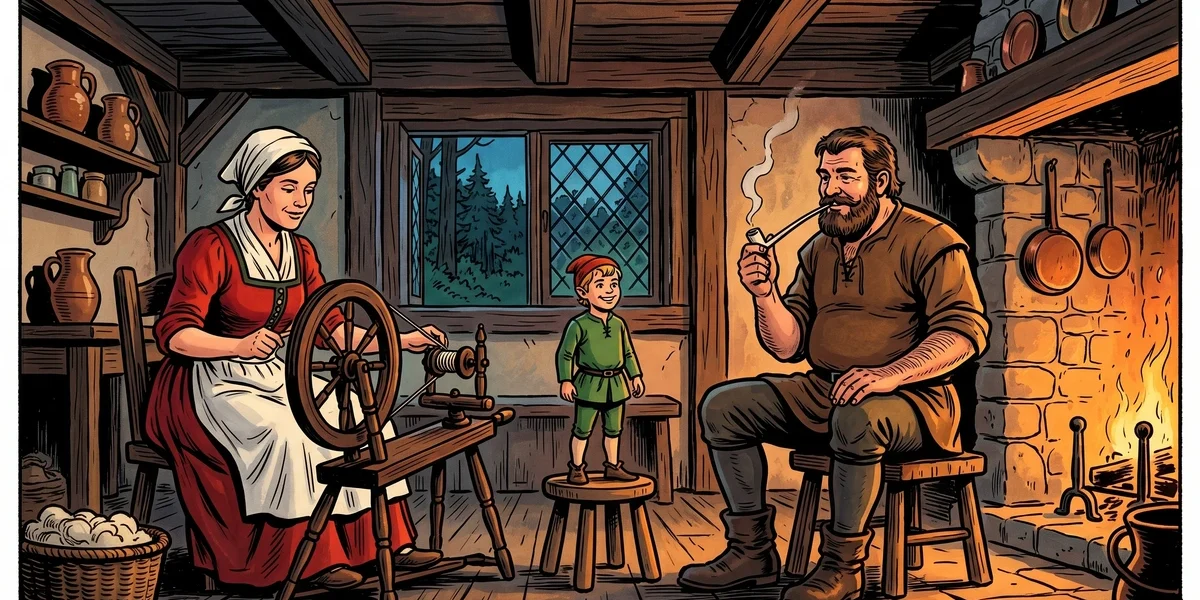
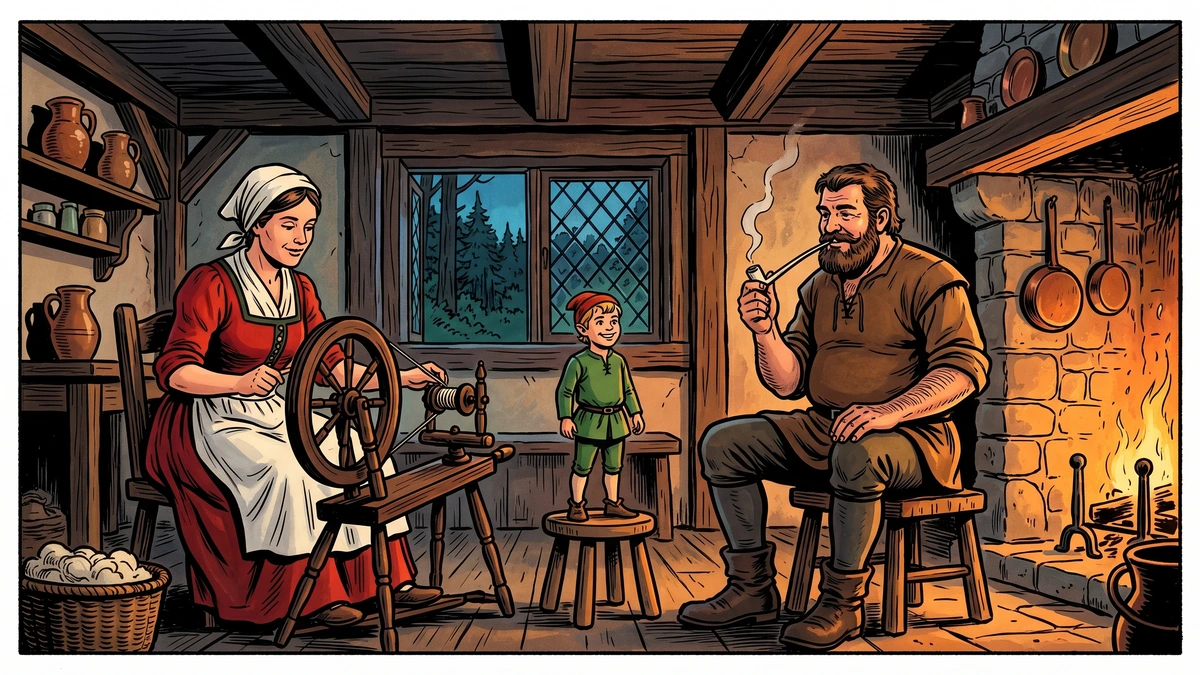
Tom Thumb: A poor woodman sat in his cottage one night, smoking his pipe by the fireside, while his wife sat by his side spinning. How lonely it is, wife,’
Origin: Germany — Kinder- und Hausmärchen, Brothers Grimm, KHM 37 (“Daumesdick”), added to the second edition of 1819 (Berlin: Realschulbuchhandlung) at position thirty-seven and retained in every subsequent edition through the seventh and final of 1857. Tale type: ATU 700 “The Thumbling,” the international type that gathers some hundred fifty European cousins of the smallest-of-children. Oral source: an unnamed informant from Mülheim am Rhein, recorded in the Grimms’ notebooks between 1812 and 1819. Translators used here: Edgar Taylor’s German Popular Stories (London, 1823), where the tale first appeared in English as “Tom Thumb” with engravings by George Cruikshank, and Margaret Hunt’s later Grimm’s Household Tales (London, 1884), in which it appears as “Thumbling.” Companion tale: KHM 45 “Daumerlings Wanderschaft” (“Thumbling’s Travels”), a related ATU 700 variant told to the Grimms by Marie Hassenpflug. Read time: 10 minutes.
The Story Behind the Story: A Wish for a Child No Bigger Than a Thumb
“Daumesdick” did not appear in the famous first edition of Kinder- und Hausmärchen in 1812. It was added by Wilhelm Grimm at position thirty-seven in the enlarged second edition of 1819, after he had heard the tale told in Mülheim am Rhein, the small Rhineland town that supplied the Grimms with several of their most polished narrative voices in the years between the first and the second printings. The unnamed Mülheim informant gave the brothers a tale that was already polished by oral retelling: a brisk, picaresque journey of a child the size of a thumb who outwits robbers, survives the inside of a cow, the inside of a wolf, and the inside of a snail-shell, and at last returns to the cottage of his rejoicing parents with stories enough to fill a winter’s evening. Wilhelm set the manuscript down in the Mülheim notebook, polished its German phrasing through the third edition of 1837 and the fifth of 1843, and let it stand essentially unaltered through the canonical seventh edition of 1857 from which every modern translation, including the Edgar Taylor and Margaret Hunt translations used here, descends.
Within the Aarne–Thompson–Uther index of international tale types, KHM 37 belongs to type ATU 700, “The Thumbling,” a category Hans-Jörg Uther’s 2004 revision lists in more than fifty national folk-tale collections from the Hebrides to the Caucasus. Johannes Bolte and Georg Polívka, in volume one of their five-volume scholarly redaction Anmerkungen zu den Kinder- und Hausmärchen der Brüder Grimm (Leipzig, 1913–1932), §37, list more than one hundred European parallels — an English “Tom Thumb” preserved by Richard Johnson in 1621 and printed as one of the earliest English-language fairy tale chapbooks; a French “Le petit Poucet” set down by Charles Perrault in Histoires ou contes du temps passé in 1697; an Italian “Il pulcino piccolino” preserved by Giambattista Basile in the Pentamerone of 1634; a Russian “Little Boy Thumb” recorded by Alexander Afanasyev in 1855–1864; and Scandinavian, Hungarian, Romanian, Greek and Armenian sisters and brothers stretching the type across the whole of Europe. All of them turn on the same conceit: a child the size of a thumb survives precisely because of the smallness that ought to have killed him.
The English-speaking world met the Grimm tale first in 1823, when the London barrister Edgar Taylor published German Popular Stories — the very first English translation of the Grimms — with engravings by George Cruikshank that fixed the tale’s iconography for the nineteenth century. Taylor borrowed the name “Tom Thumb” from Richard Johnson’s seventeenth-century English chapbook because he wanted English children to recognize the figure at once; the German “Daumesdick,” literally “Thumb-thick,” became “Tom Thumb” by Taylor’s editorial decision and has been “Tom Thumb” in English nurseries ever since. Margaret Hunt’s later 1884 translation in two volumes for George Bell & Sons reverted to the literal “Thumbling,” giving English readers two parallel English titles for KHM 37 that have run side by side for nearly two hundred years.
The Wish at the Spinning-Wheel and the Birth of Tom Thumb
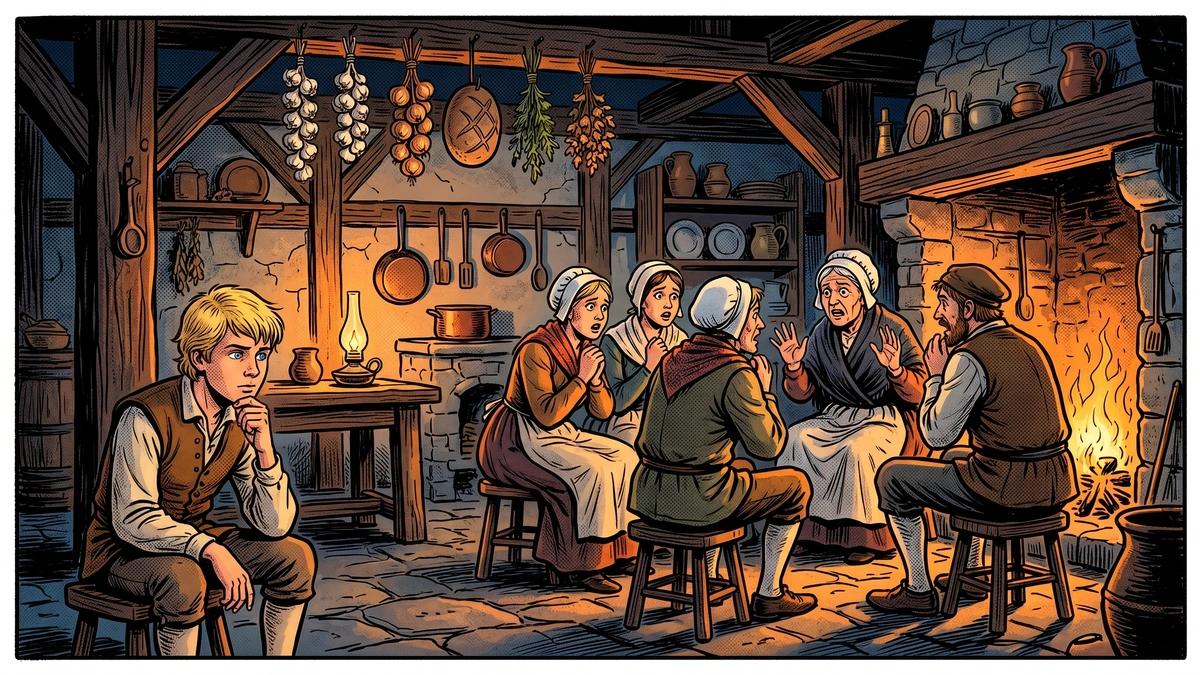
The tale opens with one of the most quietly beautiful images in the Grimm corpus: a poor woodman and his wife sitting alone in their cottage at evening, the man smoking a pipe by the fireside, the woman turning a wooden spinning-wheel beside him. “How lonely it is, wife,” the woodman says, watching the smoke curl up into the rafters, “for you and me to sit here by ourselves, without any children to play about and amuse us, while other people seem so happy and merry with their children!” The wife, in a sigh that Taylor catches with great skill in his 1823 English, answers: “What you say is very true. How happy should I be if I had but one child! If it were ever so small — nay, if it were no bigger than my thumb — I should be very happy, and love it dearly.” The fire crackles. The wheel turns. Outside, the great German forest rises against the night.
And the wish is granted, in the literal manner of fairy tales. Not long after, the wife bears a son who is “quite healthy and strong, but not much bigger than my thumb.” The parents, struck with the precision of the wish made flesh, name him Thomas Thumb — Daumesdick in the German, “Thumb-thick,” because he is exactly as long as the joint of his mother’s thumb and not a needle’s breadth longer. They feed him with all the care that any peasant mother gives a single late-born child — bread soaked in milk, cabbage broth, the white meat of a winter chicken — but he never grows. He stays the size of a thumb, year after year. His eyes, however, the Grimms tell us, are sharp and sparkling. He is, they note, “a clever little fellow, who always knew well what he was about.” The cottage adjusts to him. He sleeps in a walnut-shell cradle. He climbs the spinning-wheel as if it were a watermill. He rides the cat between the kitchen and the parlour. He learns to whistle by sticking his head into the bowl of his father’s pipe. He is, by the time the woodman next harnesses the horse, ready for an adventure that the woodman cannot imagine giving him.
The first adventure is the horse-cart adventure, and it is among the most charming scenes in any European fairy tale. The woodman is harnessing his horse to drive into the forest for fuel and complains aloud that he has no one to bring the cart on after him. Tom, hearing this, climbs onto the bench beside his father and announces: “Father, I will take care of that. The cart shall be in the wood by the time you want it.” The woodman laughs — “How can that be? You cannot reach up to the horse’s bridle” — but Tom is ready. “Never mind that. If my mother will only harness the horse, I will get into his ear and tell him which way to go.” The mother lifts the lad up to the great horse’s twitching ear, drops him gently inside, and Tom, settled in the warm dark of the ear-canal, calls out “Go on!” and “Stop!” and “Gently, gently!” as the cart rumbles down the woodland road. Two strangers, walking the same lane, hear a tiny voice giving orders to a horse and see no driver on the bench. They follow at a distance, astonished, until they catch sight of the woodman in the clearing and his thumb-sized son being lifted out of the horse’s ear. They take their first long look at Tom Thumb and they begin to scheme.
The Strangers, the Mouse-Hole, and the Snail-Shell
The strangers, in the manner of strangers in nineteenth-century Hessian forests, see in the small boy a fortune. They take the woodman aside and offer him a piece of gold the size of a pigeon’s egg if he will sell them his son to carry from town to town as a show. The woodman, indignant, refuses: “My own flesh and blood is dearer to me than all the silver and gold in the world.” But Tom, listening from his perch on the woodman’s coat-shoulder, whispers in his father’s ear: “Take the money, father, and let them have me; I’ll soon come back to you.” The trade is made. Tom is set on the brim of a stranger’s broad black hat, declares that the brim makes a fine gallery from which to see the country, and the two men set off down the road with the woodman’s gold heavy in one pocket and the woodman’s son small upon the other.
That evening Tom asks to be set down in a ploughed field to stretch his legs. The strangers, tired and inattentive, lift him from the hat-brim onto a clod of earth at the edge of the road. Tom darts at once between two great furrows of black soil, finds the entrance to an old mouse-hole, dives in, and burrows down. “Good night, my masters!” he calls back; “I’m off! Mind and look sharp after me the next time.” The strangers poke their walking-sticks into the hole, then their hands, then their longest twigs; they call into it; they kick the soil; the dusk thickens; the field goes dark; and at last they go away cursing without their prize. Tom, deep inside the mouse-tunnel, waits an hour after their footsteps have faded and then crawls out into the moonlit field. The earth-clods are mountain-sized. He worries he will fall from one of them and break his neck. He hunts along a furrow until he finds an empty snail-shell, white and dry and large enough to crawl into, and he creeps in for the night, whistling to himself in the German way.
And in the snail-shell he overhears the second adventure of the night. Two robbers come along the path beside the field, conspiring in low voices about how to steal the silver and gold of the rich parson of the next village. Tom, perfectly hidden in his snail-shell, calls out from the ground: “I can show you how!” The robbers, frightened by a voice rising from the dirt, hunt about until they find the snail-shell with the small boy inside, lift him out, and hold him up in the moonlight. “You little urchin,” they say, “what can you do for us?” Tom replies in the cool, level voice that has now become his trademark: “I can slip between the iron window-bars of the parson’s house and throw you out whatever you want.” The robbers grin. They tuck Tom into a coat-pocket and walk on through the night towards the parson’s silver-plate.
The Parson’s House, the Cow’s Belly, and the Wolf’s Larder
What follows is, in every retelling of KHM 37, the comic turn that has made Tom Thumb beloved of nursery audiences for two centuries. Tom slips between the parson’s iron window-bars without difficulty — the bars are as wide as a barn door to him — and lands lightly among the silver candlesticks. But instead of working in silence, as the robbers expect, he calls out at the top of his small lungs: “Will you have all that is here?” The cook, sleeping in the kitchen below, sits bolt upright. The robbers, hearing the cry, hiss frantically through the window: “Quietly, quietly!” Tom pretends to mishear and shouts louder: “What did you say? Will you have it all? Then I’ll throw it out!” The cook is now lighting a candle. The robbers crouch in the bushes outside. The cook, a stout woman with a stick in her hand, comes upstairs to find the silver candlesticks rattling on the table and no man near them. She finds nothing. She mutters about cats. She stamps back to bed. The robbers, whispering threats, signal Tom to throw the silver out at last. He calls back, in the same level cheerful voice: “Stand close, then; I am going to throw out a great deal.” But by then the cook has come up a second time, and Tom, with the perfect timing of a born trickster, slips down into the hay-loft to sleep among the warm dry stalks. The robbers, their plot ruined, vanish into the dark.
Tom sleeps in the hay until morning, when the maid comes to feed the cow her breakfast. She fills her armful from the very heap of hay where Tom is curled, carries it to the cow’s manger, and pours it in. Tom, half-asleep, is poured in with it. The cow eats. He goes down the cow’s gullet in a great wet swallow before he can even shout. He arrives in the cow’s stomach, where it is pitch-dark and where the warm grass is constantly being delivered fresh from above and where there are no windows. “Good gracious!” Tom cries from the cow’s interior; “the brewer must have forgotten the windows of his house!” The maid, milking the cow, hears a tiny voice calling out from somewhere in the byre and runs in terror to the parson. The parson, fearing the cow possessed, has the cow killed at once. The slaughterman cuts open the cow’s stomach and throws its contents on the dung-hill outside. Tom is in the contents. Just as he is starting to crawl out of the wet straw and the half-digested grass, a hungry wolf comes by, sees the heap, and swallows the whole cow’s stomach down at a gulp — Tom, unfortunately, included.
The wolf’s belly is the third interior in which Tom Thumb has had to live, and Tom, by now an experienced inhabitant of small dark places, makes the best of it. “Friend wolf,” he calls up the wolf’s gullet, “I know a place where you can find a wonderful feast: a cottage in the wood with a larder full of cake and ham and sausage and bread; you can eat as much as you can hold.” The wolf, naturally, asks where this cottage is. Tom describes the woodman’s cottage in such precise detail — the path through the chestnut-trees, the broken pump, the little door of the larder that does not quite latch — that the wolf trots straight there and squeezes in through the larder window. He eats. He gorges himself; he eats every sausage on the hook, every cheese on the shelf, every loaf in the bread-bin and every honey-cake in the jar. By the time he has finished, his belly is so swollen with the Grimm cottage’s winter stores that he cannot fit back through the window he came in by. Which is exactly what Tom Thumb has been waiting for. Tom, from inside the wolf’s belly, begins to shout at the top of his lungs: “Be quiet, be quiet!” the wolf hisses, “you’ll wake the people of the house!” But Tom shouts louder: “What does that signify? You have eaten your fill and I’ll have a little fun, too!” And he sets up such a yelling and hooting and screaming that the whole wood echoes.
The Moral the Grimms Set Down
“Wer klein ist und klug, der findet sein Glück im Bauch des Wolfes wieder.“
(“He who is small and clever finds his way home again, even from the belly of the wolf.”) — paraphrase of the moral the Grimms attach to KHM 37 in the Anmerkungen volume of 1822, restated by Bolte and Polívka, §37.
The woodman and his wife, asleep in the bedroom above the larder, are wakened by the small voice of their lost son shouting for help inside their own pantry. The woodman seizes a great hatchet from the woodshed; the wife seizes a scythe from the kitchen wall. They burst into the larder. The wolf, his belly ridiculously swollen with stolen sausage and a small son inside, is wedged half in and half out of the window. The woodman lifts the hatchet and brings it down with one clean stroke on the wolf’s neck; the wolf falls dead among the ham-bones and the broken jars. With his hunting knife the woodman cuts the wolf’s belly open along the line of its sleeping breath, the way the goat-mother in KHM 5 cut open the wolf’s belly to free her seven kids; and out of the cut, weak from his three swallowings but otherwise unharmed, climbs Tom Thumb. “Ah, father,” he says, blinking in the candlelight of the larder, “where have I been wandering? I have been in a mouse-hole, in a cow’s stomach, and in a wolf’s belly, and now I am at home with you.” The mother bursts into tears and kisses him on the forehead. The father puts away the hatchet. They give him fresh clothes and a bowl of warm milk and they all three sit by the fire as the dawn comes up over the chestnut-trees of the Mülheim wood, and they declare, in the line that closes the Grimms’ tale and that is the moral the Mülheim informant gave them: “We would not part with him for all the gold and silver in the world.”
The moral the Grimms set down in their Anmerkungen notebooks for KHM 37 is, in its plainest peasant form, that smallness is not weakness; that cleverness in a tiny body can do what strength in a great body cannot; and that a child, however small, belongs at the kitchen fire of his own parents and not on the brim of any stranger’s hat. Tom Thumb is sold for gold and walks back home a free child; he is swallowed by a cow and walks back home a free child; he is swallowed by a wolf and walks back home a free child. Every interior closes around him and every interior, in the end, must open. The Grimms understood — and their Mülheim informant understood before them — that this is the deepest lesson a fairy tale can give to the smallest child in any nursery audience: you may be the smallest in the room, you may be carried off in a hat, swallowed in a manger, swallowed in a meadow, but if you keep your wits about you, the door of every belly opens at last, and your father’s hatchet is on its way.
Why “Tom Thumb” Has Lasted
The reason “Daumesdick” has lasted in nursery culture for four hundred years — from Richard Johnson’s English chapbook of 1621 through Perrault’s “Le petit Poucet” of 1697 through Basile’s Pentamerone of 1634 through the Mülheim informant of 1819 through Edgar Taylor and George Cruikshank in 1823 through Margaret Hunt in 1884 to twenty-first-century picture books in seventy languages — is that it does, in twelve minutes of reading, what no parental lecture can do in a year. It teaches a child that smallness is the world’s most underestimated power. The strangers think they have bought a slave; the mouse-hole hides him. The robbers think they have hired a tool; the cook frightens them off. The cow swallows him; the cow is killed. The wolf swallows him; the wolf is killed. Each adversary, larger than Tom by a thousandfold, is undone by a body the size of a thumb shouting at exactly the wrong moment from inside its own machinery. Every culture that has ever raised small children has needed this lesson; every culture that has ever needed to give that lesson without sounding like a sermon has reached for some version of Tom Thumb.
And the tale lasts because of its homecoming. Unlike many ATU 700 cousins — the Russian Boy-Thumb who marries a princess, the French Petit Poucet who saves his brothers from the ogre — the Grimms’ Tom Thumb does not become a hero of legend; he simply comes home. The closing image of KHM 37 is the smallest in the Grimm corpus and the warmest: a thumb-sized boy in fresh clothes drinking warm milk by the fire of his parents’ cottage, the dawn breaking over the Mülheim wood, the mother weeping for joy, the father laying the hatchet aside. The Grimms understood, with the instinct of two brothers raising a household full of younger Grimms, that a tale told to small children at bedtime must end at the kitchen fire. Tom Thumb’s adventure is not the journey out into danger; it is the journey back to the kitchen. The mother’s wish at the spinning-wheel in the opening line — “if it were no bigger than my thumb, I should love it dearly” — is fulfilled in the closing line, when the parents declare that they would not part with him for all the gold and silver in the world. The wish at the wheel is the moral of the tale. The smallest child, for the parents who love him, is enough.
Frequently Asked Questions
Where does the Grimm Brothers’ “Tom Thumb” come from, and when was it first published?
“Tom Thumb” is the English title used by Edgar Taylor in 1823 for the German tale “Daumesdick” (literally “Thumb-thick”), tale number 37 in the Brothers Grimm’s Kinder- und Hausmärchen. Although the famous first edition of the Grimms appeared in 1812, KHM 37 was not part of it. Wilhelm Grimm added “Daumesdick” to the second, enlarged edition of 1819 (Berlin: Realschulbuchhandlung) at position thirty-seven, after recording it from an unnamed informant in Mülheim am Rhein, the small Rhineland town that gave the brothers several of their most polished narrative voices. The tale stayed essentially unchanged through the canonical seventh edition of 1857. Edgar Taylor’s London 1823 translation, illustrated by George Cruikshank, was the first English appearance; Margaret Hunt’s 1884 Grimm’s Household Tales gave the alternative literal title “Thumbling.”
What is the ATU tale-type classification of “Tom Thumb,” and what are its closest international cousins?
KHM 37 is classified as ATU 700, “The Thumbling,” in the Aarne–Thompson–Uther index of international folk-tale types. Hans-Jörg Uther’s 2004 revision lists the type in over fifty national folk-tale collections. Johannes Bolte and Georg Polívka, in their five-volume scholarly redaction Anmerkungen zu den Kinder- und Hausmärchen der Brüder Grimm (Leipzig 1913–1932), §37, list more than one hundred European parallels. The closest cousins are: Richard Johnson’s English chapbook “Tom Thumb” of 1621 (one of the earliest English-language fairy-tale prints); Charles Perrault’s French “Le petit Poucet” in Histoires ou contes du temps passé (Paris, 1697); Giambattista Basile’s Italian “Il pulcino piccolino” in the Pentamerone (Naples, 1634); Alexander Afanasyev’s Russian “Little Boy Thumb” in his 1855–1864 Narodnye russkie skazki; and parallel forms in Scandinavian, Hungarian, Romanian, Greek and Armenian collections. All turn on the same conceit: a child the size of a thumb survives precisely because of the smallness that ought to have killed him.
What is the “moral” of “Tom Thumb,” and what original-language line does the Grimm version preserve?
The moral the Grimms set down in their 1822 Anmerkungen volume for KHM 37 is, in plainest peasant form: “Wer klein ist und klug, der findet sein Glück im Bauch des Wolfes wieder” — “He who is small and clever finds his way home again, even from the belly of the wolf.” The tale’s closing line is the spoken moral the Mülheim informant gave to Wilhelm: when the woodman cuts Tom out of the dead wolf, the parents embrace their son and declare, “We would not part with him for all the gold and silver in the world.” The deeper teaching, traced by Bolte and Polívka and by every subsequent Grimm scholar, is that smallness is not weakness: cleverness in a tiny body can do what strength in a great body cannot, and a child, however small, belongs at his own parents’ kitchen fire and not on the brim of any stranger’s hat.
How does Grimm’s “Tom Thumb” (KHM 37) differ from the related KHM 45 “Thumbling’s Travels”?
The Brothers Grimm in fact collected two distinct ATU 700 tales: KHM 37 “Daumesdick” from an unnamed informant in Mülheim am Rhein, and KHM 45 “Daumerlings Wanderschaft” (“Thumbling’s Travels”) from Marie Hassenpflug, the eldest of the three Hanau Hassenpflug sisters whose Huguenot kitchen gave the Grimms many of their most polished tales. KHM 37 is the homecoming story: the thumb-sized boy of a poor woodman is swallowed by a cow and a wolf, escapes both, steers the wolf to his parents’ larder, is freed by his father’s hatchet, and ends at the kitchen fire. KHM 45, by contrast, is the wandering-apprentice story: the thumb-sized son of a tailor sets out into the world, ventures into the recesses of a glove (as Edgar Taylor noted in 1823), works as a servant for a series of masters, and returns at last with a small fortune. The two tales share their hero’s body and ATU type but tell opposite shapes: one a comic round trip, the other a coming-of-age journey out.
Why has “Tom Thumb” lasted in children’s literature for four hundred years?
The tale has lasted from Richard Johnson’s 1621 chapbook through Perrault in 1697 and Basile in 1634, through the Mülheim informant of 1819, through Edgar Taylor and George Cruikshank’s London 1823 edition, through Margaret Hunt’s 1884 translation, to twenty-first-century picture books in seventy languages, because it does in twelve minutes of reading what no parental lecture can do in a year: it teaches a small child that smallness is the world’s most underestimated power. Tom is sold for gold and escapes through a mouse-hole; he is taken up by robbers and frightens off the cook; he is swallowed by a cow and the cow is killed; he is swallowed by a wolf and the wolf is killed. Each adversary, larger than Tom by a thousandfold, is undone by a body the size of a thumb shouting from inside its own machinery. The closing image — a thumb-sized boy drinking warm milk by his parents’ fire as the dawn breaks over the Mülheim wood — completes the homecoming arc that has made KHM 37 the warmest small-hero tale in the Grimm canon.
You May Also Like
 Grimm's Fairy Tales
Ages 9-12
Grimm's Fairy Tales
Ages 9-12
The Straw, The Coal, And The Bean
The Straw, The Coal, And The Bean: In a village dwelt a poor old woman, who had gathered together a dish of beans and wanted to cook them. So she made a fire
 Grimm's Fairy Tales
Ages 9-12
Grimm's Fairy Tales
Ages 9-12
1. How They Went To The Mountains To Eat Nuts
1. How They Went To The Mountains To Eat Nuts: The nuts are quite ripe now,’ said Chanticleer to his wife Partlet, ‘suppose we go together to the mountains
 Grimm's Fairy Tales
Ages 9-12
Grimm's Fairy Tales
Ages 9-12
The Golden Bird
The Golden Bird: A certain king had a beautiful garden, and in the garden stood a tree which bore golden apples. These apples were always counted, and about