The Frog King (Iron Heinrich)
The Frog King (Iron Heinrich): In the days when wishes still came true and a frog could speak the language of men, there was a King with a daughter of terrible
The Frog King (Iron Heinrich) — in the original German Der Froschkönig oder der eiserne Heinrich — is the very first tale (KHM 1) in the Kinder- und Hausmärchen of the Brothers Grimm, published in 1812 and revised through seven editions to 1857. In the Aarne-Thompson-Uther international type-index it is catalogued as ATU 440, “The Frog King or Iron Henry,” with a tail of ATU 516B motifs (the faithful servant) grafted onto the closing scene. The Grimms received the story from Henriette Dorothea Wild (“Dortchen”) of Cassel, the apothecary’s daughter who would later marry Wilhelm; an earlier Latin epitome dated to about 1487 in the manuscript Wienhausen Liederbuch preserves an older Low-German oral version. Edgar Taylor’s German Popular Stories (London, 1823) introduced the tale to English readers as The Frog-Prince; Margaret Hunt’s standard 1884 translation kept the older formula The Frog-King. What makes this opening tale of the Grimm collection unique among the world’s frog-bridegroom narratives is the unforgettable coda of der treue Heinrich — Faithful Henry — whose three iron bands burst at the moment his master’s joy returns. The tale binds together two ancient lessons of the German countryside: that a promise is more solid than its speaker, and that fidelity, in the right hour, breaks even iron.
The Linden, the Spring, and the Falling Ball
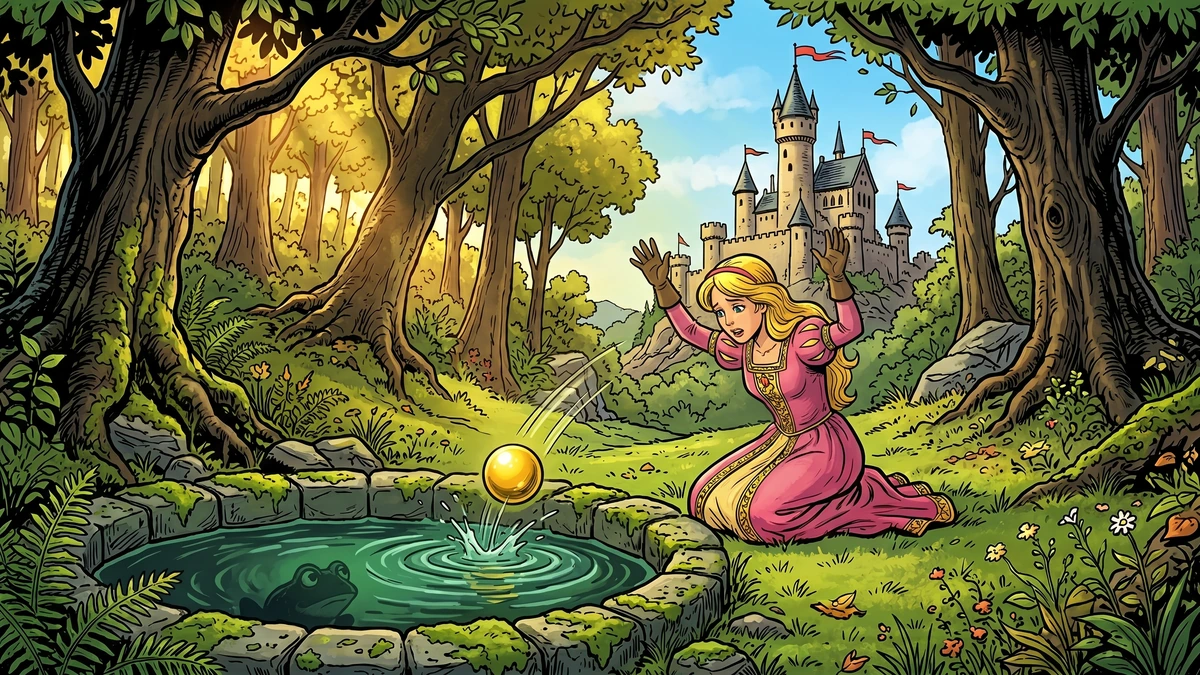
“In den alten Zeiten, wo das Wünschen noch geholfen hat, lebte ein König, dessen Töchter waren alle schön,” runs the immortal opening — “In olden times when wishing still helped, there lived a king whose daughters were all beautiful.” The youngest, the Grimms add, was so radiant that even the sun, which has seen so many marvels, was astonished each time it shone upon her face. Her habit on hot afternoons was to wander beyond the castle gardens to a deep cool spring beneath an old linden tree, the lime-leafed Tilia sacred in southern Germany since the Carolingian forest law as the tree of peace and of village judgement. There she would sit on the mossy stones with her favourite plaything — eine goldene Kugel, a golden ball — tossing it up into the green canopy and catching it as it fell. The ball is more than a toy: in the symbolic vocabulary of the Grimm tales it is a sphere of solar perfection, the round wholeness of girlhood that no person yet has asked her to set aside.
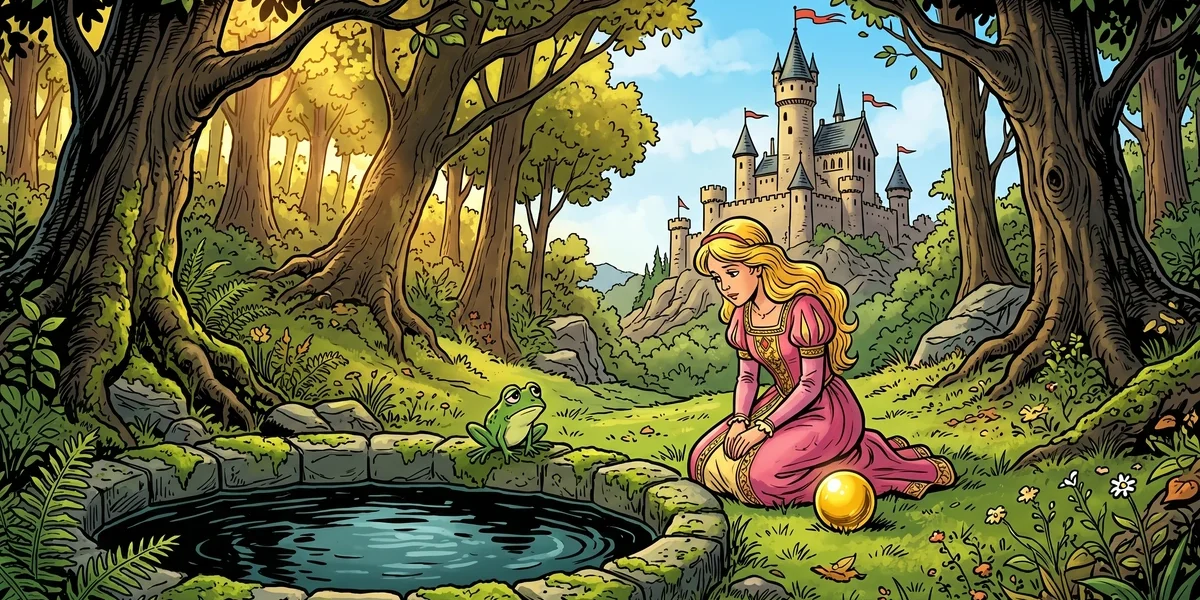
One afternoon she throws it too high, her hand misses, and the gold rolls to the rim of the spring and tips over. The princess weeps as if her heart would break. From the depths an answer rises: “Was hast du vor, Königstochter? Du schreist ja, dass sich ein Stein erbarmen möchte.” A frog has lifted his thick, ugly head out of the dark water and asks why she laments so. He will fetch the ball, he says; but he wants neither pearls nor jewels nor her crown of gold — he wants what cannot be bought. “Willst du mich lieb haben” — “if you will love me, and let me be your playfellow, and sit by you at your little table, and eat from your little golden plate, and drink from your little golden cup, and sleep upon your little bed — if you will promise me all this, I will dive down and bring back your golden ball.”
The princess promises everything, certain that an ugly frog by a forest spring is in no position to enforce his side of the bargain. She thinks the spoken word is wind. The Grimms know better. The frog plunges; he returns with the gold in his wide mouth and tosses it gleaming on the grass. The princess snatches it up and runs for the castle deaf to his small voice behind her: “Warte, warte!” — “Wait, wait! I cannot run as you can!” The promise has been spoken aloud beside the spring, and in the moral grammar of every Grimm household, a spoken promise is no longer the speaker’s: it has been breathed into the world, and the world keeps it.

The Knock at the King’s Door, the Plate, the Cup, the Pillow
That very evening, as the princess sits at the long supper table beside her father the king, an unhurried wet sound climbs the marble stair: plitsch, platsch, plitsch, platsch — an onomatopoeic line preserved verbatim from oral telling, and one of the most famous sound-effects in the German language. A small voice calls from outside the great doors. “Königstochter, jüngste, mach mir auf!” — “Youngest king’s daughter, open to me!” The princess turns pale. Her father, an old man of plain habits and unbending honour, sets down his knife and asks calmly what frightens her. Reluctantly she confesses the bargain at the spring. The king’s reply is the moral hinge of the whole collection of Kinder- und Hausmärchen: “Was du versprochen hast, das musst du auch halten.” — “What you have promised, that you must also keep.” Go, he tells her, and let him in.
What follows is one of the most extraordinary scenes of small humiliations in all of European folktale. The frog hops across the polished floor and demands to be lifted to the table. He demands to eat from her own little golden plate; she pushes the plate towards him with bad grace, and only the king’s stern eye keeps her courteous. He demands a sip from her golden cup. He demands, finally, to be carried to her chamber and laid upon her silken pillow. At every step the princess weeps with revulsion, but the king’s authority is absolute. The genius of the Grimms’ telling is that there is no escape clause and no clever way out. There is no third sister to take the burden, no helpful fairy at the bedchamber door, no riddling intervention. There is only the unglamorous discipline of keeping one’s word when one would dearly rather not. The frog’s small, methodical demands — plate, cup, pillow — are the precise tally of what the princess hoped to wriggle out of paying. The Grimms knew their German countryside: in a culture where land titles, dowries, betrothals and inheritance were sealed by spoken oath in the open air, the lesson that a promise is heavier than the throat that uttered it was the first lesson a child needed.

The Wall, the Transformation, the Eight White Horses
What happens next differs strikingly between the 1812 first edition and the popular Victorian retellings, and folklorists from Heinz Rölleke onward have studied the variants closely. In Edgar Taylor’s gentler 1823 English version — the one most familiar to Anglophone readers — the spell breaks because the princess relents, lets the frog sleep on her pillow, and finds in the morning a handsome prince standing beside her. In the Grimms’ own 1812 German, the breakthrough is more violent and more truthful to the psychology of forced reconciliation: the princess, in a fury at finding the frog still beside her in the morning, snatches him up and hurls him with all her strength against the wall. “Patsch!” writes Wilhelm Grimm, with the same blunt onomatopoeia he used at the marble stair. The impact, not a kiss, shatters the enchantment. The frog falls to the floor a king’s son, with kind and beautiful eyes. The motif of the kiss — so familiar from twentieth-century picture books, advertising, and the Disney Princess and the Frog (2009) — appears nowhere in any Grimm edition; it is a Victorian and modern overlay, a softening of the older story’s harder, truer line that transformation can be achieved as much by exasperation honoured as by tenderness given.
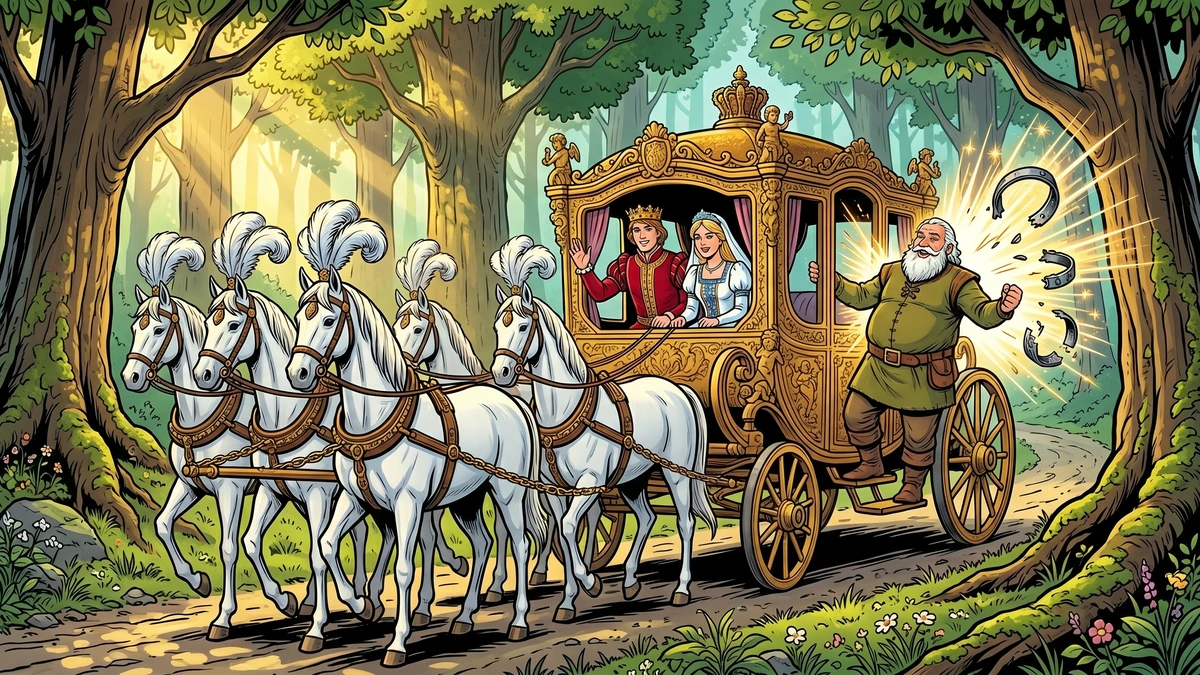
The prince explains, in courteous formal speech, that a wicked witch had cursed him into frog-shape, and that no one in the world could have released him but the youngest princess of this very kingdom. With the king’s blessing they betroth, and the next morning eight white horses with white ostrich plumes on their heads draw a magnificent coach to the castle gate. The harness is of golden chains; the wheel-rims are bound in silver. The princess and the prince climb up; and behind the coach, on the running-board, stands the prince’s faithful servant, der treue Heinrich — Faithful Henry. He greets his rescued master in silence, with a face of unspeakable gladness, and the carriage moves off through the linden avenue.
The Three Iron Bands and the Bursting of the Heart
The coda that gives the tale the second half of its German title is one of the most affecting passages in the entire Kinder- und Hausmärchen. As the white horses pick up speed along the forest road, three loud reports ring out one after another — krack! krack! krack! The prince, alarmed, leans out of the window and cries to his servant: “Heinrich, der Wagen bricht!” — “Henry, the carriage is breaking!” Each time Faithful Henry answers in the same couplet, preserved verbatim from the oral telling and reproduced in every German edition since 1812:
“Herr, der Wagen bricht nicht,
Es ist ein Band von meinem Herzen,
Das da lag in grossen Schmerzen,
Als Ihr in dem Brunnen sasst,
Als Ihr eine Fretsche wär’t.”
“Master, the carriage does not break: it is a band from my heart, which lay there in great anguish when you sat in the well, when you were a frog.”
Three times the cracks ring out; three times the answer is the same; three times an iron band falls cleanly from the breast of the loyal servant who, on the day his master had been cursed into frog-shape, had bound his own chest with three iron hoops to keep his heart from bursting of grief. Now that joy has come back into the world, the iron is no longer needed: the bands break of themselves, in order, as the coach rolls home through the kingdom. This faithful-servant motif is itself an old story, found earlier in the medieval German Volksbuch tradition and parallel to themes in Hartmann von Aue’s Der arme Heinrich (c. 1190); Wilhelm Grimm welded it onto the Frog-King narrative either from a separate oral source within the Wild household or from manuscripts he consulted in Friedrich Karl von Savigny’s library at Marburg. The result is a tale that speaks in two registers at once: the princess must be faithful to the word she has spoken; the servant must be faithful to the master who has been taken from him; and the magic of the story — its quiet conviction that the world rewards both kinds of faithfulness with the breaking of bonds and the arrival of eight white horses — is exactly the reason the Grimms placed this tale at the head of the book.
The Moral
“Was du versprochen hast, das musst du auch halten.” — Brothers Grimm, KHM 1, 1812.
“What you have promised, that you must also keep.”
Three principles, the tale insists, hold the household and the kingdom together: the inviolability of a spoken promise; the calm authority of a parent who refuses to let a child wriggle out of her word; and the readiness of a love that has waited — even concealed in a faithful servant’s iron-bound chest — to break its own bonds the moment the beloved is restored.
ATU 440 and the Frog-Bridegroom Family of Tales
In the international tale-type index, The Frog King is type 440, named “The Frog King or Iron Henry” after the Grimms’ canonical version. Hans-Jörg Uther’s revised Types of International Folktales (FFC 284, Helsinki 2004) records cognate frog-bridegroom narratives across most of Europe, with a strong continuum running from Scotland and Ireland through the Low Countries and Germany into the Slavic east. Stith Thompson’s older Motif-Index of Folk-Literature (1955-58) groups the central enchanted-bridegroom motifs under D195 (transformation: man to frog) and B643.1 (marriage to person in frog-form). The earliest written northern European analogue is the Scottish ballad The Well at the World’s End, collected by Robert Chambers in Popular Rhymes of Scotland (1842) but evidently older, in which a beggar-girl’s stepmother sends her to draw water in a sieve and a helpful frog at the well demands kisses in return for plugging the sieve with moss. A late-13th-century Welsh fragment, the Vita Mereduci, also preserves an enchanted-prince frog episode released by an act of fidelity. The Grimms’ own Anmerkungen (notes) to the third edition of 1856 list four oral variants — from Hesse, the Paderborn region, the Schwalm valley, and Lower Saxony — and a Latin couplet of about 1487 from the Wienhausen Liederbuch (“Iuncfraw du müst my dem yu juncfern slaen”) that constitutes the oldest known continental Germanic written witness.
What sets the Grimm version apart from its Scottish, Irish, and Slavic siblings is precisely the welding of two distinct tale-types into one story. The first half — spring, golden ball, broken promise, frog at the king’s table — is ATU 440 proper. The second half — the faithful servant whose iron heart-bands burst when joy returns — is ATU 516B, “The Iron Henry” / “the faithful servant.” Their fusion gave the Grimms’ opening tale its symmetrical doubling: the princess learns the discipline of her own word; the servant exemplifies the discipline of love that has waited. Where the witch’s spell breaks against the bedchamber wall, the iron bands break of themselves on the open road. Two kinds of fidelity, two kinds of release, in a single narrative arc — this is what makes KHM 1 the indispensable opening note of the entire collection.
Iron Heinrich and the Medieval German Faithful-Servant Tradition
The figure of der treue Heinrich belongs to a distinct strand of medieval German narrative about the loyal retainer whose body bears the marks of his master’s misfortunes. The closest literary parallel is in Hartmann von Aue’s late-12th-century verse romance Der arme Heinrich, in which a faithful servant figure also endures bodily transformation in his master’s service. The iron-band motif itself is paralleled in the Volksbuch tradition surrounding the Sigurd-Siegfried legends, and in folk reports of village blacksmiths who, having learned that a beloved lord had been cursed, bound their own ribs with iron to prevent their hearts from cracking. Wilhelm Grimm encountered a fragment of such a heart-band tale in oral tellings around Cassel; his editorial decision to attach it to the Frog-King narrative was not antiquarian whimsy but a deliberate compositional choice. The tale begins with a girl who would rather not keep a promise; it ends with a man whose love has been so absolute that his body had to be tied together with iron until joy came to undo it. The two halves rhyme — the bond of word, the bond of heart — and the rhyme is what makes the tale immovable from its place at the head of the book.
Why The Frog King Has Lasted Two Centuries
That this tale opens the Kinder- und Hausmärchen is no accident. The Grimms understood — with a peasant clarity that no later moralist has improved upon — that children and adults alike needed a foundational story about keeping one’s word before any other lesson could safely rest upon it. From its first English appearance in Edgar Taylor’s German Popular Stories (1823, with George Cruikshank’s spry etchings) through Lucy Crane’s 1882 translation, Margaret Hunt’s scholarly 1884 edition, and Walter Crane’s chromolithograph picture-books of the 1870s; on into Hans Fischer’s gentle 1956 lithographs, Maurice Sendak’s drawings, the Disney animated short of 1959, Anne Sexton’s sharp adult poem in Transformations (1971), Jane Yolen’s Sleeping Ugly retelling, and the Disney feature The Princess and the Frog (2009) — the tale has continually been re-illustrated and re-imagined. Every retelling, however prettily decorated, answers the same primal question with which the youngest princess wrestles at the king’s supper table: What does it cost to be the kind of person who keeps a promise even when keeping it is humiliating? And the answer, two centuries on, is still the answer the old king gave: it costs everything for one evening — and afterwards, the iron bands of a faithful heart break of their own accord, and a coach drawn by eight white horses comes for you.
You May Also Like
 Grimm's Fairy Tales
Ages 9-12
Grimm's Fairy Tales
Ages 9-12
Cinderella (Aschenputtel)
Cinderella (Aschenputtel): Long ago in a merchant’s grand estate, there lived a young girl of extraordinary grace and kindness. Her name was Ella, though after
 Grimm's Fairy Tales
Ages 9-12
Grimm's Fairy Tales
Ages 9-12
Pied Piper of Hamelin | German Legend of Promises Broken (9-12+)
The German legend of Hamelin: rats, a broken bargain, and the children who followed the piper. History, moral, and FAQ.
 Grimm's Fairy Tales
Ages 9-12
Grimm's Fairy Tales
Ages 9-12
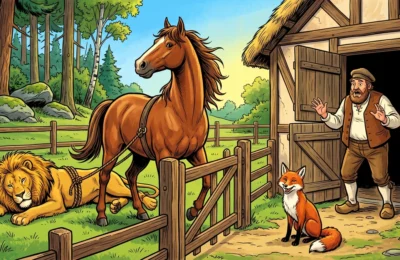
The Fox And The Horse
A farmer had a horse that had been an excellent faithful servant for many years. At length the horse grew old and worthless, and the farmer wanted to get rid of him without giving anything.