The Golden Goose
The Golden Goose: There was a man who had three sons, the youngest of whom was called Dummling,[*] and was despised, mocked, and sneered at on every occasion.

The Golden Goose — known in the original German as Die goldene Gans — is tale number 64 in the Brothers Grimm Kinder- und Hausmärchen, the celebrated Children’s and Household Tales first published in Berlin in 1812. The story sits in the great oral folk-stream that the Aarne–Thompson–Uther index catalogues as ATU 571 — “All Stick Together”, a tale type whose central comic image is a chain of greedy, curious, or self-important busybodies who, through grasping at a magical golden bird, find themselves ridiculously stuck in a procession that finally makes a melancholy princess laugh. Jacob and Wilhelm Grimm credit the tale in their notes to two oral informants: a story from Hesse (most likely supplied by the Hassenpflug family of Cassel, who were among the brothers’ most prolific Hessian sources) and a parallel version from the Paderborn region (probably drawn from the von Haxthausen circle of Westphalia). English readers met the tale first through Edgar Taylor’s pioneering 1823 translation, German Popular Stories, which George Cruikshank illustrated with the bristling line-engravings that helped fix the European imagination of fairy-tale woodlands; Margaret Hunt later issued a more philologically careful rendering in 1884 for George Bell & Sons, and her wording remains the standard English text in most modern reprints. In the Stith Thompson Motif-Index of Folk-Literature the tale draws together motifs D1413 (magic object holds person fast), H341 (suitor task: making the princess laugh), L13 (compassionate youngest son as hero), N825.3 (old man as helper), and Q42 (generosity rewarded), a fingerprint that recurs across the Indo-European tradition from Basile’s seventeenth-century Neapolitan Pentamerone to Russian and Norwegian variants of the same comic shape.
I. Three Sons, Three Loaves, Three Choices in the Wood
The story opens in a German peasant cottage of the kind Jacob Grimm catalogued so lovingly in his Deutsche Mythologie: a timber-framed dwelling at the edge of a great forest, smoke curling from a stone chimney, hens scratching in the yard, and a mother kneading dough at a scrubbed deal table. The family has three sons, and the youngest is called Dummling—a Hessian diminutive that Margaret Hunt translates as “Simpleton” and Edgar Taylor leaves untranslated, preserving the affectionate scorn the name carries in the dialect. He is, the narrator tells us, “despised, mocked, and sneered at on every occasion,” a clue to the tale’s deep moral architecture: this is one of the great jüngste-Sohn-Märchen, the youngest-son fairy tales, in which the household fool turns out to possess the only kind of intelligence the tale ultimately rewards.
One day the eldest son sets out into the forest to hew firewood. His mother packs him a fine sweet cake (Eierkuchen, Grimm’s notes specify) and a bottle of new wine. In a clearing among the beech trunks he meets a little grey-haired old man — one of the Wichtelmänner figures who haunt German folklore as testers of hearts — who asks him politely for a piece of cake and a swallow of wine. The eldest, calculating his own appetite first, refuses with a sneer: he will not share. He picks up his axe, swings it at a tree, and the blade glances off and gashes his arm. Bleeding, he limps home. The same misadventure befalls the second son, who likewise refuses the old man and likewise wounds himself. The pattern is the iron logic of the folk-tale’s rule of three: two refusals, two punishments, and the moral ground perfectly prepared for the third.

Dummling, when his turn at last comes, is given only a cake of ashes baked under the hearth-stones and a bottle of sour beer—the household’s contempt made edible. Yet when the same little old man steps out from behind a beech tree and asks him for a share, Dummling answers without hesitation: he has only poor stuff, but the old man is welcome to it, and they will sit down together. The moment they unwrap his bundle the ash-cake has become a sweet cake and the sour beer good wine—the first of the tale’s quiet, almost off-hand transformations, in which kindness produces its own miracles before any visible magic intervenes. When the meal is over the old man tells Dummling to fell a particular old tree, “and at its roots thou wilt find something.” Dummling obeys, the trunk crashes down, and there in the hollow squats a goose with feathers of pure gold.
II. The Inn, the Innkeeper’s Three Daughters, and the Sticking Spell
Dummling tucks the goose under his arm and sets out for an inn, intending to spend the night before walking on. The inn is described in the comfortable lineaments of an early-nineteenth-century Hessian Gasthaus: a half-timbered building with a painted sign, a tiled stove in the parlour, oak settles, pewter tankards, and three daughters of the innkeeper who are at the staircase the moment the strange guest arrives with his impossible bird. Each daughter is fascinated, and each, in turn, decides to wait until the others are asleep and to pluck just one feather of gold for herself. The eldest creeps down first; the moment her fingers close on a feather, her hand is fixed fast to the goose, and she cannot move. The second sister comes a moment later, sees her sister stuck, and reaches out to help — only to find that her hand sticks instantly to the elder’s gown. The third arrives, calling out a warning to keep away, but her sister cries, “For heaven’s sake, keep away!” Too late: a touch and she too is fastened, and the three of them must spend the night standing rigid by the goose.
The next morning Dummling, perfectly serene and entirely unaware that anyone has tried to rob him, picks up the goose by its neck and walks out, never noticing the three sisters trailing helplessly behind. The folkloric machinery here is the magic adhesion motif, Stith Thompson D1413, an ancient and widespread comic engine: in Basile’s Pentamerone IV.4, “Lo Bbabbasone,” it is a magical object that creates a queue of clinging ridiculous figures; in the Norwegian “På gullberget” tradition the same plot drives a similar comic procession. The Grimms preserved the structure exactly because it provided one of the most cinematic images in the entire fairy-tale corpus — an unwitting hero, a magical bird, and a steadily lengthening tail of stuck pursuers, each new busybody adding to the absurdity of the parade.

III. The Comic Procession Through the Village
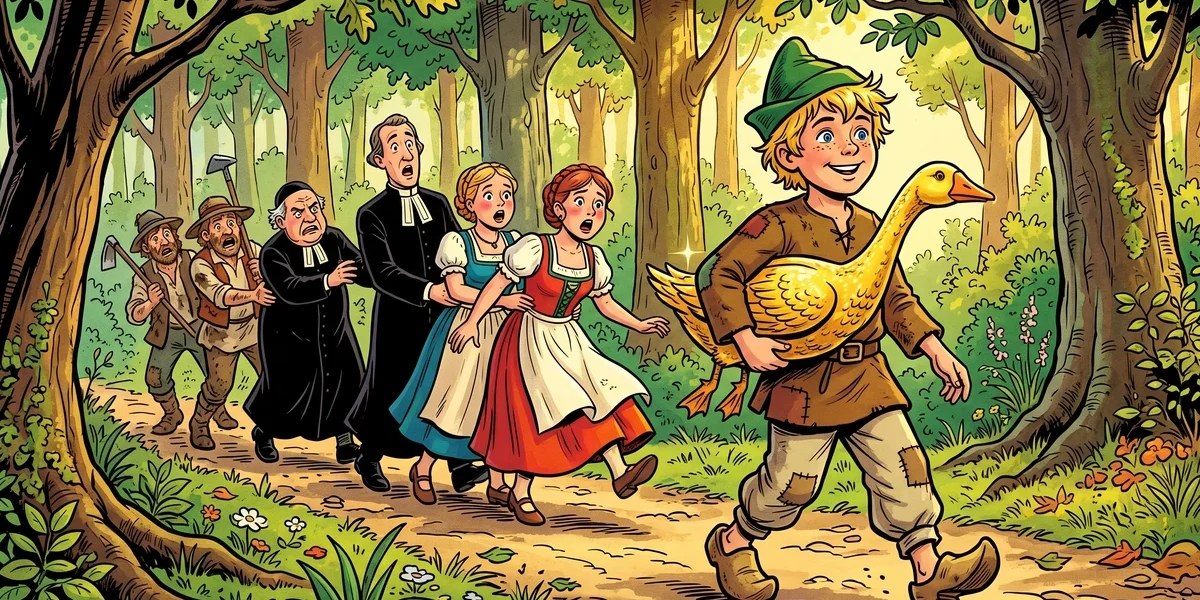
Out on the road, the trail of caught fools grows by an iron logic of social satire. A parson, hurrying to morning service, sees the three young women trotting after a peasant lad and disapproves loudly — “Are you not ashamed to chase the young man through the field?” — and seizes the youngest sister by the hand to pull her away. He sticks. A sexton coming the other way, scandalized at the sight of a clergyman trotting through the village with an inn-keeper’s daughter, takes the parson by the sleeve to admonish him; he sticks too. Two peasants with hoes over their shoulders, stopping to gawk at the spectacle of priest and sexton and three girls all running after a goose, are called by the sexton to release them; the moment they touch the holy man’s robes they are fastened and added to the chain. So Dummling, perfectly oblivious, walks across country with seven foolish people clinging to one another behind him, and behind them all the golden goose flashing its impossible feathers in the morning sun.
This is one of the most pointed pieces of folk-comic satire in the entire Kinder- und Hausmärchen. Each new addition to the chain represents a different social pretension — the inn-keeper’s daughters’ greed, the parson’s officious moralising, the sexton’s busybody propriety, the peasants’ rubbernecking curiosity — and the magic of the golden goose punishes every one of them with the same comic fate: the inability to let go. The Grimm brothers, who in their philological work were tireless documenters of regional German custom, were also acute readers of the way folk humour pricks the dignity of every estate. Their parson is no anti-clerical caricature in the Voltairian style; he is the Hessian village priest of their own observation, full of reflexive moral certainty, and his fate in the procession is gentle but exact.
IV. The Sad Princess, the Three Impossible Tasks, and the Old Man Returns
Dummling’s road brings him at last to a city ruled by a king whose only daughter has never in her life laughed. The king, in his grief at her perpetual sadness, has issued an edict: whoever can make the princess laugh shall marry her. Many princes and clever young men have tried and failed, for the princess’s gloom is profound and her court is starched stiff with formality. Dummling, knowing nothing of the edict, simply walks into the city square with his goose and his trailing chain of seven captives. The princess, looking down from her tower window, sees a peasant lad ambling along with a golden bird under his arm and seven adults — three young women, a parson in his cassock, a sexton in his black gown, and two muddy peasants with hoes — running absurdly behind him, each clinging helplessly to the next. She bursts into peals of laughter that shake the palace, laughter that goes on and on and cannot be stopped.

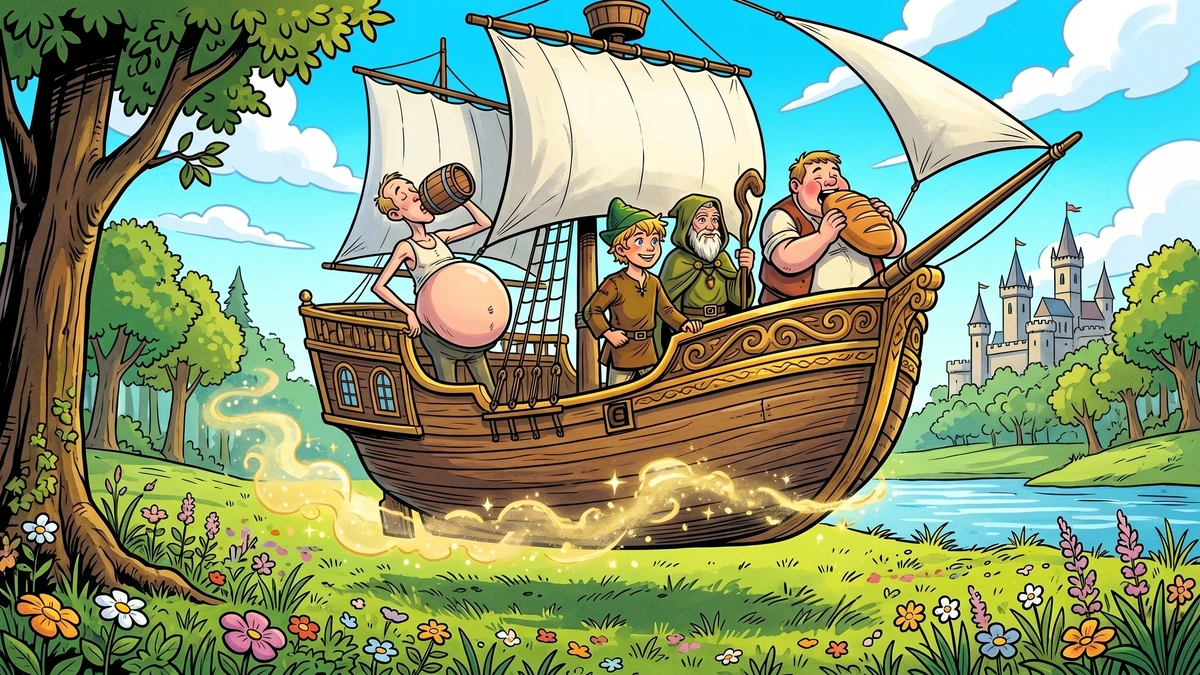
The king, delighted, summons Dummling and offers his daughter; but the king has, in true folk-tale fashion, his second thoughts, and he sets the boy three impossible tasks before the wedding can be celebrated. Dummling must find a man who can drink a whole cellar full of wine; he must find a man who can eat a mountain of bread; and he must produce a ship that will sail on land as well as on water. Dummling does what every fool-hero of the folk-tradition does in his hour of need: he goes back to the place where he had once been kind. In the same forest clearing he finds the same little grey-haired old man, who reveals himself now in his true folkloric office — the helpful donor, Stith Thompson motif N825.3, the supernatural rewarder of generous youngest sons. The old man produces a thirsty companion who can drain the cellar at one draught, a hungry companion who can devour the bread-mountain, and finally the magical ship that sails over field and meadow and river alike. The king, his every objection met, has no choice but to keep his word.
V. The Wedding, the Inheritance, and the Tale’s Final Image
Dummling marries the princess; the old king dies in due course; and Dummling, the despised youngest son, the boy who had been given ashes and sour beer, becomes king after him and rules the realm in long contentment with his wife. The Grimm text closes on this almost matter-of-fact dynastic note, a pattern repeated across a great many tales in the collection: the apparent fool is the true heir, kindness is the only reliable form of cleverness, and the social order is renewed not by the calculating elder brothers but by the open-hearted youngest son who shared his ash-cake in a forest clearing.
Moral — Die Moral der Geschichte
“Wer freundlich gibt, dem wird zurückgegeben; wer nichts geben will, der hält am Ende selbst die Hand fest am goldenen Gut und kann nicht mehr los.”
The German moral — literally, “Whoever gives kindly receives back; whoever will give nothing ends by sticking his own hand fast to the golden goods and cannot let go” — folds the entire two-part comic engine of the tale into a single image. The brothers refused, and the woods refused them in return; the daughters and the parson and the sexton and the peasants grasped, and the goose held them prisoner; Dummling alone, who shared without calculation, walked out of the forest with the bird, then with a kingdom, then with a princess for a wife. The moral does not teach that one ought to be foolish in order to be lucky; it teaches that what looks like cleverness in the elder brothers is in fact a meanness of soul that makes them unable to recognise the old man in the wood for what he really is. Generosity is itself a form of vision.
Why The Golden Goose Has Lasted Two Hundred Years
Of the more than two hundred tales in Kinder- und Hausmärchen, only a relative handful — Cinderella, Snow White, Hansel and Gretel, Rapunzel, Little Red-Cap, Rumpelstiltskin, the Bremen Town Musicians, and the Golden Goose among them — have crossed every linguistic and cultural border to become genuinely global. Die goldene Gans‘s endurance has many sources. Its central comic image — a chain of pompous adults stuck helplessly to a magical bird — is one of the most visually translatable jokes in the European folk repertoire, and it has been illustrated by every major fairy-tale artist from Cruikshank in 1823 through Walter Crane and Arthur Rackham to the picture-book traditions of the twentieth century. Its moral architecture is unusually clean: a precise three-act test (refusal, refusal, generosity) followed by a wonder, a comic procession, a princess freed from sorrow, and three impossible tasks resolved by the same supernatural friend. Its emotional arc — the despised child made king through kindness — is one of the deepest consolations the folk-tradition offers, a consolation that Carl Jung, Bruno Bettelheim (The Uses of Enchantment, 1976), and Marie-Louise von Franz all read as one of the central images of the integrating self. And the tale ends, almost uniquely, in laughter: not the destruction of an antagonist but the freeing of a princess from her own gloom, a comic rather than tragic resolution that has made the tale a particular favourite of children’s-theatre adaptations across Europe and Asia for two centuries.
The story has been adapted in opera (Engelbert Humperdinck’s Die Königskinder draws on related material), in early German silent film, in the Lotte Reiniger silhouette tradition, in dozens of picture-book editions in every major language, and in the modern Indian classroom anthology where it sits beside the Panchatantra and the Jataka tales as a perennial example of the universal grammar of the folk-tale. Its hero remains, in his stubborn affectionate diminutive, Dummling — the simpleton who is the wisest in the wood — and his golden goose remains the precise, comic, two-centuries-old emblem of the truth that what we cannot let go of is what holds us prisoner, and what we freely give away is what at last gives us the kingdom.
Frequently Asked Questions about The Golden Goose
Q1. Who wrote The Golden Goose, and when was it first published?
The Golden Goose was collected, edited, and published by the brothers Jacob and Wilhelm Grimm as tale number 64 (KHM 64) in the inaugural volume of Kinder- und Hausmärchen (Children’s and Household Tales), first issued in Berlin in 1812 by the Realschulbuchhandlung. The Grimms did not “write” the tale in the modern authorial sense; they recorded an oral German folk story whose two principal informants were the Hassenpflug family of Cassel in Hesse and the von Haxthausen circle of Paderborn in Westphalia. The tale was revised across the seven editions of Kinder- und Hausmärchen between 1812 and 1857, with the brothers polishing the diction in each successive edition.
Q2. What is the ATU classification of The Golden Goose?
In the international Aarne–Thompson–Uther index of folk-tale types, The Golden Goose is classified as ATU 571 — “All Stick Together”. The defining feature of this tale type is a magical object that fastens itself to anyone who tries to take possession of it, producing a chain of stuck individuals whose comic procession finally releases a sad princess into laughter. Cognate tales appear in Basile’s Pentamerone IV.4 (“Lo Bbabbasone”), in the Norwegian “På gullberget” tradition, and in many Russian and Italian regional variants. The Stith Thompson motif-index pinpoints the operative magical mechanism as D1413, “magic object holds person fast,” with related motifs H341 (suitor task: making the princess laugh), L13 (compassionate youngest son as hero), and N825.3 (the old man helper).
Q3. Why is the youngest son called Dummling and what does the name mean?
“Dummling” is a Hessian-German diminutive of dumm (dull, foolish, simple) and is rendered by Margaret Hunt’s authoritative 1884 English translation as “Simpleton.” Edgar Taylor’s 1823 translation preserves the German name without translating it. The diminutive ending -ling in German conveys both smallness and a certain affection — not contempt so much as a family nickname. The name is the precise mark of the jüngste-Sohn (youngest-son) folk archetype: in tale after tale across Indo-European folklore, the apparent fool of the family is the one who has the moral intelligence to share with strangers, and that moral intelligence is what the magical world rewards. The same archetype runs through “The Queen Bee” (KHM 62), “The Three Feathers” (KHM 63, immediately preceding the Golden Goose), and in countless Russian Ivan-the-Fool stories.
Q4. What does the magical “sticking” of the daughters and the parson actually represent?
The sticking-spell is a piece of folk-comic moral architecture: every character who tries to grasp the goose for themselves becomes literally unable to let go. The innkeeper’s daughters represent simple greed; the parson represents officious moralising; the sexton represents busybody propriety; the peasants represent idle curiosity. Each form of grasping — whether material, moral, or merely nosy — produces the same fate: the inability to release what one has seized. The image is a visual epigram of the moral that runs through the whole tale — that what we cannot let go of is what holds us prisoner. The folkloric mechanism is Stith Thompson motif D1413, “magic object holds person fast,” which appears in many international tale variants and reaches as far as the Italian Pentamerone.
Q5. How does the princess’s laughter resolve the story, and why is laughter the moral test?
The princess in the tale has never laughed in her life, and the king has decreed that whoever can make her laugh will marry her. Many clever and well-rehearsed suitors have failed before Dummling, who comes to the city not as a suitor at all but simply as a peasant boy walking home with a goose under his arm and a comically lengthening chain of stuck busybodies trailing behind him. The princess laughs not at any joke designed to amuse her but at the spectacle of a procession of pompous adults — daughters, parson, sexton, peasants — held prisoner by their own grasping. Laughter, in the folk-tale grammar, is the moral test that no plotted suitor can pass: it can only be won by the spontaneous, unselfconscious goodness of a hero who is not even trying. This is one of the deepest images in the Grimm corpus — the princess freed from her gloom not by ingenuity but by witnessing, in a single comic glance, the truth that what we grasp at holds us, and what we freely share sets us free.
You May Also Like
 Grimm's Fairy Tales
Ages 6-8
Grimm's Fairy Tales
Ages 6-8
The Elves and the Shoemaker: A Grimm Retelling
The Elves and the Shoemaker: A Grimm Retelling: In a quiet town of Germany, there lived a shoemaker whose heart was pure though his fortune was poor. His shop
 Grimm's Fairy Tales
Ages 9-12
Grimm's Fairy Tales
Ages 9-12
Sleeping Beauty (Briar Rose)
Sleeping Beauty (Briar Rose): On the morning that the princess was christened, the entire kingdom gathered in the grand cathedral of the castle to celebrate
 Grimm's Fairy Tales
Ages 9-12
Grimm's Fairy Tales
Ages 9-12
Doctor Knowall
Doctor Knowall: There was once upon a time a poor peasant called Crabb, who drove with two oxen a load of wood to the town, and sold it to a doctor for two