The Six Swans
The Six Swans: In a kingdom bordered by enchanted forests and ancient mountains, a King mourned his first wife, a woman of wisdom and grace. Years passed in
The tale of the silent sister
Among the more than two hundred tales the Brothers Grimm gathered between 1806 and 1857 for their Kinder- und Hausmärchen, three close cousins stand together near the heart of the collection: The Twelve Brothers (KHM 9), The Seven Ravens (KHM 25) and The Six Swans (KHM 49). Each tells, with different numbers and different birds, the same haunting story — a girl whose brothers have been transformed into wild things, and a sister who must carry their human shape in her own silence until she has earned them back. Folklorists call this story-pattern ATU 451, after the standard Aarne-Thompson-Uther catalogue: The Maiden Who Seeks Her Brothers. It is one of the most widely attested European folktale types, recorded from the Atlantic coast of Ireland to the Russian taiga, and the Grimm version of 1812 — narrated to Wilhelm Grimm by Jeanette Hassenpflug in the family parlour at Cassel — became its most influential literary form.
The tale should not be confused with Hans Christian Andersen’s De vilde svaner (“The Wild Swans,” 1838), which Andersen himself acknowledged was inspired by the Grimms’ KHM 49 but which differs in many particulars: Andersen’s princess has eleven brothers rather than six, is named Eliza, must spin shirts of stinging nettles rather than the asters of the German tale, and is rescued by an archbishop rather than by her own act of throwing the shirts. The Grimm version preserves the older, sparer, more pagan-feeling form that the Hassenpflug sisters had received as oral tradition — a story whose sister has no name, whose brothers number six, whose flowers are the white starwort of central Germany, and whose silence is its own moral architecture.
A king lost in the forest
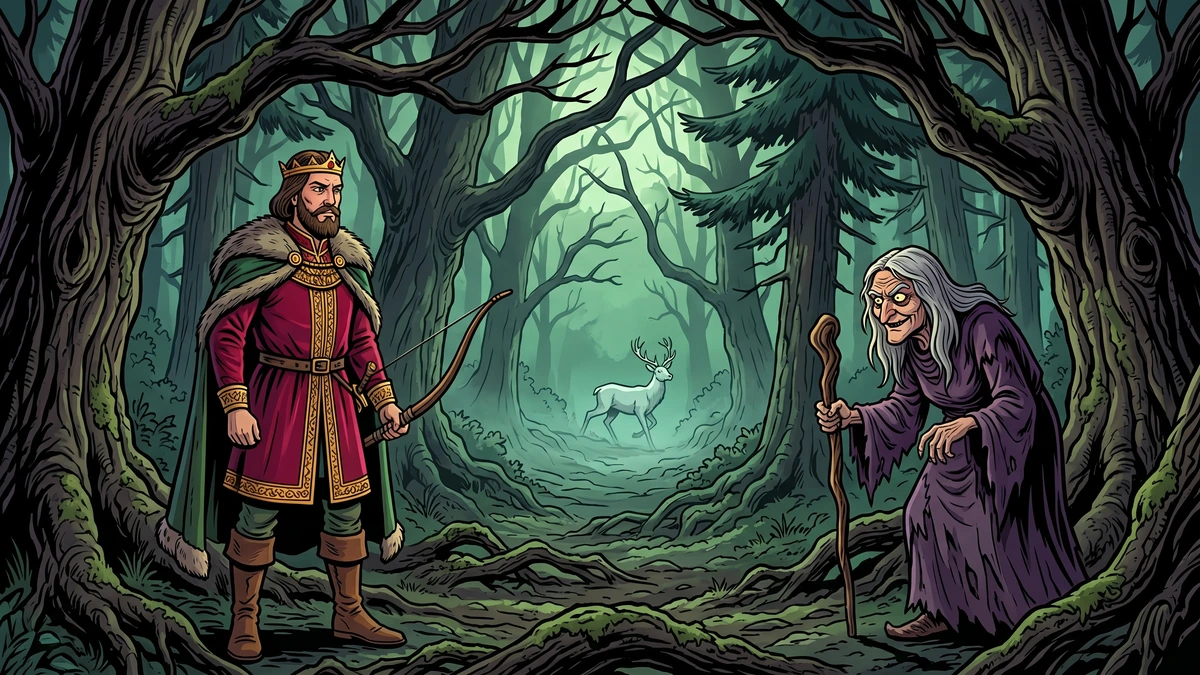
The opening of Die sechs Schwäne is one of the strangest in the whole Grimm canon. A king is hunting alone in a great forest and pursues a stag so deep into the trees that none of his huntsmen can keep pace with him. By evening he is lost, and the woods grow dark around him. Out of the gathering shadow steps an old woman with a nodding head. She is, the Grimms tell us in their characteristic plain register, a witch: “sie war aber eine Hexe”. She offers to lead him out of the forest on one condition — that he marry her daughter and make her his queen. The daughter is beautiful but the king feels in his heart, even before he has seen her properly, that something is wrong. He agrees nonetheless, because he cannot find his way home, and rides out of the trees with the witch’s daughter behind him on his horse.
The Grimms made very few alterations to this passage between their first edition of 1812 and their seventh and final of 1857. The tone of foreboding — the sense that the king has bought his return at a cost he does not yet understand — is intentional and extremely old. The folklorist Heinz Rölleke, in his 1980 critical edition Die älteste Märchensammlung der Brüder Grimm, traces the motif of the bargain-struck-in-the-wood through more than a dozen pre-Grimm German variants and back to medieval romance; the king who saves his life by promising what is dearest to him is the same figure, in a darker key, who appears in The Frog King and The Robber Bridegroom.
The seven children in the secret wood
The king has, the tale now reveals, been a widower for some years and has by his first wife seven beloved children: six sons and one daughter. He fears the new queen even as he has just married her, and so before bringing her home he hides his children in a remote castle hidden so deeply in another forest that no one but he can find the way. The path is so impossible to retrace that he ties a magical ball of yarn to a tree and follows it whenever he wishes to visit them; thrown ahead of him along the forest floor, the yarn unrolls and shows him the way.
This is the second time, only a page into the story, that a forest serves as the boundary between safety and danger. The Grimms’ German woods are not the bucolic woodlands of nineteenth-century English picture books; they are the great Hercynian forests that still pressed against villages in Hesse and Thuringia in 1812, and which had until recently sheltered wolves, bears and bandits. To hide one’s children in such a wood was, in the imagination of the Grimms’ first audience, both protective and ominous. The folklorist Maria Tatar, in her commentary in The Annotated Brothers Grimm (Norton, 2012), notes that the doubling of forests in this tale — one for the king’s first marriage, one for his children — is a structural device the Hassenpflug sisters’ family had inherited from older oral retellings, in which the natural world is always at the service of the family secret.
The king’s visits do not stay secret for long. The new queen, who is herself a witch as her mother was, watches her husband closely and noticing his absences questions the servants. They tell her, eventually, of the magical yarn. The queen takes it for herself, follows it into the woods, and finds the castle where the seven children are kept.
The shirts that turn boys into birds
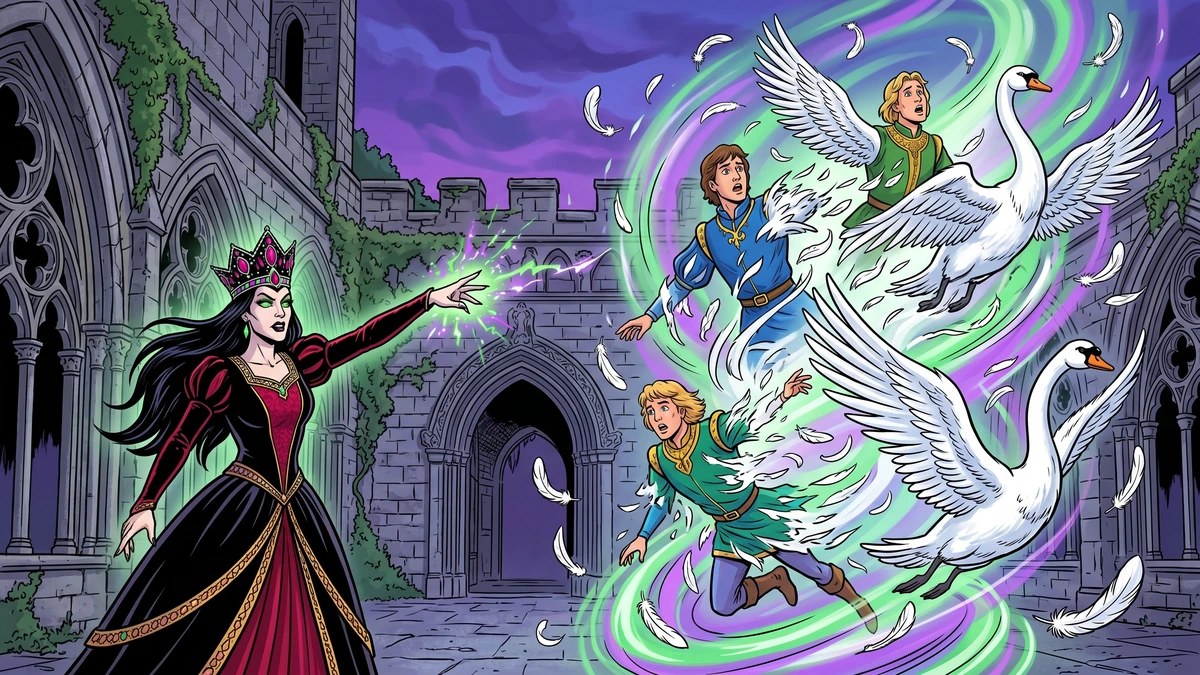
Before her journey the queen has done something terrible and quiet. She has sewn six small shirts, one for each of the six brothers, and into each shirt she has worked a charm. When she comes upon the children playing in the courtyard of the hidden castle, she throws the shirts over them. The six boys are at once transformed into white swans and fly away over the trees. Only the youngest — the daughter — escapes, because she has been inside the castle and is not in the courtyard when the queen arrives. The Grimms are deliberately unsentimental about this moment. There is no scream, no farewell. The brothers simply rise into the air on white wings and are gone.
The transformation by enchanted garment is one of the most distinctive motifs in the European folktale tradition, catalogued as Motif D551 in Stith Thompson’s Motif-Index of Folk-Literature (Indiana, 1955–1958). It carries an ancient logic: the garment touches the skin, the skin remembers, and shape follows. This logic survives intact in the resolution of the tale, where the sister will use the same principle in reverse — if a shirt can make a brother into a swan, a shirt can make a swan back into a brother. What she does not yet know is what the shirts must be made of, or what the cost of weaving them will be.
The little princess, hidden, watches her brothers fly away. When her father comes to the castle the next morning following his magical yarn she runs to him weeping and tells him what she has seen. He is full of dread but cannot bring himself to take her back to the palace, where the queen would surely destroy her too. So he tells her she must travel on at once, deeper into the forest, and find her own way. She kisses him goodbye and walks alone into the trees.
The hut of the huntsmen and the law of silence
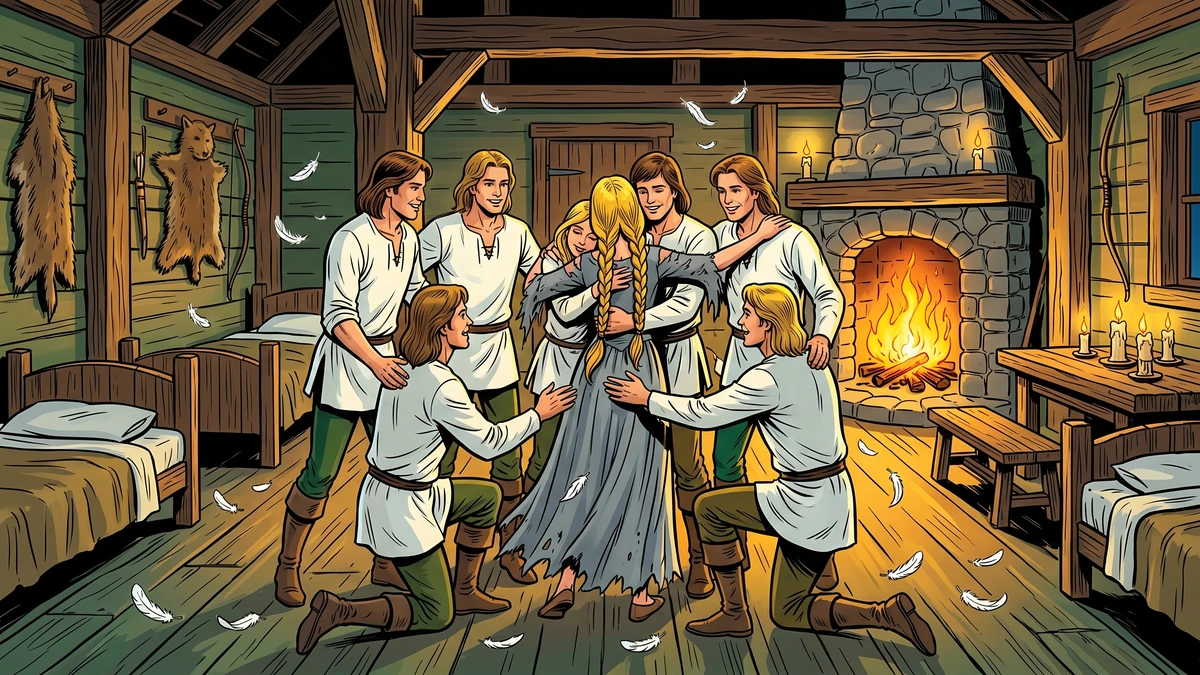
The princess walks for a whole day and night, the Grimms tell us, until she comes to a small forest hut. Inside is a single room with six small beds. She does not dare lie in any of them — there is something in her that recognises this place as her brothers’ — but she crawls beneath one of them and falls asleep on the floor. When the sun is sinking she hears a great rustle of wings, and six white swans come in through the window, lay aside their feathers and become her brothers again, only for fifteen minutes; this is the small grace the queen’s spell has left them. They tell her that she is in danger here, because their hut is a refuge of robbers and a girl found alone will be killed. They have time only to embrace her once before the fifteen minutes are spent and the feathers fly back to them and they are swans again, and out of the window into the dusk.
The princess that night decides to deliver them. The next morning, before the brothers return, she sits on the floor of the hut and considers the only thing she has heard about saving the bewitched in the village stories of her childhood: that one must sew shirts and never speak. The Grimms write this passage, in the German, with great economy and great weight: “sie wollte ihre Brüder erlösen, und sollt’ es ihr Leben kosten” — “she meant to deliver her brothers, even if it should cost her life.” There follows the central condition of the tale, the rule that will dominate the next six years of her existence: she must not speak a single word, nor laugh once, in the time it takes her to gather the white starwort flowers (Sternblumen in the German — anemones or asters) and sew six small shirts from them. If she utters one syllable before the last shirt is finished, all the work is undone and her brothers will remain swans forever.
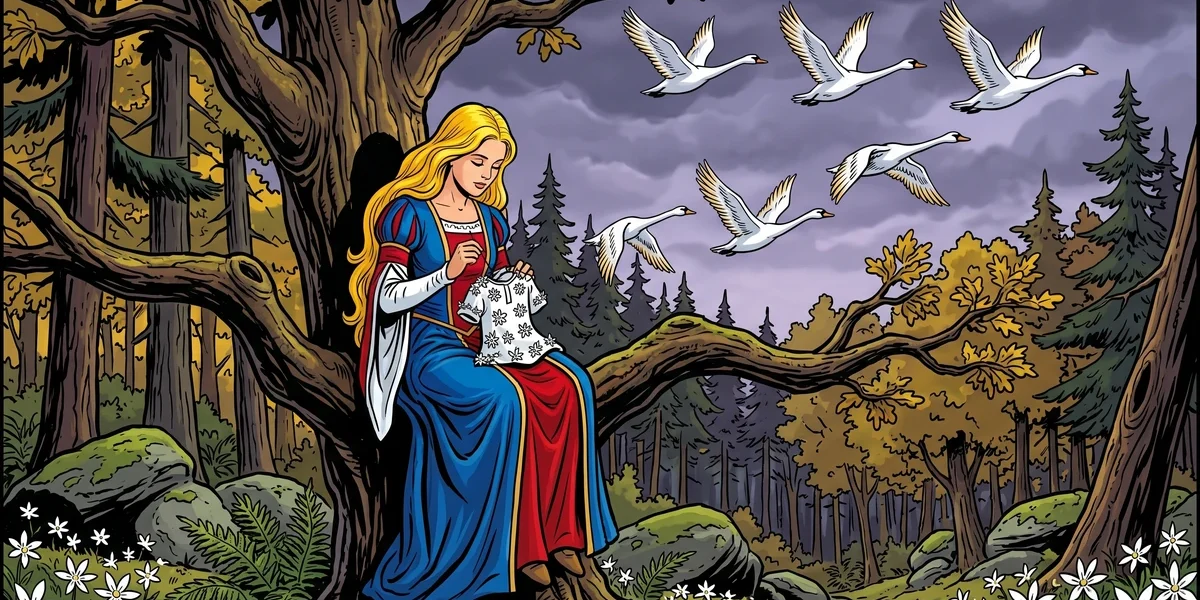
For the next several years the princess sits in a tree she has chosen as her workplace, gathering the starwort flowers and stitching them slowly into cloth. Her hands are wounded. She does not laugh. She does not speak. The forest grows around her. Folklorists from Friedrich Panzer to the Italian comparatist Giuseppe Pitrè have noted that this archetype — the silence that saves — is one of the oldest in Indo-European narrative, and is older than any written language to record it. It appears in the Bengali folktale Chand Sadagar, in the Russian Marya Morevna, in the Welsh Mabinogion‘s tale of Branwen, and in the Norse saga of Helgi. The girl who must not speak is, across cultures, the figure on whom the world’s healing depends.
The king who finds her in the tree
One day a king of a neighbouring country is hunting in this forest and his huntsmen come upon the strange tree in which the silent princess sits sewing. They climb up and bring her down. She is ragged and beautiful and makes no answer to any question. They take off her cloak and her gold chains and offer them to her, but she only weeps. The king, when he sees her, is at once in love with her. He takes her on his horse and brings her to his castle. He cannot draw a word from her either, but he marries her — for, the Grimms say, “she pleased him beyond all others on earth.” She continues, in the king’s palace, to stitch the starwort shirts whenever she can sit alone with them, and she does not speak.
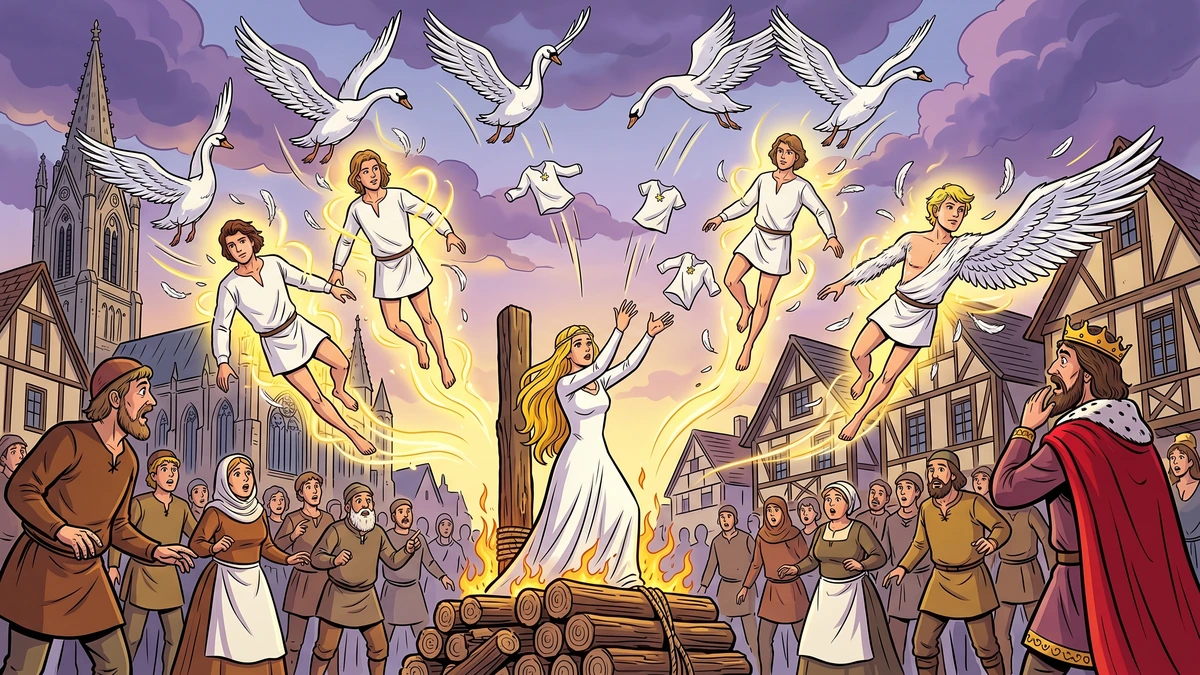
The king has a wicked mother who hates her new daughter-in-law. When the queen bears her first son, the king’s mother takes the baby in the night, smears the sleeping queen’s mouth with blood, and accuses her of having devoured her own child. The king is troubled but cannot believe it of his wife. The accusation is repeated when the second son is born, and again when the third. Each time the queen makes no defence. She does not speak — for the spell still binds her, and the shirts are not finished — and her silence is read by the court as guilt. At last the king himself, unable to defend her any longer to his counsellors, sentences her to be burned at the stake.
The German prose of the next paragraph is among the most quoted in all of Grimm. The princess is led to the pyre on the morning of her execution. She has the six shirts in her arms — five complete and the sixth nearly finished, but with the left sleeve missing. The fire is lit. And at that very moment the six swans come flying through the air, beating their wings, and settle around her. She throws the shirts over them as they pass and they are at once her brothers again — six tall young men — except for the youngest, whose unfinished shirt leaves him with a swan’s wing in place of his left arm. He bears it, the tale says, for the rest of his life.
The first words after six years of silence
And now, at last, the princess speaks. She tells the king the whole story — of the witch-queen who turned her brothers into swans, of the years in the tree, of the children the wicked mother-in-law has hidden away, for they are not dead but only stolen. The king is overwhelmed with sorrow and joy and brings the children back at once. The wicked mother is condemned and burned in her place — for in the Grimm world poetic justice is symmetrical and rarely soft — and the king and queen, with the six brothers and the three saved children, live, the tale ends, “in peace and contentment for many years.”
The closing image of the youngest brother, with his swan’s wing, is one that has fascinated readers ever since. The Grimms themselves did not annotate it, but Heinz Rölleke and Maria Tatar have both observed that in dozens of older variants of ATU 451 — including a fourteenth-century French version preserved in the chivalric romance Le Chevalier au Cygne (“The Knight of the Swan”) that became part of the Crusader cycle — the youngest brother’s incomplete restoration is the price the family pays for the rescue. Magic, the tale insists, is never quite reversed. Something always lingers. In the Crusader romance the swan-knight himself, founder of the lineage of Godfrey of Bouillon, retains a swan as his emblem all his life. In the Grimm tale the wing is the mark of how close the family came to losing each other altogether.
The moral that German peasants would have heard
For a Hessian household reading Die sechs Schwäne aloud on a winter evening in 1812, the moral was not far to seek. It is a tale about the cost of speaking too soon, and the strength of those who hold their counsel under accusation. It is also, the Grimms knew well, a tale about the work of women — about the slow, painful, repetitive labour of weaving, sewing, mending, the work that kept a peasant family clothed and that was almost never recognised in the heroic registers of contemporary German literature. The princess in the tree is a sister, a daughter and a queen, but most of all she is a worker. She saves her family by doing, with bleeding hands, what every woman in her audience knew well.
“Sie wollte ihre Brüder erlösen, und sollt’ es ihr Leben kosten.”
— “She meant to deliver her brothers, even if it should cost her life.” (Brothers Grimm, KHM 49, Kinder- und Hausmärchen, 1857 edition)
The German verb the Grimms chose here, erlösen, is theologically charged: it is the same word Luther used in his Bible for “to redeem.” A peasant audience would have heard the religious echo without anyone needing to point it out. The princess is, for the duration of her silence, a redeemer, and her wordlessness is the form her vow takes. This is why folklorists from Max Lüthi to Marina Warner have read Die sechs Schwäne not as a passive story about a girl who suffers but as an active story about a girl who chooses — at every moment, for six years, with every fresh accusation — not to break the rule that holds her brothers’ lives.
Why the tale has lasted
The Grimms gave the world dozens of better-known tales than The Six Swans. Cinderella and Snow White and Sleeping Beauty have crossed every ocean of the modern imagination. The Six Swans has not made the same journey. And yet it endures — re-told by writers as different as Juliet Marillier in her novel Daughter of the Forest (1999), in the Czech feature film O šesti labutích (2007), in Yumiko Igarashi’s manga adaptations, and in the long shadow it casts over Andersen’s far more famous Wild Swans. Every generation rediscovers the tale and finds something new in it.
The reason, perhaps, is the tale’s unusual interior geometry. Many folktales are built around what their hero does: slays the dragon, climbs the tower, breaks the spell. The Six Swans is built around what its heroine refuses to do. She does not speak. She does not defend herself. She does not laugh, even when she is happy. She does not break, when her own children are taken from her. The whole of her heroism is restraint — and the world she saves, when she is finally allowed to speak, is the world she has been holding in her silence the whole time.
It is a deeply unfashionable form of heroism in our own moment, when speaking out is celebrated and silence often coded as complicity. But the tale’s quiet logic still cuts. Some kinds of love require us to bear an accusation we cannot answer until the work is done. Some kinds of repair are slow. Some kinds of voice — the voice the princess finally finds at the burning pyre, when she names everything at once — only carry their full weight because of the years they were not used. The Hassenpflug sisters knew this, and the Grimms, when they wrote it down, took unusual care not to rush the story to its end.
For the curious reader
The standard German text of Die sechs Schwäne is in volume one of the seventh edition of Kinder- und Hausmärchen (Göttingen: Dieterich, 1857), tale 49, where it has stood since the first edition of 1812. Wilhelm Grimm received it from Jeanette Hassenpflug in 1808 or 1809; her sister Marie supplied the parallel material in The Twelve Brothers. The earliest English translation is in Edgar Taylor’s German Popular Stories (London: C. Baldwyn, 1823). The most authoritative modern English version is in Jack Zipes, The Original Folk and Fairy Tales of the Brothers Grimm: The Complete First Edition (Princeton, 2014).
For folkloristic context, see Heinz Rölleke, Die älteste Märchensammlung der Brüder Grimm (Cologny-Genève: Fondation Bodmer, 1975); Hans-Jörg Uther, The Types of International Folktales: A Classification and Bibliography (Helsinki, 2004), entry 451; Maria Tatar, The Annotated Brothers Grimm (Norton, 2012); and Marina Warner, From the Beast to the Blonde: On Fairy Tales and Their Tellers (Vintage, 1995), which has a sustained reading of ATU 451 across European versions.
ATU 451 across Europe: the maiden and her birds
The Grimm tale is one of more than two hundred recorded variants of ATU 451 in the European corpus. The numbers and species of the bewitched brothers vary greatly. In KHM 25 Die sieben Raben (“The Seven Ravens”) there are seven brothers, transformed into ravens by their father’s careless curse rather than by a stepmother’s spell, and the silent sister must travel to the end of the world to save them. In KHM 9 Die zwölf Brüder (“The Twelve Brothers”) there are twelve, exiled rather than enchanted, and the sister’s silence is again the price of their return. In Andersen’s De vilde svaner (1838) the brothers are eleven, the cloth is woven from nettles rather than asters, and the heroine is named Eliza.
Outside the Germanic-Scandinavian sphere the tale is just as widely told. The Italian variant Li sette palommielli (“The Seven Doves”) in Giambattista Basile’s Lo cunto de li cunti (Naples, 1634) is one of the oldest written versions in Europe; Basile’s seven brothers have been turned into doves by a cursed mother, and the sister must seek out the four winds and the moon to learn how to release them. The Russian The Seven Simeons and the Welsh-Irish Children of Lir — in which the four children of King Lir are transformed into swans by a jealous stepmother and condemned to nine hundred years on the icy seas — are independent traditions that arrive at strikingly similar resolutions.
What unites these scattered tellings, the folklorist Stith Thompson argued in The Folktale (Dryden, 1946), is the figure of the sister whose suffering — physical, emotional, vocal — is the engine that restores her brothers. In a body of folk tradition often dominated by daring princes and resourceful tricksters, ATU 451 is one of the few story-types in which the central heroic act is endurance. The Grimms understood this, and their version of Die sechs Schwäne is, in its quiet way, one of the most concentrated examples of that endurance in print.
Reading the story today
For a modern reader, especially a parent reading the tale aloud, Die sechs Schwäne can feel slow and severe. Its central figure does almost nothing for years on end, her brothers are absent for most of the narrative, and the suffering is real even when the magic is fabulous. The temptation, as with many of the Grimm tales, is to soften it — to let the princess speak in her own defence, to grant the sixth brother both his arms back, to leave the wicked mother-in-law unburned. Many modern picture-book retellings do exactly this.
What is lost in those softenings is the tale’s central insight: that some kinds of devotion are unverifiable from the outside, that the sister’s silence is read by the court as guilt because it cannot be read as anything else, and that the work of saving a family is sometimes the work of accepting that misreading until the work is done. The youngest brother’s swan-wing, in the closing image, is the mark of that whole strange logic. He is restored, but not entirely. The family is whole, but not unscarred. The price of love, in the Grimm world, is that it leaves a feather.
Frequently asked questions
Who first wrote down “The Six Swans”?
The Brothers Grimm published Die sechs Schwäne as tale KHM 49 of Kinder- und Hausmärchen in their first edition of 1812. They received the story from Jeanette Hassenpflug (1791–1860) of Hesse-Cassel, the same Huguenot-descended family that supplied them with Little Red Riding Hood, Snow White and Sleeping Beauty. The tale was already an established part of European oral tradition; closely related literary forms appear in Giambattista Basile’s Italian Lo cunto de li cunti of 1634, and the basic story-pattern (ATU 451) is documented in medieval romance.
Is “The Six Swans” the same story as Andersen’s “Wild Swans”?
No, but they are close cousins. Hans Christian Andersen’s De vilde svaner (“The Wild Swans”), published in 1838, was inspired by the Grimms’ KHM 49 but differs in significant ways: Andersen’s heroine is named Eliza and has eleven brothers, the shirts she must sew are made from stinging nettles rather than the white starwort flowers of the Grimm tale, and her trial reaches its climax through the intervention of an archbishop rather than through her own wordless act of throwing the shirts. The Grimm version preserves the older oral form; Andersen’s is a literary reworking with explicitly Christian motifs.
What does ATU 451 mean?
ATU 451 is the entry for The Maiden Who Seeks Her Brothers in the Aarne-Thompson-Uther index, the standard scholarly catalogue of folktale types. It groups together more than two hundred variants from across Europe and beyond in which a sister must redeem brothers who have been transformed into birds — swans, ravens, doves or eagles depending on the region — by performing a long task in silence. The classification was first proposed by Antti Aarne in 1910, expanded by Stith Thompson in 1928 and 1961, and revised by Hans-Jörg Uther in 2004.
Why does the youngest brother keep a swan wing at the end?
Because his sister’s last shirt is still missing its left sleeve when the swans descend on her pyre. The Grimms’ tale is precise on this point: she has finished only five complete shirts and has begun the sixth, but the spell binds the work she has actually done. The incomplete sleeve becomes a permanent swan wing. The motif is older than the Grimm tale and appears in medieval European romance, most famously in Le Chevalier au Cygne (“The Knight of the Swan”), the late twelfth-century Crusader cycle in which the swan emblem of Godfrey of Bouillon’s lineage is traced back to a brother whose enchantment was never fully reversed.
What were the shirts actually made of?
White starwort flowers — in the German, Sternblumen, sometimes translated as “asters” or “anemones.” These are small white wildflowers common in central German woodlands. The choice is deliberate: the German starflower has six narrow petals radiating from a yellow centre, echoing the six brothers themselves, and was associated in folk medicine with healing wounds and binding skin. Andersen’s later use of nettles in The Wild Swans shifts the material toward physical pain — nettles sting the hands of any who touch them — but the Grimm starwort is gentler and more symbolic. The labour, in the older tale, is the silence, not the suffering of the fingers.
Why doesn’t the princess just defend herself when she is accused?
Because the spell of release that binds her requires absolute silence for its full duration. The Grimms make this rule explicit and unbreakable: a single word in defence, even at the foot of the pyre, would unmake all the work she has done and condemn her brothers to remain swans forever. Folklorists read this as an extreme form of the broader ATU 451 motif, in which the heroic act is the act of endurance under unjust accusation — the same logic that animates the medieval saints’ lives the Grimms knew well, and which is echoed in the silence of similar heroines in the Italian and Russian variants of the tale.
You May Also Like
 Grimm's Fairy Tales
Ages 9-12
Grimm's Fairy Tales
Ages 9-12
Tom Thumb
Tom Thumb: A poor woodman sat in his cottage one night, smoking his pipe by the fireside, while his wife sat by his side spinning. How lonely it is, wife,’
 Grimm's Fairy Tales
Ages 9-12
Grimm's Fairy Tales
Ages 9-12
The Robber Bridegroom
The Robber Bridegroom: There was once a miller who had one beautiful daughter, and as she was grown up, he was anxious that she should be well married and
 Grimm's Fairy Tales
Ages 9-12
Grimm's Fairy Tales
Ages 9-12
The Valiant Little Tailor
The Valiant Little Tailor: One summer’s morning a little tailor was sitting on his table by the window; he was in good spirits, and sewed with all his might. A