The King Of The Golden Mountain
The King Of The Golden Mountain: There was once a merchant who had only one child, a son, that was very young, and barely able to run alone. He had two richly
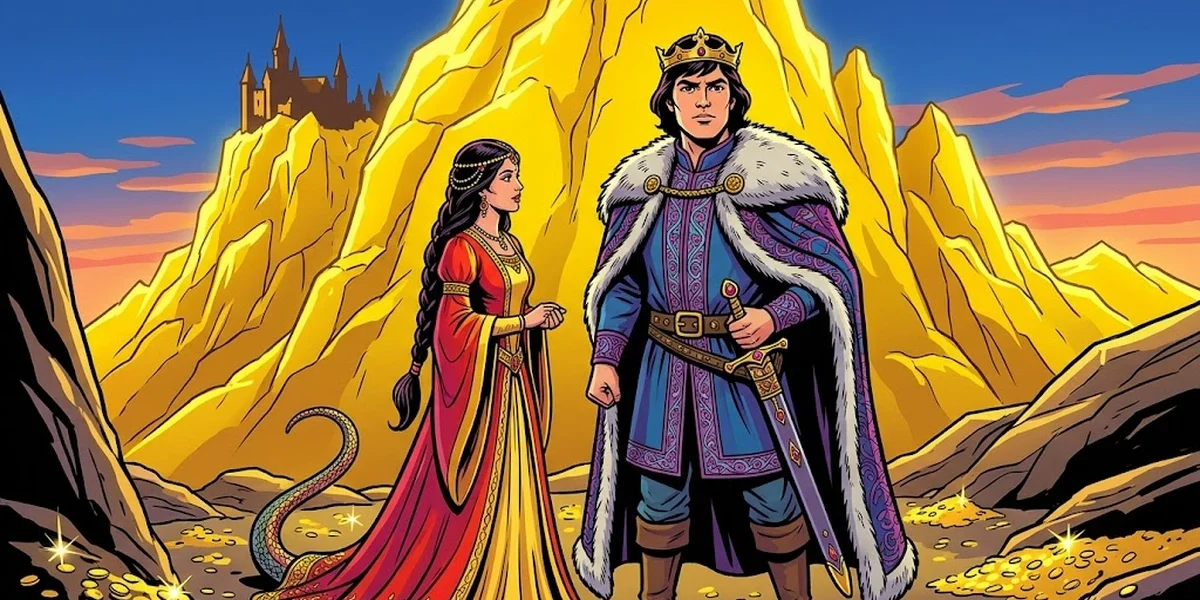
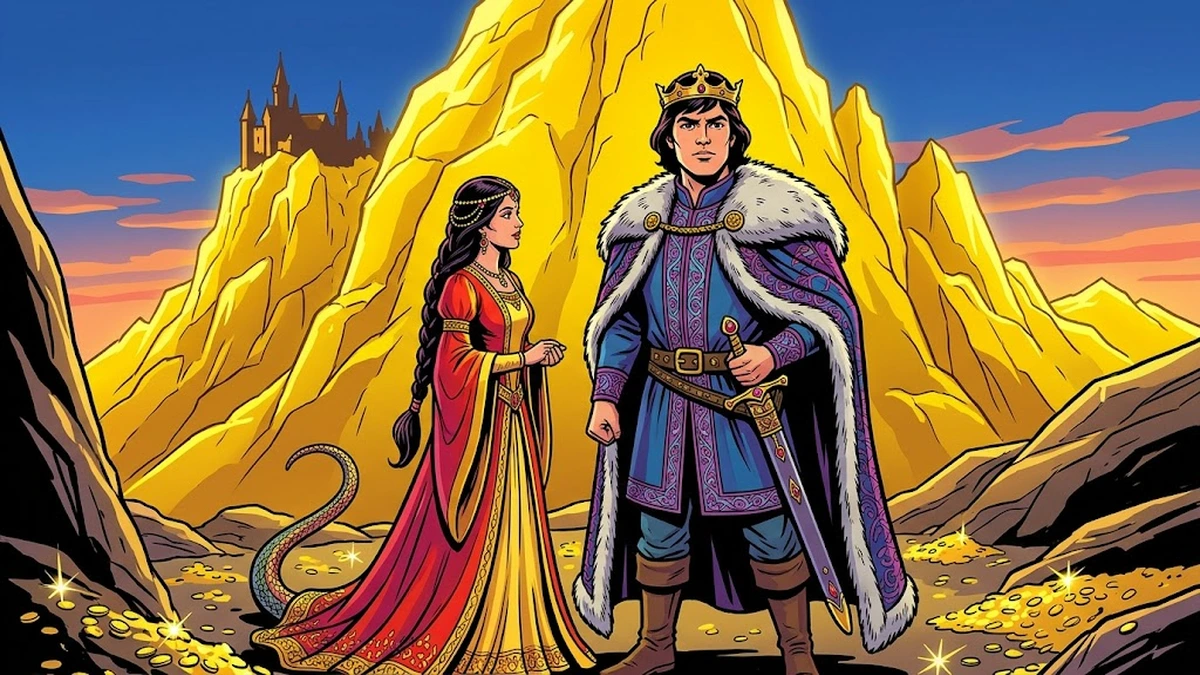
The King of the Golden Mountain — in the original German Der König vom goldenen Berg — is tale number 92 in the Brothers Grimm Kinder- und Hausmärchen, the celebrated Children’s and Household Tales. It first appeared in the second volume of the inaugural edition (Berlin, 1815) and was carried, with successive philological refinements, through every one of the seven editions Jacob and Wilhelm Grimm prepared between 1812 and the definitive Ausgabe letzter Hand of 1857. In the international Aarne–Thompson–Uther index of folk-tale types the story is classified as a complex of ATU 400 — “The Man on a Quest for His Lost Wife,” with the closing magical-object episode forming a perfectly textbook example of ATU 518 — “Devils (or Giants) Fight Over Magic Objects.” The Grimms received the tale orally from their Hessian circle — the brothers’ own marginal notes in the Anmerkungenband (the third, scholarly volume of Kinder- und Hausmärchen, 1822 and 1856) record it as taken down “aus dem Zwehrnschen” (from the Niederzwehren tradition), the same Hessian village that gave them The Goose-Girl, The Twelve Brothers, and so much else through the great story-teller Dorothea Viehmann and her family. English readers met the tale first in Edgar Taylor’s German Popular Stories (London, 1823, with George Cruikshank’s iron-line engravings), and then more fully in the standard Margaret Hunt translation for George Bell & Sons (London, 1884), which remains the canonical English text. In the Stith Thompson Motif-Index of Folk-Literature the tale gathers an extraordinary cluster of motifs: S221 (child sold or promised in return for help by demon or dwarf), S141 (exposure of child in a chest cast adrift on the water), D735 (disenchantment of an animal-bride by enduring a vigil of three nights), D1361.12 (magic invisibility-cloak), D1521.1 (seven-league boots), D1602.12 (sword that beheads a host at command), K335.1.1.1 (cheating heirs out of inherited magic objects), D1470.1 (magic wishing-ring), and L161 (the lowly hero finally restored to royal estate). It is one of the most architecturally ambitious of all the Grimm tales — a triple folk-novella whose three sections (the merchant’s reckless promise; the disenchantment of the serpent princess on the Golden Mountain; the cheated giants and the sword that beheads a treacherous court) add up to a small Hessian epic of broken oaths, magical labour, and final restitution.
I. The Merchant, the Black Dwarf, and the Reckless Promise
The story opens in the way so many Grimm tales open — in the modest, almost middle-class world of the German Bürgertum rather than the courts of kings: a merchant in a Hanseatic-feeling port town, who has only one child, a small boy barely able to walk on his own, and who has invested his entire fortune in two richly laden trading ships now on a long voyage. Word arrives that both vessels have been lost at sea; from being a wealthy merchant of the Kaufherrenstand he has become, in a single morning, a poor man whose only remaining property is a small plot of land outside the town walls. He goes there in the evenings to walk and to ease his troubles, and on one of these walks — in a passage that the Grimms keep almost word-for-word in the laconic register of the original oral telling — he meets a little, rough-looking, black dwarf who asks him, with the unsettling courtesy of folk-tale supernaturals, why he is so sorrowful. The dwarf belongs to the great Northern European family of subterranean wealth-spirits — cousin to the Nibelungs of the Rhine, to the Hessian Erdmännchen of the mining country, and to the dwarves of the Eddic Völuspá — and he offers, in the time-honoured folk-bargain, to restore the merchant’s wealth in return for “was dir zuerst entgegenkommt, wenn du nach Hause gehst” — whatever first comes to meet you when you go home, twelve years hence.
The merchant accepts the bargain, certain that the first creature to greet him will be his old dog, perhaps the cat by the kitchen step. He signs the dwarf’s promise and walks home in a much lightened mood. But the first thing that comes to meet him at the threshold is his small son, who has run out of the house at the sound of his father’s footsteps; and the merchant understands, in one cold instant, what he has bargained away. The motif — Stith Thompson S221, the child promised in return for help by a demon or dwarf — runs from the Old Testament Jephthah’s daughter through the Greek Idomeneus, through the medieval Faust legends, through the Russian The Sea-Tsar and Vasilisa the Wise, into the Grimms’ own The Girl Without Hands (KHM 31), Rumpelstiltskin (KHM 55), and The Nixie of the Mill-Pond (KHM 181). The merchant says nothing to his wife. The years pass. The two ships, miraculously recovered, return laden with goods; the family’s wealth is restored. The boy grows into a strong, clever child of twelve, and the day of the bargain at last falls due.
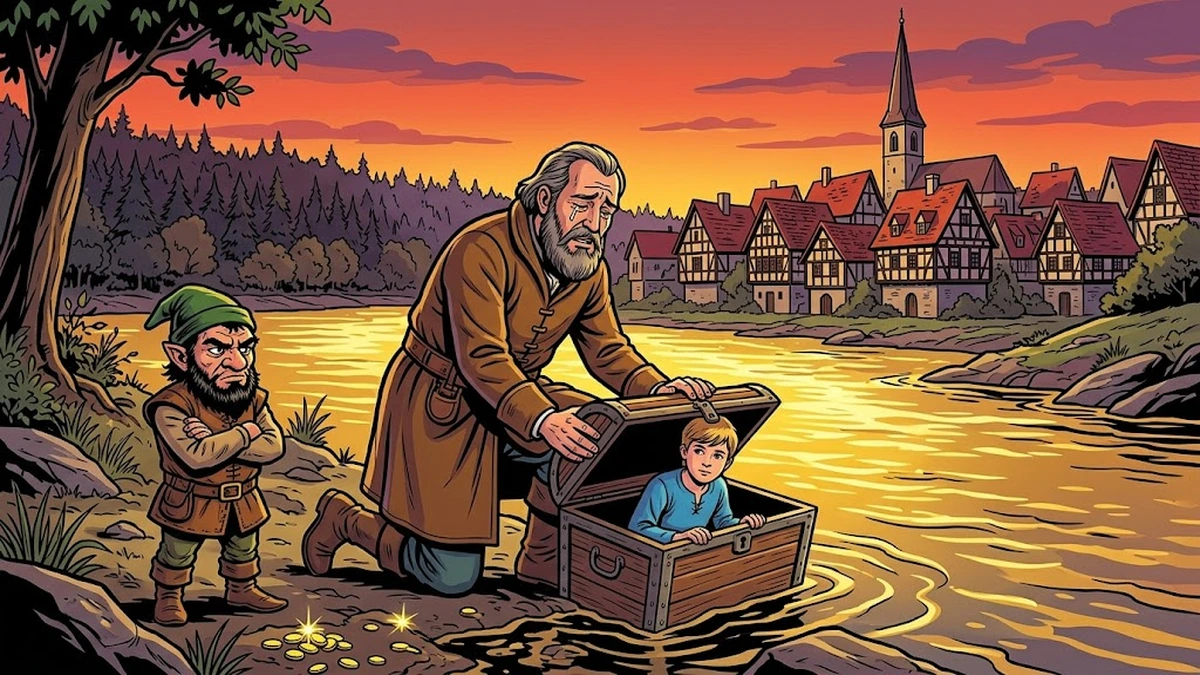
When the merchant tells the boy the truth, the child, with the brisk practical courage of folk-tale heroes, takes the matter in hand. He goes with his father to the appointed place by the river. The black dwarf is waiting. The boy steps forward; but instead of submitting to be carried away, he points to a small wooden chest on the river bank and asks to be set into it and pushed out into the water, “for whatever shall come of me, let it come by the river’s choice and not by yours.” The dwarf, struck either by the boy’s calm or by some folk-magical principle that an unwilling tribute is no tribute, agrees. The merchant, weeping, lifts the boy into the chest, closes the lid, and pushes him out into the current. The motif — Stith Thompson S141, exposure of a child set adrift in a chest on the water — is one of the oldest in the world’s folk-stock, running from the Akkadian Sargon to the biblical Moses to the Greek Perseus and Telephus to the Roman Romulus and Remus to the medieval Pope Gregorius (Hartmann von Aue, c. 1190), and the Grimms place their merchant’s son squarely inside that ancient lineage of children entrusted by despairing parents to the carrying water.
II. The Golden Mountain, the Enchanted Serpent, and the Three Nights
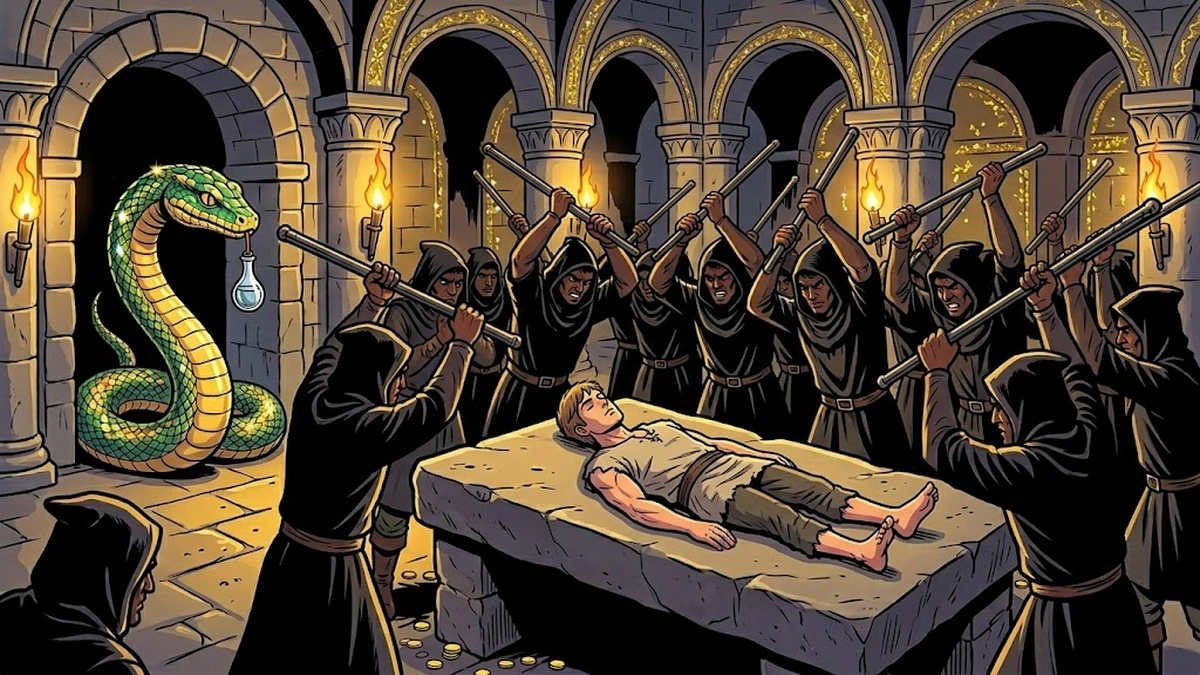
The chest drifts down the river, then out into the sea, and at last is washed up on the strand of a strange country where, on the inland side of the beach, rises a mountain of pure gold — der goldene Berg, the Golden Mountain, an emblem of the Otherworld in the same family as the Welsh Annwn, the Norse Glasisvellir (the Shining Plains), the Russian tridevyatoe tsarstvo (the thrice-ninth kingdom), and the Indo-European folk-image of the radiant Otherworld mountain that recurs from the Mahâbhârata‘s Mount Meru to the Celtic Mag Mell. On the slope of the mountain stands a great enchanted serpent, who is in fact a princess verwunschen (under enchantment), bound by a wicked spell to the form of a snake until a mortal can be found who will endure for three nights, in the locked hall of the mountain, the assault of a host of black men with iron rods, never crying out and never striking back. The boy, undismayed — the Grimm hero is always undismayed — agrees. The motif is Stith Thompson D735, disenchantment of an animal-bride by enduring a vigil of three nights, and it appears in close cognate form in the Grimms’ own The Iron Stove (KHM 127), in the Norwegian East of the Sun and West of the Moon, and in the Scottish Black Bull of Norroway; but nowhere is the ordeal more hauntingly described than here.
For three successive nights the boy lies down in the locked hall; for three successive nights the host of the mountain comes in with iron rods and beats him almost to death; and for three successive nights the serpent comes in at dawn with a flask of the Water of Life and restores his broken body. On the third dawn the spell is broken; the serpent slips out of her snake’s skin and stands before him as a princess of dazzling beauty — in the original German “schöner als die Sonne und der Mond“, “fairer than the sun and the moon” — and the boy, the merchant’s son washed up in a wooden chest, is crowned King of the Golden Mountain. They marry, and reign together for some seven or eight years in a peace as bright as the metal of their kingdom. A small son is born to them. The motif of the fairy-bride who must be loved through her serpent-form before she can step into her royal one is one of the deepest in Indo-European folk-imagination, and runs from the Hindu Nâgî brides of the Mârkandeya Purâna to the Mélusine of the medieval Lusignan chronicles to the loathly bride of the Wife of Bath’s Tale.
But the King of the Golden Mountain is human, and a human heart, however royal, has memories. After some years, sitting at his window of an evening, he begins to think of his old father and mother — the merchant who pushed him off into the river, the mother who never knew of the bargain — and he tells his queen that he must go and visit them. The queen, with the grief of all folk-tale wives forced to give consent to a dangerous journey, gives him a single magical wishing-ring — Stith Thompson D1470.1, the magic wishing-ring — with one strict condition: he is not to use the ring to wish her or their child away from the Golden Mountain, and above all, in his old home, he is on no account to mention either her name or his royal title, on pain of losing kingdom, queen, and child forever. He swears it. He turns the ring; he wishes himself before his father’s gate; and in an instant he is standing in the dust of the German trading town from which, eight years before, a small boy had been pushed off into the water in a wooden box.
III. The Broken Oath and the Wishing-Ring’s Theft
His parents do not at first recognise him; he is a tall young man in foreign royal clothes, with the bearing of a king. When he tells them who he is, his mother weeps with joy. He sits down to a homely meal at the old kitchen table; and there, fatally, in the warmth of his mother’s kitchen and his father’s pride and the soft Hessian evening, he begins to talk. He tells his father of the chest and the river, of the Golden Mountain, of the enchanted serpent, of the three nights of iron rods, of his queen “fairer than the sun and the moon”, and of the small son she has borne him. As he speaks, the wishing-ring on his finger turns of its own accord; the queen, far away on the Golden Mountain, knows in that instant that her husband has broken his oath; and the kingdom of the Golden Mountain, with its queen and its small prince and the long happiness of their seven years, is taken away from him. He looks down at the ring; the stone is dim. He has lost everything. The motif — the magical taboo broken in the warmth of the human hearth — is one of the most poignant in folk-tradition, and is closely related to the Mélusine taboo (Geoffroy de Lusignan, c. 1393), to the swan-maiden taboo of countless North-European tales, and to the Indo-European folk-rule that the Otherworld and the human world cannot be spoken of in one another’s language without consequence.
The young man, half-mad with grief, sets out at once to walk back to the seashore where the chest first washed up. He walks for many days. He arrives at last at the foot of a great mountain, on whose summit, in the way of Grimm landscapes, stand three giants — rough, quarrelling, brother-giants of the German Riesen family — who have just come into possession of three enchanted objects left to them by a dead father. The objects are an invisibility-cloak (Stith Thompson D1361.12), a pair of seven-league boots (D1521.1), and a sword that, at the words “Heads off all but mine!”, beheads any host its bearer commands (D1602.12). They are quarrelling about the inheritance and have nearly come to blows. The young king, with the sharp wits of a folk-hero, offers to settle the dispute for them — he will run to a distant rock, pick up a stone, and the giant who first reaches him from the other side of the field shall have the boots; the next, the cloak; the last, the sword. The giants agree. The hero, the moment they have lined up at the far side, throws the cloak around himself, pulls on the boots, takes up the sword, and is gone in seven-league strides over the horizon. The motif is Stith Thompson K335.1.1.1, cheating heirs out of inherited magic objects — the same trick by which Hermes in the Homeric Hymn outwits Apollo, and by which Loki in the Eddas separates the dwarves from their treasures, and by which countless folk-heroes from the German The Brave Little Tailor (KHM 20) to the Russian Ivan-the-Fool walk away with the magical equipment they need to set the world right.
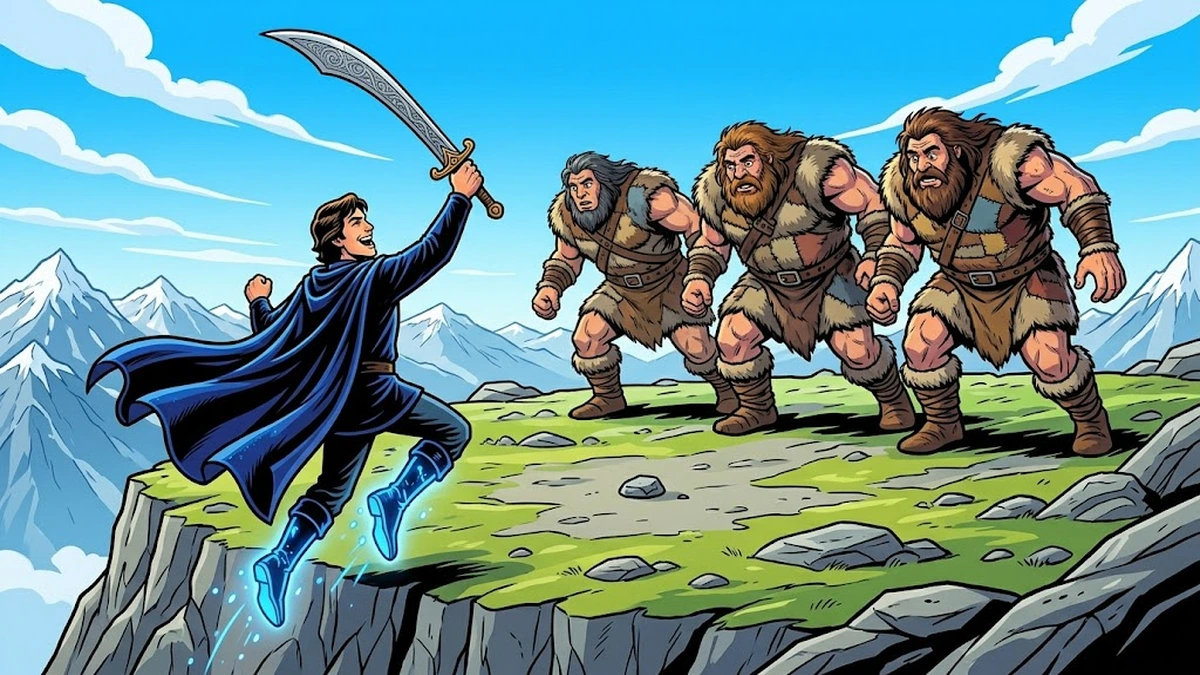
In seven-league boots the journey across half of Europe takes a day. He flies in cloak and boots over land and sea; he lands, on the third leap, on the strand of his own Golden Mountain. He climbs invisibly to his palace gate; and there he finds, with the cold horror that is the proper note of this scene in every folk-version of it, that his queen, believing him dead, has at last been persuaded to consent to a second marriage, and that the wedding-feast is in progress at this very hour in the great hall of the kingdom. The folk-narrative architecture is exactly that of The Odyssey — the long-absent king returns invisible to his own court on the day his wife is being given to another — and the Grimm tale, faithful to the deepest grammar of European folk-imagination, plays it through to the proper close.
IV. The Sword, the Wedding-Feast, and the Restoration
He passes invisibly through the hall. He sits down at his queen’s right hand — she does not see him. He takes a piece of meat from her plate, and a sip from her cup; he speaks her name softly into her ear; she starts and turns her head, but there is no one beside her. The new bridegroom, suspicious, calls his guards. The young king throws off the invisibility-cloak; the queen recognises him with a great cry; the false bridegroom and his retinue draw their swords; and the King of the Golden Mountain, holding up the great inherited blade of the giants, says quietly the formula the German tale gives in its bare folk-Latin: “Alle Köpfe ab, nur meiner nicht” — “All heads off, but mine!” The sword does its work. The hall falls silent. The traitorous court, the false bridegroom, the courtiers who had urged the queen to a second marriage, all lie in a single moment without their heads on the marble of the hall. The motif — Stith Thompson D1602.12, the obedient beheading sword — is among the bloodiest in the Grimm corpus and was preserved by the brothers exactly as their oral source gave it; in the savage Q414 register of folk-justice, it is the proper price of a treasonous court.
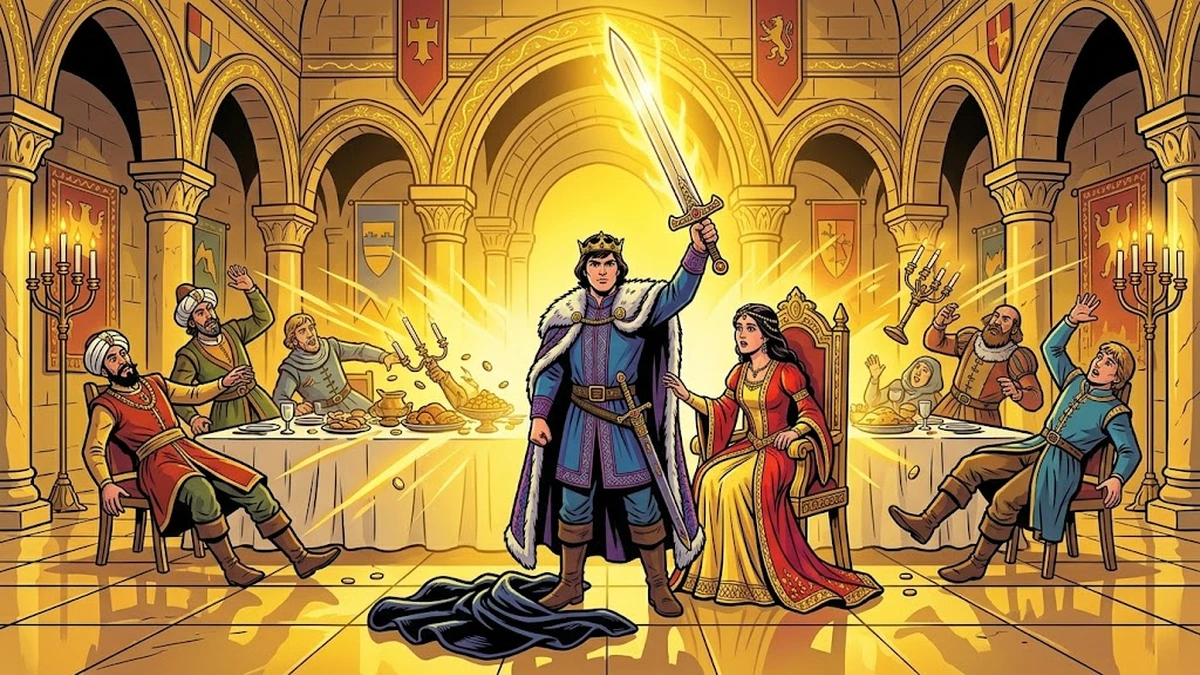
The King of the Golden Mountain takes back his queen, his small prince, and his shining kingdom, and reigns over the Golden Mountain (the closing line of the original German runs in the matter-of-fact perfect tense of folk-conclusion) “noch viele Jahre in Frieden und Glanz” — many further years in peace and brilliance — and the tale ends, as so many Grimm tales end, on the slow steady note of a kingdom restored. The merchant’s reckless promise is paid; the boy in the chest has come, by way of a serpent princess, three nights of iron rods, a wishing-ring, three cheated giants, an invisibility-cloak, seven-league boots, and an obedient sword, into the kingdom that the river and the Otherworld between them had marked out for him from the first.
Moral — Die Moral der Geschichte
“Wer einen Eid bricht, verliert sein Königreich; wer einen Eid hält und bei den eisernen Ruten schweigt, dem öffnet sich das Tor des goldenen Berges.”
The German moral — “He who breaks an oath loses his kingdom; he who keeps an oath and is silent under iron rods, to him the gate of the Golden Mountain opens” — gathers the entire moral architecture of the tale into a single paired epigram. The hero earns his Otherworld kingdom by silent endurance: three nights of iron rods, no cry uttered, no blow returned. He loses it the moment he speaks the wrong word in the wrong room: a careless evening at his father’s table, the queen’s name and the kingdom’s secret spoken outside their proper walls, and the ring on his finger turns dim. The deepest claim of the tale is not that virtue is rewarded — though here, after long suffering, it is — but that both the winning and the keeping of an enchanted kingdom rest on the discipline of the tongue: silence under the iron rod earns it, silence in the home keeps it, and a single garrulous evening can lose it. The moral is also, in its small Hessian way, a moral about the obligation of the man who has been twice given his life by women — once by the queen with the flask of the Water of Life, once again by the giants’ magical equipment that lets him return to her — to come back faithful and silent to the kingdom that has been shown to him.
Why The King of the Golden Mountain Has Lasted Two Hundred Years
Of the more than two hundred tales in Kinder- und Hausmärchen, only a relatively small group have crossed every linguistic boundary to become genuinely global property — Cinderella, Snow White, Rapunzel, Hansel and Gretel, Little Red-Cap, Rumpelstiltskin, The Goose-Girl, the Bremen Town Musicians, the Frog King. Der König vom goldenen Berg is not among that tiny outermost ring of universally illustrated tales, but it has its own unmistakable place in the second and equally beloved circle of the corpus — the great structural fairy-tales beloved of folklorists and scholars precisely because so much of the deepest Indo-European folk-stock is held in them in undiluted form. Its central images — the merchant on the river bank, the wooden chest carried away on the current, the Golden Mountain rising out of the strand, the enchanted serpent and the flask of the Water of Life, the three nights under the iron rods, the wishing-ring that turns dim on a finger at a kitchen table, the three quarrelling giants on the mountain-top with their inherited magical inheritance, the seven-league boots, the invisibility-cloak, and the sword that beheads a faithless court — are among the most cinematically and visually translatable images in the entire European folk-stock.
Its scholarly reception has been correspondingly rich. Bolte and Polivka, in their monumental five-volume Anmerkungen zu den Kinder- und Hausmärchen der Brüder Grimm (Leipzig, 1913–1932), devote a substantial entry to KHM 92 (volume II, pages 318–335), tracing close cognates in the Czech, Russian, Ukrainian, Slovak, Hungarian, Italian, Spanish, Catalan, Sicilian, French, Breton, Norwegian, Swedish, Danish, Finnish, and Estonian traditions. Stith Thompson, in The Folktale (1946), groups it with the great cluster of ATU 400/401/518 tales as one of the canonical European examples of the “Quest for the Lost Wife” pattern. Max Lüthi, in The European Folktale: Form and Nature (1947, English edition 1982), uses passages from the tale to illustrate the famous “one-dimensionality” of folk-narrative — the way in which the supernatural Golden Mountain and the German market-town stand on the same flat narrative plane, with no metaphysical seam between them, and the merchant’s son passes from one to the other simply by stepping into a chest on the river. Heinz Rölleke, the leading modern editor of the Grimms, in his standard apparatus for the Reclam edition (1980), points out the unusually clean three-act architecture of the tale and the Grimms’ relatively light editorial hand on its diction, making KHM 92 one of the texts in the collection closest to its presumed oral original. The tale has been retold in Andrew Lang’s Green Fairy Book (1892), in Wanda Gág’s mid-twentieth-century selections, in Philip Pullman’s Grimm Tales for Young and Old (Penguin, 2012), and in the modern Indian classroom anthology where it sits beside the Panchatantra and the Jataka tales as a perennial example of the universal grammar of the folk-tale.
Its hero remains, in his particular Grimm way, one of the more unusual royal figures in the European tradition: a merchant’s son with no royal blood, who earns his kingdom not by the sword but by silent endurance, loses it not in battle but in a moment’s careless conversation, and wins it back not by the legitimacy of his birth but by the wits of his cheating of the giants and the obedience of an inherited blade. The tale ends, almost uniquely in the Grimm corpus, on the unsentimental folk-note of an entire false court losing its heads at the king’s quiet command; and that closing image — the silent invisible king at the wedding-feast, the hand of the queen on his arm, the heads of the traitors falling at a single Latin-style imperative — is one of the most enduring images of folk-restoration in any European literature. What an oath wins, an oath can keep; what is taken in a careless evening, only an obedient blade and an invisible journey home can win back. Two hundred years on, Der König vom goldenen Berg remains exactly as it stood in its Hessian source in 1815: one of the great parables of the European imagination of how a kingdom is won by silence, lost by words, and regained by the long bright road of fidelity.
Frequently Asked Questions about The King of the Golden Mountain
Q1. Who wrote The King of the Golden Mountain, and when was it first published?
The King of the Golden Mountain (German Der König vom goldenen Berg) was collected, edited, and published by the brothers Jacob and Wilhelm Grimm as tale number 92 (KHM 92) in the second volume of Kinder- und Hausmärchen (Children’s and Household Tales), first issued in Berlin in 1815 by the Realschulbuchhandlung. The Grimms did not “write” the tale in the modern authorial sense; they recorded an oral German folk story whose source they record in their Anmerkungenband (the third, scholarly volume of Kinder- und Hausmärchen, 1822 and 1856) as “aus dem Zwehrnschen” — from the Niederzwehren oral tradition near Cassel that gave them so many of their best second-volume tales through the great Hessian story-teller Dorothea Viehmann. The tale was revised across all seven editions of Kinder- und Hausmärchen between 1815 and the definitive Ausgabe letzter Hand of 1857. Edgar Taylor introduced an English version of part of the tale in German Popular Stories (London, 1823) and Margaret Hunt issued the standard accurate English translation in 1884.
Q2. What is the ATU classification of The King of the Golden Mountain?
In the international Aarne–Thompson–Uther index of folk-tale types, The King of the Golden Mountain is classified primarily as ATU 400 — “The Man on a Quest for His Lost Wife,” with the closing magical-objects episode forming a textbook instance of ATU 518 — “Devils (or Giants) Fight Over Magic Objects.” The defining features of the ATU 400 tale type are: a hero who comes into possession of an Otherworld bride; a journey home in which the bride or kingdom is lost through the breaking of a taboo; and a long quest in which the hero, often equipped with magical objects taken from giants or devils, returns to claim her on the day of her second marriage. Cognate ATU 400 tales appear all across Europe and Indo-European folklore, from the Norwegian East of the Sun and West of the Moon to the Russian The Sea-Tsar and Vasilisa the Wise. The Stith Thompson motif-index pinpoints the operative magical mechanisms as S221 (child promised to dwarf), S141 (exposure of child in a chest on water), D735 (disenchantment by enduring three nights’ vigil), D1470.1 (wishing-ring), D1361.12 (invisibility-cloak), D1521.1 (seven-league boots), D1602.12 (obedient beheading sword), and K335.1.1.1 (cheating giants out of inherited magic objects).
Q3. What is the Golden Mountain, and where does the image come from?
The Golden Mountain (German der goldene Berg) is the Otherworld kingdom of the tale — an emblem of the radiant Indo-European Otherworld in the same family as the Welsh Annwn, the Norse Glasisvellir (the Shining Plains), the Russian tridevyatoe tsarstvo (the thrice-ninth kingdom), the Celtic Mag Mell (the Plain of Delight), and the Indo-European folk-image of the radiant Otherworld mountain that recurs from the Mahâbhârata‘s Mount Meru (the cosmic golden mountain at the centre of the world) to the medieval European Glasberg tales of glass mountains accessible only to those who can climb them by feats of magical endurance. In the Grimm tale the Mountain is reached not by climbing but by being carried to it by the river and the sea, in the chest the merchant pushed away from the bank: the Otherworld is across the water, as it is in nearly every Indo-European folk-tradition from the Celtic Tir na nÓg to the Greek Hesperides. The serpent-princess who waits there is part of the wide European family of enchanted brides who must be loved through their animal form before they can step into their royal one, a folk-image that runs from the Hindu Nâgî brides of the Mârkandeya Purâna through the Mélusine of the medieval Lusignan chronicles into the loathly-bride tradition of the Wife of Bath’s Tale.
Q4. What does the three-night ordeal under the iron rods mean?
The three nights of beating with iron rods, endured in silence by the merchant’s son in the locked hall of the Golden Mountain, are the disenchanting ordeal proper of the serpent-princess: she has been bound by a wicked spell, and the spell can be broken only by a mortal who will lie three nights in the hall, take the assault of the host of the mountain without crying out and without striking back, and be restored each dawn by the princess herself with a flask of the Water of Life. The motif — Stith Thompson D735, disenchantment of an enchanted bride by enduring a vigil — is one of the deepest in European folk-imagination and appears in close cognate form in the Grimms’ own The Iron Stove (KHM 127), in the Norwegian East of the Sun and West of the Moon, in the Scottish Black Bull of Norroway, in the Russian Frog Princess cycle, and in countless other tales of the silent endurance of an Otherworld ordeal as the price of an Otherworld bride. The folk-meaning is precise: the kingdom of the Otherworld is not won by force or by cleverness but by the discipline of silence, and the boy who can lie three nights under the rods of the dark host without uttering a sound has earned the gate of the Golden Mountain by the only currency the Otherworld accepts.
Q5. Why does the King of the Golden Mountain lose his kingdom, and how does he get it back?
The King of the Golden Mountain loses his kingdom in the most poignant of all Grimm-tale ways: not by enemy attack, not by treason, but by a single careless evening of conversation at his father’s kitchen table. His queen has given him a wishing-ring with the strict condition that he is on no account to mention either her name or his royal title in his old home, on pain of losing kingdom, queen, and child. He breaks the condition; the ring on his finger turns dim; the kingdom is taken from him. He gets it back by the long road of folk-magical equipment: he walks for many days, comes upon three quarrelling giants on a mountain-top dividing an inherited treasure of an invisibility-cloak, seven-league boots, and an obedient beheading sword, tricks the giants out of all three by sending them on a footrace, leaps in seven-league strides across half of Europe and the sea to his own Golden Mountain, finds his queen on the point of a second marriage, sits invisible at the wedding-feast, throws off the cloak at her side, and at the formula “All heads off, but mine!” ends the false court at a stroke and reclaims his queen, his small prince, and his shining kingdom. The folk-meaning is precise: a careless tongue can lose what silent endurance has won, and only a long disciplined road and an obedient blade can win it back.
You May Also Like
 Grimm's Fairy Tales
Ages 9-12
Grimm's Fairy Tales
Ages 9-12
The Seven Ravens
The Seven Ravens: There was once a man who had seven sons, and last of all one daughter. Although the little girl was very pretty, she was so weak and small
 Grimm's Fairy Tales
Ages 9-12
Grimm's Fairy Tales
Ages 9-12
The Wolf And The Seven Little Kids
The Wolf And The Seven Little Kids: There was once upon a time an old goat who had seven little kids, and loved them with all the love of a mother for her
 Grimm's Fairy Tales
Ages 6-8
Grimm's Fairy Tales
Ages 6-8
The Golden Goose: Kindness Rewarded, Greed Punished
The Golden Goose: Kindness Rewarded, Greed Punished: The Foolish Youngest Son In a time when the world still held magic in its forests and mountains, there