Sweetheart Roland
Sweetheart Roland: There was once upon a time a woman who was a real witch and had two daughters, one ugly and wicked, and this one she loved because she was
“Sweetheart Roland” is the standard English title under which the Brothers Grimm’s tale KHM 56, Der Liebste Roland, has been read in the Anglophone world since Edgar Taylor introduced it to British nurseries in his 1826 second volume of German Popular Stories (London: C. Baldwyn). Jacob and Wilhelm Grimm first printed the tale in the second volume of the first edition of their Kinder- und Hausmärchen (Berlin: Realschulbuchhandlung, 1815), at pages 49–52. Wilhelm Grimm’s notes in the Anmerkungen zu den Kinder- und Hausmärchen (Göttingen, 1856) record that the primary informant for Der Liebste Roland was Dortchen Wild (1793–1867), the daughter of the Cassel apothecary Rudolf Wild, who recited it for the brothers in the Wild family parlour in 1812 and who was to become Wilhelm Grimm’s wife in 1825. The Wild sisters — Dortchen, Gretchen, Lisette and Marie — supplied a substantial proportion of the Hessian core of the Kinder- und Hausmärchen, and the brothers’ courtship-collaboration with Dortchen between 1810 and 1815 is one of the small love-stories embedded in the editorial history of the collection. Folklorists place Sweetheart Roland under ATU 313 “The Magic Flight”, sometimes called “The Forgotten Bride,” in Hans-Jörg Uther’s revised Types of International Folktales (FFC 284–286, Helsinki: Suomalainen Tiedeakatemia, 2004), with motif clusters S31 (the cruel step-mother), K1611 (substituted bedfellow saved from murder), D672 (obstacle flight), D642 (transformation to escape pursuer), D215 (transformation to plant), D154.1 (transformation to duck), D2006.1 (forgotten fiancée), and the closing H11.1 (recognition by song). Cognates of the tale type are attested across the whole of Europe and the Caucasus, from the Norwegian The Master-Maid recorded by Peter Christen Asbjørnsen and Jørgen Moe in Norske Folkeeventyr (Christiania, 1843) to the Russian The Sea-Tsar and Vasilisa the Wise in Aleksandr Afanasyev’s Russkie narodnye skazki (Moscow, 1855–1863), and the same plot — a maiden who flees her witch-mother with a lover, performs a sequence of transformations on the road, and finally reclaims him after a magical forgetting — is woven through more than five hundred attested European, Anatolian and Caucasian variants, making ATU 313 one of the largest tale-type families in the comparative index.
I. The Witch’s Daughter and the Apron: The Substituted Bedfellow
The opening of “Sweetheart Roland” is one of the bleakest in the entire Grimm corpus, and it sets the tone for everything that follows. There was once upon a time, the tale begins, a woman who was a real witch and who had two daughters, one ugly and wicked whom she loved because she was her own child, and one beautiful and good whom she hated because she was her stepdaughter. The plot is set in motion by the smallest of objects: a pretty linen apron belonging to the stepdaughter, of which the witch’s own daughter has grown so envious that she has demanded it, and which her mother has promised to deliver by the simplest expedient she knows, that of murder. “Be quiet, my child,” the witch says, in the chilling matter-of-fact tone of her speech throughout the tale, “and you shall have it. Your stepsister has long deserved death; tonight when she is asleep I will come and cut her head off. Only be careful that you are at the far side of the bed, and push her well to the front.” The Hessian dialect specifically and the village kitchen-economy of the Wild family informants more generally are everywhere visible in this opening. Two girls share a single bed, as poor Hessian sisters in the early nineteenth century would have done; the killing weapon is a household axe, not the crown’s sword; the pretext is a piece of stepdaughter’s clothing, not a kingdom or an inheritance. The Grimm tale operates throughout in this small kitchen-and-cottage register, and the strength of its later magic is amplified by the modesty of its opening.
The stepdaughter, however, is standing in a corner of the cottage when the witch makes her promise, and she hears every word. She does not run. She does not weep. Instead she carries out, that very night, the first of the small clear-headed manoeuvres that will save her life through the remainder of the tale. When the witch’s own daughter climbs first into bed and takes the place at the far side, the stepdaughter waits until her stepsister is asleep, then quietly pushes her toward the front of the bed and herself takes the place at the back, close by the wall. In the night the witch comes creeping in, holding her axe in her right hand and feeling with her left to see if anyone is lying at the outside, then grasps the axe with both hands and brings it down upon her own child’s neck. This grim substitution — folklorists number it motif K1611, the “substituted bedfellow saved from murder” — appears in tale types as far apart as the Norse Volsunga saga, in which the children of King Hreidmar substitute themselves for one another in their father’s vengeance, and the medieval Welsh Mabinogion, in which Branwen’s son is saved by a similar nighttime exchange. What is distinctive in the Grimm version is the cool intelligence of the stepdaughter. She does not panic. She acts. The Wild parlour audience of 1812 would have recognised in her the small competence of a Hessian household girl who has grown up cooking, washing and minding her younger siblings on a margin too narrow for hesitation.
II. The Three Drops of Blood and the Many-League Boots
The morning after the murder, the stepdaughter slips out of the cottage and runs to her sweetheart, a young man named only Roland, who lives nearby. She knocks at his door, and when he comes out she tells him in three short sentences what has happened, and that they must fly together at once. Roland’s reply is the small piece of practical magic that converts the tale from a domestic horror into a chase narrative. “But,” he says, “I counsel you first to take away her magic wand, or we cannot escape if she pursues us.” The maiden returns to the cottage and fetches the wand, and as she goes she takes the dead girl’s severed head and lets three drops of blood fall onto the cottage floor: one in front of the bed, one in the kitchen, and one on the stairs. The drops of blood, by the wand’s lingering enchantment, will speak in the dead girl’s voice when the witch calls for her in the morning. This is one of the strangest small motifs in the European fairy-tale repertoire, and it is older than the Grimms by at least a thousand years. The Norwegian Master-Maid uses three drops of saliva left on the kitchen floor for the same purpose; the Russian Sea-Tsar and Vasilisa uses three small magic puppets of bread; the Italian La sapia, recorded by Giuseppe Pitrè in Fiabe novelle e racconti popolari siciliani (Palermo, 1875), uses three apples that answer in the heroine’s voice. Stith Thompson catalogues the family of motifs together as D1611, “the magic objects answering for fugitive,” and notes that it is one of the most stable cross-cultural elements of ATU 313.
The morning is exactly as the stepdaughter has planned. The witch calls her daughter; the first drop of blood answers from the stairs that it is sweeping; the second answers from the kitchen that it is warming itself; the third answers from the bedroom that it is sleeping. The witch goes from drop to drop without finding her child, and only when she enters the bedroom and pulls back the bedcovers does she discover what she has done in the night. She runs to the window, looks out across the country, and far away she sees her stepdaughter and Roland hurrying down the road. “That shall not help you,” she cries, “even if you have got a long way off, you shall still not escape me.” She puts on her many-league boots — in the Grimms’ phrasing, Siebenmeilenstiefel, “seven-league boots”, in which she covers an hour’s walk at every step — and sets off in pursuit. The boots are themselves a folkloric inheritance: Charles Perrault’s 1697 Histoires ou contes du temps passé had introduced bottes de sept lieues to French print readers in the tale of Le Petit Poucet, and the Grimms knew Perrault’s edition well; what they took from him they re-made for their Hessian setting, where the boots become not a hero’s prize but a witch’s weapon, the magical accelerant of her vengeance.

III. The Duck and the Briar Hedge: The Magic Flight
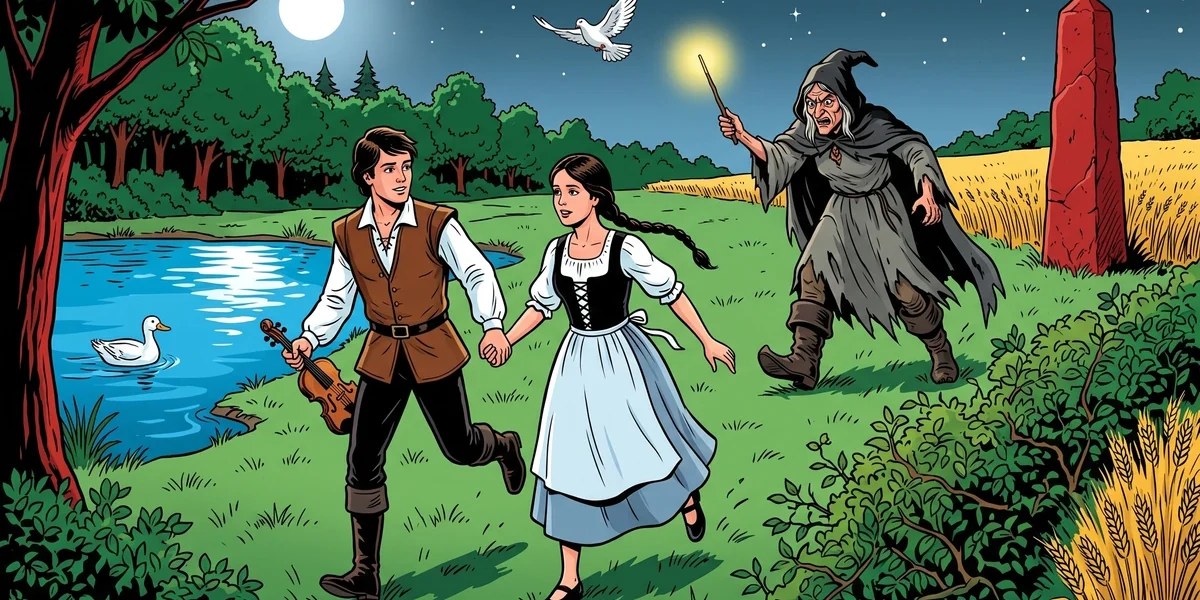
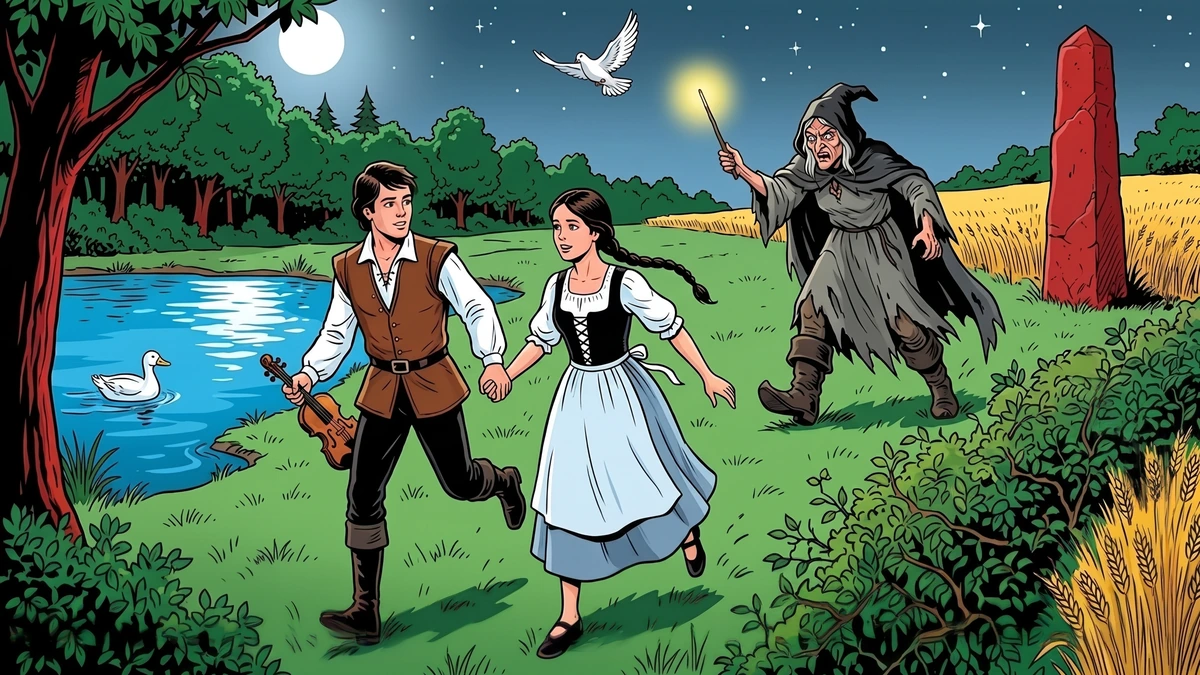
The chase that follows is the Grimm tale’s structural centre, and it is one of the great set-pieces of the entire Kinder- und Hausmärchen. As the witch in her many-league boots strides across the plains and gains on the fugitives, the stepdaughter takes out the magic wand she has stolen from the cottage and carries out the first of two transformations. She turns Roland into a clear lake and herself into a duck swimming in the middle of it. The witch arrives at the shore, recognises the duck at once, and tries to coax her out of the water by throwing in breadcrumbs. The duck, like every prudent fairy-tale heroine in disguise, refuses to be enticed; the witch waits the entire afternoon on the lake’s edge, growing more furious as the daylight fades, and at last is forced to give up and walk home. The folkloric grammar of this episode is exact: the heroine and her lover have transformed into the elements themselves, and the witch’s human-scale magic cannot reach across the elemental boundary. Motif D672, the “obstacle flight,” and D642, “transformation to escape pursuer,” together with the more specific D154.1, “transformation to duck,” cluster here in a pattern that Vladimir Propp, in his Morfologiya skazki (Leningrad, 1928), identified as one of the most stable narrative units in the European folk repertoire.
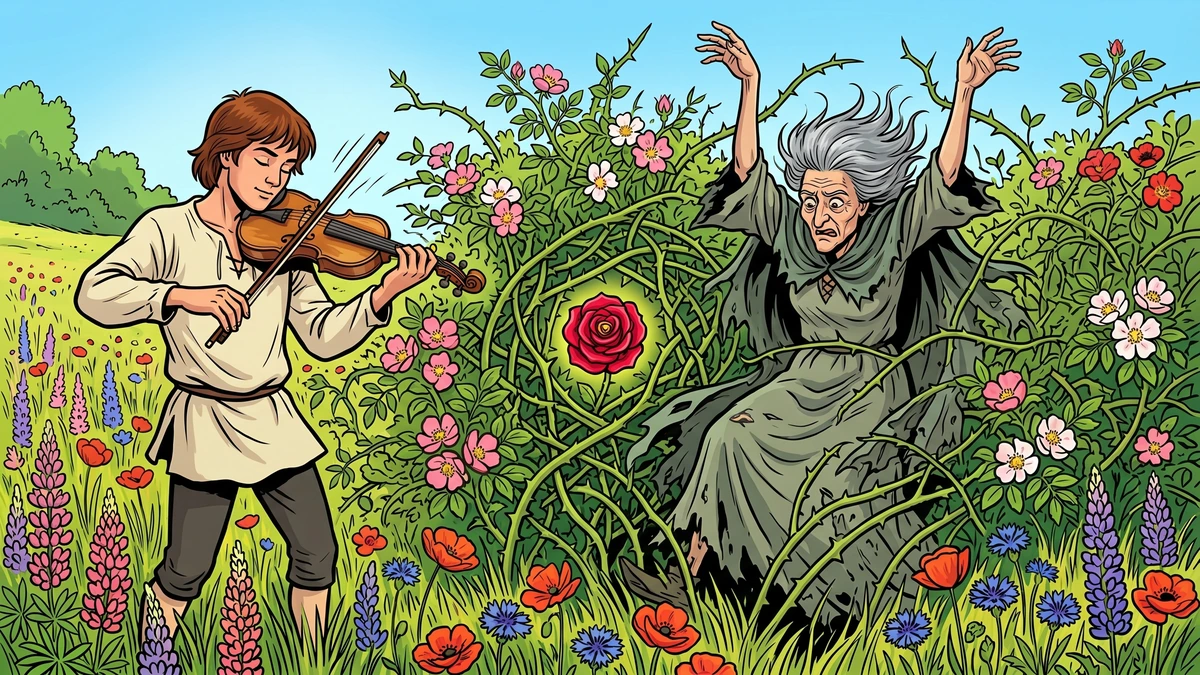
The lovers resume their human shapes when the witch is gone, and walk on through the night until daybreak. Then the stepdaughter performs the second transformation. She turns Roland into a fiddler and herself into a beautiful flower standing in the midst of a thick briar hedge. The witch, walking on through the morning, arrives at the hedge and asks the fiddler whether she may pluck the flower for herself. The fiddler — for so the Grimms call him from this point on — replies, with the courteous treachery of a folktale hero in disguise, that she may, and that he will play to her while she does it. He sets bow to string and begins to play; and as the witch pushes her way into the briars to reach the flower, his music compels her to dance. Whether she will or not, she must dance; and the faster he plays, the higher and the more violent are her dancing-leaps, until the thorns of the briar tear the clothes from her body and prick her until she bleeds. The fiddler does not stop. The Grimms’ phrasing for this passage is one of the most chilling in the collection — “er hörte nicht auf, bis sie tot zur Erde fiel,” “he did not stop, until she fell down dead upon the earth” — and it is the witch’s only end in the tale. Like the queen at the wedding in Sneewittchen, the witch in Der Liebste Roland dies inside a dance she cannot stop dancing; the reciprocal cruelty of the punishment matches the cruelty of the original axe. The Hessian audience of 1812 would have recognised the formula at once: the persecutor of innocents is killed by an enchantment of her own kind, in the precise manner she had inflicted on others.
IV. The Red Stone and the Forgotten Bride
The witch is dead, but the tale is only half over. Roland says to his sweetheart, “Now I will go to my father and arrange for the wedding.” The stepdaughter answers, “Then in the meantime I will stay here and wait for you, and that no one may recognise me, I will change myself into a red stone landmark.” This second waiting transformation is the small turning-point on which the entire latter half of the tale will hinge, and it represents a different folkloric register from the obstacle flight. Where the duck and the briar were defensive transformations against an active enemy, the red stone in the field is a passive transformation against time itself, a way for the heroine to become invisible until her lover returns. The motif is part of the cluster D215, “transformation to plant or stone,” and it appears across ATU 313 cognates from the Norwegian Master-Maid (in which the heroine becomes a wooden bowl on a shelf) to the Russian Vasilisa the Wise (in which she becomes a candle in a chapel). The risk in every cognate is the same: the longer the heroine remains transformed, the greater the chance that the hero will forget her.
And in the Grimm tale, this is exactly what happens. Roland goes home, intending to arrange the wedding. But on the way, he falls into the snares of another woman, who so fascinates him that he forgets the maiden he left waiting in the field. Motif D2006.1, the “forgotten fiancée”, is one of the oldest and most psychologically arresting elements of ATU 313, and the Grimms’ phrasing for it — “er fiel in die Schlingen einer anderen, die ihn so bezauberte, dass er die Jungfrau ganz und gar vergass,” “he fell into the snares of another, who so bewitched him that he forgot the maiden entirely” — preserves the moral ambiguity that scholars of the type have always noticed. There is no overt magic. The other woman is not called a witch. The Grimms simply say that Roland was bewitched by her, in the same idiomatic Hessian phrase that any village mother might use of a son who had married unwisely. The forgetting is treated as a moral, not a supernatural, event — and this is one of the most modern features of the tale, and one of the reasons it has continued to be read and adapted into the twenty-first century.
The poor stepdaughter waits in the field for a long time, but Roland does not come back. At length, in her sadness, she changes herself once more, this time into a flower, and thinks to herself, “Es kommt wohl jemand, der mich zertritt,” “someone will surely come this way and trample me down.” This is the lowest point of the heroine’s arc, and the Grimms render it with the small Hessian fatalism that characterises so many of their best moments. She does not curse Roland. She does not seek revenge. She simply transforms into something small and trampling-prone, and waits.
V. The Shepherd, the White Cloth, and the Voice at the Wedding
What comes next is the small mercy of the tale’s third movement, and one of the most domestic episodes in the Grimm corpus. A shepherd, keeping his sheep in the field, sees the flower and is struck by its beauty. He plucks it, takes it home with him, and lays it carefully in his oaken chest. From that moment on, strange things begin to happen in his cottage. When he wakes in the morning, all the work is already done: the room is swept, the table and benches are cleaned, the fire is lit on the hearth, and the day’s water has been fetched from the well. At noon, when he comes home from the pasture, the table is laid and a good dinner is served. He cannot conceive how this comes to pass, for he never sees a human being in the cottage and no one could have concealed himself in it. He is grateful, but at length he becomes afraid, and he goes to a wise woman in the next village to ask her advice.
The wise woman’s counsel is the small piece of magical procedure on which the rest of the tale turns. “There is some enchantment behind it,” she says. “Listen very early some morning to see if anything is moving in the room, and if you see anything, no matter what it is, throw a white cloth over it, and the magic will be stopped.” The wise-woman figure, in the Grimm collection, is almost always a benevolent rural specialist who knows the local repertoire of small enchantments and can identify a household haunting from its symptoms; folklorists number her under motif N825.3. The white cloth she prescribes is a small piece of folk medicine: in Hessian peasant practice it was held that any spell could be broken by covering the enchanted object with white cloth at the moment of its transformation, in much the same way that holy water was held to break a vampiric curse. The shepherd does as she bids him, and one morning, as the day is just dawning, he sees the chest open and the flower come out. Swiftly he springs forward and throws a white cloth over it. Instantly the transformation comes to an end, and a beautiful girl stands before him, who confesses that she has been the flower all along and that it was she who had been keeping his house in order while he was at work in the pasture. She tells him her whole story; and the shepherd, much moved, asks her to marry him. She refuses, gently but firmly: she wishes to remain faithful to her sweetheart Roland, who has forgotten her, but who is still her true betrothed. She promises, however, not to leave the shepherd’s cottage, but to continue keeping house for him until she can return to Roland, and the shepherd accepts this small kindness for the small kindness that it is.
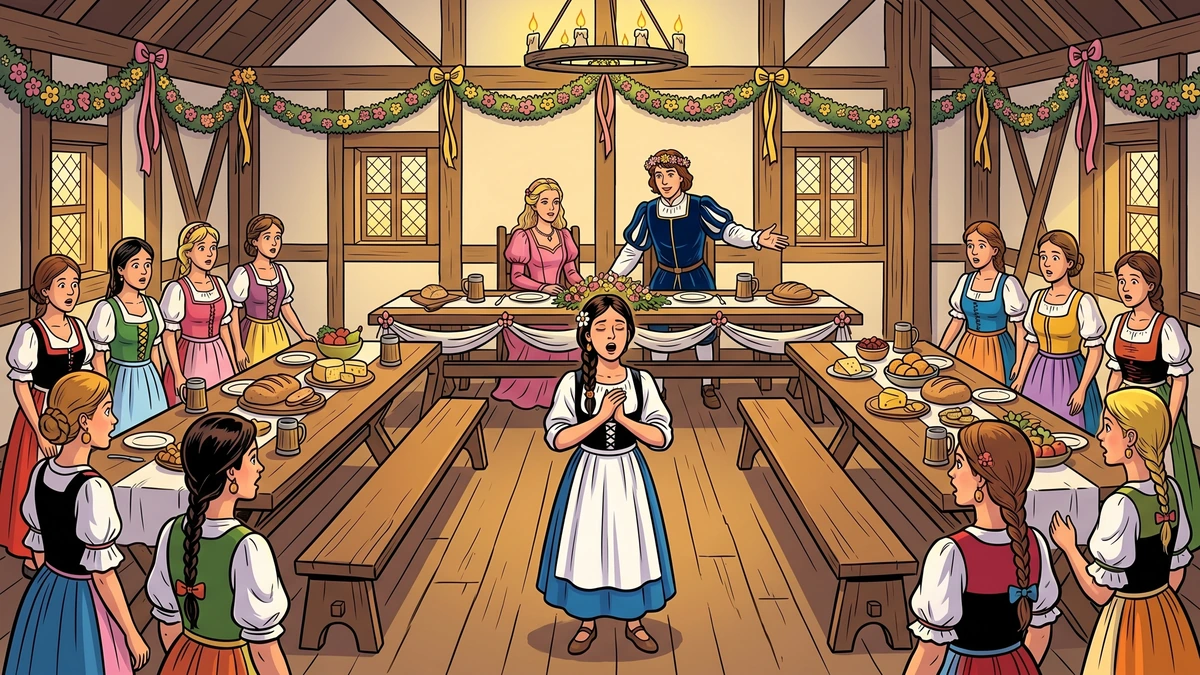
The closing of the tale is one of the most satisfying recognition scenes in the entire Grimm corpus. The time draws near for Roland’s wedding to the woman who has bewitched him, and according to an old Hessian custom it is announced that all the unmarried girls of the parish are to attend the celebration and sing in honour of the bridal pair. When the stepdaughter hears of this, she grows so sad that she thinks her heart will break. She does not want to go; but the other girls of the village come and take her with them. When her turn arrives to sing — she is held back to the very last, and at last she is the only one who has not yet sung — she steps into the centre of the room and lifts her voice. Roland hears the first phrase of her song, springs to his feet, and cries out: “Ich kenne die Stimme, das ist die rechte Braut, eine andere will ich nicht!” “I know the voice, that is the true bride, I will have no other!” Everything that he has forgotten, and that has vanished from his mind during the months of his enchantment, comes home again to his heart in a single instant. The recognition is not by appearance, not by any token, not by any magical proof — motif H11.1, “recognition by song,” one of the rarest and most affecting in the comparative folklore index. Then the faithful maiden holds her wedding with her sweetheart Roland, and the Grimms close the tale with one of their plainest and most beloved closing formulas: “und das Leid hatte ein Ende und die Freude fing an,” “and grief came to an end and joy began.”
The Moral: Faithfulness, Voice, and Recognition
The Grimms, like all good German storytellers of their generation, refused to print a single explicit moral after the body of the tale. But the closing formula — “und das Leid hatte ein Ende und die Freude fing an” — carries its own quiet judgement, and the Hessian dialect storytellers from whom Dortchen Wild had learned the tale appended a small proverbial couplet that the folklore collector Heinrich Pröhle recorded in his Kinder- und Volksmärchen (Leipzig: G. A. Avenarius, 1853) in this form, used by Hessian mothers as the closing summary of every Liebste Roland retelling:
“Wer treu in seinem Herzen bleibt,
Den findet auch der Liebste, der ihn vertreibt.”“Whoever stays faithful in their own heart, / Their dearest will find them, even when driven apart.”
— Hessian closing couplet to Der Liebste Roland, in H. Pröhle, Kinder- und Volksmärchen (Leipzig, 1853), no. 47.
The proverb, like all good Hessian closing-couplets, is precise about the kind of faithfulness it is praising. It is not the faithfulness of the betrayed lover who waits passively in a tower for years, nor the faithfulness of the wronged maiden who plots her revenge. It is the faithfulness of the woman who keeps a shepherd’s house in order while she is half-flower and half-girl, who refuses a marriage of comfort because her heart is already given, and who sings at the wedding of the man who has forgotten her, not as a curse or a complaint but simply because the song is hers to sing. Roland does not deserve her. The tale is unsentimental about this: he has been bewitched by another woman, he has forgotten his sweetheart in a field, and he is on the point of marrying the woman who bewitched him. What saves him is not his own merit but the fact that the maiden’s voice, when he hears it, is recognisable to him as something older than the enchantment. Recognition by voice, in the comparative folklore record, is almost always the recognition of an essential, pre-enchanted self — the part of one’s identity that no spell can erase. This is the deeper moral of Der Liebste Roland, and it is the reason the tale has continued to be read and adapted by writers as different as Anne Sexton in her 1971 Transformations and A. S. Byatt in her 1994 The Djinn in the Nightingale’s Eye: faithfulness, in this register, is not blind constancy but the patient maintenance of one’s own voice against all the small enchantments of forgetting.
Why It Lasted: The Magic Flight Across Continents
The placement of “Sweetheart Roland” under ATU 313 “The Magic Flight” puts it at the centre of one of the largest and most internationally distributed tale-type families in the comparative index. Hans-Jörg Uther’s revised Types of International Folktales lists more than five hundred attested variants of the type from across Europe, the Caucasus, North Africa, the Mediterranean Levant and Anatolia. The Norwegian cognate is The Master-Maid, recorded by Peter Christen Asbjørnsen and Jørgen Moe in Norske Folkeeventyr (Christiania: Dahl, 1843); in this version the witch is replaced by a giant troll, the lake by a thicket of thorns, and the briar by a sea, but the structural pattern of three obstacle-flights followed by a magical forgetting and a recognition by voice is preserved exactly as in the German. The Italian cognate is La sapia, recorded by Giuseppe Pitrè in Fiabe novelle e racconti popolari siciliani (Palermo: Pedone Lauriel, 1875), in which the heroine becomes a fountain, then a chapel, then a peasant girl on the wedding-day. The Russian cognate is The Sea-Tsar and Vasilisa the Wise, in Aleksandr Afanasyev’s Russkie narodnye skazki (Moscow, 1855–1863), in which the obstacles are a comb that turns into a forest, a brush that turns into a mountain, and a towel that turns into a sea. The Greek cognate is The Twins of Stars, recorded by Johann Georg von Hahn in Griechische und Albanesische Märchen (Leipzig: Engelmann, 1864). The Caucasian cognate is the Georgian Asphurtsela, in which the obstacle-flight is performed by a young woman riding a magical horse. The Welsh cognate is Pwyll, embedded in the medieval Mabinogion, in which the lovers’ obstacle-flight takes the form of a chase across the borders of the Otherworld.
What makes the Grimm version distinctive within this great family is its compression and its psychological economy. The opening witch-mother and the closing recognition-by-song are packed into a tale of barely fifteen hundred words, and yet every motif of the type is present and exactly placed. The obstacle flight is reduced from the more usual three transformations to two — duck and flower-and-fiddler — but the briar-hedge dance is given an extended treatment, with its slow build of tempo and its terrifying inevitability, that no other version of the tale type achieves. The forgotten-fiancée episode is treated with the small Hessian moral realism that has no equivalent in the more elaborate Slavic and Mediterranean cognates: Roland’s forgetting is not the result of a poison or a magical drink but of his having “fallen into the snares” of another woman, and the tale’s implicit verdict is that this is a fault of will, not of magic. Above all, the recognition by song at the wedding is unique to the Grimm version among the major nineteenth-century printed cognates; most ATU 313 endings use a magical token (a ring, a feather, a piece of cloth) for the final recognition, but the Grimms preserved the older Hessian motif of recognition by voice, which is rooted in the pre-literate village culture in which a girl’s voice would have been the most distinctive thing about her, more so than her face. These three Grimm contributions — the briar-hedge dance, the moralised forgetting, the recognition by song — are exactly the elements that have made “Sweetheart Roland” the version of ATU 313 most widely read and adapted in the twentieth and twenty-first centuries.
Iconography: Lakes, Briars, and Wedding-Songs
“Sweetheart Roland” entered Anglophone visual tradition through the elegant chromolithographs of Walter Crane for Lucy Crane’s 1882 Household Stories (London: Macmillan), in which the heroine is shown at the moment of her transformation into the duck, with Roland’s lake spreading out around her as a smooth circular pond. The German visual reference is Otto Ubbelohde’s 1907–1909 ink illustrations for the Turm-Verlag edition of the Kinder- und Hausmärchen, which set the tale firmly in the Hessian uplands in peasant clothing and which gave the briar-hedge scene the sinuous Jugendstil treatment that has been imitated in nearly every twentieth-century German edition. Arthur Rackham’s 1909 watercolours for the English Fairy Tales of the Brothers Grimm (London: Constable) include a particularly striking image of the witch dancing in the briars, her clothing torn and her boots flying, that has become one of the canonical visual representations of the tale. Wanda Gág’s sturdy 1936 woodcuts for Tales from Grimm (New York: Coward-McCann) gave the opening axe-and-bedroom scene a small Mid-Western austerity that has aged well. Maurice Sendak’s 1973 line drawings in The Juniper Tree and Other Tales from Grimm (translated by Lore Segal and Randall Jarrell, New York: Farrar, Straus and Giroux) are the most psychologically penetrating: Sendak draws the recognition scene at the wedding with a face on Roland that is half-awake and half-still-bewitched, and the maiden’s singing posture echoes the Brueghel paintings Sendak loved. The poem-cycle Transformations by Anne Sexton (Boston: Houghton Mifflin, 1971), illustrated by Barbara Swan, includes a verse retelling of the tale that emphasises the forgotten-fiancée motif as a parable of female silencing. A. S. Byatt’s novella The Djinn in the Nightingale’s Eye (London: Chatto & Windus, 1994) borrows the briar-hedge dance and recasts it as a meditation on female ageing and storytelling power.
Reading with Children
For parents, teachers, and storytellers reading Der Liebste Roland aloud, four details from the Grimms’ text repay slowing down for. First, the substituted bedfellow. The opening axe-and-bedroom scene is brutal, but it is also one of the clearest small lessons in cool intelligence in the entire Grimm corpus. Pause after the maiden takes the place at the back of the bed, and let listeners feel the weight of the choice she has made. Second, the three drops of blood that answer for her. The cottage waking up to find the murdered child still “sweeping” on the stairs and “warming herself” in the kitchen is one of the most uncanny small set-pieces in the European fairy-tale corpus, and children grasp at once the idea that a clever maiden can leave behind a piece of magic that buys her time. Third, the briar-hedge dance. The witch’s slow, accelerating, helpless dance among the thorns is a small lesson about how cruelty can rebound on its perpetrator without any divine intervention — the fiddler simply will not stop playing. Older children love being told that the witch’s death is one of the most precise small examples of poetic justice in the whole Grimm collection. Fourth, the recognition by song. The wedding-day scene is the heart of the tale and the part most worth pausing on with younger listeners. The maiden does not arrive on a horse; she does not bring a token; she simply opens her mouth and sings, and the song is enough to break the enchantment. This is one of the great small moments of female agency in the entire Kinder- und Hausmärchen, and a generation of feminist re-readers from Marina Warner in From the Beast to the Blonde (London: Chatto & Windus, 1994) onward has held it up as a counter-example to the more passive heroine-types of Aschenputtel and Dornröschen.
A Note on Sources
The text on this page follows KHM 56, “Der Liebste Roland,” in Jacob and Wilhelm Grimm, Kinder- und Hausmärchen, 1st edition, volume II (Berlin: Realschulbuchhandlung, 1815), pages 49–52, with reference to the canonical 7th edition (Göttingen: Dieterich, 1857) which made small stylistic revisions to the witch’s speeches and slightly tightened the briar-hedge scene. The English wording is closely adapted from Margaret Hunt’s standard 1884 translation, Grimm’s Household Tales (London: George Bell & Sons), volume I, pages 226–230, with reference to Lucy Crane’s 1882 Household Stories for the briar-hedge wording and to Edgar Taylor’s earlier 1826 German Popular Stories, volume II, in which the heroine first appeared in English under the title Sweetheart Roland. The provenance of the tale is documented in Wilhelm Grimm’s Anmerkungen zu den Kinder- und Hausmärchen, 3rd edition (Göttingen: Dieterich, 1856), volume I, pages 117–119; for the role of Dortchen Wild as primary informant, the indispensable modern reference is Heinz Rölleke, Die Märchen der Brüder Grimm: Eine Einführung (Stuttgart: Reclam, 1985), chapter 5, and Donald Haase (ed.), The Greenwood Encyclopedia of Folktales and Fairy Tales (Westport, Conn., 2008), entry on the Wild family. For the comparative folklore the standard reference remains Hans-Jörg Uther’s The Types of International Folktales (FFC 284–286, Helsinki, 2004), entry on ATU 313; for the motif inventory, Stith Thompson, Motif-Index of Folk-Literature, revised edition (Indiana University Press, 1955–58), motifs S31, K1611, D672, D642, D215, D154.1, D2006.1, H11.1, N825.3, D1611. The Pröhle dialect couplet is preserved in Heinrich Pröhle, Kinder- und Volksmärchen (Leipzig: G. A. Avenarius, 1853), no. 47. All cited editions are in the public domain and freely available through the Internet Archive and the German Deutsches Textarchiv.
Read time: about 10 minutes. Suitable for ages 6 and up; suitable for read-aloud from age 4 with the opening bedroom scene treated, in the Grimms’ gentle phrase, simply as the night when the witch-mother “made a great mistake she could not take back,” and the briar-hedge dance treated as the music that “played until the witch could dance no more.”
You May Also Like
 Grimm's Fairy Tales
Ages 9-12
Grimm's Fairy Tales
Ages 9-12
The Travelling Musicians
The Travelling Musicians: An honest farmer had once an ass that had been a faithful servant to him a great many years, but was now growing old and every day
 Grimm's Fairy Tales
Ages 9-12
Grimm's Fairy Tales
Ages 9-12
Rumpelstiltskin
Rumpelstiltskin: By the side of a wood, in a country a long way off, ran a fine stream of water; and upon the stream there stood a mill. The miller’s house was
 Grimm's Fairy Tales
Ages 9-12
Grimm's Fairy Tales
Ages 9-12
The Seven Ravens
The Seven Ravens: There was once a man who had seven sons, and last of all one daughter. Although the little girl was very pretty, she was so weak and small