The Seven Ravens
The Seven Ravens: There was once a man who had seven sons, and last of all one daughter. Although the little girl was very pretty, she was so weak and small
The Seven Ravens — Die sieben Raben in the original German — is one of the most haunting and tender tales preserved by Jacob and Wilhelm Grimm in their landmark collection Kinder- und Hausmärchen (Children’s and Household Tales). Catalogued as KHM 25, it tells how a father’s careless curse transforms his seven sons into ravens, and how their newborn sister, growing into a brave young woman, journeys to the very ends of the world to undo the harm her birth innocently caused. In Antti Aarne and Stith Thompson’s international index of folk narrative, the story is the cornerstone example of ATU 451 — The Maiden Who Seeks Her Brothers, a tale-type with parallel forms scattered from Iceland to the Caucasus.
The textual history is unusually well-documented. In the first edition of Kinder- und Hausmärchen, published in Berlin in 1812, KHM 25 appeared under the title Die drei Raben (The Three Ravens), drawn from a manuscript in Jacob Grimm’s hand and most likely transmitted orally to the brothers by the Hassenpflug family — the Huguenot-descended Kassel household whose daughters Marie, Jeanette, and Amalie supplied many of the collection’s most celebrated narratives. For the second edition of 1819, Wilhelm Grimm replaced the opening with a version from the Vienna region, lengthened the brothers from three to seven, and rechristened the tale Die sieben Raben. From that moment forward, the seven-fold form became the canonical one, surviving unchanged into the seventh and final authorised edition of 1857. The English-speaking world inherited the tale chiefly through Edgar Taylor’s German Popular Stories (1823) and, later, Margaret Hunt’s complete 1884 translation.
Beyond its textual lineage, the story belongs to a wider European fascination with the motif of brothers transformed into birds and rescued by a devoted sister. ATU 451 numbers among its branches the Grimms’ own KHM 9 (The Twelve Brothers) and KHM 49 (The Six Swans), Hans Christian Andersen’s The Wild Swans (1838), the Irish legend of The Children of Lir, and a string of Italian, Greek, and Slavic variants. What sets Die sieben Raben apart is its terse miniature scale, its astral sequence in which the heroine consults Sun, Moon, and Stars, and its single most unforgettable image: the little sister, locked out of the glass mountain, slicing off her own finger to fashion a key. Few moments in European wonder-tale literature express so exactly the quiet cost of love.
The Father’s Cursed Wish
The story opens with a small domestic disaster. A man and his wife have seven strong sons but long for a daughter. When at last the wife bears a girl, the child is so weak and sickly that the parents fear she will not live, and the father sends his eldest son hurrying to the village spring with a pitcher to fetch water for an emergency baptism. The other six brothers, in their love and excitement, race after him. At the well they jostle one another, all seven pitchers tumble in, and the boys stand staring at the dark mouth of the spring, ashamed to come home empty-handed and ashamed to come home late. None of them dares move.
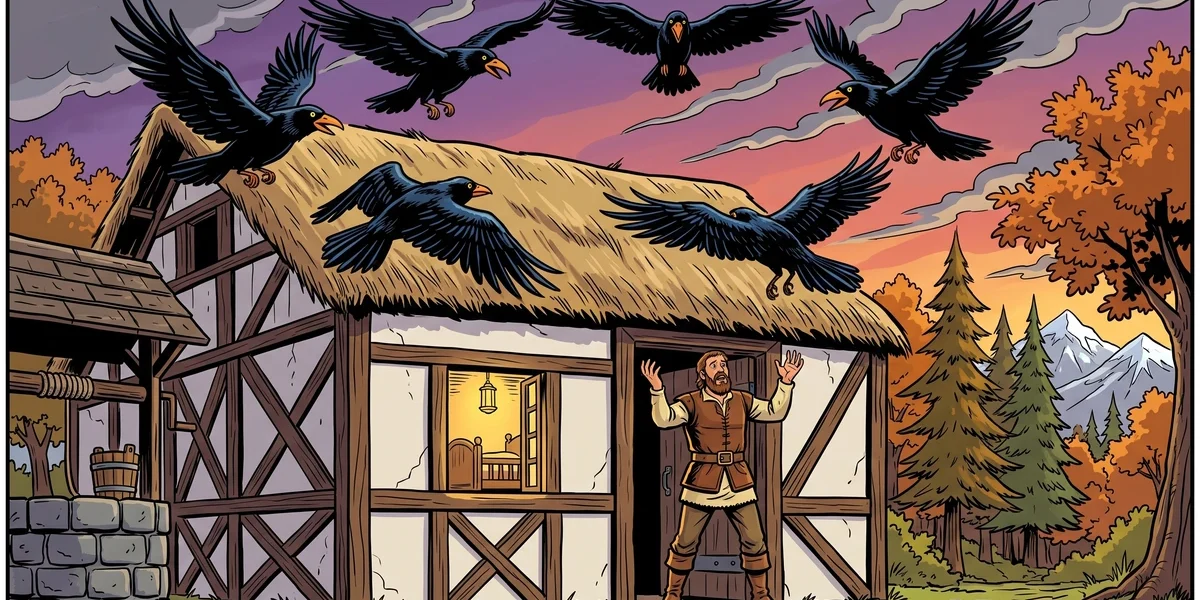
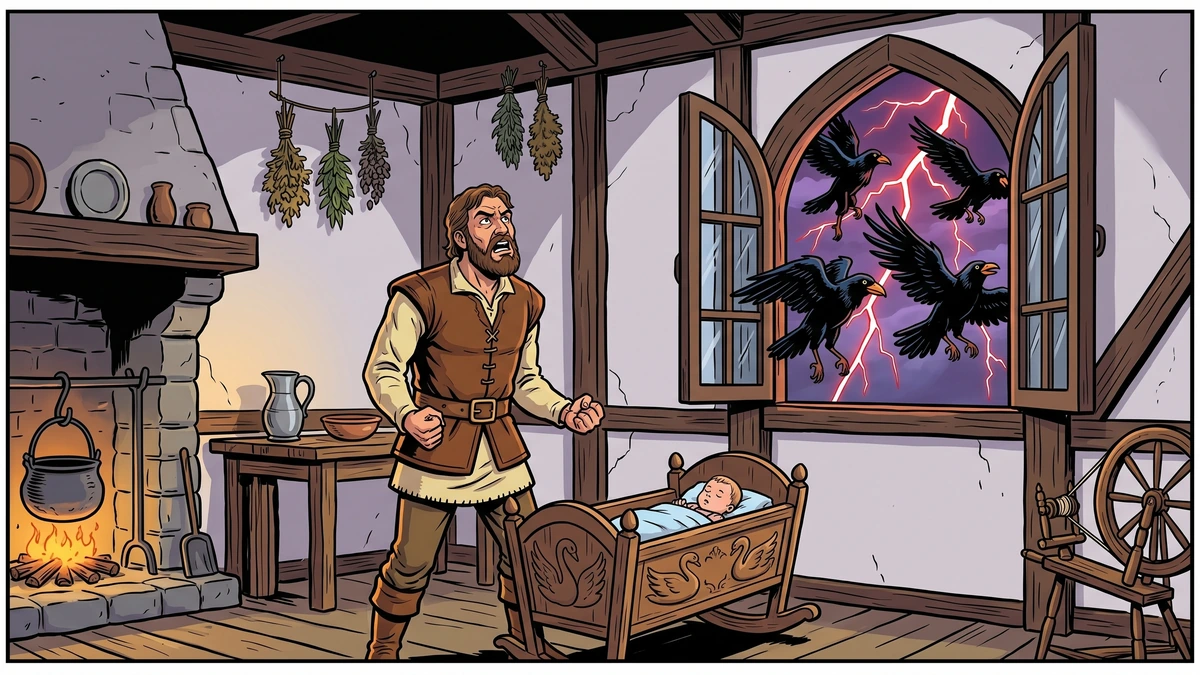
The father, waiting at the cradle while his daughter weakens by the minute, grows first anxious, then suspicious, then furious. Surely, he says — the words rendered in countless English versions as a half-spoken sigh — the whole seven must have forgotten themselves over some game of play. And in the heat of his fear for the baby, he speaks the curse: he wishes his sons were turned into ravens. The German wording is starkly compact, a single fatal subjunctive clause. Scarcely has the wish left his lips when a hard, dry croaking comes down from the rafters. He looks up and sees seven black ravens, coal-feathered and identical, wheeling over the house. They circle once and fly away.
The Grimms set this opening in the deceptively flat, almost legal prose that is the hallmark of their middle and later editions. There is no melodrama and no scolding voice from the narrator. The wish is cruel and irreversible because it is human, and the household must absorb it the way real households absorb sudden grief: by silence. The little sister recovers and grows up beautiful, but her brothers’ names are never spoken. A small portrait of seven boys hangs — or perhaps does not hang — somewhere out of view. Folklorists from Max Lüthi onward have noted how this restraint converts a fairy-tale shock into something close to lyric. The reader is allowed to feel both the parents’ guilt and the absent brothers’ bewilderment, and to feel them at once.
The Sister’s Vow and Her Departure
For many years the daughter knows nothing. Then one day she overhears the village women whisper that she is, after all, the cause of seven lost sons. The remark cuts her exactly the way malice intends. She returns to her parents and presses them; reluctantly, they tell the truth. She decides at once that she will set out, find her brothers wherever in the wide world they are, and bring them home.
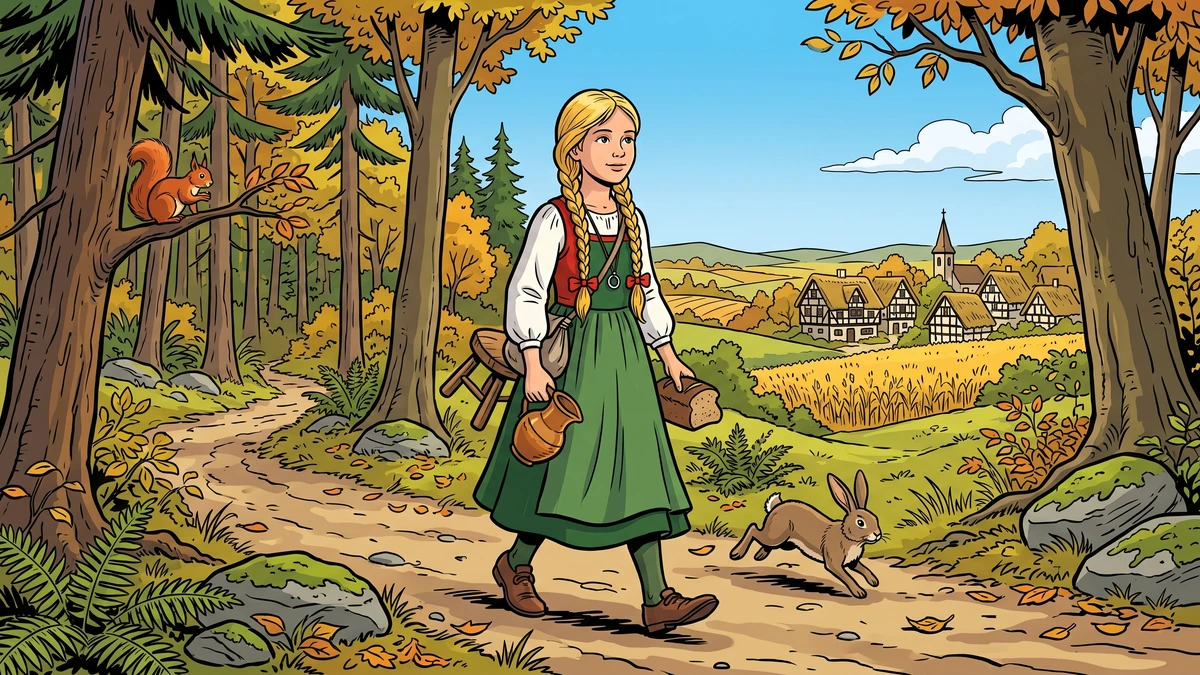
The Grimms’ description of her preparations is one of the best small inventories in the collection. She takes a little ring her parents had given her at birth, in case she should need a token; a loaf of bread, in case she should be hungry; a little pitcher of water, in case she should be thirsty; and a tiny stool, in case she should be weary. The deliberate, listed quality of these four objects is a feature of oral narration — rhythmic enough to carry on the tongue, concrete enough to anchor the imagination — but it also tells the reader something important about the heroine. She is methodical, modest, and self-sufficient. She does not arm herself; she packs as a child packs for a long walk, with whatever is small enough to carry.
She walks until the inhabited world ends — until village, then field, then forest, then road give way to a cold, bare country at the edge of the cosmos. The transition is unmarked by any spectacle. The Grimms simply write that she went on and on, and at last came to the end of the world. This is perhaps the oldest convention of the European wonder tale: distance is measured not in leagues but in moral effort, and a child’s persistence can be relied upon to traverse it. Hers does.
Sun, Moon, and the Friendly Stars
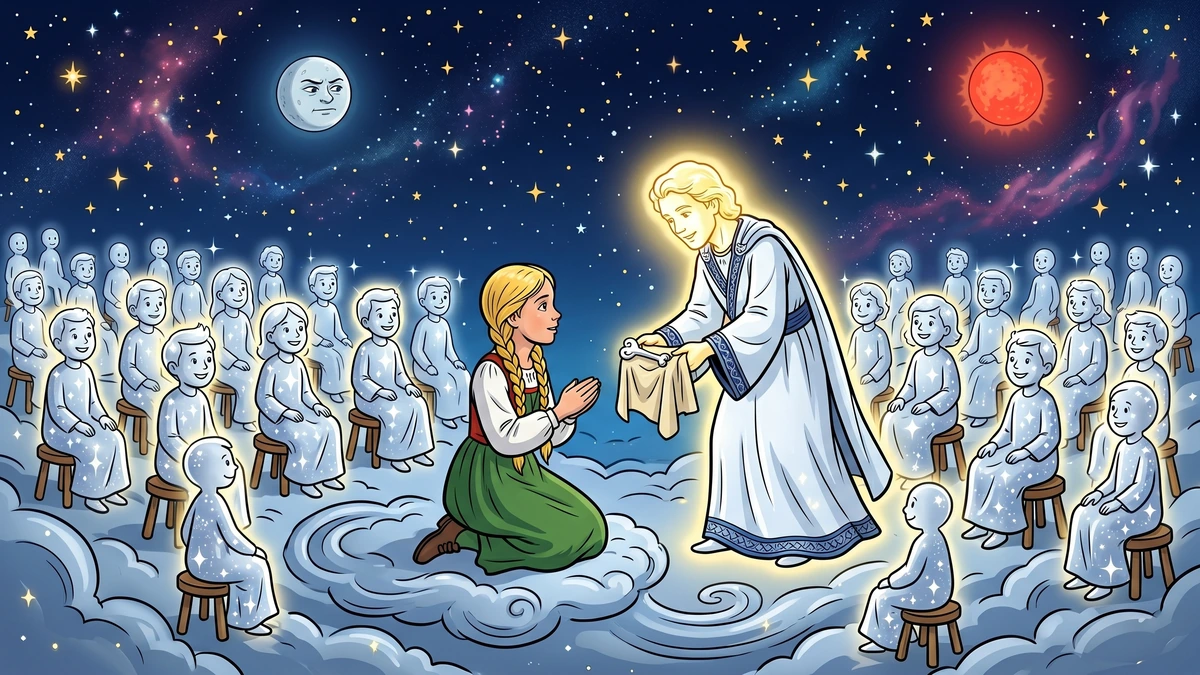
At the world’s end she comes first to the Sun, who proves much too hot and fiery; she runs from him as one runs from an oven door. She climbs next to the Moon, who is icy and pale and who, in the most chilling of the tale’s small touches, sniffs the air and mutters that he smells human flesh. She flees again. At last she reaches the country of the Stars, and here, for the first time on her journey, she is met with kindness. Each of the stars sits on its own tiny stool — the same kind of stool she has been carrying, a small homely echo across the vault of heaven — and the morning star rises and gives her a present. It is a chicken-bone, sometimes rendered as a small piece of wood, with which she will be able to unlock the glass mountain where her brothers now live.
The astral sequence is one of the oldest known elements of ATU 451 and ATU 450 and has cousins all over the Indo-European world: Russian Vasilisa is helped by the rising sun and the clear moon; Greek Psyche is sent to consult them; the Norse Völuspá imagines the stars as known characters in their own right. The Grimms preserve the motif at its purest. The Sun is dangerous because he is brilliant and indifferent; the Moon is dangerous because he is hungry; only the Stars, smallest and most numerous, are kind. This is not theology, but it is a moral arrangement: in this story, scale matters. The very small — a child, a star, a stool — turn out to be the sources of help. The very large are simply weather.
She wraps the bone-key in a cloth, hides it in her bodice, and walks on. After many more days she reaches the glass mountain, climbs its slippery sides, and finds the door of the castle locked. She reaches into her cloth for the key. It is gone — lost somewhere along the way, perhaps blown out by a wind, perhaps fallen on the glass slope where it could never be found.
The Severed Finger and the Brothers Restored
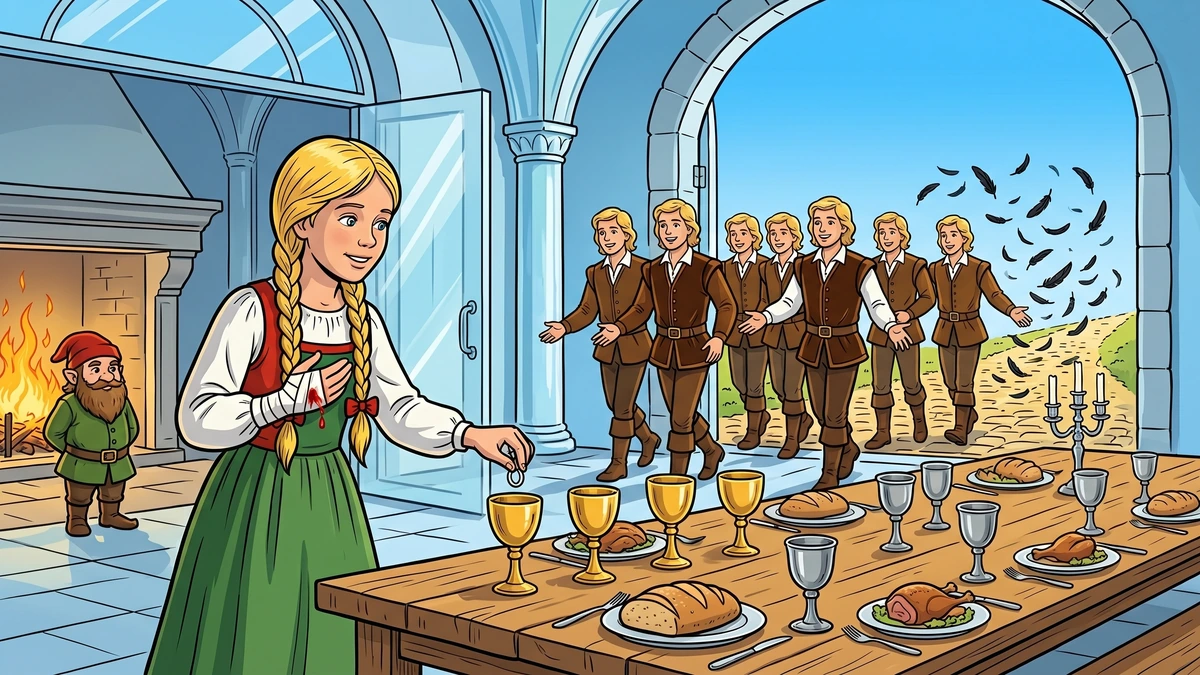
The next sentence in the Grimms’ German is one of the most quietly extraordinary in the entire collection. The little sister thinks for a moment, takes the small knife she carries, and cuts off her own little finger, fits it to the lock, and turns. The door opens.
This is the central image of Die sieben Raben and the reason it has been illustrated, dramatised, and reinterpreted for two centuries. There is no flinching, no hesitation, and the narrator offers no commentary. The act is self-mutilation and the act is love, and the story refuses to separate the two. Folklorists have read it as a residue of older sacrificial logic — the body offered for the body, blood for blood — while modern readers more often see it simply as the moral high-water mark of the tale, the moment at which the heroine demonstrates that she will give of herself precisely what is needed and not a particle less.
Inside the castle she finds a small dwarf laying the table for seven masters. She begs to wait. As the dwarf serves out the meal — seven plates, seven cups — she takes a small bite from each plate and a small sip from each cup, and into the seventh cup she drops the ring her parents gave her. Then she hides. Presently a great rushing of wings is heard outside; the seven ravens come home. They eat and drink in silence until one cries out that someone has been at his cup. Each of the others looks: someone has been at all seven cups. The seventh raven turns his cup upside down and the ring falls, ringing, onto the table. He recognises it at once. The brothers cry, half in hope, half in disbelief, that their dear little sister must be here, and at the sound of their voices she steps out from her hiding place. In that instant the spell breaks. Seven young men stand where seven ravens stood. They all embrace her, weeping, and together they walk home.
The Moral — A Family Restored by Sacrifice
What does Die sieben Raben teach? At the surface it is a story about the cost of careless words: a single angry sentence flung in a moment of fear costs a family seven sons. The Grimms, sons of a Reformed Lutheran jurist, were sensitive to the destructive force of human speech, and the curse here is not laid by a witch or a sorcerer but by an ordinary, decent father in an ordinary, decent fit of temper. That is the real horror, and the real warning.
But the deeper teaching belongs to the daughter. Where the father’s wish is reckless, her vow is deliberate. Where his anger is loud, her resolve is quiet. Where he gives nothing of himself, she gives a finger. The story argues, very gently and without ever raising its voice, that words can be unsaid only by deeds, and that the deeds must come from someone who consents to be diminished by them. There is a German proverb the Grimms knew well, drawn from Friedrich von Logau and quoted in their own letters:
„Was ein Wort verdirbt, kann nur die Tat erlösen.“
— What a word ruins, only a deed can redeem.
That sentence might stand as the epigraph for the whole tale. The closing image — eight children walking back along the same road that one of them once walked alone — is one of the most healing in the collection precisely because the little sister has paid for it. Her finger does not grow back. The ring slips somewhat looser on the hand it returns to. But the family is whole.
Why the Tale Has Lasted
Two centuries after Wilhelm Grimm rewrote it for the second edition, Die sieben Raben remains one of the most adapted of the lesser-known Grimm tales. The Czech-German animator Lotte Reiniger filmed her famous silhouette version, Die sieben Raben, in 1937; the West German live-action production of 1953, directed by Ferdinand Diehl with hand-built puppets, is a beloved staple of childhood viewing in central Europe. The tale appears in almost every illustrated Grimm anthology from Arthur Rackham to Maurice Sendak, and it has fed countless modern retellings — from young-adult novels to opera, from picture books to feminist short fiction — in which the heroine’s silent, decisive courage is the central interest.
For Indian readers the story will feel familiar in unexpected ways. The motif of a sister rescuing brothers from a curse is woven through the Mahabharata’s Savitri legend and through countless Panchatantra and Jataka narratives in which a younger sibling redeems an elder by quiet penance. The astral helpers — sun, moon, and stars — are at home in Hindu cosmology as Surya, Chandra, and the Nakshatras. Even the small finger sacrificed for a key has its echoes in the Ekalavya episode of the Mahabharata, where the devoted forest pupil cuts off his thumb for his teacher. Different cosmologies, different climates, the same underlying intuition: that love, when it is real, is paid for in pieces of the self.
That is finally why the story has lasted. It is short enough to be told in a single sitting, simple enough for a child of five to follow, and grave enough for an adult of fifty to weep at. It does not pretend that a thoughtless word can be merely apologised for. It insists, gently and unforgettably, that a deed of love — offered without ceremony, without applause, without complaint — can still bring the lost ones home.
The Four Small Objects — A Note on Folkloric Symbolism
It is worth pausing on the four small things the heroine packs before she leaves: a ring, a loaf, a pitcher, and a stool. Folklorists from Stith Thompson onward have observed that wonder-tale heroines who leave home to redress an injustice almost always carry a token of identity (here, the ring), a token of bodily endurance (the bread and the water), and a token of patience (the stool, on which one waits). Together these four amount to a small grammar of the long quest: to name yourself, to feed yourself, to refresh yourself, and to be willing to sit down and wait. Die sieben Raben is unusual among Grimm tales in laying out this grammar so transparently. The reader is invited, almost catechistically, to notice that the heroine has prepared for every part of her ordeal except the part that will demand a piece of her body — for that, no preparation is possible, only love.
The glass mountain (der gläserne Berg) on which the brothers are imprisoned is itself a recurring fixture of central European folklore, appearing in tales as far apart as Polish Szklana Góra, Hungarian Üveghegy, and Bohemian Skle ná hora. It is the otherworld in its hardest, brightest, most translucent aspect: visible from far off, yet impossible to climb without aid. Folklorists generally read it as a daylight cousin to the underworld, a place where the disenchanted live in a kind of crystalline suspension. Its smooth verticality is what makes the heroine’s climb a feat in itself, and what makes the bone-key — or, when the bone-key is lost, the small severed finger — so necessary. Glass yields only to bone.
You May Also Like
 Grimm's Fairy Tales
Ages 9-12
Grimm's Fairy Tales
Ages 9-12
Jorinda And Jorindel
Jorinda And Jorindel: There was once an old castle, that stood in the middle of a deep gloomy wood, and in the castle lived an old fairy. Now this fairy could
 Grimm's Fairy Tales
Ages 9-12
Grimm's Fairy Tales
Ages 9-12
Cat and Mouse in Partnership
A cat and a mouse hide a pot of fat for winter, but not every friend keeps a promise.
 Grimm's Fairy Tales
Ages 6-8
Grimm's Fairy Tales
Ages 6-8
Hansel and Gretel: A Short Retelling for Kids
Hansel and Gretel: A Short Retelling for Kids: In a small cottage at the edge of a great forest lived a woodcutter and his wife with two children - Hansel and