The Elves And The Shoemaker
The Elves And The Shoemaker: There was once a shoemaker, who worked very hard and was very honest: but still he could not earn enough to live upon; and at last
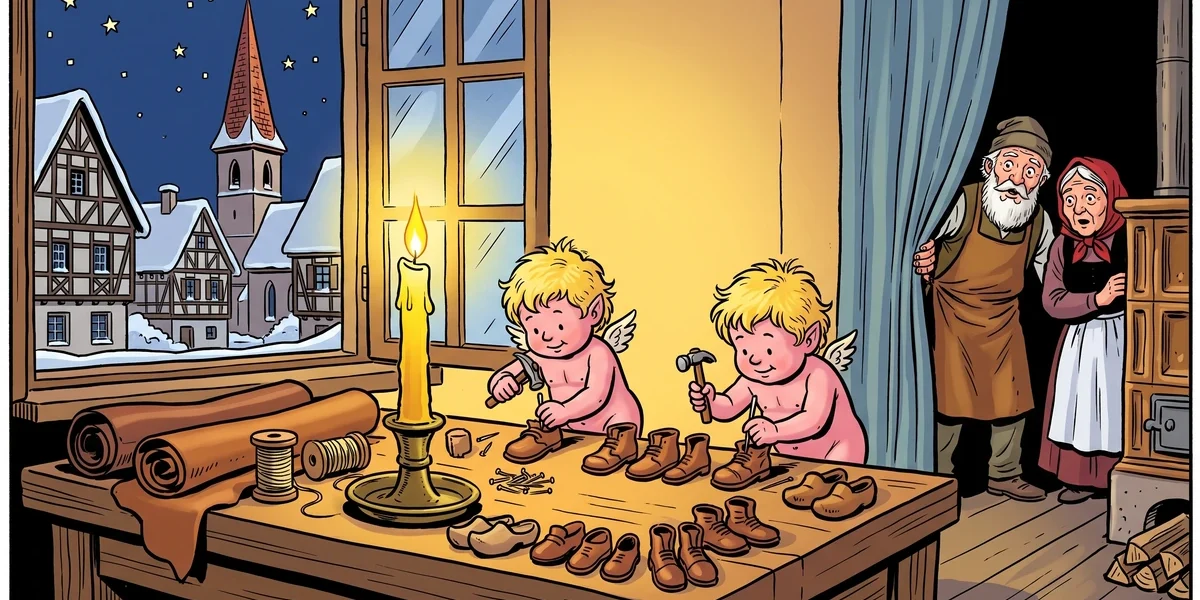
“The Elves and the Shoemaker” — known to its first German readers as the opening section of Die Wichtelmänner — was set down in print in 1812 by Jacob and Wilhelm Grimm in the very first volume of their Kinder- und Hausmärchen (Children’s and Household Tales). Catalogued internationally as ATU 503* (Helpful Elves), the story belongs to a wide European family of legends about household spirits who labour invisibly through the night for the deserving poor — and who depart, often with gentle laughter, the moment a human gift acknowledges them. Two centuries on, the tale still does what the Grimms hoped every house-tale would do: it teaches a quiet lesson about gratitude, dignity, and the strange courtesy that even the smallest of wonders demands.
A Note on Source and Scholarly Attribution
The text published as KHM 39 in the 1812 edition of the Kinder- und Hausmärchen was, like many of the most beloved tales in the Grimm corpus, gathered in the salons and kitchens of Hessian Germany rather than invented by the brothers themselves. Scholarly consensus traces the immediate source of the shoemaker tale to the Wild family of Kassel, with the storytelling almost certainly attributed to Henriette Dorothea Wild — known affectionately as Dortchen — who would in 1825 marry Wilhelm Grimm. Dortchen’s family contributed numerous tales to the early Grimm collection, and her warm, oral cadences are detectable in the unhurried, almost lullaby rhythm of the shoemaker’s nights.
The international index of folk-tale types (Aarne-Thompson-Uther) lists the narrative as ATU 503*, “Helpful Elves” or “Gifts of the Little People.” The migratory legend index of Reidar Th. Christiansen places the closing motif — the elves laughing and bounding away once the shoemaker leaves clothes for them — under ML 7015 (“The Brownie Leaves When Given Clothes”). The motif itself is catalogued as F381.3 in Stith Thompson’s Motif-Index of Folk-Literature: “Fairy leaves when gift of clothing is left for him.” Cognate stories appear across the Germanic and Celtic worlds, from the English brownie traditions recorded by William Henderson in Notes on the Folk-Lore of the Northern Counties (1879) to the Cornish piskies, the Welsh bwbachod, and the Scandinavian nisse and tomte, all of whom share the same fragile etiquette around payment.
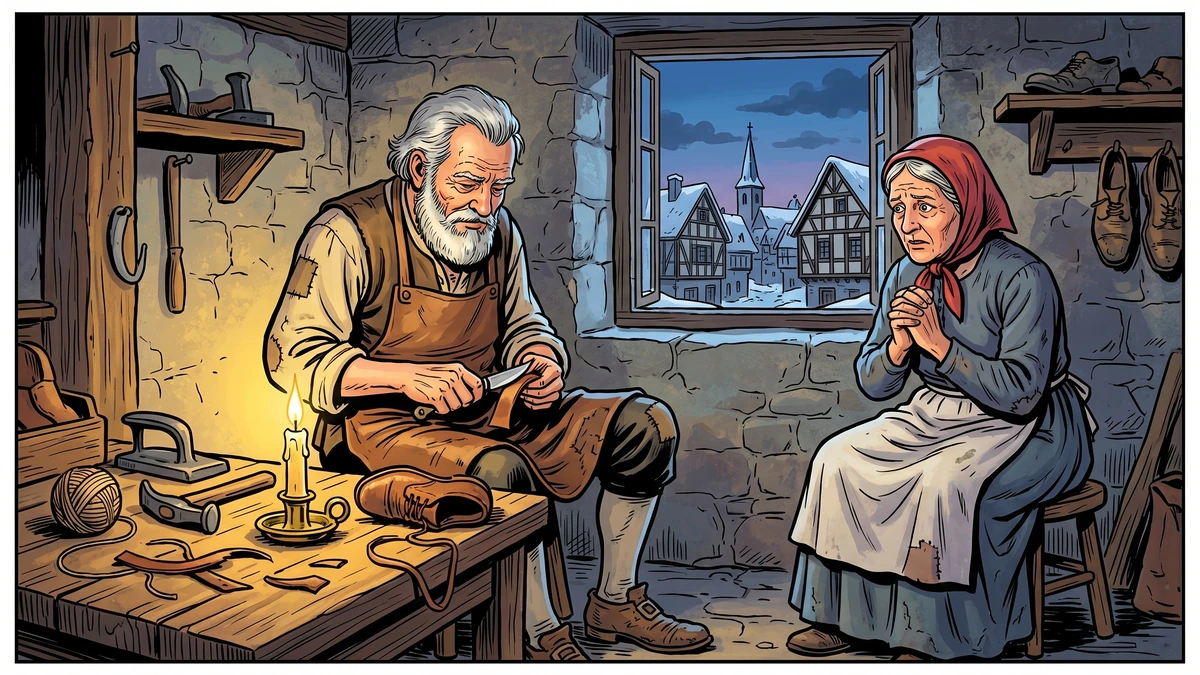
The First Night: Honest Hands and an Empty Larder
The Grimms open the tale on a single, deliberately spare image: a shoemaker, the leather almost gone, cutting out one last pair of shoes by the fading light of a winter evening. The brothers chose the detail with care. In the early nineteenth-century Hessian countryside they were beginning to document, the cobbler’s bench was a familiar landmark of village life — and so was the quiet desperation of an honest craftsman who could no longer make ends meet despite long hours and unstinting work. The shoemaker is not lazy, not foolish, not greedy. He is, in the careful adjective the Grimms repeat, fleißig — diligent — and that diligence has somehow not been enough.
Crucially, before he goes to bed that night, the shoemaker does three things that frame everything that follows. He cuts the leather neatly and lays it out for the morning, so that his last day’s work is at least prepared. He says his evening prayers. And he commends his cares to Heaven — befahl Gott seine Sorgen — and lies down with what the Grimms describe as a clear conscience and a light heart. The narrative grammar is unmistakable: this is a household in which the small disciplines of an honest life are still being kept, even when the larder is empty. The reward that arrives in the night is not a magical lottery ticket. It is a response to a particular kind of human posture — patient, prepared, unembittered — that the storytellers of Hesse plainly considered worth marking.
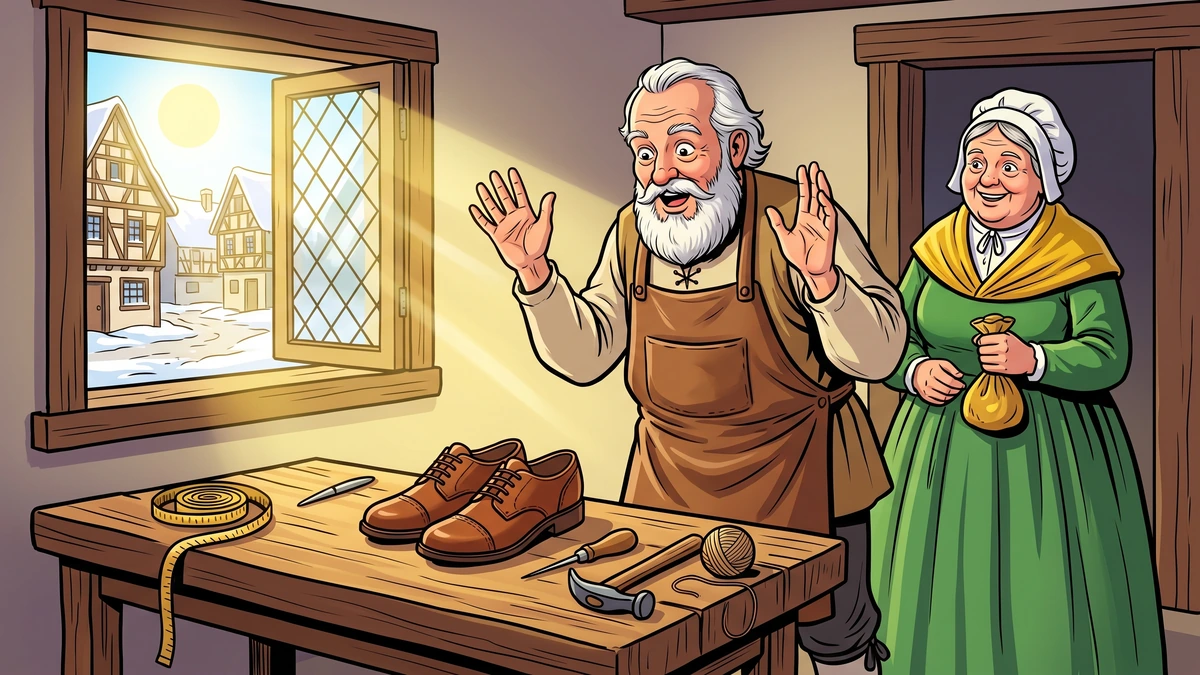
When the shoemaker rises in the morning he finds the shoes already standing on his bench, finished and faultless. The Grimms take a moment to dwell on the workmanship: not one stitch is false, the seams are true, the leather is worked as if by a master craftsman. The first customer who walks into the shop pays a higher price than usual for them, and with that money the shoemaker buys leather enough for two pairs more. The story has begun its quiet, almost arithmetical rhythm of restoration: one pair becomes two, two becomes four, four becomes eight, and a household that had stood at the very edge of ruin begins, night by night, to be lifted back into modest sufficiency.
The Watching: Discovery in the Candlelight
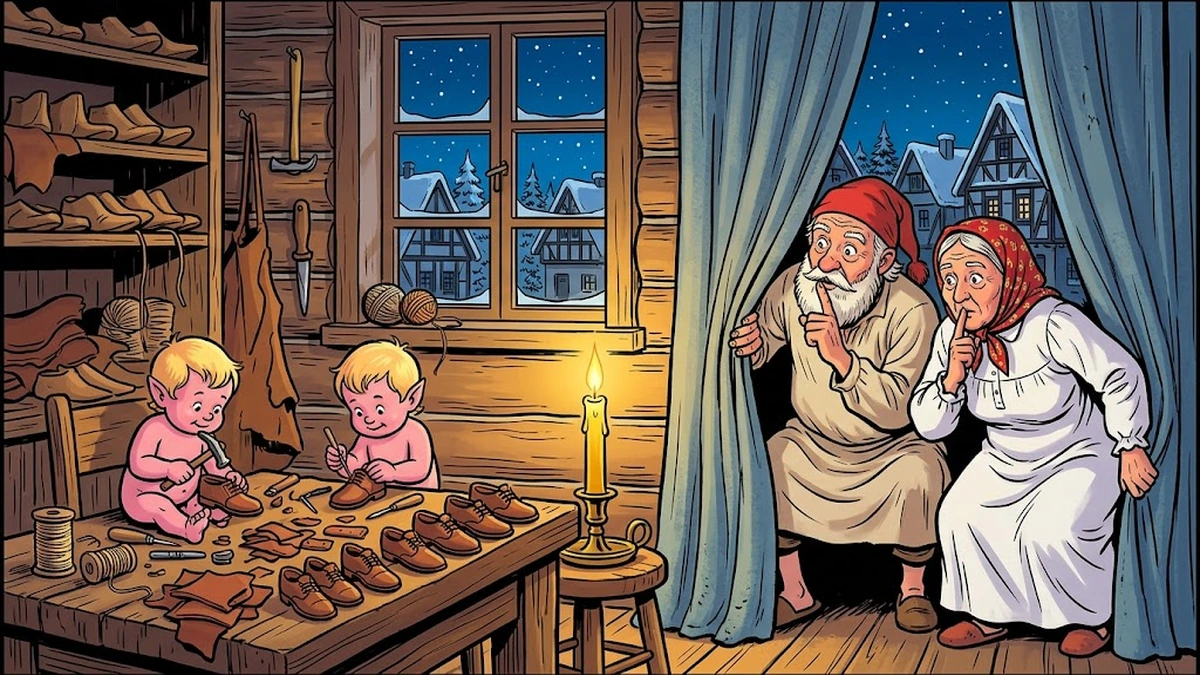
Several weeks pass in this gentle increase. Each evening the shoemaker cuts his leather, says his prayers, and goes to bed; each morning the finished shoes are waiting. He and his wife are too busy with their restored trade — and perhaps too superstitious of their own good fortune — to ask many questions. But on a winter night not long before Christmas, the shoemaker pauses at his bench and says to his wife, in one of the loveliest quiet lines in the whole tale, that he should very much like to know who has been helping them so kindly. His wife agrees. They will leave a small candle burning on the bench, and they will hide themselves behind the curtain that hangs across one corner of the workroom, and they will watch.
What follows is one of the most charming small set-pieces in the Grimm canon. At midnight, by the steady light of the single candle, two tiny naked figures — the German Wichtelmänner, untranslatable but rendered most often into English as elves or little men — climb onto the shoemaker’s bench and set immediately to work. The Grimms describe their hands as deft beyond reckoning: stitching, hammering, pulling thread with a speed and accuracy that the watching shoemaker can scarcely follow with his eyes. The little men do not speak. They do not look up. They simply finish each pair of shoes in turn, set them in a neat row, and at the first hint of dawn they spring down from the bench and vanish out of the door without a sound.
The husband and wife look at each other in the half-light. They have been watching the engine of their own salvation, and the engine, they now see, has been working in the cold, on a winter’s night, with no clothing whatsoever on its tiny frame. The Grimms allow this realization to land without commentary. Two people who have lately known what it is to be poor and cold are looking at two even smaller persons who have spent the autumn and winter giving freely to them. The story does not need to underline what comes next; the moral grammar is already writing itself in the watchers’ minds.
The Gift: Tiny Coats, Tiny Trousers, Tiny Shoes
The next morning the wife says to her husband: those little people have made us rich, and we ought to show them that we are grateful for it. They are running about with nothing on, and they must freeze. I will sew them little shirts and coats and waistcoats and trousers, and knit them each a pair of stockings, and you must make them each a tiny pair of shoes. The shoemaker agrees at once. The pair work all day at their respective benches, and by the evening every garment is finished — small linen shirts, neat little jackets and breeches, two pairs of warm woollen stockings, and at last two pairs of perfectly stitched leather shoes scarcely larger than a thumb.
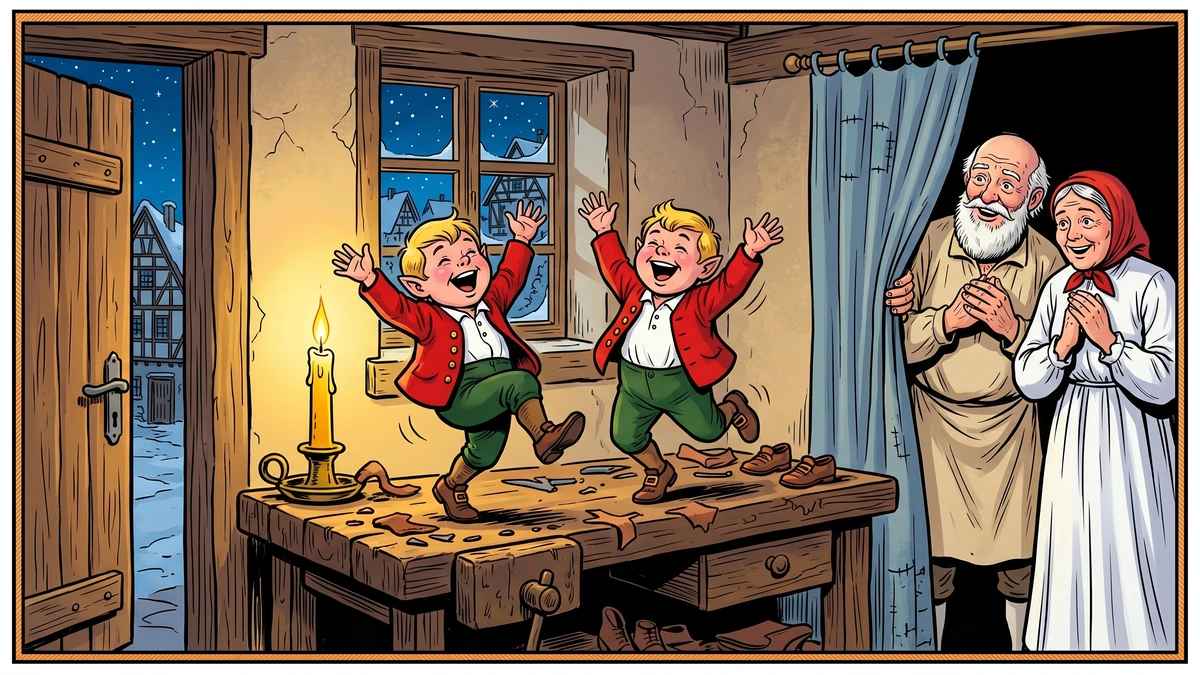
That night, instead of laying out leather on the bench as usual, the shoemaker and his wife arrange the tiny clothes in a neat row where the work would normally be — and then they conceal themselves once more behind the curtain. At midnight the elves bound in as before, ready to take up their tools. They look at the bench, and they see, instead of leather, the little garments. The Grimms describe their reaction with a precision that has delighted readers for two centuries: the elves are at first astonished, then enormously pleased, and they dress themselves with great speed and great glee, smoothing the new clothes down and stroking the fabric.
And then, in the famous closing image of the first Wichtelmänner tale, they begin to sing — a small rhyming verse that the Grimms preserved in their characteristic Hessian dialect:
“Sind wir nicht Knaben glatt und fein?
Was sollen wir länger Schuster sein!”“Are we not boys, smooth and fine?
Why should we cobblers be any longer!”
Singing this verse, the two little men leap from the bench, dance their way across the workroom floor, and skip out of the door for the last time. The shoemaker and his wife never see them again — but, as the Grimms are careful to add in their final sentence, the household prospers from that day forward in everything it puts its hand to. The departure of the elves is not a punishment. It is a graduation. Their work in this house is finished, and they have been thanked in the only currency that matters.
The Moral: Gratitude as the Quiet Engine of Grace
Folklorists have argued for two centuries about what, exactly, the elves’ departure means. Why do they leave when given clothes? In the older Germanic and Celtic legends from which the Grimm tale almost certainly draws, the answer is sometimes mischievous (the spirit considers itself dressed up too finely to do menial work), sometimes melancholy (the gift breaks an unspoken contract of invisibility), and sometimes — as in the Grimm version — frankly joyful (the helpers have completed what they came to do, and the household no longer needs them). What unites every variant of the motif is the recognition that genuine help, freely given, calls forth a particular human duty: to notice it, to name it, and to honour it.
Read in this light, the Grimm tale is not really a story about magic at all. It is a story about gratitude as a craft — something that, like cobbling, must be sat down to with patient hands and finished without shortcut. The shoemaker’s wife does not toss a coin onto the bench. She and her husband spend an entire day making, with their own hands, garments fitted exactly to the little persons who have helped them. They give back not money but matched effort. The elves, in turn, leave not because they have been bought off but because the relationship has been completed: gift answering gift, work answering work, kindness answering kindness. The Grimms close the story with the unobtrusive German line “und es ging dem Schuster, so lange er lebte, wohl in allem, was er nur unternahm” — and from that day on, the shoemaker prospered in everything he undertook, all his life long. The prosperity is not the elves’ parting gift. It is the natural fruit of a household that has learned how to give thanks with its hands.
Why the Tale Has Lasted
The first Wichtelmänner tale is one of the shortest stories in the entire Grimm collection — barely four manuscript pages — and yet it has outlived almost every more elaborate fable around it. Picture-book editions appeared in English within a generation of the 1812 publication; by the late nineteenth century it had become a standard Christmas tale across Europe and America, retold in countless illustrated versions from George Cruikshank’s 1823 plates onward. In the twentieth century it crossed easily into puppet theatre, animated film, and primary-school classrooms in dozens of languages. There is something about its small, perfectly closed shape — a household saved by invisible kindness and answered by visible thanks — that survives every translation and every adaptation.
It survives, perhaps, because every generation needs the lesson it teaches in the quietest possible terms. The shoemaker is not heroic. He does not slay a dragon or solve a riddle. He simply keeps working, keeps praying, keeps his bench tidy, and — when help arrives from a quarter he could not have predicted — he and his wife respond not with greed but with the immediate, instinctive impulse to give back. In an age of large transactions and impersonal exchange, the Grimms’ tale still whispers that the most important economies in any human life are the small ones: the candle left burning, the warm garment sewn in secret, the song sung when a debt has been kindly paid. That whisper is why, two centuries after a young woman in Kassel told the story to a quiet pair of philologist brothers, children all over the world still ask to hear it again.
Parallel Traditions Across Northern Europe
The shoemaker tale stands at the heart of one of the largest and best-documented folk-tale clusters in the European tradition. The same essential pattern — a household helper, invisible or nearly so, who labours through the night and departs the moment a gift of clothing is offered — recurs with remarkable consistency across the entire Germanic and Celtic north. In England, the household spirit is the brownie, recorded throughout the seventeenth and eighteenth centuries in places as far apart as Northumberland and the West Country; the standard nineteenth-century reference, William Henderson’s Notes on the Folk-Lore of the Northern Counties of England and the Borders (1879), preserves dozens of brownie legends in which the helper vanishes, often weeping or laughing aloud, when a farmer or housewife leaves out a hood, a pair of breeches, or a smock. In Scotland the tradition takes the form of the bogle and the urisk; in Wales, the bwbach; in Cornwall, the pisky; and across the North Sea, in Norway, Denmark, and Sweden, it appears as the much-loved nisse or tomte, the small farmstead spirit still pictured today on countless Christmas cards.
What is striking about this entire family of stories is the sheer steadiness of the central image. Across centuries and across languages, the helper is small. He works in the dark. He works for nothing. And he always — always — leaves when a gift of clothing is offered. The Grimms’ shoemaker tale is exceptional only in the gentleness of its tone: where many of the cognate brownie legends end on a note of loss (the farmstead falls into ruin once the spirit departs), the German story ends on a note of completion. The elves leave singing. The household prospers. Even the parting is gracious. It is one of the small mercies of the Grimm version that the brothers, working with a particular vision of the moral universe of the German hearth, chose to tell the story this way.
The Grimm Aesthetic in Miniature
For students of the Grimm collection as a whole, the shoemaker tale is also a useful miniature of the brothers’ editorial method. The tale as published in 1812 is short, formally tidy, and ethically transparent — three qualities that Wilhelm Grimm in particular spent the next four decades polishing into the recognisable Grimm style across the seven editions of the Kinder- und Hausmärchen that appeared in his lifetime. The dialect rhyme of the elves’ song is preserved in its original Hessian form, even when surrounding sentences have been smoothed into more standard High German. Religious detail (the shoemaker’s evening prayers, his commendation of his cares to Heaven) is left intact, as the Grimms believed it had been in the original oral telling. The wife’s instinct to sew rather than to pay is allowed to stand without authorial comment. And the closing sentence is given in the calm, almost biblical cadence the brothers favoured for their endings, an echo of Luther’s German that gave even the smallest of household tales a faint, dignified weight.
Read alongside more famous Grimm stories — Hansel and Gretel, Snow White, Rumpelstiltskin — the shoemaker tale can look almost too quiet to belong. There is no villain, no ordeal, no transformation. But it is precisely this quietness that makes it indispensable to the collection. The Grimms understood that the moral universe they were trying to record was not built only out of dragons and witches; it was built, even more, out of the small, almost invisible exchanges that hold a household together when there is very little else. The shoemaker’s pair of tiny coats is, in its way, as significant a Grimm artefact as Cinderella’s slipper. It is the visible answer to an invisible kindness — and the storytellers of Hesse, the Grimms believed, had been wise enough to insist that such answers be told.
You May Also Like
 Grimm's Fairy Tales
Ages 6-8
Grimm's Fairy Tales
Ages 6-8
The Bremen Town Musicians: The Strength of Friendship and Kindness
The Bremen Town Musicians: The Strength of Friendship and Kindness: There was once a farmer who owned four animals: a donkey, a dog, a cat, and a rooster. True
 Grimm's Fairy Tales
Ages 9-12
Grimm's Fairy Tales
Ages 9-12
King Grisly-Beard
King Grisly-Beard: A great king of a land far away in the East had a daughter who was very beautiful, but so proud, and haughty, and conceited, that none of
 Grimm's Fairy Tales
Ages 9-12
Grimm's Fairy Tales
Ages 9-12
The Goose-Girl
The Goose-Girl: The king of a great land died, and left his queen to take care of their only child. This child was a daughter, who was very beautiful; and her