The Story Of The Youth Who Went Forth To Learn What Fear Was
The Story Of The Youth Who Went Forth To Learn What Fear Was: A certain father had two sons, the elder of who was smart and sensible, and could do everything
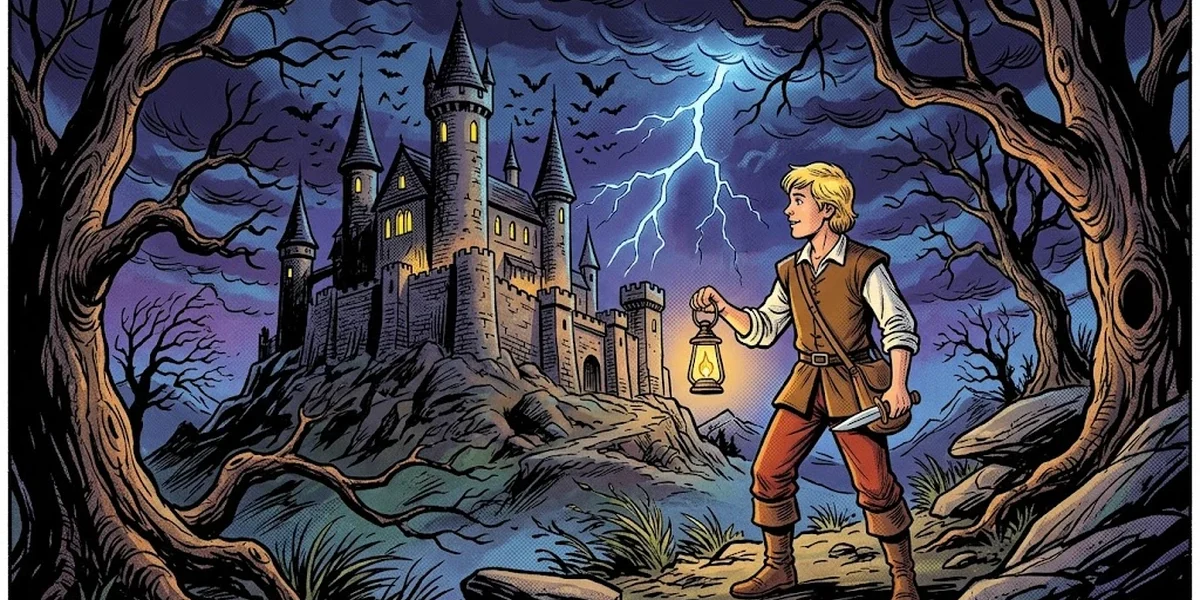
Among the most beloved and unusual fairy tales recorded by the Brothers Grimm, this story (KHM 4 in their Kinder- und Hausmärchen, 1812) reverses the conventional fairy-tale arc. Where most heroes set out to slay dragons or win princesses, this fearless youth journeys to learn the one thing he lacks — the simple human shudder. Folklorists classify the tale as ATU 326, "The Youth Who Wanted to Learn What Fear Is", a type with cognates from Iceland to Italy and a long pre-Grimm pedigree in medieval German Schwankliteratur.
Origin & Canonical Attribution
The Brothers Grimm published this tale as Number 4 in the first volume of Kinder- und Hausmärchen (Berlin, 1812) under the German title “Märchen von einem, der auszog das Fürchten zu lernen” — literally, “Tale of one who went forth to learn fear.” The Grimms’ source was a manuscript supplied by the Mecklenburg pastor and folklore collector Ferdinand Siebert, who had heard versions in northern Hessen. Wilhelm Grimm rewrote the tale substantially across the seven editions of the KHM, lengthening the haunted-castle episode, sharpening the moral, and softening the boy’s character from a callous simpleton into a sympathetic innocent. The 1819 edition added the famous closing scene with the gudgeons.
In the international index of folktale types developed by Antti Aarne, Stith Thompson, and Hans-Jörg Uther, the story is catalogued as ATU 326. Parallels appear in Asbjørnsen and Moe’s Norwegian collection (“The Boy Who Was Not Afraid”), in Italo Calvino’s Fiabe italiane (“Il giovane senza paura”), and in Jón Árnason’s Icelandic corpus. The motif of the man who cannot shudder also surfaces in Old Norse saga literature, where it functions as a marker of heroic temperament rather than comic deficiency. The Grimms’ version is the first to treat the lack of fear as a peculiar moral problem the hero must solve.
Beat I — The Boy Who Could Not Shudder
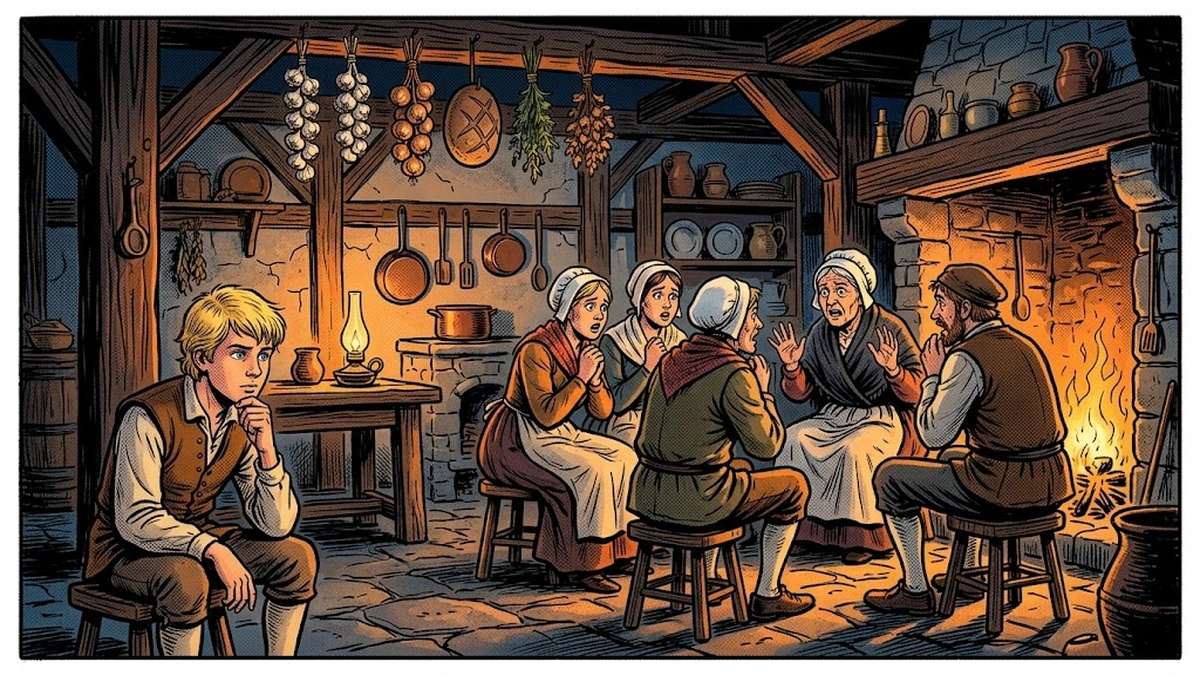
In a quiet German village a farmer has two sons. The elder is clever, dutiful, and capable, but afraid of the churchyard at night and of the eerie tales told around the hearth. The younger is, in the household’s verdict, a hopeless dunce; yet when his brother trembles at ghost stories, he listens with frank puzzlement. It does not make me shudder, the boy thinks. That, too, must be an art of which I understand nothing.
One evening his exasperated father asks what trade he means to learn. The boy answers without irony: he would like, above all, to learn how to shudder. The household laughs, but the boy is in earnest. The Grimms here introduce a comic inversion that runs through the entire tale: the protagonist is not a fool because he is afraid of nothing, but because he believes fear is a craft to be acquired, like blacksmithing or weaving. The neighborhood sexton, hearing the boy’s wish, offers to teach him by means of a midnight prank in the bell-tower. He sends the youth up to ring the bell at midnight, then climbs ahead in a white sheet to play the ghost.
The boy meets the “apparition” with practical questions: who are you, and what do you want? When the figure refuses to answer, the boy hurls it down the stairs — killing the sexton and earning the indignation of the village. His father gives him fifty Talers and tells him to go forth into the wide world and never name his birthplace again. The boy, untroubled, sets off muttering only that he still has not learned to shudder.
Beat II — Gallows, Hanged Men, and the Charcoal Fire
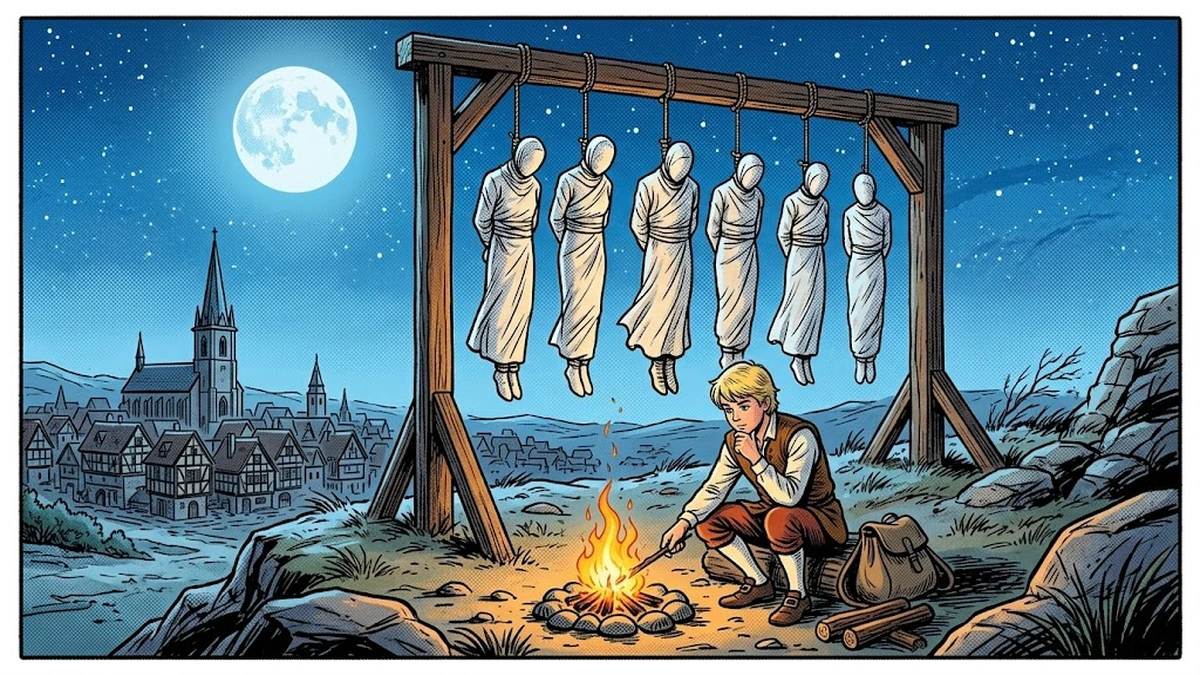
On the road the youth falls in with a wagoner who hears the strange refrain — “If only I could shudder, if only I could shudder!” — and recommends a night beneath the local gallows, where seven men hang from the crossbeam. The youth makes his bed at the foot of the gibbet, builds a small fire, and observes that the corpses overhead are swinging in the cold wind. With cheerful concern he climbs up, unties them, and seats them around his fire to warm themselves. When their clothes catch alight he scolds them for carelessness, hangs them up again, and lies down to sleep. Dawn finds him still unshaken.
The episode condenses two motifs that medieval German tradition associated with the deepest dread: the Galgenberg (gallows-hill) outside the town walls, and the unburied dead of the executed. By treating both with the matter-of-fact courtesy he would extend to chilly travellers, the youth dramatises the tale’s central paradox — that the absence of fear is at once a kind of innocence and a kind of estrangement from ordinary human feeling. The Grimms’ diction in this passage is deliberately domestic: the boy’s Holzscheite (firewood), Strick (rope), and Hemd (shirt) belong to the everyday world of the rural household, not the supernatural.
Beat III — The Three Nights in the Haunted Castle
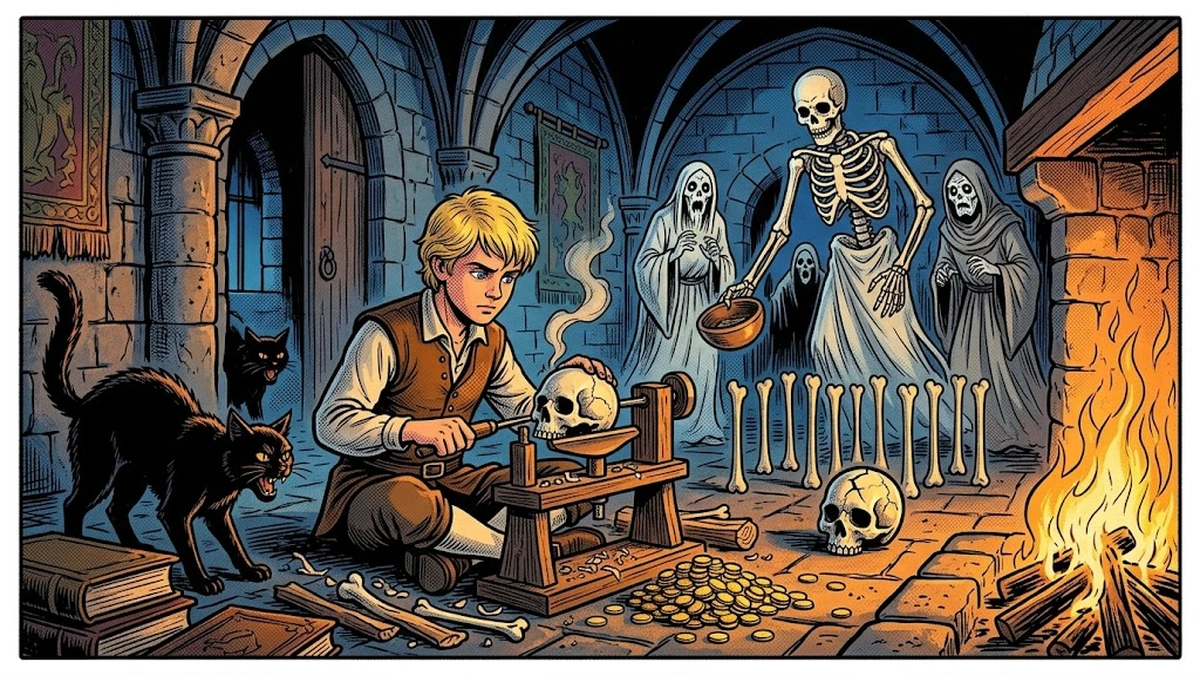
At an inn the youth hears of a king who has promised his daughter and great treasure to any man brave enough to spend three nights in a haunted castle and lift its enchantment. Many have tried; none has come out alive. The youth volunteers cheerfully, asking only to bring with him a fire, a turning-lathe, and a cutting-board with a knife. The king grants the request and the great gates close behind him.
The first night, as the boy sits by his fire on the lathe, two black cats spring from the chimney, miaowing for a game of cards; he traps and kills them, then drives off the stream of cats and dogs that follow. Next a bed gallops about the hall on its own legs; he rides it like a wild horse until it overturns and lies still. The second night a half-man falls from the chimney piece by piece — first the lower half, then the upper — and is joined by other ghastly companions who play ninepins with skulls and shin-bones; the boy lathes the skulls round, joins the game, and wins all their gold. The third night six tall men carry in a coffin containing a corpse; the youth, thinking the body cold, lays it in his own bed to warm it, and when the dead man revives and tries to throttle him, the boy returns him to the coffin with a brisk, “You are not grateful, lie down again.”
In the small hours an old man with a long white beard descends and challenges the youth to a contest of strength at the anvil. The boy traps the beard in a cleft of the anvil, beats him with an iron bar, and wrings from him the secret of three buried chests of gold — one for the poor, one for the king, and one for himself. At dawn the king finds the youth alive, the castle disenchanted, and the treasure ready to be distributed. The princess is given to him in marriage; the wedding is celebrated with great rejoicing; and yet, as the new bridegroom paces his chamber, his only complaint remains: If only I could shudder!
Beat IV — Cold Water and Minnows
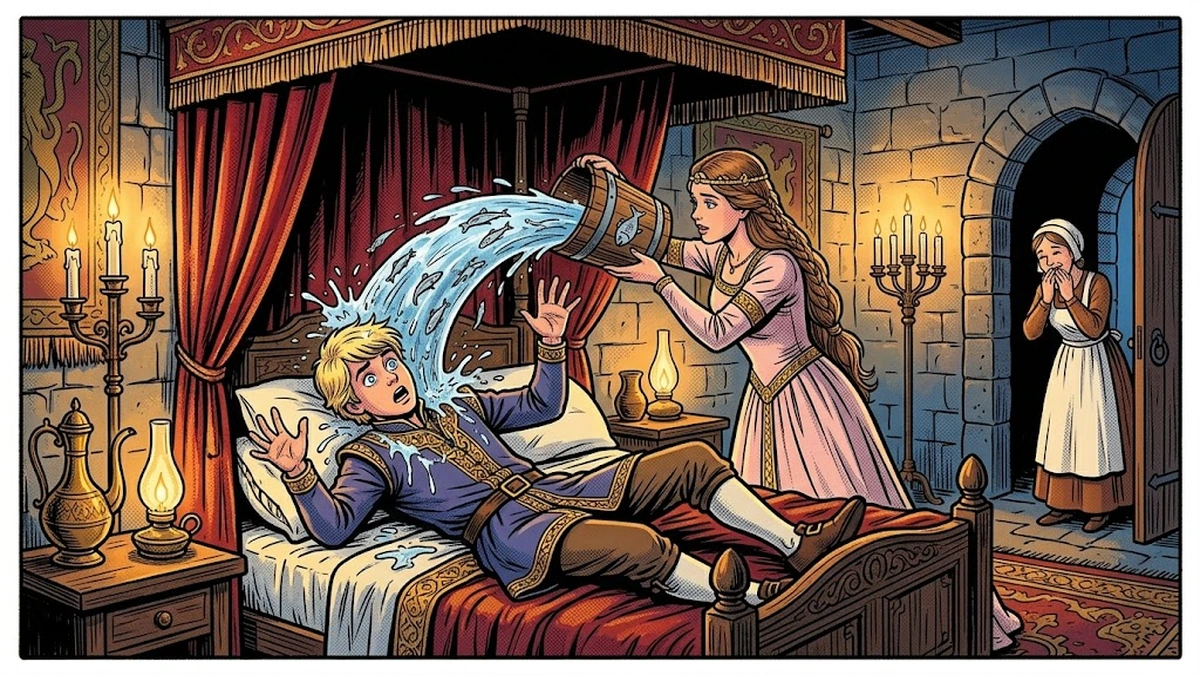
The princess takes the matter to heart. After listening night after night to her husband’s puzzled refrain, she consults her chambermaid, who proposes a remedy as old as it is humble. While the boy sleeps, the maid fetches a bucket of cold water from the brook, full of small wriggling fish — Gründlinge, gudgeons or minnows in older English translations — and the princess pulls back the bedclothes and pours the whole bucket over her sleeping husband.
The youth springs awake, the cold water shocking his skin, the live minnows flapping against his ribs, and at last he cries out the words he has chased across half the kingdom: “Ach, was schaudert mir! was schaudert mir, liebe Frau! Ja, nun weiß ich, was Schaudern ist!” — “Oh, what a shuddering! What a shuddering, dear wife! Now I know what shuddering is!”
The Grimms close the tale on this domestic miracle. Where the gallows, the corpses, the black cats, the rolling bed, the dismembered ghosts, and the bearded old man have failed, the small intimate prank of a loving wife succeeds. Fear, the story insists, is not a metaphysical condition to be hunted at the foot of a gibbet; it is a sensation of the body, easily produced by the right combination of cold and surprise, and it arrives only when the heart has something tender it does not wish to lose.
The Moral — What the Tale Teaches
“Ach, was schaudert mir! Nun weiß ich, was Schaudern ist.”
— Brothers Grimm, KHM 4 (1812)
The moral of the Grimm tale is gentler and more ironic than the apparent comedy suggests. Courage without limit, the story implies, is not heroism but a small species of ignorance — an inability to feel one’s own life keenly enough to fear losing it. The boy is not a coward redeemed; he is a kind of pre-moral child who must learn fear in order to become a husband, a citizen, a complete adult. The minnows in the bed are not punishment; they are initiation. Only when he is loved and surprised at once does he discover the trembling that other men have all along.
Read alongside the Grimms’ broader project of recording Hausmärchen as carriers of folk wisdom, the tale gestures at something subtle about the moral architecture of feeling: virtues, like fingers, depend on their opposites for shape. Bravery without the capacity to tremble is not bravery but absence; love without the possibility of loss is sentimentality, not love. The youth has gold, a princess, and a kingdom; what he lacks until the last sentence is the small humble shudder that ties him to the human family.
Why The Tale Has Lasted
For more than two hundred years “The Youth Who Went Forth to Learn What Fear Was” has remained one of the most retold of the Grimms’ minor tales, alive in puppet theatres, picture books, and twentieth-century operatic adaptations — including the chamber opera Der Junge, der auszog, das Fürchten zu lernen set by several modern composers. Its appeal lies in the clarity of its inversion. Where most heroes pursue the impossible, this hero pursues the ordinary; where most quests end in dragons, this quest ends in a bedsheet and a bucket. Children laugh at the gallows scene because the boy treats hanged men as ungrateful guests; adults are quietly moved by the closing line because they recognise in it the shape of their own first encounters with fear — usually arriving, like the princess’s bucket, from a person they love. The Grimms understood that the deepest folk wisdom often hides in the smallest gestures, and that a story which begins with a corpse-strewn castle can end with a wet shirt and still feel like a moral education.
Variants Across Europe
Versions of the tale circulated widely before the Grimms wrote it down. In Norway, Asbjørnsen and Moe collected “Gutten som ikke var redd for noko” (“The Boy Who Was Not Afraid of Anything”); in Italy Giovanni Francesco Straparola included a comic kernel of the same plot in Le piacevoli notti (1550), and Calvino re-told a Tuscan oral version under the title “Il giovane senza paura.” In Iceland the tale appears in Jón Árnason’s Íslenzkar þjóðsögur og æfintýri; in Russia it shadows the figure of Ivan the Fool, who likewise stumbles unafraid through encounters with ghosts and the Baba Yaga. The Brothers Grimm’s distinctive contribution is the three-night haunted-castle frame, which seems to be a North-German narrative habit, and the closing prank with the wife and the bucket of fish, which appears in their version more cleanly than in any earlier analogue.
Folklore scholar Stith Thompson, in The Folktale (1946), grouped the tale with stories of the “Fearless Hero” type and noted that the closing motif — fear arriving via cold water or living creatures slipped under the bedclothes — is anciently attested in Indian, Persian, and Arabic story collections. Hans-Jörg Uther’s revised type-index (2004) preserves ATU 326 as a stable international tale type with documented variants from Norway, Sweden, Denmark, the Netherlands, Germany, Switzerland, France, Italy, Spain, Portugal, the Slavic lands, the Baltic states, Hungary, Romania, Greece, and the Caucasus. Few Grimm tales are so widely diffused; few have travelled so unchanged.
Scholarly Notes
KHM Number: 4 (Brüder Grimm, Kinder- und Hausmärchen, 1st edition, Berlin: Realschulbuchhandlung, 1812; final form in the 7th edition, Göttingen, 1857).
German Title: “Märchen von einem, der auszog das Fürchten zu lernen.”
ATU Type: 326 — “The Youth Who Wanted to Learn What Fear Is.”
Source: Manuscript supplied to the Grimms by Ferdinand Siebert, with oral parallels recorded in Hessen and Mecklenburg.
Notable adaptations: Engelbert Humperdinck planned an operatic setting that was never completed; Franz Wittenbrink, Sigfried Matthus, and others have set the tale for puppet theatre and chamber stage; English translations include Margaret Hunt’s 1884 edition and the more recent Jack Zipes complete Original Folk and Fairy Tales of the Brothers Grimm (Princeton, 2014), which restores the briefer 1812 text.
Read this story aloud at bedtime and listen for the moment your listener laughs — usually at the gallows, sometimes at the rolling bed, almost always at the gudgeons. That laughter is the Grimms’ real gift: a centuries-old joke about the strangeness of being human, told in the simplest possible voice.
Reading the Tale Today
For modern readers the tale rewards attention to its rhythm. The Grimms structured it in the classic three-and-a-day pattern: three preliminary tests (the sexton, the gallows, the inn), three nights in the castle, and one quiet domestic resolution. Each cycle of three culminates in an act of competent calm by the youth; the resolution, by contrast, takes only a sentence and a bucket of water. The proportion is deliberate — the heroic register is loud and protracted, while the moment of true revelation is brief and intimate. Storytellers who pace the tale aloud often slow the final paragraphs almost to a whisper, allowing the contrast to land.
The tale is also notable for what it omits. There is no wicked stepmother, no jealous siblings, no transformation curse. The villains are mostly comic ghosts; the rewards arrive without trickery; the marriage is a calm conclusion rather than a triumphant restoration. Among the Grimms’ two hundred and one canonical tales, very few share this cheerful, almost philosophical economy. It is, in the truest sense, a wisdom tale: a story that teaches not by showing virtue rewarded but by showing a particular human capacity — the small humble shudder — arriving exactly when, and from whom, it is most needed.
You May Also Like
 Grimm's Fairy Tales
Ages 9-12
Grimm's Fairy Tales
Ages 9-12
Hans In Luck
Hans In Luck: Some men are born to good luck: all they do or try to do comes right all that falls to them is so much gain all their geese are swans all their
 Grimm's Fairy Tales
Ages 9-12
Grimm's Fairy Tales
Ages 9-12
Ashputtel
Ashputtel: The wife of a rich man fell sick; and when she felt that her end drew nigh, she called her only daughter to her bed-side, and said, ‘Always be a
 Grimm's Fairy Tales
Ages 9-12
Grimm's Fairy Tales
Ages 9-12
The Fisherman And His Wife
The Fisherman And His Wife: There was once a fisherman who lived with his wife in a pigsty, close by the seaside. The fisherman used to go out all day long