The Wolf And The Seven Little Kids
The Wolf And The Seven Little Kids: There was once upon a time an old goat who had seven little kids, and loved them with all the love of a mother for her
Origin: Germany — Kinder- und Hausmärchen, Brothers Grimm, KHM 5 (“Der Wolf und die sieben jungen Geißlein”), first printed in the inaugural 1812 first edition of volume one (Berlin: Realschulbuchhandlung) and revised through the seventh and final edition of 1857. Tale type: ATU 123 “The Wolf and the Kids.” Oral source: the Hassenpflug family of Hanau and Cassel — especially Marie, Jeanette and Amalie Hassenpflug, of French Huguenot descent — who told the tale to Wilhelm Grimm in 1808–1810. Translators: Edgar Taylor (London, 1823, in German Popular Stories) and Margaret Hunt (London, 1884, Grimm’s Household Tales) — the prose used here follows Hunt with light modernization. Read time: 10 minutes.
The Story Behind the Story: A Latin Couplet From 1023
“The Wolf and the Seven Little Kids” is one of the very oldest tales in the Brothers Grimm collection, and one of the very few European fairy tales whose written ancestry can be traced back to a specific Latin manuscript copied by a specific monk on a specific shelf. Within the Aarne–Thompson–Uther index of international tale types it is registered as ATU 123, “The Wolf and the Kids,” a category devoted to stories in which a predator imitates a parent, gains entry to the home of trusting children, and is undone by an act of vigilance — a stone in the belly, a tell-tale paw, a bowl of milk over a hot stone. The Grimms collected their German version in the 1808 to 1810 period from the Hassenpflug household of Hanau, a wealthy French Huguenot family whose daughters Marie, Jeanette and Amalie became, with Dorothea Viehmann of Zwehrn, the Grimms’ four most rhythmic informants. The tale was set down in writing in 1810, polished for the press, and printed in 1812 as number five of the first volume of Kinder- und Hausmärchen, where it has remained in every edition ever since.
The earliest surviving European witness, however, is not the Grimms’ notebook but a Latin manuscript completed around the year 1023 in the cathedral school of Liège in present-day Belgium. Egbert of Liège, a teacher of choirboys, wrote a long Latin schoolbook in leonine hexameters titled Fecunda Ratis (“The Well-Laden Ship”) — a verse miscellany of proverbs, fables, and exempla intended for use in cathedral lessons. In the section De puella a lupellis servata (“On the Little Girl Saved from the Wolf-Cubs”), and the immediately preceding couplets on the wolf and the kid, Egbert preserves what is unmistakably an early form of our tale: a wolf attempts to coax a young kid out of safety; the kid recognizes the deception and refuses; the wolf is foiled. Egbert presents the matter as a children’s fabula already current among Latin-speaking schoolboys in the Meuse valley a thousand years ago. Charles Perrault did not invent the European wolf story when he wrote “Little Red Riding-Hood” in 1697; nor did the Grimms invent it in 1812. Both were drawing on a single deep current that had run through Frankish, Burgundian, German and Hessian peasant kitchens for at least eight centuries.
Behind Egbert’s couplets there are still older forms. The Aesopic corpus preserved by Phaedrus in the first century of the Roman Empire contains a brief fable, De lupo et capella, in which a wolf tries to lure a kid out of a folded house and the kid refuses on the strength of his mother’s warning. Babrius preserves a Greek verse twin in the second century, and Avianus a fourth-century Latin twin. Marie de France, writing Anglo-Norman fables at the court of Henry II in the late twelfth century, retells the story in octosyllabic couplets as Du Lou e du Chevril, “Of the Wolf and the Kid.” Johannes Bolte and Georg Polívka, in their five-volume scholarly redaction of the Grimms’ notes (Leipzig, 1913–1932), volume one, §5, listed more than fifty European cousins of the story stretching from Iceland and the Hebrides to Sicily and the Caucasus. Hans-Jörg Uther’s 2004 revision of the ATU index counted the type in over forty national folk-tale collections. Whatever Hessian kitchen the Grimms heard the story in, the audience of children gathered around the hearth had been hearing it, in one form or another, for a thousand years.
The Mother’s Warning and the Wolf at the Door
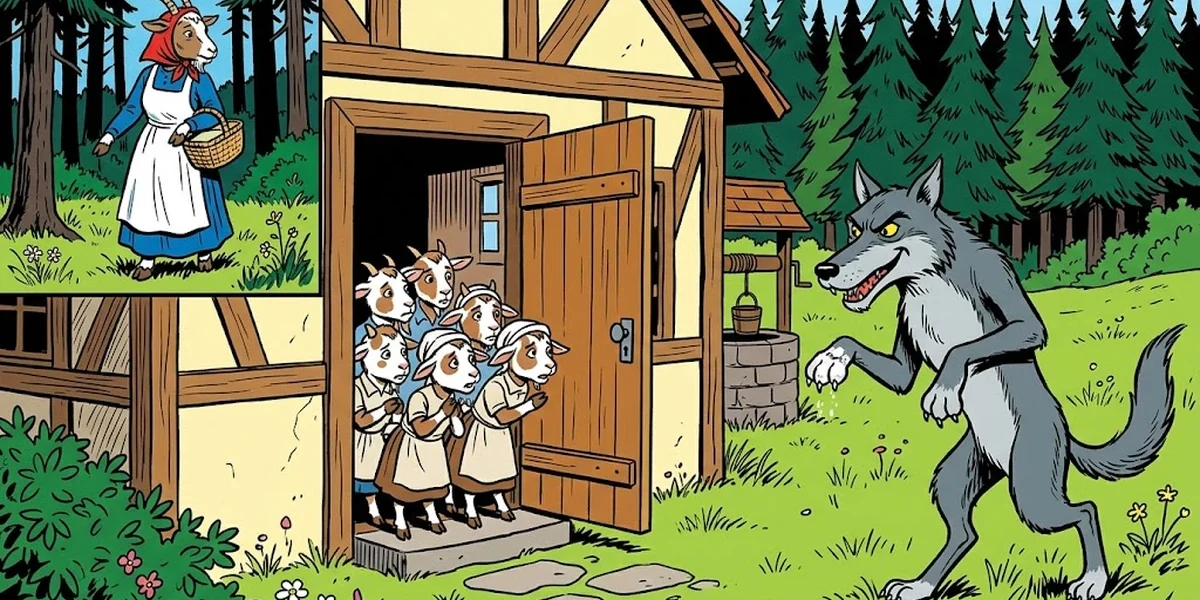
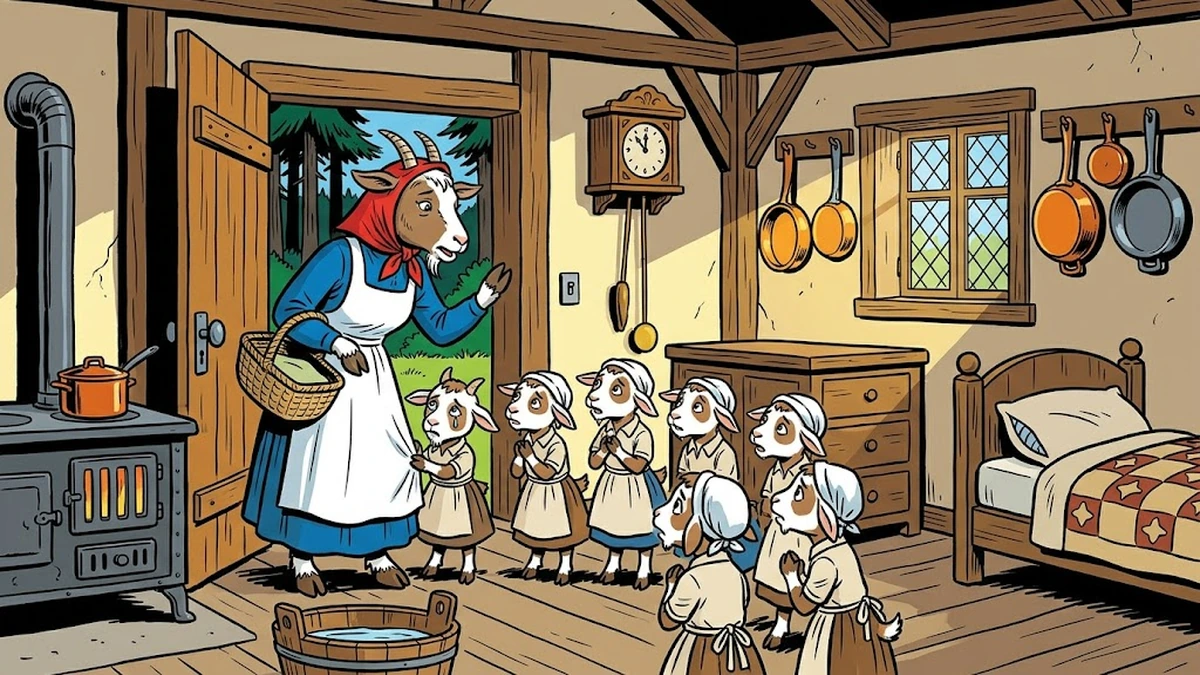
The tale opens, as so many Grimm tales open, in a small house at the edge of a great forest. There once was an old goat who had seven little kids, and who loved them, the Grimms say, with all the love a mother has for her children. One bright morning she has business in the wood — she must fetch food for her family — and before she leaves she summons the seven about her and gives them the warning that will, by the end of the story, save their lives. “Dear children,” she tells them in Hunt’s English, “I have to go into the forest. Be on your guard against the wolf; if he comes in, he will devour you all — skin, hair and everything. The wretch often disguises himself, but you will know him at once by his rough voice and his black feet.” She kisses each of the seven, lifts the door-latch, and trots away among the trees. The kids promise to take care of themselves; they bolt the door; they play; and they wait for the click of her hoof on the threshold.
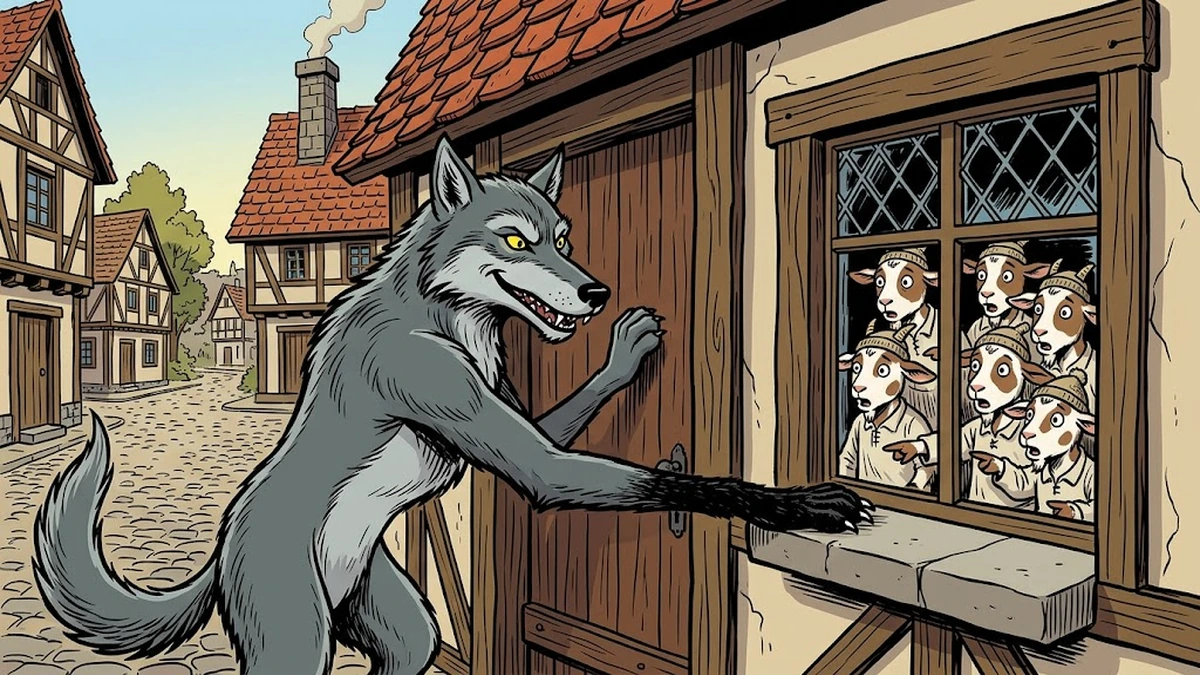
It is not their mother’s hoof that comes. The wolf, who has been watching the cottage for some time, presents himself at the door soon after she is out of sight and knocks with the elaborate good-cheer of a relative back from a journey. “Open the door, dear children,” he calls; “your mother is here, and has brought something back for each of you.” But his voice, as the mother predicted, is rough — a heavy, low, growl-edged voice nothing like the tenor of the goat. The seven crowd to the door and hold a conference through the cracks. “We will not open the door,” they tell him; “thou art not our mother. She has a soft, pleasant voice, but thy voice is rough; thou art the wolf.” The wolf, frustrated, trots off to the village shop and buys a great lump of chalk — the soft, white, schoolroom kind — and swallows it whole. The chalk coats his throat. When he returns to the cottage and calls again through the keyhole, his voice is a passable falsetto. The kids, listening at the bottom of the door, hear what they think is their mother. They begin to slide the bolt.
But one of them — the youngest, the cleverest, the one in the cradle by the window — remembers the second half of his mother’s warning. “First show us thy paws,” the kids call back through the closed door, “that we may know if thou art our dear little mother or not.” The wolf, careless again, lays his black paw on the windowsill. The kids see it and shriek through the door: “We will not open the door — our mother has not a black foot like thee; thou art the wolf.” Off the wolf goes a second time, this time to the village baker. “Knead some dough on my paw,” he commands, and the baker, frightened, presses pale dough into his black fur. To the miller next: “Strew some white meal over my paw,” he orders. The miller hesitates; the wolf threatens to eat him; the miller dusts the dough-coated paw with white flour. The wolf trots back to the cottage with a paw as white as a goat’s foot and a voice as soft as a chalk-coated wolf’s voice can be. The seven, hearing the soft voice and seeing through the window-slit a foot as white as new bread, slide the bolt. He is in.
The Search Through the Cottage and the Belly of the Wolf
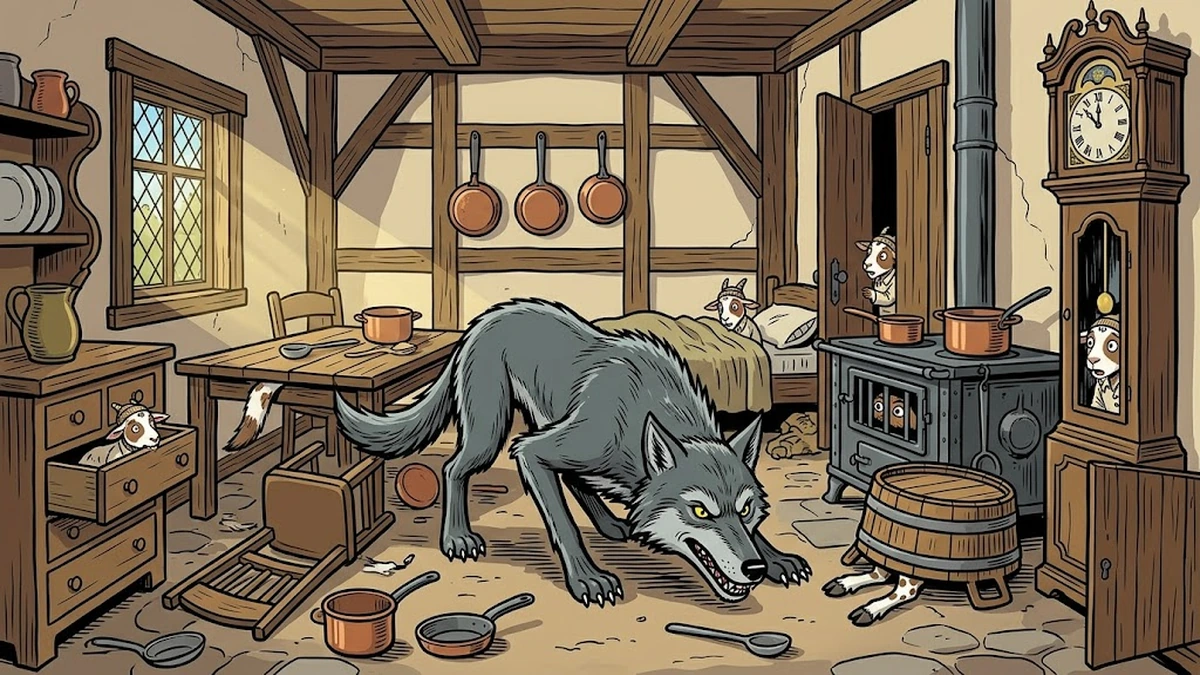
What follows is among the most remembered scenes in any European fairy tale: the wolf inside a small kitchen, hunting for hidden children among the household furniture. The seven scatter. The first kid leaps under the table. The second crowds himself into the bed. The third climbs into the great stove with its iron door. The fourth jumps into the kitchen cupboard. The fifth squeezes himself into the chest of drawers where his mother folds the linen. The sixth wedges himself under a great wash-tub turned upside down on the floor. And the seventh and youngest, the cleverest of all, climbs into the case of the tall pendulum clock that stands ticking against the wall — closes the door behind him — and pulls the door shut over his head as the clock continues to tick. The wolf, who can smell goat and almost nothing else, finds them one by one. From under the table; from inside the bed; from the depths of the stove; from the cupboard; from the chest of drawers; from beneath the wash-tub. Six small kids are swallowed in turn, head and hoof and tail, into the wolf’s belly. Only the seventh, in the clock case, breathes very quietly and is missed. The wolf, his belly tight as a drum, lumbers out into the meadow behind the cottage, lies down in the grass under a green pear-tree, and falls into the deep, snoring, milk-and-mutton sleep of the very full.
The mother goat, returning from the forest with her basket on her back, comes up the path and sees the door of the cottage standing open. The chairs are overturned. The wash-tub is upside down on the kitchen floor. The chest of drawers is pulled out, its linen on the boards. The bed is rumpled. The cupboard is open. There is no sound and no answer from any of her seven. She calls each of them by name — the names are different in different editions, but the youngest is always the youngest — and at last from the case of the clock comes a small voice. “Dear mother, I am in the clock-case.” She lifts him out. He sobs out the whole story between her ears: the wolf disguised as a mother, the chalk-soft voice, the flour-white paw, the eating of his six brothers and sisters one after another; she weeps for them all on the threshold of her ruined kitchen.
The Stone-Stuffed Belly and the Well
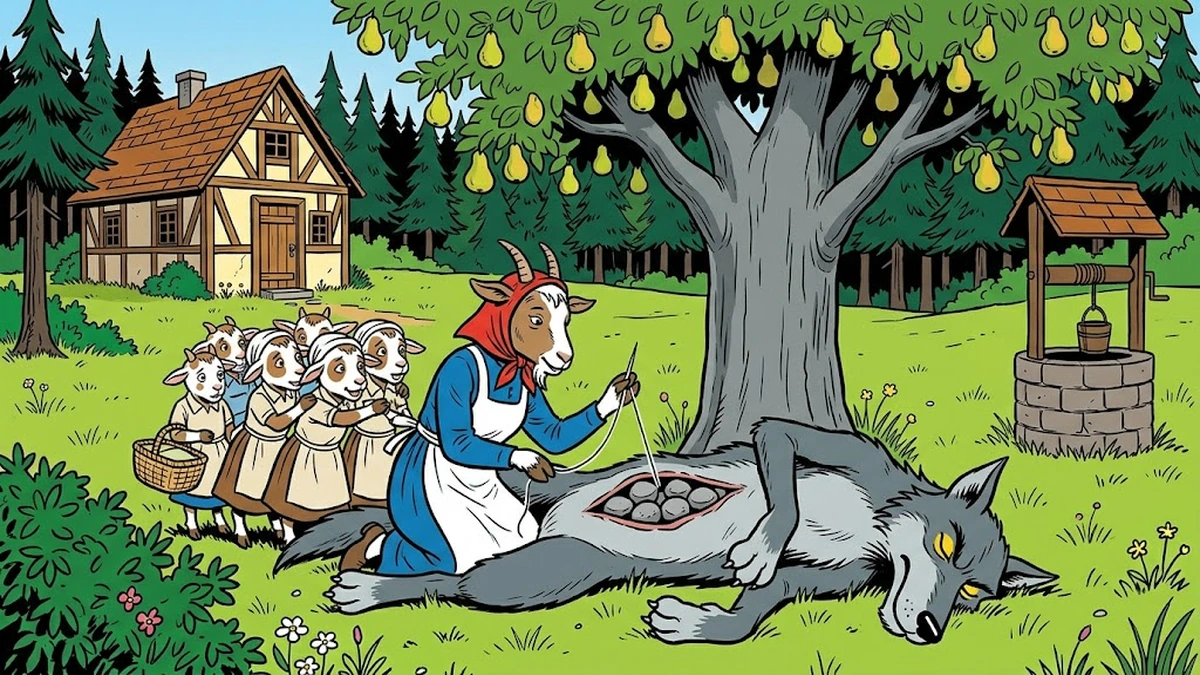
What happens next is the most famous scene in KHM 5, and the scene by which the Grimms’ version distinguishes itself from every earlier ATU 123 cousin: the mother’s surgical revenge. With her remaining child trotting beside her, the goat takes up a needle, a thread, and a pair of sharp scissors and follows the wolf’s trail out into the meadow behind the cottage. There, under the green pear-tree, the wolf lies asleep with his stomach so swollen by his meal that the goat can see, through the fur and the taut skin, six small shapes stirring softly inside him. The kids are alive. They have been swallowed whole, head first, without a single bite, and the wolf, in his greed, has packed them down into his belly like loaves into a baker’s basket. The goat understands at once what she must do. She takes her scissors. She kneels beside the wolf in the long meadow grass. With great care, so as not to wake him, she cuts open his belly along the line of his sleeping breath.
The first kid leaps out, shaking himself, then the second, then the third, then the fourth, the fifth, the sixth — all six of them whole, all six of them unharmed, all six of them blinking at the sun and at the meadow and at their mother in disbelief. They embrace her; they cry; they laugh; they dance round the sleeping wolf in the grass. But the goat is not finished. She sends the seven to the brook to fetch six large stones. They roll the stones across the meadow grass. The mother goat lifts the wolf’s loose skin where the kids have come out, fills the empty belly with the six round stones, and stitches the cut up again with her needle and thread, neatly, the way she has always darned the household linen. The wolf goes on snoring. He notices nothing. The goat takes her seven living kids by the hand and walks back across the meadow to the cottage to wait.
What follows is, in every kitchen retelling and every later illustration, the moral arc of the story. The wolf wakes. The stones, which are no light load, drag down at his belly. He is parched; the chalk has dried his throat, and the labour of swallowing six kids whole has made him thirstier than he has ever been in his life. He gets to his feet with great difficulty — the stones grinding inside him — and lurches across the meadow towards the well that stands beside the cottage. As he goes, the stones roll inside him and he says, in the line that every German child knows by heart and that the Grimms recorded almost word for word from Hassenpflug:
“Was rumpelt und pumpelt
in meinem Bauch herum?
Ich meinte, es wären sechs Geislein,
so sind’s lauter Wackerstein.“
(“What rumbles and tumbles
inside of me?
I thought ’twas six kids,
but it’s nothing but stones.”) — KHM 5, the wolf’s complaint, 1812 first edition.
He reaches the well, leans his great head over the curb, and bends down to drink. The weight of the stones tips him forward. His paws scrabble at the stone rim of the well. For one long moment he is balanced — head down, belly heavy — and then the stones decide the matter and he topples in. He drowns under his own load. The goat and her seven children, watching from the cottage door, run out into the meadow with cries of joy. The seven dance round the well in the bright morning. The wolf, in the cold green water below, has paid the debt the story has been keeping for him since the Hassenpflugs first told it to Wilhelm Grimm a century and a half before this telling.
The Moral the Grimms Set Down
“Wer dem Lupus die Thür öffnet, dem schluckt der Lupus die Kinder. Wer aber wachet und der Mutter folgt, der findet sich am Abend ungefressen wieder.“
(“He who opens the door to the wolf, the wolf swallows his children. But he who keeps watch and minds his mother is found again at evening, uneaten.”) — paraphrase of the closing moral the Grimms attach to KHM 5 in their Anmerkungen volume of 1822.
The moral the Grimms set down in their notebooks, like the moral they set down for “The Willow-Wren and the Bear,” is plainer than the moral in the printed tale. It is a peasant-kitchen moral: the kid who heeds his mother lives; the kids who slide the bolt without checking the foot first do not. The mother in this tale is a working mother — she leaves the cottage to fetch food, she returns at evening with her basket, she keeps the children safe by giving them two specific tests of identity (the voice and the paw) — and the story of KHM 5 is, on its surface, a story about how to teach children to recognize a stranger. The Hassenpflugs, who fed the tale to Wilhelm in their Hanau parlour in 1808, were a household of grown-up sisters raising younger siblings; the mother in the tale is, transparently, the elder sister who has stepped out for an hour and has left careful instructions. The story honours her instructions and punishes their abandonment.
There is a second, deeper moral that scholars from Bolte and Polívka onwards have read into KHM 5 and into all the ATU 123 tales: that the wolf can be defeated only by exact observation of detail. He covers his voice with chalk; the kids, looking only at the voice, are deceived. He covers his paw with flour; the kids, looking only at the paw, are deceived. The youngest kid, who hides in the clock case — the case of the very instrument that measures time and attention — is the one who survives, because he listens past the voice and the paw and waits to hear the whole truth. The moral the German tale teaches, gently and through laughter, is that vigilance is the price of safety, that disguises are always partial, and that the small detail you almost overlook is usually the detail that saves your life. The mother goat, in the closing scene, performs that same vigilance in her surgery on the sleeping wolf: she sees the children moving through the taut skin of his belly, she counts six shapes, and she acts. Bigness, in this story as in “The Willow-Wren and the Bear,” is not a defence; the wolf, twenty times the size of any kid, is brought down by a needle, a thread, and six stones from the brook.
Why “The Wolf and the Seven Little Kids” Has Lasted
The reason “Der Wolf und die sieben jungen Geißlein” has lasted in nursery culture for one thousand years — from Egbert’s Liège cathedral school in 1023 through Marie de France’s Anglo-Norman court in the 1180s through the Hassenpflug parlour of 1808 through the seventh Grimm edition of 1857 to twenty-first-century picture books in seventy languages — is that it does, in twelve minutes of reading, what an entire moral curriculum could not do in a year. It teaches a child the practical anatomy of a deception: voice can be faked with chalk, but the paw, hidden under the door, gives the lie. It teaches that strangers come dressed as friends, and that the price of opening the door is the price of opening it carelessly. It teaches that the smallest member of a household, the one in the clock case, is often the one who saves it; and that a mother’s instructions, repeated at the doorway, are not nagging but blueprint. Every culture that has ever had to raise children at the edge of a wood has needed this lesson, and every culture that has ever had to tell that lesson without sounding like a sermon has reached for the seven kids.
And the tale lasts because of its mercy. Unlike the wolf in “Little Red Riding-Hood” — who in some versions kills the grandmother and the girl beyond recovery — the wolf in KHM 5 is foiled in a way that returns every child to the kitchen alive. The mother’s scissors do what no other instrument in fairy tale does: they undo the swallowing. The Grimms understood, with the instinct of two brothers raising a household full of younger Grimms, that a tale told to small children at bedtime must end with all six brothers and sisters home from the meadow. The seven kids, dancing round the well as the wolf drowns under his stones, are a Hessian peasant kitchen’s image of the mercy that fairy tales, at their best, can show. In the closing line of Hunt’s translation the children call to one another, “The wolf is dead! the wolf is dead!” and the mother gathers them in. That is why the Hassenpflugs gave it to the Grimms, and it is why we are still reading it eight centuries after Egbert wrote it down.
Frequently Asked Questions
What is the original German title of ‘The Wolf and the Seven Little Kids’ and where does it appear in the Brothers Grimm collection?
The original German title is ‘Der Wolf und die sieben jungen Geißlein’ and it stands as KHM 5 (the fifth tale) in Kinder- und Hausmärchen, first printed in the 1812 first edition of volume one (Berlin: Realschulbuchhandlung) and retained, with light revisions, through the seventh and final edition of 1857. The Brothers Grimm collected the story between 1808 and 1810 from the Hassenpflug family of Hanau — chiefly Marie, Jeanette and Amalie Hassenpflug, three sisters of French Huguenot descent who supplied a number of the most polished early tales in the collection. Its Aarne–Thompson–Uther tale-type number is ATU 123, ‘The Wolf and the Kids,’ a category that Hans-Jörg Uther’s 2004 revision recorded in over forty national folk-tale collections worldwide.
How old is the story of ‘The Wolf and the Seven Little Kids’ — does it predate the Grimms?
It predates the Grimms by about eight centuries. The earliest surviving European version is preserved in ‘Fecunda Ratis’ (‘The Well-Laden Ship’), a Latin schoolbook in leonine hexameters completed around the year 1023 by Egbert of Liège, master of the cathedral school in Liège. In the section ‘De puella a lupellis servata’ and the immediately preceding couplets, Egbert preserves what is unmistakably an early form of ATU 123: a wolf attempts to coax a young kid out of safety, the kid recognizes the deception by its mother’s warning, and the wolf is foiled. Older still is the Aesopic Greek fable ‘De lupo et capella’ preserved by Phaedrus in the first century, by Babrius in Greek verse in the second century, and by Marie de France in twelfth-century Anglo-Norman as ‘Du Lou e du Chevril.’ Bolte and Polívka’s scholarly notes (Leipzig, 1913–1932, vol. I §5) list more than fifty European cousins.
Why does the wolf swallow chalk and dip his paw in flour?
The wolf disguises himself in two stages because the mother goat, before leaving for the forest, has given her seven kids two specific tests of identity: ‘You will know him at once by his rough voice and his black feet.’ The wolf’s first attempt fails when the kids hear his low growling voice through the door, so he buys a great lump of chalk at the village shop and swallows it whole — the chalk coats his throat and softens his voice into a passable falsetto. His second attempt fails when he carelessly lays his black paw on the windowsill, so he forces the village baker to knead pale dough onto the paw and the village miller to dust it with white flour. Only when both tests have been defeated — soft voice, white foot — do the kids slide the bolt. The detail of the chalk and the flour is the Grimms’ practical lesson on how disguises actually work: each cover is partial, and the only real defence is to test the stranger against more than one identity-marker before opening the door.
How do the kids survive being eaten by the wolf?
Six of the seven kids are swallowed whole, head first and undamaged, when the wolf bursts into the cottage and finds them hidden under the table, in the bed, in the stove, in the cupboard, in the chest of drawers, and beneath the wash-tub. Only the seventh and youngest, who climbs into the case of the tall pendulum clock and pulls the door shut over his head, escapes notice. The wolf, his belly tight as a drum, goes out into the meadow behind the cottage, lies down under a green pear-tree, and falls asleep. The mother goat returns from the forest, hears her youngest sob the story from the clock case, and follows the wolf’s trail. With needle, thread, and a sharp pair of scissors she cuts open his sleeping belly along the line of his breath, frees all six children alive and unharmed, fills the empty belly with six round stones from the brook, and stitches it shut again. When the wolf wakes and lurches to the well to drink, the weight of the stones pulls him head-first into the water and he drowns under his own load.
What is the moral of ‘The Wolf and the Seven Little Kids,’ and why has it lasted in nursery culture for a thousand years?
The Grimms set down the moral in their 1822 Anmerkungen volume in a peasant-kitchen paraphrase: ‘He who opens the door to the wolf, the wolf swallows his children — but he who keeps watch and minds his mother is found again at evening, uneaten.’ The deeper moral, which scholars from Bolte and Polívka onwards have read in the tale, is that vigilance is the price of safety: every disguise is partial, every cover (chalk on the throat, flour on the paw) is incomplete, and the small detail you almost overlook is usually the detail that saves your life. The youngest kid, who hides in the clock case — the case of the very instrument that measures time and attention — is the one who survives. The story has lasted in nursery culture from Egbert’s Liège schoolroom in 1023 to twenty-first-century picture books in seventy languages because it teaches, in twelve minutes of telling, the practical anatomy of a deception, the price of opening the door carelessly, and the mercy of a mother who will, if she is brave enough, undo the swallowing with a needle, a thread, and six stones from the brook.
You May Also Like
 Grimm's Fairy Tales
Ages 9-12
Grimm's Fairy Tales
Ages 9-12
The Miser In The Bush
A faithful servant who shows kindness to a magical being gains reward while a cruel miser faces supernatural retribution.
 Grimm's Fairy Tales
Ages 9-12
Grimm's Fairy Tales
Ages 9-12
The Raven
The Raven: There was once a queen who had a little daughter, still too young to run alone. One day the child was very troublesome, and the mother could not
 Grimm's Fairy Tales
Ages 9-12
Grimm's Fairy Tales
Ages 9-12
Cat and Mouse in Partnership
A cat and a mouse hide a pot of fat for winter, but not every friend keeps a promise.