The Miser In The Bush
A faithful servant who shows kindness to a magical being gains reward while a cruel miser faces supernatural retribution.
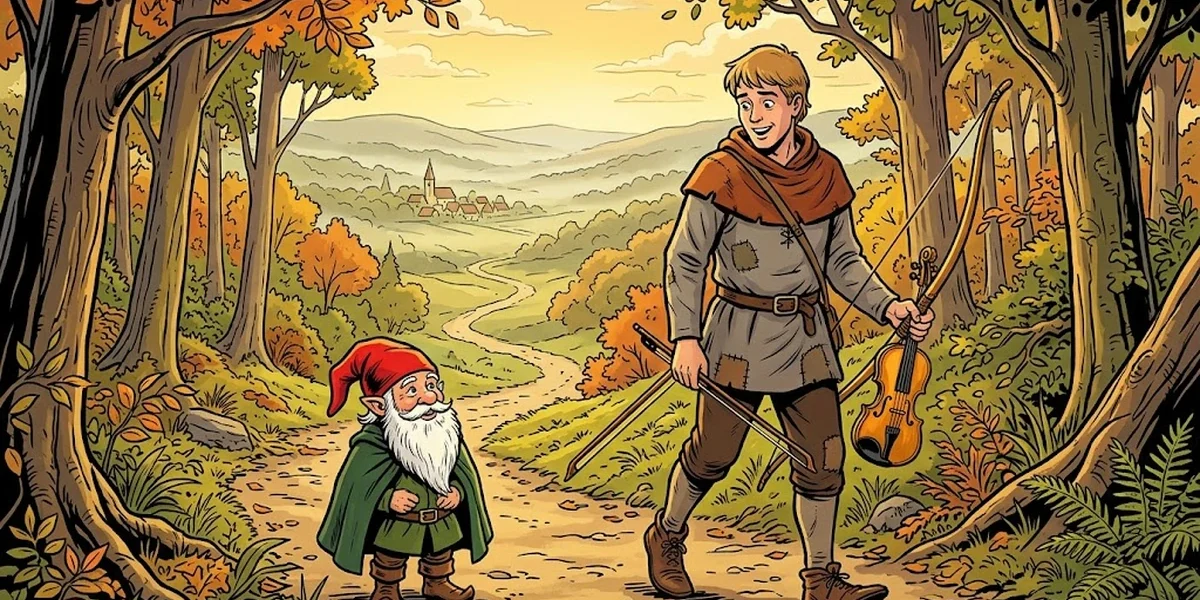
The Miser in the Bush — published originally as Der Jude im Dorn in KHM 110 of the Brothers Grimm’s Kinder- und Hausmärchen (2nd ed., Realschulbuchhandlung Berlin, 1815) and catalogued by folklorists worldwide as ATU 592, “The Dance Among Thorns” — is a small comic masterpiece of poetic justice in which a poor honest servant, armed with three magical gifts received from a grateful dwarf, sees an avaricious traveller dance himself bloody in a thorn-bush and finally hang in his own legal trap. The tale carries an unusually layered editorial history. Its original Grimm-era title was overtly antisemitic; Edgar Taylor and David Jardine’s German Popular Stories (London: C. Baldwyn, 1823) rendered it as “The Jew in the Bush,” and Margaret Hunt’s Grimm’s Household Tales (London: George Bell, 1884) as “The Jew Among Thorns,” but late-Victorian children’s editions — most influentially Lucy Crane’s translation, illustrated by Walter Crane (Macmillan, 1882) — replaced the Jewish villain with the generic figure of a “miser,” a substitution that has been preserved in nearly every English-language anthology aimed at young readers ever since. The Grimms themselves had at least four written predecessors before them: Albrecht Dietrich’s Historia von einem Bawrenknecht (1618), originally drafted as a rhymed dramatic interlude in 1599, and Jakob Ayrer’s Fritz Dölla mit seiner gewünschten Geigen (1620), both of which feature a Christian monk rather than a Jew dancing in the thorns — evidence that the antagonist of the original sixteenth-century version was a different ecclesiastical figure altogether before later popular reworkings substituted the Jewish stereotype.
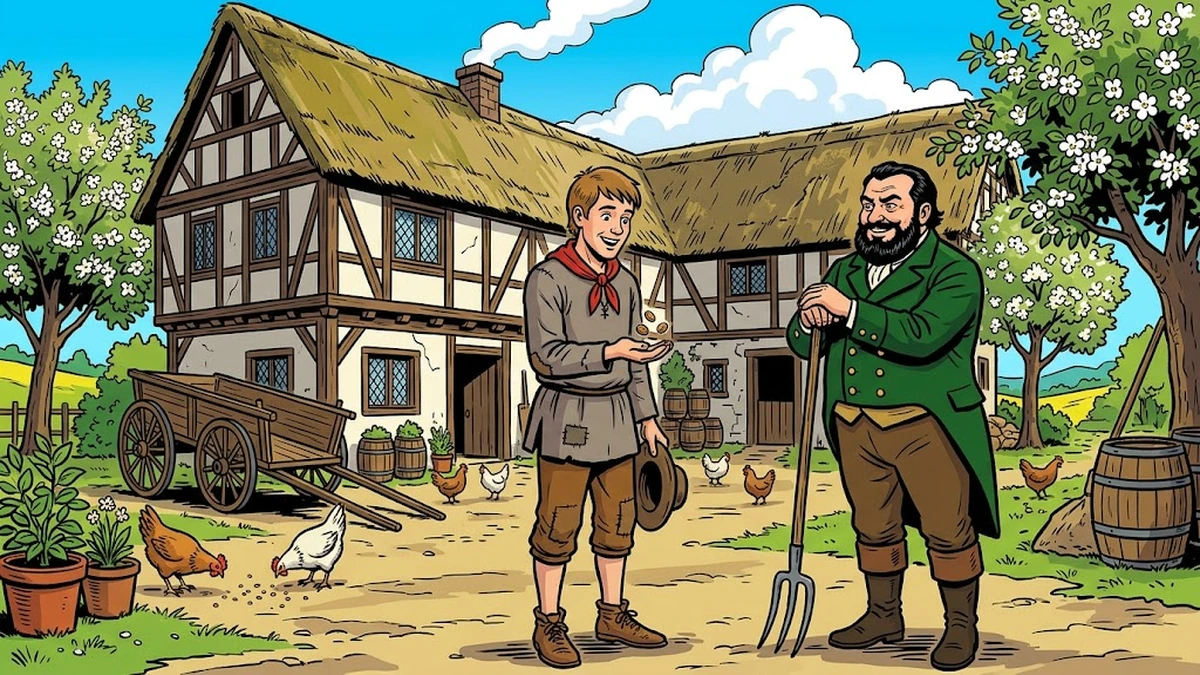
Three Years’ Wages, Three Pennies, Three Wishes
The story opens on a German farmstead in an unnamed province of late-medieval Hesse. A young countryman has worked faithfully for a wealthy farmer for three full years and has never once been paid. At last, weary of broken promises, he goes to his master and asks to receive whatever the farmer thinks he deserves. The farmer, “a sad miser,” knows his servant is simple-hearted and cheats him with theatrical generosity: he counts out three pennies, one for each year of labour, and presses them into the young man’s palm. The servant, far from grasping the insult, is delighted — for he has never held such a sum — and he sets out singing into the wide world, kerchief over his shoulder and bow neither in his hand nor in his mind. The opening stresses three traits Grimm tales reserve for the protagonist of numinose good fortune: poverty, faithfulness, and an almost holy lack of guile. Heinz Rölleke, dean of modern Grimm scholarship (Die Märchen der Brüder Grimm: Eine Einführung, 2004), notes that this triple opening — three years, three pennies, three wishes — is the structural fingerprint of ATU 592, present already in Dietrich’s 1618 chapbook and Ayrer’s 1620 dramatic version, and recognisable as far afield as the Russian skazka Tri zhelaniya.
On the road our hero meets a little dwarf (kleines Männlein) who asks why he is so merry. The countryman declares himself rich and sound, with full threepence in his purse and the world before him. The dwarf, pleading great poverty, asks for the coins. Without hesitation the servant gives them all. In the moral economy of the Märchen this single, unprompted act of charity is everything; it is the spiritual coin against which every later wonder will be paid out. The dwarf, true to his fairy nature, grants three wishes — one for every penny relinquished. The servant, asked to choose, names three things in this curious order: a bow that will bring down whatever I shoot at; a fiddle that will set everyone dancing who hears it; and the gift that no man, when I ask him a thing, may refuse me. The dwarf produces the bow and the fiddle from beneath his cloak, smiles, and is gone. Maria Tatar (The Hard Facts of the Grimms’ Fairy Tales, 1987; rev. 2003) has called this triad — weapon, music, social compulsion — “the three modes by which the powerless poor turn the moral world upon its hinges”: violence held in reserve, joy made coercive, and authority overridden by speech.
The Bird, the Bush, and the Dance
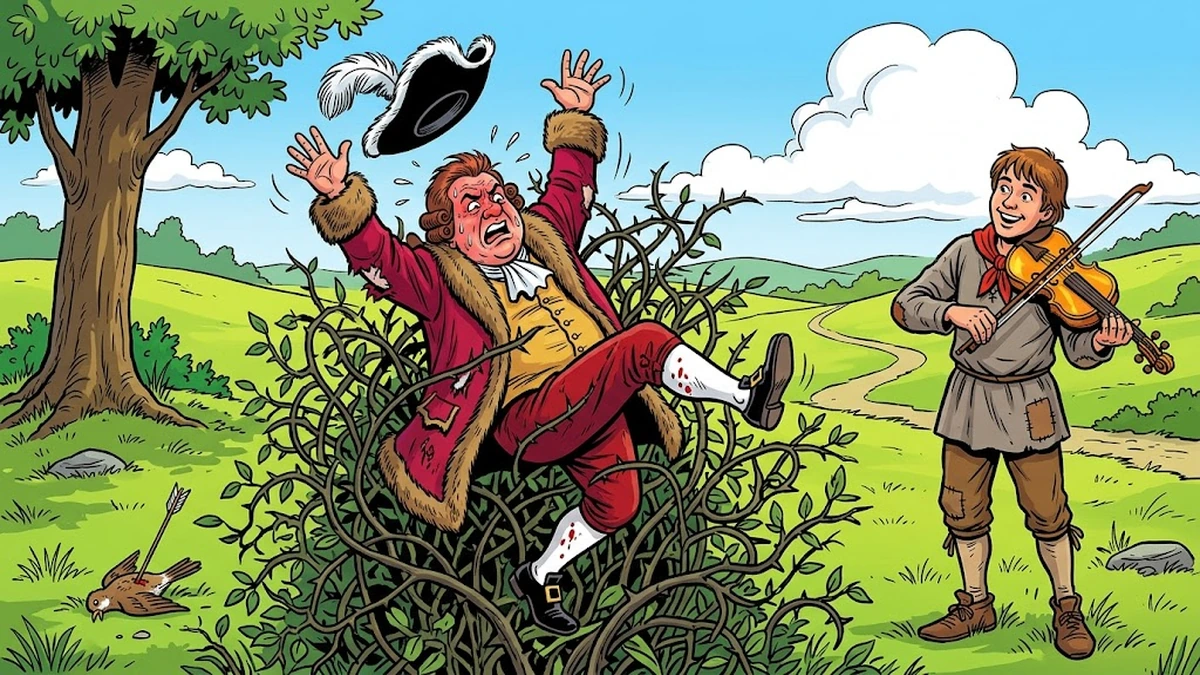
Walking on, the servant overtakes a richly dressed traveller who stands beside the road gazing up at a thrush singing in a tree. The traveller is captivated by the bird and laments aloud that so small a creature should have so great a voice. “Wait,” says the servant, “I will bring him down for you,” and lifts his enchanted bow. The arrow strikes; the thrush falls into a thicket of blackthorn (Schlehdorn). The traveller, greedy for the carcass and eager to pluck so fine a singer for his pot, scrambles into the thorn-bush at once. The moment he is in to the waist among the spines, the servant raises his fiddle and begins to play.
The fiddle’s enchantment is irresistible. The traveller’s feet jerk, his arms fly upward, his coat tears, the thorns bite his skin, his beard catches on the briars — and still he must dance. The harder the music, the wilder the leap; the wilder the leap, the deeper into the thicket he is driven. He shrieks for mercy. The servant plays on, smiling. At last, bleeding from a hundred small wounds, the dancer offers a purse of gold for his release. The fiddle stops; he climbs out, ragged and torn, hands over the gold, and limps away cursing every step. Jack Zipes (The Brothers Grimm: From Enchanted Forests to the Modern World, 2nd ed. 2002) reads the dance-among-thorns as “the comic image of bourgeois greed forced into involuntary motion by the very poverty it has tried to silence” — a folk inversion of the medieval danse macabre in which Death no longer leads the wealthy out of the world but compels them, instead, to lay down what they have stolen.
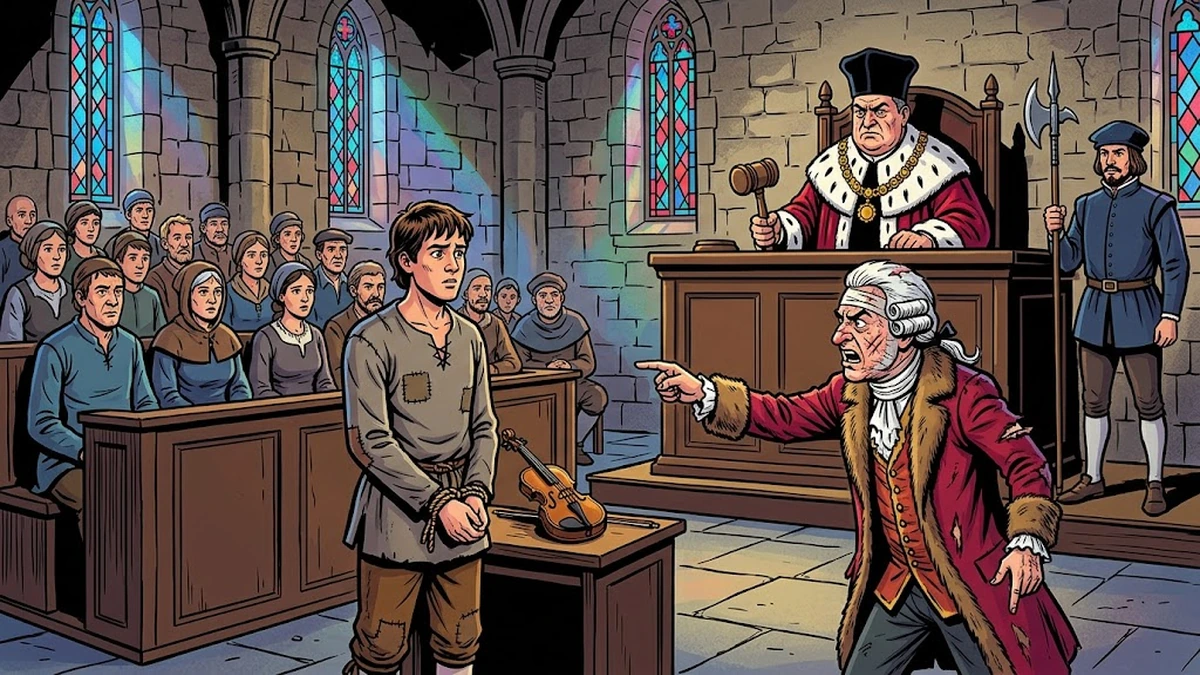
The Trial and the Judge’s Bench
The injured man hobbles into the next town and lays charge before the magistrate: a tramp with a fiddle has robbed him on the highway of a purse of gold. The court convenes; the servant is brought in and recognised by his fiddle, the very article of identification. He pleads that the gold was given freely, but the prosecutor produces the bleeding traveller as living proof of violence, and witnesses are not lacking to confirm that gold has changed hands. Rural justice in the Grimm tales is rarely subtle. The servant is sentenced to hang. He is led from the courtroom to the gallows hill outside the town walls, the rope is fixed, the executioner climbs his ladder. The crowd presses close.
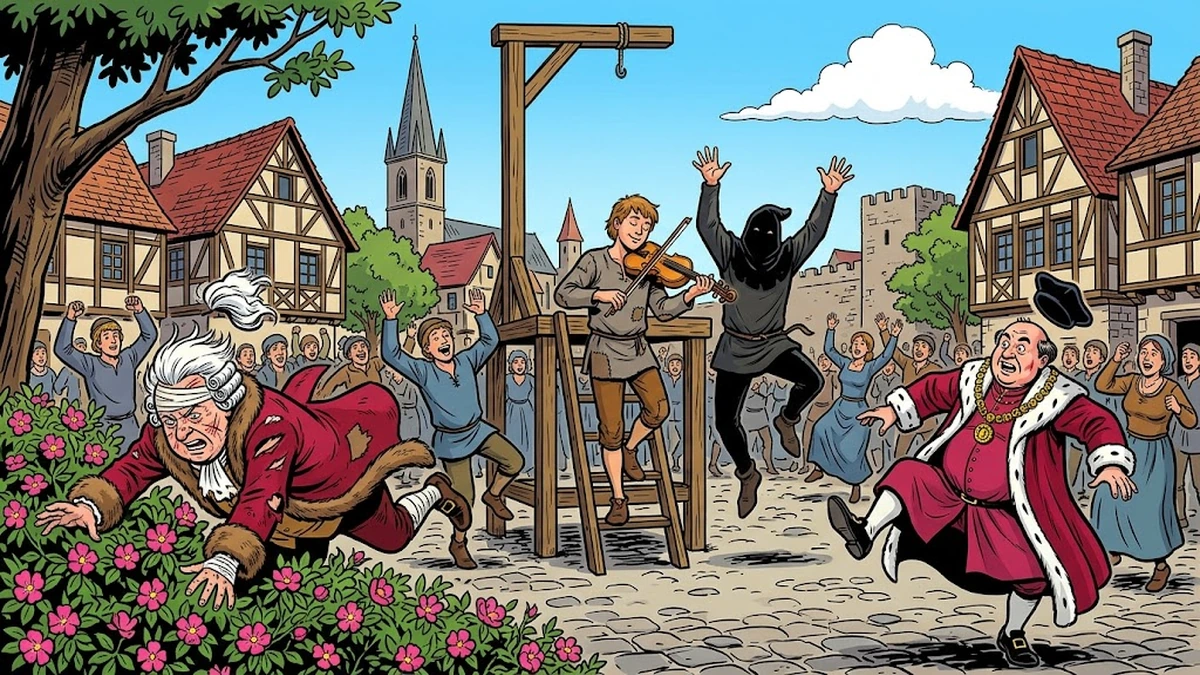
At the foot of the gallows the servant turns to the magistrate — who, robed in red, sits on horseback to oversee the execution — and asks one last favour: he begs leave to play a single tune on his fiddle before he dies. The miser, on the bench beside the magistrate, screams “By no means!” He alone in all the crowd remembers what that fiddle can do. But the magistrate, in the indulgent humour of a man who has just sentenced another to death, grants the dying request. Lutz Röhrich (Erzählungen des späten Mittelalters, 1962) has identified the gallows-fiddle scene as one of the oldest preserved layers of the tale: variants of it appear in fifteenth-century German Schwanksammlungen a hundred and fifty years before Dietrich’s printed chapbook of 1618, and the comic motif of the doomed prisoner who plays his way to a reprieve is widespread across Central European jest literature.
How the Hangman Danced and the Verdict Turned
The servant draws the bow across the strings. The first chord is enough. The magistrate’s horse rears and prances; the magistrate himself, robe and chain swinging, leaps from the saddle and capers; the executioner drops his rope and twirls on the ladder; the constables, the prosecutor, the recorder, the goodwives at the back of the crowd, the mayor and the town clerk — all are seized and spun. The miser, kicking the highest of all in his terror, dances helplessly into a hedge of fresh briars and is again torn upon the thorns. The fiddle plays. The dancers wear themselves into agonised pleading, and at last the magistrate — gasping, panting, hopping — bellows that he will reverse the sentence and grant the servant his life if only the music will stop.
The servant lowers the bow. Silence falls. Breath returns. The magistrate, half collapsed in the dust of the gallows hill, sits up and begins to think clearly for the first time since the trial began. He turns upon the miser and demands the truth. The man, broken at last by his thorn-wounds and his terror, confesses: he stole the gold himself, long ago, and the servant came by it honestly as a gift. The verdict is reversed on the spot. The servant is set free with the gold purse intact in his belt; the miser is stripped of his rich coat, marched up the ladder in the servant’s place, and, in the final image of the tale, hanged for his own theft. The crowd disperses in stunned good humour, and the countryman walks on his way, fiddle on his back, three pennies the richer in justice for every one he had given to the dwarf. Bruno Bettelheim (The Uses of Enchantment, 1976) places the tale in the small but important class of Grimm stories he termed Komische Gerechtigkeitsmärchen — comic justice tales — in which the victim of social cruelty does not have to grow up, marry a princess, or inherit a kingdom to triumph: he need only outlast the cruelty by means of a song.
Moral
“The Miser in the Bush” teaches that charity given freely, even from the empty hand, returns enriched; that greed always lays its own snare; and that the poor man’s three small gifts — honest skill, sweet music, and a clear voice — are sufficient to overturn the verdict of any court that has been bought. Wilhelm Grimm formulated the moral compactly in his 1815 commentary, where he wrote of the tale’s hero:
“Wer barmherzig ist und gibt, was er hat, dem wird gegeben werden, und der Geiz fällt in die eigene Grube, die er gegraben hat.”
— “He who is merciful and gives what he has shall receive in turn; and the miser falls into the very pit he has dug for himself.” (Wilhelm Grimm, Anmerkungen zu den Kinder- und Hausmärchen, 1822)
Why It Lasted
The tale has lasted because its central image is irresistible: a fiddle that turns avarice into a public dance. Centuries before street theatre or political cartoon found other ways to make the wealthy ridiculous, the Märchen had already produced this perfect comic engine, in which the moral question is settled not by sermon or by sword but by the involuntary movement of bodies caught in the grip of music. Generations of children — from the readers of Edgar Taylor’s 1823 illustrated quarto to the audiences of Oliver Postgate’s 1969 BBC television adaptation — have laughed at the spectacle and remembered the lesson. The story has survived, too, despite a deeply uncomfortable original frame: late-twentieth-century scholars including Ruth B. Bottigheimer (Grimms’ Bad Girls and Bold Boys, 1987) and Maria Tatar have devoted significant attention to the editorial choices by which Lucy Crane and her successors transformed an antisemitic figure into the universal type of the miser, restoring to the tale the original sixteenth-century target — greed itself — that Dietrich’s 1618 chapbook and Ayrer’s 1620 dramatic poem had carried before Grimm refocused it. The version preserved in modern children’s anthologies, including the Indian Folk Tales retelling reproduced here, is the cleansed and humanised story; in it, the miser is simply a miser, and his thorn-bush dance is the dance of every greedy man whose grip on his purse has tightened until it begins to crack.
Editorial History and Textual Genealogy
The textual descent of Der Jude im Dorn is unusually well charted. The Grimms first added it as KHM 110 in the second edition of Kinder- und Hausmärchen (1815), basing their text on a contributor from Hesse whose identity has not survived in the brothers’ notebooks; Heinz Rölleke, in his critical edition of the brothers’ working papers (Die wahren Märchen der Brüder Grimm, 1989), characterises the source as “ein hessischer Gewährsmann ohne weitere Angabe.” The brothers themselves were entirely conscious that the tale stood in a long printed tradition: their 1822 Anmerkungen volume cites both Albrecht Dietrich’s Historia von einem Bawrenknecht, der dreyer Wunsch begehrte (Strassburg, 1618) — itself a rhymed Strasbourg Schwankspiel of 1599 — and Jakob Ayrer’s Fritz Dölla mit seiner gewünschten Geigen (Nürnberg, 1620), which dramatises the same plot for the Nuremberg Fastnachtspiel stage. In both these sixteenth-century sources the dancing victim is a Christian friar — usually a hypocritical mendicant — not a Jew, and the comic engine of the bow, fiddle, and unfettered request is already complete. The eighteenth-century chapbook tradition shifted the antagonist to a Jew, and the Grimms received the tale in that form. Edgar Taylor’s 1823 translation, working from the 1819 third edition, retained the Grimms’ figure but softened the dialogue; Margaret Hunt (1884) translated faithfully and added the first English scholarly notes; Lucy Crane (1882) introduced the substitution of “miser” for “Jew” in a translation of the 1857 Ausgabe letzter Hand; her brother Walter Crane’s accompanying engraving showed a portly burgher in a tail-coat dancing among long-stemmed roses, a visual that cemented the new figure in the Anglophone imagination. The standard modern scholarly translations are those of Ralph Manheim (Pantheon, 1977) and Jack Zipes (Bantam, 1987; revised Princeton, 2014), both of which restore the Grimms’ German title in the front matter and discuss the tale’s history of antisemitic reception in their critical apparatus.
International Variants of ATU 592
The Aarne-Thompson-Uther index records ATU 592 — “The Dance Among Thorns,” sometimes catalogued together with the kindred type 593, “The Magic Fiddle” — in more than thirty national folklore corpora across Europe. In Scandinavia, the tale is preserved in Asbjørnsen and Moe’s Norske Folkeeventyr (1841–44) as Spilleren med den underlige fele, where the protagonist is a poor fiddler who outwits a stingy parson. The Russian variant, in Aleksandr Afanasyev’s Narodnye russkie skazki (1855–63), sets the dance scene in a birch wood and gives the magic fiddle to a clever soldier returning from service. Italian Tuscan and Sicilian collections (Pitrè, 1875) replace the thorn-bush with a prickly fig (fico d’India) and the magistrate with a baron. The English chapbook tradition produced an early version of the dance-and-thorn motif in The Pleasant History of John Hick the Fiddler (London, 1668), independently of Grimm. Across all these variants the underlying comic shape is preserved: an honest poor protagonist receives a magic instrument from a supernatural giver, uses it to humiliate a greedy authority figure in a public space of physical discomfort (thorns, nettles, beehives, ice), and then survives a corrupt trial by inducing the entire court to dance until the verdict is reversed. The remarkable stability of this plot from the Strasbourg Schwankspiel of 1599 to the Norwegian and Russian collections of the nineteenth century testifies to its grip on the popular imagination of pre-industrial Europe.
The Magical Fiddle in Folk Tradition
The fiddle that compels its hearers to dance is one of the most ancient surviving motifs in European folklore. Comparative folklorist Stith Thompson indexed it under D1415.2.5 (“Magic musical instrument causes hearers to dance involuntarily”) and traced it from medieval Latin exempla through the troubadour tradition into the printed chapbook. The motif is famously echoed in the sinister German legend of the Pied Piper of Hamelin (1284, recorded by the Grimms in Deutsche Sagen 245), where the same coercive music is used not for justice but for revenge. In Märchen the fiddle is virtually always positively coded: it belongs to the poor protagonist and the dancing it causes humbles the rich. Linda Dégh (Folktales and Society, 1969) connects the motif to the historical figure of the wandering peasant musician who, lacking land or livestock, possessed only his instrument as social capital; the fairy promotion of the fiddle to a moral weapon, she argues, mirrors the village musician’s actual capacity to shame the powerful through performance, song, and public recollection. Walter Crane’s 1882 engraving for Lucy Crane’s translation depicts the servant’s fiddle as larger than his head, lit from within, while the dancing miser’s wig flies into the air — an image so pleasing to Victorian readers that it appeared in successive editions throughout the late nineteenth century and was reproduced in Andrew Lang’s Red Fairy Book (1890).
Cultural Afterlives
The story has had a quieter afterlife than such marquee Grimm tales as Snow-White or Cinderella, but a remarkably durable one. Engelbert Humperdinck, the composer of Hänsel und Gretel, sketched but never completed an opera based on the tale in the late 1890s; the manuscript fragments survive in the Bayerische Staatsbibliothek. The British BBC radio series Children’s Hour dramatised the story repeatedly between 1947 and 1962, always in the Lucy Crane “miser” form, and the 1969 Oliver Postgate stop-motion adaptation The Pogles’ Wood: The Magic Fiddle reset it in an English country lane. Modern children’s picture-book adaptations — including those of Wanda Gag (Tales from Grimm, 1936) and Maurice Sendak (The Juniper Tree and Other Tales, 1973) — consistently use the miser frame. In academic literature, the tale is most often cited in studies of folk justice and social inversion, where it is paired with The Brave Little Tailor (KHM 20) and How Six Made Their Way in the World (KHM 71) as one of the Grimm corpus’s clearest articulations of the moral promotion of the poor.
Frequently Asked Questions
What is the original German title of The Miser in the Bush, and where does it appear in the Brothers Grimm collection?
The original German title is Der Jude im Dorn. It appears as KHM 110 in the Brothers Grimm’s Kinder- und Hausmaerchen, where it was first added in the second edition published by the Realschulbuchhandlung in Berlin in 1815. It is catalogued internationally as ATU 592, ‘The Dance Among Thorns,’ a folktale type known across more than thirty European national traditions. The standard English translations are by Edgar Taylor and David Jardine (1823, as ‘The Jew in the Bush’), Margaret Hunt (1884, as ‘The Jew Among Thorns’), and Lucy Crane (1882), the last of whom introduced the bowdlerised title ‘The Miser in the Bush’ that has become standard in English-language children’s anthologies.
Why was the original Grimm title changed to ‘The Miser in the Bush’ in English children’s editions?
The Grimm original Der Jude im Dorn carried an explicit antisemitic stereotype as its antagonist, an inheritance of the eighteenth-century chapbook tradition. The earliest printed predecessors of the tale, however, including Albrecht Dietrich’s Historia von einem Bawrenknecht of 1618 and Jakob Ayrer’s Fritz Doella mit seiner gewuenschten Geigen of 1620, did not feature a Jewish villain at all but a hypocritical Christian friar. When Lucy Crane translated the Grimms in 1882 for Macmillan, illustrated by her brother Walter Crane, she replaced the Jew with the figure of a miser, restoring the sixteenth-century focus on greed itself rather than on any ethnic or religious group. Most English children’s anthologies, including the version preserved on this site, follow Crane’s editorial choice.
What three magical wishes does the servant ask for, and why does he choose them?
After giving his entire wage of three pennies to a poor dwarf out of pure charity, the servant is granted three wishes. He asks for, in order: a bow that will bring down whatever he aims at; a fiddle that will compel everyone who hears it to dance; and the gift that no man may refuse him whatever he asks. Maria Tatar, in The Hard Facts of the Grimms’ Fairy Tales, calls this triad ‘the three modes by which the powerless poor turn the moral world upon its hinges’ – violence held in reserve, joy made coercive, and authority overridden by speech. Each gift comes into operation in the tale exactly once, in narrative sequence, and together they form a complete arsenal of folk justice.
Which earlier German texts are the literary ancestors of The Miser in the Bush?
The Grimms knew at least four written predecessors of the tale before they recorded it in 1815. The two most significant are Albrecht Dietrich’s Historia von einem Bawrenknecht, der dreyer Wunsch begehrte, printed in Strasbourg in 1618 but originally drafted as a rhymed Schwankspiel in 1599, and Jakob Ayrer’s Fritz Doella mit seiner gewuenschten Geigen, performed in Nuremberg around 1610 and printed in 1620 as part of the city’s Fastnachtspiel tradition. Both versions feature a Christian monk rather than a Jew dancing in the thorn-bush. The substitution of the Jewish villain entered the popular tradition during the eighteenth-century chapbook era, before the Grimms received the tale in that form. Heinz Roelleke’s critical edition Die wahren Maerchen der Brueder Grimm (1989) discusses these predecessors in detail.
How does the servant escape the gallows, and what is the final fate of the miser?
Convicted of robbery on the strength of the miser’s testimony, the servant is led to the gallows. As his last request he asks leave to play one tune on his fiddle. The miser begs the magistrate to refuse, knowing the fiddle’s power, but the magistrate grants the request. The servant plays, and the entire crowd – magistrate, executioner, constables, the miser himself – is seized in irresistible dance. The miser is whirled into a fresh hedge of thorns and torn anew. When the magistrate gasps for the music to stop and offers a reprieve in exchange, the servant lowers the bow. The miser, broken, confesses that the gold was originally his own theft. The verdict is reversed, the servant is freed with the gold purse intact, and the miser is hanged in his place – a perfectly symmetrical reversal of folk justice that Bruno Bettelheim, in The Uses of Enchantment (1976), classified among the Grimm corpus’s komische Gerechtigkeitsmaerchen, the comic justice tales.
You May Also Like
 Grimm's Fairy Tales
Ages 9-12
Grimm's Fairy Tales
Ages 9-12
3. How Partlet Died And Was Buried, And How Chanticleer Died Of Grief
From that day Chanticleer would eat and drink no more, and pined away until he died of grief.
 Grimm's Fairy Tales
Ages 9-12
Grimm's Fairy Tales
Ages 9-12
Jorinda And Jorindel
Jorinda And Jorindel: There was once an old castle, that stood in the middle of a deep gloomy wood, and in the castle lived an old fairy. Now this fairy could
 Grimm's Fairy Tales
Ages 9-12
Grimm's Fairy Tales
Ages 9-12
The Turnip
The Turnip: There were two brothers who were both soldiers; the one was rich and the other poor. The poor man thought he would try to better himself; so