Second Story
Second Story. Kids-friendly retelling with setting, characters, moral, and a lesson for today.

This is the second of the two short fox tales the Brothers Grimm placed together as KHM 38 in the Kinder- und Hausmärchen, under the joint German title Die Hochzeit der Frau Füchsin — “The Wedding of Mrs Fox.” In the first edition (Berlin: Realschulbuchhandlung, 1812), Jacob and Wilhelm Grimm printed the longer first tale (Erste Geschichte) in which old Mr Fox of the nine tails tests his wife’s fidelity by feigning death; this present text, the much terser Zweite Geschichte, “Second Story,” was added because the Grimms had heard it almost word-for-word from a different informant in Lower Hesse, and they could not bring themselves to discard it. Wilhelm Grimm’s own annotation in Anmerkungen zu den Kinder- und Hausmärchen (3rd edition, Göttingen, 1856) records that the tale came from the household of Frau Dorothea Viehmann (1755–1815), the “Marburger Märchenfrau,” the tailor’s widow of Niederzwehren whose memory supplied roughly forty of the Grimms’ finest tales. Folklorists classify both halves of KHM 38 as ATU 65 “She-Fox’s Suitors” in the Aarne–Thompson–Uther index, with motif clusters B281 (animal wedding), B282.7 (the she-fox’s widowhood and remarriage), H310 (the suitor test), Z32.3 (formulaic dialogue between cat-servant and mistress), and the closing Z61 (formula ending: “and if they have not left off, they are dancing still”). The tale type recurs from the Russian Lisa-svakha of Afanasyev to the Romanian Vulpea váduvă recorded by Petre Ispirescu, and the same motif — an animal widow holding court for unsuitable suitors — is woven into Aesop, La Fontaine, and the Indian Pañcatantra.
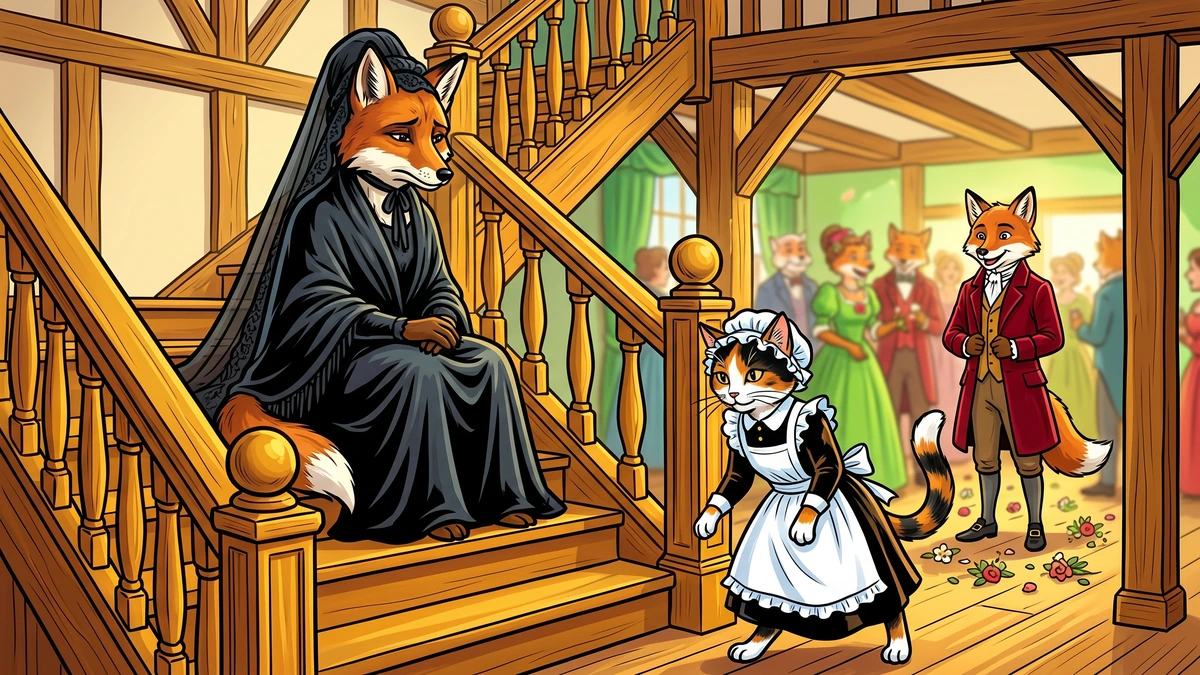
I. The House in Mourning: Old Mr Fox is Dead
The story opens, as so many German animal tales do, on a domestic stillness rather than a forest scene. Old Herr Fuchs — the patriarch of the foxes’ household — is dead. His widow, the Frau Füchsin, has taken to her room upstairs, where she “sits weeping for her sorrowful doom, bewailing her trouble so sore.” The verb the Grimms use, betrauern, has a very specific connotation in nineteenth-century Hessian usage: it is not simply private grief but the public performance of mourning, the locked door behind which a respectable widow withdraws for a fixed period before she is permitted, by custom, to return to society. The detail of the upstairs room is essential to the story’s small architecture. The fox-house has at least two storeys, with a parlour above and an entrance hall below, exactly like the timbered Fachwerkhäuser of Hesse-Kassel that the Grimms’ informants knew at first hand. The widow’s position above the staircase makes her physically and morally elevated; every suitor, from the wolf onward, must climb to reach her. The cat’s repeated journeys up and down the stair are the spine of the tale.
The cat is the only servant in the house. The Grimms call her Frau Katze von Kehrewit, “Mrs Cat of Kehrewit,” a name whose second element is one of those sound-mimicking refrain-words that German nursery verse uses for its own pleasure. Kehren means “to sweep,” and Hessian children would have heard in the syllable Kehrewit the swish of a witch-hazel broom across a flagged kitchen floor. Wilhelm Grimm noted in his Anmerkungen that the same refrain-word appears in older Hessian rhymes about household cats, and that the formulaic dialogue between cat and visitor is older than the wedding-plot it now carries. The cat’s role is the tale’s comic and structural anchor. She is the one who breaks bread in milk in the kitchen, the one who answers the door, the one who runs upstairs, the one who delivers her mistress’s steady refrain to each rejected suitor. In every retelling, the cat’s pace and her formulaic replies are what give the story its rhythm: knock, dialogue, refusal, return; knock, dialogue, refusal, return.
II. The Procession of Suitors and the Test of the Red Stockings
What now begins is the formal sequence the folklorists call a cumulative animal-suitor catalogue. The wolf comes first, knocking at the door, greeting the cat with the verse:
“Guten Tag, Frau Katze von Kehrewit,
Wie kommt’s, dass Sie alleine sitzt?
Was machen Sie Gutes?”“Good day, Mrs Cat of Kehrewit, / How comes it that alone you sit? / What are you making good?”
The cat answers with her own verse about breaking bread in milk and inviting him to dine, but the wolf’s real business is the widow upstairs. He asks whether Frau Füchsin is at home; the cat conveys his proposal; the cat brings back the widow’s test question, the same question she will put to every suitor in turn:
“Hat der Herr rote Strumpf an, und hat er ein spitzes Mäulchen?”
“Has the gentleman red stockings on, and has he a pointed mouth?”
This is the riddle on which the entire tale turns, and the sharpest small joke in the Grimm collection. Rote Strumpf — red stockings — describes the rust-orange of a fox’s lower legs; spitzes Mäulchen — a pointed little mouth — describes the slender, prying snout that distinguishes a fox from every other beast in the German woods. The widow is not asking, in any abstract sense, whether her new husband will be wise or kind or rich. She is asking, with brutal practicality, whether he will look exactly like the husband she has just buried. The question is meant to be funny — the audience grasps at once that no creature except another fox can pass it — and it is also meant to expose a truth about widowed remarriage that the Hessian peasant tradition treated with the same dry humour that English ballads gave to the same theme: the widow does not want a new life, she wants the old one back.
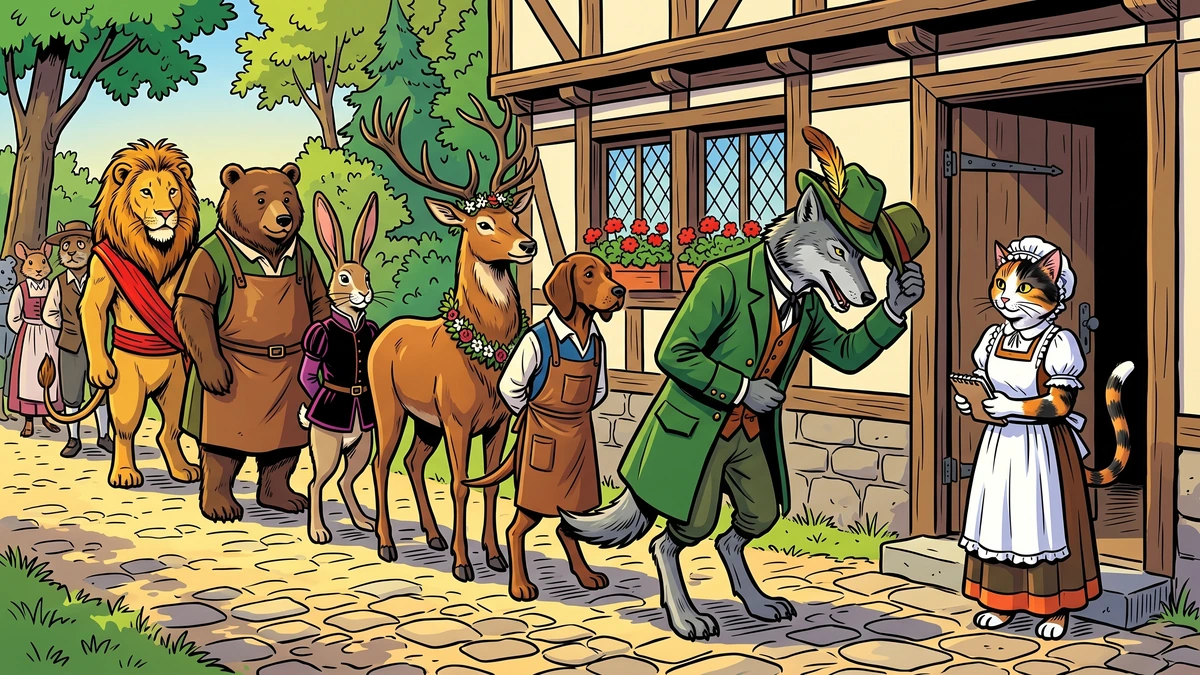
So the wolf is sent away. After him comes a dog, then a stag, then a hare, then a bear, then a lion, and at last — in the wonderful Grimm formula — “alle Tiere des Waldes, eines nach dem anderen”, “all the beasts of the forest, one after the other.” Each in turn climbs the stair in his courting-clothes, makes his verse, has the test-question put to him, fails it, and is dismissed. The Grimms’ original Hessian text varies the line for almost every animal — the stag has antlers but no pointed mouth, the bear has a black snout but no red stockings, the lion has a tawny mane but is far too large to climb the staircase — and the comic timing of the catalogue is exact. Children listening to the tale begin, after the third or fourth refusal, to chant the cat’s reply along with the storyteller, and this is precisely the participatory effect the Grimms valued most in their oral sources.
III. The Young Fox: The Suitor Who Passes the Test
At length, after the catalogue has exhausted the forest, there arrives a young fox. The cat performs the same ritual: she runs upstairs, knocks with her five gold rings (a small detail that delighted the Grimms because it gave the cat a courtly accessory of her own), and asks the widow her own question. This time the answer is different. “Ja,” says the cat. “Yes, he has red stockings on, and a little pointed mouth.” Frau Füchsin orders the young fox brought up at once and the wedding feast prepared. The cat’s wedding-cry is the rudest and most memorable line in the tale, sung from the staircase to the kitchen below:
“Fegt mir die Stube, so rein als ihr könnt,
Auf mit dem Fenster, wirft den alten Herrn hinaus!
Manch schöne fette Maus brächt’ er heim,
Doch fraß er sie immer alleine, gab seiner Frau nie davon!”“Sweep me the room as clean as you can, / Up with the window, fling out my old man! / For many a fine fat mouse he brought, / Yet of his wife he never thought, / But ate up every one he caught.”
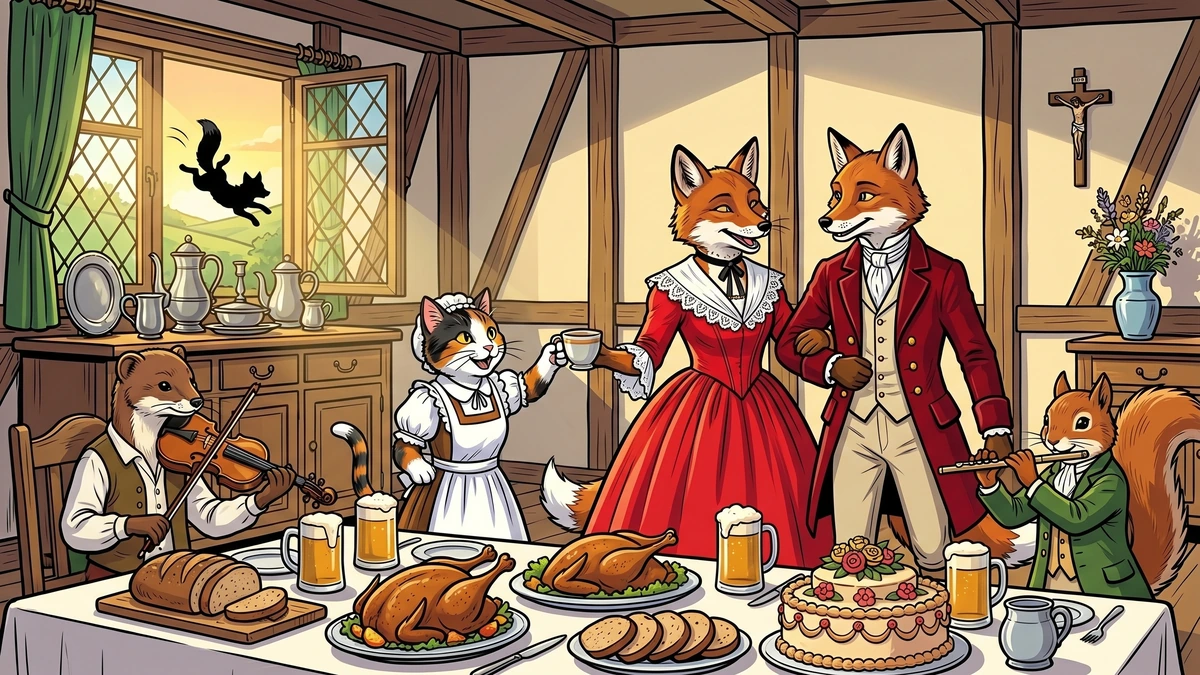
The widow’s grief, the audience now learns, was not for her husband’s soul. It was for the household’s temporary lack of a male hunter. The dead Herr Fuchs is hurled out of the window by his cat-servant on the orders of his widow as soon as the wedding-cake is on the table. This is one of the great small reversals in Grimm comedy — a feature of the tale Wilhelm Grimm himself praised in his Anmerkungen as “an example of the rough humour the people of Hesse keep alive in their winter evenings.” Then, with a speed the Hessian audience would have recognised from village remarriages of their own, the wedding is “solemnised with young Mr Fox, and there was much rejoicing and dancing.” The tale closes with the great Grimm formula that English readers have inherited as “and if they have not left off, they are dancing still” — in German, “und wenn sie nicht aufgehört haben, so tanzen sie noch heute.” It is the open-ended close that signs every German fairy tale, the storyteller’s polite refusal to claim the story is finished, leaving the listener to imagine the dance still going on somewhere over the next hill.
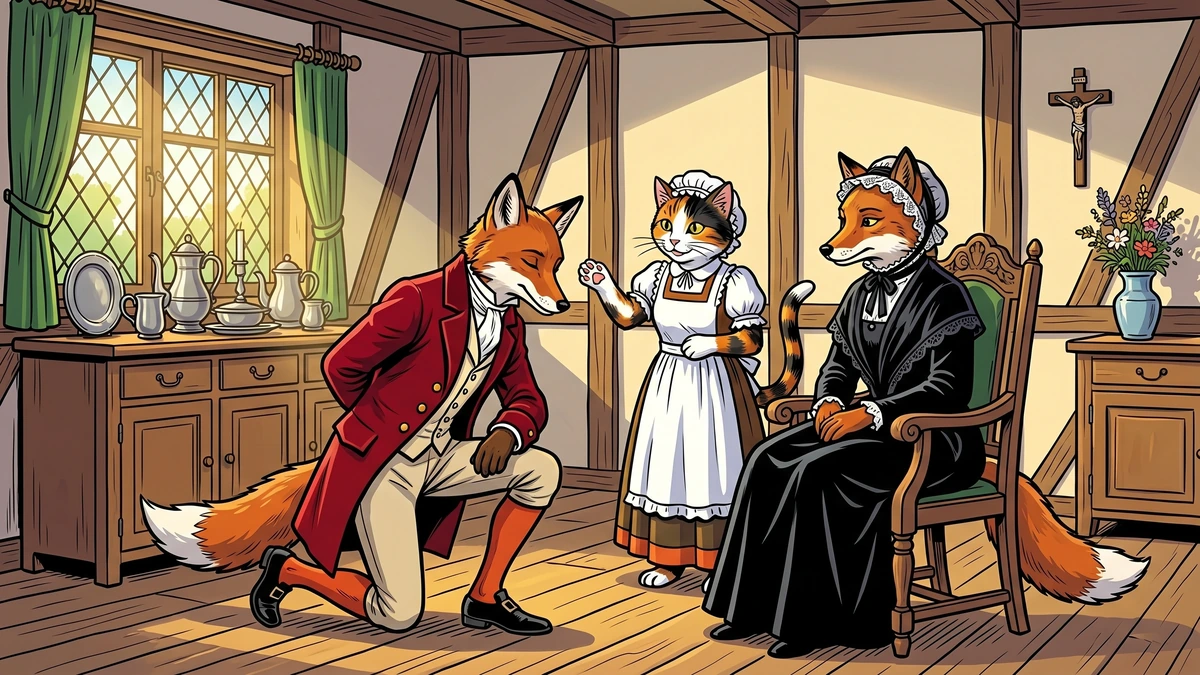
IV. The Comic Architecture of the Tale
What the Grimms preserved here is one of the most economical animal comedies in the European corpus. In fewer than four hundred words of German prose, the tale builds a complete domestic household (mistress, servant, dead husband, parlour, staircase, window, kitchen, wedding-feast), introduces a recurring formal exchange (the cat’s greeting, the suitor’s proposal, the widow’s test, the cat’s refusal), runs an entire bestiary through that exchange in a single accelerating paragraph, lands its joke (the only acceptable suitor is a younger version of the dead one), and closes on a wedding that is also a defenestration. The technical name for this structure is the kumulative Tiermärchen, the cumulative animal tale, and its closest German cousins are KHM 27 (Die Bremer Stadtmusikanten, “The Bremen Town Musicians”) and KHM 41 (Herr Korbes). All three depend on the same engine: a list of animals, a repeated verbal formula, and a final twist that turns the catalogue inside out.
The deeper joke of the tale, which only adult listeners catch, is its sly portrait of widowed remarriage. The widow is not without resources; she has a respectable house with at least two storeys, a steady cat-servant, and a queue of suitors that includes the most powerful animals in the forest. What she chooses is the youngest and least imposing of them, on the sole ground that he physically resembles her dead husband. The Hessian audience would have recognised this pattern at once. Nineteenth-century rural Germany ran on the economic logic of the household farm, and a widow with a working farm was expected to remarry as quickly as the customary mourning year permitted — ideally to a younger relative of her husband’s, so that the farm should not pass into another family’s hands. The young fox is, in folkloric shorthand, the dead husband’s younger cousin; the wedding is not romance but the kind of practical replacement that kept Hessian smallholdings inside their lineages for generations.
The Moral: The Widow’s Test and the Hidden Joke
Wilhelm Grimm, who never moralised heavily and was suspicious of any addition that smelt of the pulpit, allowed only the bare formula to close his text. But the Hessian oral tellers from whom Frau Viehmann had learned the tale are recorded by later folklorists as appending a small proverbial couplet, which the Marburg dialect collector Heinrich Pröhle wrote down in his Kindermaerchen (Leipzig, 1853) in this form:
“Wie der alte Mann gewesen,
so soll der neue auch genesen.”“As the old husband used to be, / so shall the new one have to be.”
— Hessian closing couplet to Die Hochzeit der Frau Füchsin, in H. Pröhle, Kindermaerchen (Leipzig, 1853), no. 21.
The proverb cuts in two directions at once. Read straight, it is the widow’s reasonable demand that her second husband should match the first — a sober, even touching, refusal to settle for less than she has known. Read sideways, with the rough Hessian humour the tale itself prefers, it is the storyteller’s warning that nothing changes in such houses: the old fox is replaced by a fox just like him, and the same household will run on tomorrow exactly as it ran yesterday. Children laugh at the surface joke; their grandparents nod at the deeper one. This double readability — the same words working as a child’s riddle and an adult’s sigh — is the quiet genius of the Grimm tales at their best, and the reason Frau Viehmann’s versions in particular have survived translation into more than one hundred and seventy languages without losing their snap.
Why It Lasted: She-Fox’s Suitors Across Three Continents
The tale’s placement under ATU 65 “She-Fox’s Suitors” puts it in a small but very widely distributed family. Hans-Jörg Uther’s revised Types of International Folktales (FFC 284–286, Helsinki, 2004) lists attestations from across northern and central Europe, the Balkans, the Caucasus, Turkey, the Iranian plateau, north India, and as far east as the Mongolian and Buryat oral repertoires. The Russian cognate is Lisa-svakha, “The Match-making Vixen,” recorded by Aleksandr Afanasyev in Narodnye russkie skazki (Moscow, 1855–63), in which a fox-widow on the Volga performs almost the same suitor-procession before settling on a young vixen of her late husband’s village. The Romanian cognate is Vulpea váduvă, “The Widowed Vixen,” in Petre Ispirescu’s Legende sau basmele românilor (Bucharest, 1872). The South Asian cognate is the cumulative beast-suitor sequence inside the Pañcatantra’s “Mouse-Maiden Married to a Mouse” (Sanskrit Músika-vivaha), in which the candidate-suitors are the Sun, the Cloud, the Wind, and the Mountain in succession before the maiden returns to her own kind — the same plot logic, dressed in cosmic clothes. The English-language cognate that twentieth-century children know best is the second of Joseph Jacobs’s tales in English Fairy Tales (London: David Nutt, 1890), “The Wee Bannock,” which preserves the cumulative-suitor structure in a more boisterous Scottish form.
What makes the Grimm version distinctive within this large family is its compression and its formal symmetry. Where Afanasyev’s Russian text sprawls across a dozen pages and embeds a full village wedding sequence, the Grimms keep the German tale to four hundred words and let the cat’s repeated trips up and down the staircase do the work of the entire plot. Where the Pañcatantra uses cosmic suitors to make a philosophical point about caste and self-knowledge, the Grimm tale uses ordinary forest beasts to make a humbler social joke about widowed remarriage in a Hessian village. Both points land. Both readings are correct. The tale is one of the smallest and one of the most adaptable in the Grimm corpus, and its survival across two hundred years of European childhood is a quiet testament to the durability of well-built comic formulas.
Iconography: The Cat on the Staircase, the Suitor at the Door
The tale entered Anglophone visual tradition through Walter Crane’s 1882 chromolithographs for Household Stories from the Collection of the Brothers Grimm (London: Macmillan), translated by Lucy Crane, in which the cat is shown in a stiff Sunday apron at the top of a Hessian timbered staircase, the wolf bowing in court dress at the foot. Otto Ubbelohde’s 1907–1909 ink illustrations for the great Turm-Verlag edition of the Kinder- und Hausmärchen are the German visual reference: in his rendering, Frau Füchsin wears a black widow’s lace cap above her parlour door and the suitors form a long queue down the stair, each in the precise costume the storyteller’s village would have given him — the wolf in a hunter’s green coat, the bear in a forester’s leather apron, the stag with antlers crowned with a wedding-wreath. Ubbelohde’s composition has been imitated in nearly every twentieth-century illustrated Grimm. In picture-book form the tale appears, much abbreviated, in Wanda Gág’s Tales from Grimm (New York, 1936) and in Maurice Sendak’s 1973 The Juniper Tree and Other Tales from Grimm, in which Sendak’s cat is given the unsmiling competence of a Hessian housekeeper whose patience is being tried by the morning’s seventh suitor.
Reading with Children
For parents, teachers, and storytellers reading Die Hochzeit der Frau Füchsin aloud, three details from the Grimms’ text repay slowing down for. First, the cat’s formulaic verse. The opening lines — “Good day, Mrs Cat of Kehrewit, how comes it that alone you sit?” — are best read with the same lilt one gives to a counting-out rhyme. By the third suitor, children will be chanting along; by the fifth, they will be inventing additional animals and adding them to the queue. This kind of participation was the entire point of the tale in the oral tradition Frau Viehmann inherited, and recovering it in modern reading is one of the small gifts a careful read-aloud can offer. Second, the test-question. “Has he red stockings on, and a pointed mouth?” is one of the most exact descriptions of a fox in any folk literature. Pause after asking it, and let listeners look at the fox’s hind legs in any picture they can find. The understanding that the widow is asking for “another fox” is the moment children grasp the joke for themselves, and the satisfaction is theirs to keep. Third, the closing formula. “If they have not left off, they are dancing still” is the standard German fairy-tale ending; older children love being told that this is the same line that ends Snow White, Hansel and Gretel, and a hundred other Grimm tales, because it gives them their first taste of how a literary tradition signals its own conventions. The line is, in effect, the storyteller’s gentle wink: the dance is still going somewhere, and you are welcome to imagine it.
A Note on Sources
The text on this page follows the second tale of KHM 38, “Die Hochzeit der Frau Füchsin”, in Jacob and Wilhelm Grimm, Kinder- und Hausmärchen, 1st edition (Berlin: Realschulbuchhandlung, 1812), volume I, pages 165–166, with reference to the canonical 7th edition (Göttingen: Dieterich, 1857) which made only minor stylistic revisions. The English wording is closely adapted from Margaret Hunt’s standard 1884 translation, Grimm’s Household Tales (London: George Bell & Sons), volume I, pages 162–163, with corrections from Lucy Crane’s 1882 Household Stories and Edgar Taylor’s earlier 1823 German Popular Stories. The provenance of the tale is documented in Wilhelm Grimm’s Anmerkungen zu den Kinder- und Hausmärchen, 3rd edition (Göttingen: Dieterich, 1856), volume I, pages 86–88; for the role of Frau Dorothea Viehmann as primary informant, the indispensable modern reference is Heinz Rölleke, Die Märchen der Brüder Grimm: Eine Einführung (Reclam, Stuttgart, 1985), chapter 3. For the comparative folklore the standard reference remains Hans-Jörg Uther, The Types of International Folktales (FFC 284–286, Helsinki: Suomalainen Tiedeakatemia, 2004), entries on ATU 65 and ATU 2030; for the motif inventory, Stith Thompson, Motif-Index of Folk-Literature, revised edition (Indiana University Press, 1955–58), motifs B281, B282.7, H310, Z32.3, Z61. The Pröhle dialect couplet is preserved in Heinrich Pröhle, Kindermaerchen (Leipzig: G. A. Avenarius, 1853), no. 21. All cited editions are in the public domain and freely available through the Internet Archive and the German Deutsches Textarchiv.
Read time: about 10 minutes. Suitable for ages 6 and up; suitable for read-aloud from age 4 with the wedding scene’s defenestration of old Mr Fox treated, in the Grimms’ gentle phrase, simply as “sweeping the old husband out of the parlour to make room for the new.”
Frequently Asked Questions
Why is this Grimm tale called simply ‘Second Story’?
Because it is the shorter of the two short fox tales the Brothers Grimm placed together as KHM 38 in their Kinder- und Hausmärchen, under the joint German title Die Hochzeit der Frau Füchsin, ‘The Wedding of Mrs Fox.’ The longer first tale (Erste Geschichte) features old Mr Fox of the nine tails feigning death to test his wife’s fidelity. This second tale (Zweite Geschichte) is a separate, simpler version the Grimms had heard from a different Hessian informant — Frau Dorothea Viehmann of Niederzwehren — and they printed it after the first because they could not bring themselves to discard it. The English translators of the 1820s chose to render Zweite Geschichte literally as ‘Second Story,’ and that has been the tale’s English title ever since.
What does ‘red stockings and a pointed mouth’ actually mean in the story?
It is the test-question Mrs Fox puts to every suitor through her cat-servant, and it is the sharpest small joke in the Grimm collection. Rote Strumpf — red stockings — describes the rust-orange of a fox’s lower legs; spitzes Mäulchen — a pointed little mouth — describes the slender, prying snout that distinguishes a fox from every other beast in the German woods. The widow is asking, with brutal practicality, whether her new husband will look exactly like the husband she has just buried. Folklorists classify this riddle under motif H310, the suitor test, and the comic point is that no creature except another fox can pass it. The wolf, dog, stag, hare, bear, and lion all fail; only the young fox who arrives last has both features.
Who is Frau Katze von Kehrewit, and why does the cat have such an unusual name?
Mrs Cat of Kehrewit is the only servant in Mrs Fox’s household and the structural anchor of the whole tale. The second element of her name, Kehrewit, is one of those sound-mimicking refrain-words that German nursery verse uses for its own pleasure. Kehren means ‘to sweep,’ and Hessian children would have heard in the syllable Kehrewit the swish of a witch-hazel broom across a flagged kitchen floor. Wilhelm Grimm noted in his Anmerkungen (1856) that the same refrain-word appears in older Hessian rhymes about household cats, and that the formulaic dialogue between cat and visitor is older than the wedding-plot it now carries. The cat is the one who answers the door, runs upstairs with each proposal, and finally sweeps the dead Mr Fox out of the window when the wedding feast begins.
What is the ATU classification of this tale, and what other folk traditions tell similar stories?
Both halves of KHM 38 are classified as ATU 65, ‘She-Fox’s Suitors,’ in Hans-Jörg Uther’s revised Types of International Folktales (FFC 284–286, Helsinki, 2004). The same plot — an animal widow holding court for unsuitable suitors who fail her test — appears across northern and central Europe, the Balkans, the Caucasus, Turkey, the Iranian plateau, north India, and as far east as the Mongolian and Buryat oral repertoires. The Russian cognate is Lisa-svakha, ‘The Match-making Vixen,’ recorded by Aleksandr Afanasyev (1855–63); the Romanian cognate is Vulpea văduvă, ‘The Widowed Vixen,’ in Petre Ispirescu’s collection (1872); and the South Asian cognate is the cumulative beast-suitor sequence inside the Pañcatantra’s ‘Mouse-Maiden Married to a Mouse,’ in which the candidate-suitors are the Sun, the Cloud, the Wind, and the Mountain in succession before the maiden returns to her own kind.
Is this story really about widowed remarriage, or just a children’s joke about animals?
It is both, and that is the source of its long life. On the surface, children laugh at a queue of forest animals each failing a riddle until the right one comes along. Underneath, adult Hessian listeners would have recognised at once a sharp portrait of nineteenth-century rural German remarriage practice. A widow with a working farm was expected to remarry as quickly as the customary mourning year permitted — ideally to a younger relative of her husband’s, so that the farm should not pass into another family’s hands. The young fox is, in folkloric shorthand, the dead husband’s younger cousin; the wedding is not romance but the practical replacement that kept Hessian smallholdings inside their lineages for generations. The Grimms preserved both readings by changing nothing. Children get the riddle; their grandparents get the sigh. This double readability — the same words working as a child’s puzzle and an adult’s commentary — is the quiet genius of the Grimm tales at their best.
You May Also Like
 Grimm's Fairy Tales
Ages 9-12
Grimm's Fairy Tales
Ages 9-12
Pied Piper of Hamelin | German Legend of Promises Broken (9-12+)
The German legend of Hamelin: rats, a broken bargain, and the children who followed the piper. History, moral, and FAQ.
 Grimm's Fairy Tales
Ages 9-12
Grimm's Fairy Tales
Ages 9-12
Snow White and the Seven Dwarfs
Snow White and the Seven Dwarfs: In a kingdom where mountains touched the clouds and forests stretched endlessly, there lived a king and queen who ruled with
 Grimm's Fairy Tales
Ages 9-12
Grimm's Fairy Tales
Ages 9-12
The Blue Light
The Blue Light: There was once upon a time a soldier who for many years had served the king faithfully, but when the war came to an end could serve no longer