The Golden Bird
The Golden Bird: A certain king had a beautiful garden, and in the garden stood a tree which bore golden apples. These apples were always counted, and about

The Golden Bird (German: Der goldene Vogel) is one of the great quest-romances of the Brothers Grimm, a glittering tale of three brothers, a magical fox, and an impossible chain of stolen treasures. Catalogued as KHM 57 in the Kinder- und Hausmärchen, it appeared in the first edition of 1812 and was repeatedly polished by Wilhelm Grimm across the seven editions that followed, reaching its definitive form in the seventh and final edition of 1857. The tale was supplied to Jacob and Wilhelm in Kassel by Dortchen Wild — the daughter of the Wild family of pharmacists, later (in 1825) Wilhelm Grimm’s wife — whose Hessian voice can be heard beneath the editorial smoothing in the rhythm of its three-fold journey. Folklorists classify it as Aarne–Thompson–Uther type ATU 550, “Bird, Horse and Princess” — the great European cycle of the youngest son’s quest for a luminous bird, with structural ties to ATU 551 (The Water of Life) and the Grateful Animal Helper motif (Thompson’s motif B375). The standard English texts are Edgar Taylor’s free 1823 rendering in German Popular Stories — the volume that placed the Grimms on every English nursery shelf and influenced the young Charles Dickens and John Ruskin — and Margaret Hunt’s scholarly 1884 translation in Grimm’s Household Tales.
Origins, Sources, and the Long Memory of a Luminous Bird
Few tales in the Grimm corpus reach so deeply into the European subconscious as Der goldene Vogel. It belongs to one of the most widely diffused narrative families on the continent: the cycle of the youngest son who sets out, against the failures of his elder brothers, to recover a creature of pure light from a far kingdom — a creature whose feathers, in the words of the king’s first council in the Grimms’ opening, were thought to be worth “more than all the wealth of the kingdom.” The bird itself is a luminous emblem of an older Indo-European pattern, the solar bird whose theft and recovery encode, at the level of myth, the seasonal disappearance and return of the sun. Folklorists from Theodor Benfey in his great 1859 introduction to the Pancatantra through Vladimir Propp in Morphology of the Folktale (1928) have read the tale’s underlying form as a quest-romance of the highest archaic clarity: lack — departure — helper — tests — treasures — return.
The brothers’ immediate source, as established by Heinz Rölleke in his definitive critical edition of the Kinder- und Hausmärchen (Reclam, 1980, revised 2009), was the household of the Wild family in Kassel, where Dortchen Wild and her sisters Gretchen and Lisette supplied many of the early tales. The Wild girls’ versions, in turn, drew on a Hessian oral tradition long permeated by chapbook romances and by the great German verse romance Reinhart Fuchs (c. 1180) of Heinrich der Glîchêzære, in which the cunning fox first emerges as a fully realised literary character. Closely related variants exist across nearly every European folk tradition: the Russian Skazka ob Ivan-Tsareviche, Zhar-Ptitse i o serom volke (“The Tale of Ivan-Tsarevich, the Firebird, and the Grey Wolf”) collected by Aleksandr Afanasyev in his Russian Folk Tales (Moscow, 1855–63, no. 168) — the immediate source of Igor Stravinsky’s 1910 ballet L’Oiseau de feu; the Italian L’uccel bel-verde (“The Greenish Bird”) in Giuseppe Pitrè’s Sicilian collection of 1875; the French L’oiseau de vérité; the Norwegian Gullfuglen; and the Hungarian Az aranymadár. The Italian Renaissance prose-tale collection Il Pentamerone (1634–36) of Giambattista Basile contains, in its fourth day, third diversion Lo cuorvo (“The Raven”), a closely-related variant in which a king’s brother undertakes the quest. Still further back, the basic narrative architecture — impossible quest, animal helper, treacherous brothers, restoration — appears in the medieval Persian frame-narrative The Three Princes of Serendip, transmitted to Europe via Christoforo Armeno’s Italian rendering of 1557.
For Wilhelm Grimm, the tale’s enduring fascination lay in its perfect symmetry. Three apples, three brothers, three quests, three thefts — the structural triplicity that Axel Olrik in 1909 would call das Gesetz der Dreizahl (the Law of Three) and identify as one of the deep epic laws of folk narrative. The Grimms’ philological intuition was that this triplicity was no nursery decoration but an ancient cognitive scaffolding: the human ear’s preference for sequences of three reflected, they believed, the same patterning that governed Grimm’s Law of consonant shifts in Germanic languages. Der goldene Vogel, on this reading, is not merely a bedtime story but a small monument of European cultural geology — an oral form whose internal architecture preserves, like a fossil, the deep patterning of ancient narrative thought.
The Stolen Apple and the Feather of Pure Gold
The tale opens in a register of almost classical brevity: a certain king had a beautiful garden, and in the garden stood a tree which bore golden apples. The detail is at once domestic and cosmic. The king’s golden apples are an immediate echo of the Apples of the Hesperides guarded by the dragon Ladon at the western edge of the world — the eleventh labor of Heracles — and of the apples of Iduna in the Norse Skaldskaparmal, whose theft by the giant Thiazi precipitates the gods’ decline. In the pan-Indo-European mythological imagination, the golden apple is the food of the immortal: a fruit that cannot be possessed without the discipline of vigil, and cannot be lost without consequence.
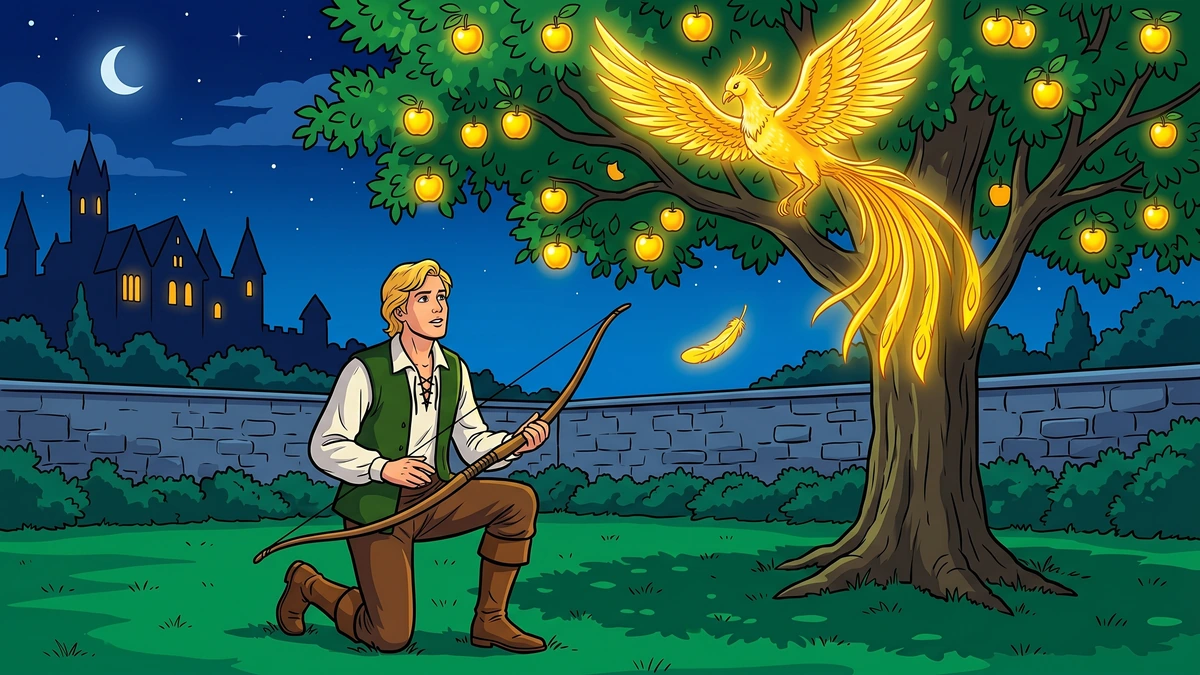
The king counts the apples nightly. One by one they vanish. The eldest son keeps watch and falls asleep at midnight; the second son fares no better; only the third — the youngest, the underrated, the figure whom Propp would call Ivan-durak, the simpleton-hero — succeeds in remaining awake. As the clock strikes twelve he hears a rustling in the air and sees, descending out of the night, a bird “of pure gold.” The youth shoots; the arrow misses; the bird flies away leaving behind a single golden feather. That feather, brought to the council the next morning, is judged to be worth more than the entire treasury of the kingdom. The king pronounces the word that sets the entire tale in motion: “One feather is of no use to me; I must have the whole bird.”
This opening encodes one of the great fairy-tale equations: the visible fragment of magic is always less valuable than the magic itself. The feather, dazzling though it is, names a lack rather than a possession. The king does not wish to own a piece of the bird; he wishes to own the bird’s whole flight, its luminous economy, the very source of the wealth the feather merely advertises. It is the same hunger that drives Aladdin past the lamp’s lustre to the genie’s voice, that drives Jason past the Golden Fleece itself to the kingdom Medea will help him keep. The Grimms’ opening is, in this sense, a textbook lesson in how a folk-tale economy works: a single shining thing is permitted to enter the kingdom only as a goad, and the body of the story consists of the long journey by which the kingdom must be re-balanced around what it has glimpsed.
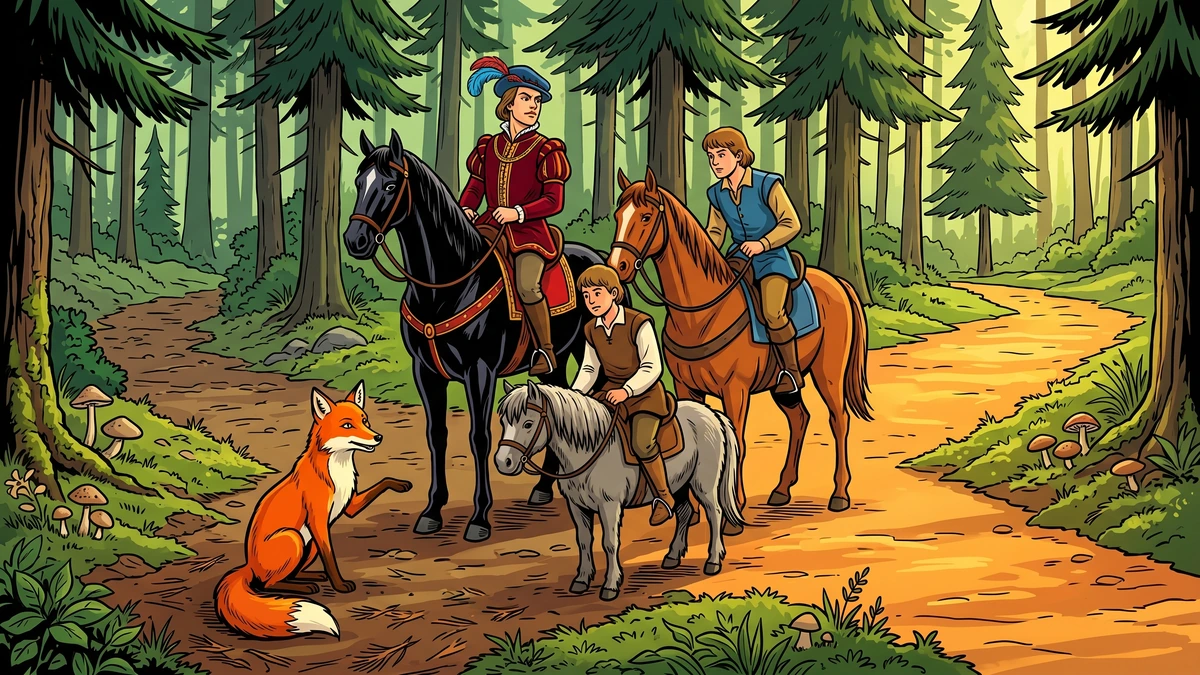
The two elder brothers ride out, each in turn. Each meets, at a crossroads in the wood, a fox who offers counsel: take the simple inn, refuse the splendid one, and the way to the golden bird will open. Each ignores the fox — the eldest out of arrogance, the second out of impatience — and each ends up dawdling in the comfortable inn, drinking and forgetting his quest. The third son, the simpleton (der Dummling in the German), receives the same advice and, alone of the three, accepts it. He spares the fox’s life when he could have shot it; he chooses the humble inn over the brilliant one; he listens. The Grimms’ moral architecture is already in place: the bird belongs not to the brother with the loudest horse but to the brother with the quietest ear.
The Three Quests and the Counsel of the Fox
What follows is the great triple-helix of the tale, one of the most elegant nested-quest structures in European folktale. The youngest son does not, as in simpler quest-romances, ride straight to the golden bird and bring it home. He must, instead, undertake three sequential thefts, each one trading up: to win the golden bird he must steal the golden horse from a second king; to win the golden horse he must steal the golden princess from a third; to win the golden princess he must perform a fourth task — the levelling of a hill before her father’s window in eight days. The fox, with the patient pedagogy of the great folktale helpers, lays out each step before the youth attempts it, and at each step the youth makes one small mistake — takes the wooden cage and reaches for the golden one, takes the plain saddle and reaches for the saddle of gold, lets the princess kiss her parents farewell — and at each step the kingdom’s alarm bells ring.

This pattern of almost succeeding is the subtle genius of the Grimms’ construction. Folktale heroes who simply follow instructions are not interesting; folktale heroes who fail outright are tragic. The simpleton in Der goldene Vogel walks the precise narrative line between the two: he is teachable but not perfect; he listens but not in every detail; he reaches, at the last moment, for the golden cage and the golden saddle because the human eye cannot resist the brighter object even when the wiser counsel is the duller one. This small recurring failure is what saves the youth from being mere obedience-incarnate and makes him recognisably one of us. The fox, watching, does not abandon him for it. The fox, indeed, simply re-engineers the tale around each failure — instructs him to perform a task for the next king, lays out the trick by which the princess can be substituted for the bride, suggests the cunning by which the levelling task may be accomplished. The structural beauty of this recursion is that the youngest son’s growth is measured not in his obedience but in his return to the fox after each lapse, in his willingness to listen one more time. Folktale heroism, in Der goldene Vogel, is not the heroism of the perfect knight but the heroism of the apprentice who keeps coming back to his teacher.
By the end of the triple quest the youth has acquired the bird, the horse, and the princess; he has paid no fee that he cannot recover; he has cost no kingdom anything that the fox cannot return to it by sleight. The Grimms, with their characteristic compression, allow the entire serial theft to occur without sentimental dwelling: the prose moves with the brisk pleasure of a well-conducted heist, and the reader, sharing the youngest son’s mounting astonishment, recognises that the kingdom that began with a stolen apple is being slowly reassembled, around its young heir, with everything the wider world had hidden in its corners.
Betrayal at the Well, and the Long Return
The tale’s third movement is its darkest, and its preservation in the household tales is one of the small triumphs of the Grimms’ editorial integrity. As the youngest son rides home with bird, horse, and princess, he encounters at last his two elder brothers — loitering, in the original 1812 text, at the gate of one of the inns at which they had drunk away their own quests. They greet him with false fraternal warmth, learn the worth of his cargo, and on the third evening of the homeward ride throw him down a well at the edge of the forest. They take the bird, the horse, the princess, and the fame; they ride to their father’s court and present themselves as the three-fold conquerors; the youngest son, in the bottom of the well, is presumed dead.
The Grimms preserve this betrayal with the unflinching realism that distinguishes their corpus from the prettifying retellings of the later nineteenth century. The well is a real well; the brothers are real brothers; the betrayal is the same betrayal of Joseph and his brothers in Genesis 37, of The Two Brothers (KHM 60) in their own collection, of The Three Princes of Tlatelolco in Mesoamerican oral tradition. This is one of the deep narrative patterns of human storytelling — the elder siblings’ resentment of the younger’s success — and the Grimms record it without commentary, allowing the act of fratricidal expulsion to stand for itself. The German is laconic: “sie warfen ihn in einen tiefen Brunnen” (“they threw him into a deep well”). No psychology is offered; no motive is glossed; the deed simply happens, as such deeds in the older folk tradition simply happen.
What rescues the youth is not a miraculous human intervention but the loyalty of the fox. The fox, who has been the youth’s teacher throughout the triple quest, returns once more — as the helpers in the great quest-romances always return, in their hour, to the heroes who have spared their lives — and pulls the youth from the well. The princess at the court of the false brothers refuses to speak, the golden horse refuses to eat, the bird refuses to sing; the entire glittering inheritance falls silent until its true owner returns. The youngest son arrives at his father’s gate; the bird sings; the horse eats; the princess speaks. The brothers are punished — in the 1812 edition by drowning, in the gentler 1857 redaction by banishment — and the youngest son inherits the kingdom and marries the golden princess.

There remains, however, one final movement that distinguishes Der goldene Vogel from its cruder analogues: the fate of the fox. After the wedding the fox returns to the youth and asks of him a single grim favor — that the youth shoot him and cut off his head and feet. The youth, naturally, refuses; he loves the fox, who has been his only true companion in the whole long journey. But the fox insists, and at last, weeping, the youth complies. The moment the deed is done the fox is transformed: he is no fox at all but a man, the long-lost brother of the golden princess, who had been bewitched into vulpine form and could only be released by precisely this final, unwilling act. The tale closes with two reunions — the youngest son with his princess, the princess with her brother — and with the moral pattern, ancient as the Pancatantra, that the helper in disguise is always more than he seems, and that the only true return for kindness given is the kindness that was, all along, hidden inside it.
The Moral, in the Original German
The Grimms, as a rule, avoided pasting explicit morals onto their tales — they were folklorists, not fabulists, and preferred to let pattern do the work that earlier collectors had done with epigrams. But the closing movement of Der goldene Vogel carries an unmistakable moral weight, one that the popular nineteenth-century German chapbook tradition rendered, in various paraphrases, in something like the following couplet preserved in the Volksbücher of the period:
“Der einfältige Hörer findet das Gold,
und der treue Freund trägt eine Königskrone unter dem Pelz.”
(“The simple listener finds the gold,
and the faithful friend wears a king’s crown beneath his fur.”)— Paraphrastic moral in the spirit of Der goldene Vogel, KHM 57
This is the heart of the tale’s enduring appeal. The moral runs in two directions at once. Outward, toward the youngest son: it is the patient ear, not the strong arm, that wins the bird; the simpleton who listens is the brother who returns from the quest, while the brilliant brothers who do not listen are the brothers who never get past the inn. Inward, toward the fox: every helper in a fairy tale carries, beneath his disguise, more dignity than the hero suspects, and the act of kindness shown to a creature of the wood is always, in the long arithmetic of the tale, the act of kindness shown to a king. The fox of Der goldene Vogel is the ancestor of every animal helper in modern children’s literature — from C. S. Lewis’s Mr. Tumnus to Ursula K. Le Guin’s otak Hoeg to the wolf in Walter de la Mare’s The Three Royal Monkeys — and the secret of the Grimm tale is that the fox’s wisdom is finally not magical at all but ethical: he tells the youth to listen, to choose the humble inn, to avoid the bright cage. The magic of the tale is simply the world’s response to a young man who, against all his brothers’ example, agrees to be taught.
Why the Tale Has Lasted Two Hundred Years
It would be easy to read Der goldene Vogel as a glittering nursery confection — the kind of tale that gets reprinted with watercolor illustrations and recommended for ages five to nine. But the tale has lasted, in print and in oral retelling, since the Wild family first told it to the Grimm brothers in Kassel two centuries ago, because its glitter is structural rather than ornamental. Beneath the surface of feathers and apples lies a serious moral architecture. The kingdom that begins with a single stolen apple is reassembled, by the end of the tale, into a kingdom larger and richer than the one that lost it — but only by passing through the youngest son’s discipline of listening, the fox’s discipline of patience, and the brothers’ discipline of having to confess that they were not the heroes of the story they thought they were.
It is, at its heart, a story about who gets to inherit. The two elder brothers, in their easy primogeniture, ride out expecting that the world will yield to them as the king’s hall has always yielded to them. They are corrected by failure, by drink, by the inn. The youngest son, lacking their entitlement, has to earn what he wins; and what he learns in the earning — that the helpful stranger may be a prince, that the duller cage is the better choice, that the fox at the crossroads knows more than the king at the gate — is precisely the wisdom by which a kingdom is best ruled. The Grimm brothers, who collected Der goldene Vogel in the years immediately after the Napoleonic occupation of Hessen-Kassel, knew exactly what kind of moral education their tale was offering. The kingdom of the future, the tale suggests, will not be ruled by the brother who was brilliant enough to be lazy; it will be ruled by the brother who was modest enough to be taught.
Modern readers, especially those raised in the era of meritocracy and the long debate over what merit is, recognise the tale’s architecture instantly. The youngest son’s success is not the success of native genius; he is, in the tale’s own description, a Dummling, a simpleton. His success is the success of openness — openness to the fox’s counsel, openness to the lesson of his brothers’ failure, openness to the possibility that the bird he seeks is bound up with a horse he must steal and a princess he must rescue and a hill he must level. He is not a clever hero; he is a teachable one. And the Grimms’ great pedagogical insight, preserved in the tale’s structure across two centuries, is that teachability is the rarest and most kingly of virtues.
Reading the Tale Today: Listening as a Fairy-Tale Skill
One of the quieter pleasures of returning to Der goldene Vogel as an adult is noticing how carefully the Grimms preserved the fox’s pedagogy. He never lectures. He never threatens. He gives the youth a single small piece of advice at each crossroads — choose the humble inn, take the wooden cage, take the plain saddle, do not let the princess go to her parents — and waits to see whether the youth has the discipline to follow it. When the youth fails, the fox does not punish him; he simply re-engineers the tale until the failure can be redeemed. This is the rarest kind of teaching. It is the teaching of the great folkloric helpers — of Vasilisa’s doll in the Russian tradition, of the old woman in the wood in The Three Spinning Women (KHM 14), of the jackal Damanaka in the Sanskrit Pancatantra — and it is teaching that asks nothing of its pupil except attention.
For the modern reader, especially the modern young reader, the tale offers a quietly subversive moral. The world, the tale insists, is full of foxes — helpful strangers, marginal advisors, animals who can speak when spoken to with kindness — and the kingdom belongs to those who can hear them. The bright cage is not the right cage; the splendid inn is not the right inn; the brother who rides off in glory is not the brother who comes home with the bird. The Grimms’ great final image — the youngest son weeping over the body of the fox he was forced to slay, only to see the fox rise as a man — is a small, perfect emblem of the moral logic of the entire tale: the kindness given to the apparently lower creature is, in the long economy of the wood, the kindness given to a brother. Two hundred years after Dortchen Wild first told the tale to her future husband by the fire of the Wild family pharmacy in Kassel, that is still the lesson worth carrying out of Der goldene Vogel into a world full of crossroads, foxes, and choices between cages.
You May Also Like
 Grimm's Fairy Tales
Ages 9-12
Grimm's Fairy Tales
Ages 9-12
Ashputtel
Ashputtel: The wife of a rich man fell sick; and when she felt that her end drew nigh, she called her only daughter to her bed-side, and said, ‘Always be a
 Grimm's Fairy Tales
Ages 9-12
Grimm's Fairy Tales
Ages 9-12
1. How They Went To The Mountains To Eat Nuts
1. How They Went To The Mountains To Eat Nuts: The nuts are quite ripe now,’ said Chanticleer to his wife Partlet, ‘suppose we go together to the mountains
 Grimm's Fairy Tales
Ages 9-12
Grimm's Fairy Tales
Ages 9-12
The Pink
The Pink: There was once upon a time a queen to whom God had given no children. Every morning she went into the garden and prayed to God in heaven to bestow on