Mother Holle
Mother Holle: Once upon a time there was a widow who had two daughters; one of them was beautiful and industrious, the other ugly and lazy. The mother
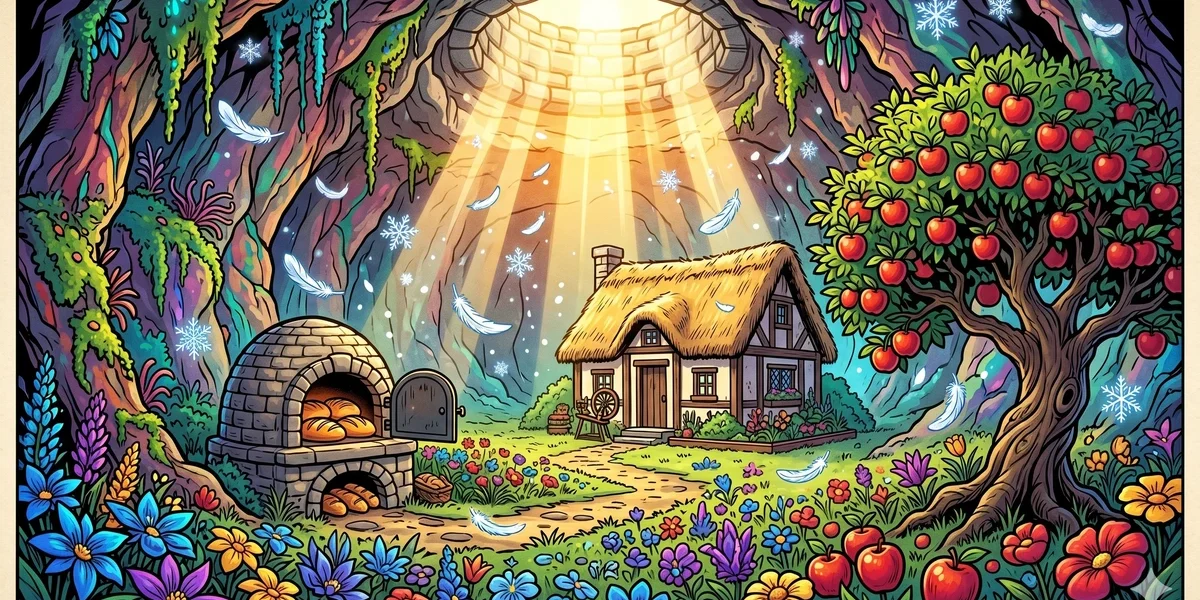
Mother Holle is the Grimm collection’s most luminous allegory of work, character, and cosmic reciprocity — a tale in which two sisters encounter the same supernatural figure and receive diametrically opposite fates based not on luck but on the quality of their engagement with the world. Through Indian philosophical frameworks, the tale enacts the doctrine of karma-phala (the fruit of action) mediated through a cosmic feminine figure who represents both Bhūmi-devī (Earth Goddess) and the Vedic principle of ṛta (cosmic order that returns to each being precisely what they have earned).
The Tradition: Karma-Phala and the Cosmic Feminine as Witness
The structure of Mother Holle — two contrasting figures tested by the same cosmic arbiter — belongs to a narrative pattern found throughout Indian didactic literature under the rubric of satpātra vs. kupātra (worthy vs. unworthy recipient). The Mahābhārata‘s numerous paired characters — Dharmarāja Yudhiṣṭhira and his flawed brothers; the virtuous Damayantī and her unworthy counterparts — are built on the same recognition: that character is not hidden from cosmic reality but perfectly transparent to it, and that the universe eventually returns to each being an exact reflection of what they have contributed.
Mother Holle herself — ancient, powerful, demanding but utterly fair, who shakes snow from her featherbeds to make it snow on earth — is one of European folklore’s most compelling goddess-figures. Her domain beneath the well is precisely the pātāla (underworld) of Indian cosmology: not a realm of punishment but a realm of primal power, where the forces that govern the surface world originate. Her demand for attentive, wholehearted work — baking bread when it asks to be taken from the oven, shaking her featherbeds so the world has snow — is the demand of dharma itself: that the world be engaged with fully, that its needs be met as they arise, without complaint and without eye toward reward.
Plot and Philosophical Analysis: Svabhāva (Nature) as Destiny in Two Sisters
The hardworking, kind girl — maltreated by her stepmother and stepsister — falls into the well and enters Mother Holle’s realm. She attends carefully to every task: she takes the bread from the oven when it calls, she shakes the apple tree when it asks, she serves Mother Holle with diligence and care. When she returns home, golden rain falls on her. The lazy stepsister, envying her reward, follows the same path but ignores the bread, ignores the apples, and serves Mother Holle poorly. She returns home covered in pitch.
The Bhagavad Gītā‘s concept of svabhāva-niyata karma — action arising from one’s inherent nature — is perfectly illustrated here. The hardworking sister does not work well strategically, calculating that good work will produce golden reward; she works well because it is her nature. The lazy sister does not fail strategically either; she fails because sloth and self-interest are her svabhāva. The Gītā’s teaching that character produces action and action produces consequence — that karma-phala is not externally imposed punishment but the natural ripening of what was already present in the actor — is what Mother Holle embodies. She does not punish or reward; she reveals.
The Sāṃkhya concept of the three guṇas applies precisely: the hardworking sister is sāttvic (luminous, attentive, responsive to need), the lazy sister is tāmasic (inert, self-absorbed, resistant to effort). Mother Holle’s domain tests both; what she receives reflects what she brings. Gold falls on sattva because sattva naturally harmonizes with the universe’s productive capacity; pitch adheres to tamas because tamas naturally produces the sticky, darkening consequence of inert self-absorption.
Scholarly Synthesis: Ṛta and the World That Rewards Attention
The Vedic concept of ṛta — cosmic order, the underlying rightness of things — holds that the universe is structured as a reciprocal system: generous contribution is met with generous return not as moral reward but as systemic reflection. The Ṛgveda‘s yajna (sacrifice) theology is premised on this: the worshippers who give to the gods receive from the gods because the universe is structured as an exchange of attentiveness and abundance. Mother Holle’s realm operates by the same logic: she is not an arbitrary judge but a mediating principle of ṛta.
The Karma-Mīmāṃsā school’s analysis of apūrva — the unseen potency generated by dharmic action that eventually produces its fruit — explains the mechanism: the hardworking sister’s attentive service generates apūrva that ripens as golden rain. There is no supernatural arbitrariness; there is only the patient accumulation of what one has actually contributed to the world, waiting for the moment of return. The pitch that covers the lazy sister is her own accumulated indifference returned to her with equal precision.
“Mother Holle does not decide your fate — she simply returns to you, with exquisite precision, exactly what you have been giving to the world all along. The golden shower and the pitch are not rewards and punishments but mirrors: one shows you your sattva, the other your tamas.”
Why This Story Lasted
Mother Holle endures because it offers the most satisfying account of why character matters that folklore has produced: not because virtue will be noticed and rewarded by some human authority, but because the universe itself — represented by the ancient, utterly fair Mother Holle beneath the well — is structured to return to each being a faithful reflection of what they have brought to it. The tale survives because this is a truth that every generation needs to hear and that the story delivers without preaching, through the simple drama of two sisters and the golden rain.
Frequently Asked Questions
What is the moral of Mother Holle?
The tale embodies karma-phala (the fruit of action) mediated through a cosmic feminine figure who represents ṛta — Vedic cosmic order that returns to each being precisely what they have contributed. Mother Holle does not reward or punish arbitrarily; she reveals each sister’s svabhāva (inherent nature) by returning its precise consequence. Gold for attentive sattva; pitch for inert tamas.
Who is Mother Holle in German folklore?
Mother Holle is a pre-Christian Germanic goddess figure associated with earth, weather, and cosmic justice. Her domain beneath the well corresponds to the pātāla (underworld) of Indian cosmology — not a realm of punishment but of primal power where surface-world forces originate. She shakes her featherbeds to create snow, linking her to the Bhūmi-devī (Earth Goddess) archetype as keeper of the world’s productive rhythms.
Are there Indian parallels to Mother Holle?
The satpātra vs. kupātra (worthy vs. unworthy recipient) narrative pattern appears throughout Indian didactic literature, including the Mahābhārata and Pañcatantra. The cosmic feminine as impartial dispenser of karma-phala appears in Śākta traditions. The Vedic yajna theology — generous contribution met with generous return as systemic reciprocity, not moral reward — directly parallels Mother Holle’s ṛta-logic.
Why does the lazy stepsister get covered in pitch in Mother Holle?
The pitch is not punishment but reflection: Karma-Mīmāṃsā’s apūrva (unseen potency of action) accumulated from her indifferent service ripening as sticky, darkening consequence. In Sāṃkhya terms, her tāmasic svabhāva — inert, self-absorbed, resistant to effort — naturally produces a tāmasic return. Mother Holle does not decide; she merely serves as the medium through which the universe returns each being’s own contributions.
What does the well symbolize in Mother Holle?
The well is the threshold between the ordinary social world (where the stepmother’s favoritism distorts just recognition of the hardworking girl) and Mother Holle’s realm of ṛta (cosmic order), where character is perfectly transparent and consequence perfectly calibrated. The underground journey is an initiation: both sisters must enter the domain where social performance is irrelevant and only their genuine svabhāva is visible.
You May Also Like
 Grimm's Fairy Tales
Ages 9-12
Grimm's Fairy Tales
Ages 9-12
The Four Clever Brothers
The Four Clever Brothers: Dear children,’ said a poor man to his four sons, ‘I have nothing to give you; you must go out into the wide world and try your luck.
 Grimm's Fairy Tales
Ages 9-12
Grimm's Fairy Tales
Ages 9-12
The Travelling Musicians
The Travelling Musicians: An honest farmer had once an ass that had been a faithful servant to him a great many years, but was now growing old and every day
 Grimm's Fairy Tales
Ages 9-12
Grimm's Fairy Tales
Ages 9-12
3. How Partlet Died And Was Buried, And How Chanticleer Died Of Grief
From that day Chanticleer would eat and drink no more, and pined away until he died of grief.