The Three Languages
The Three Languages: An aged count once lived in Switzerland, who had an only son, but he was stupid, and could learn nothing. Then said the father: ‘Hark you
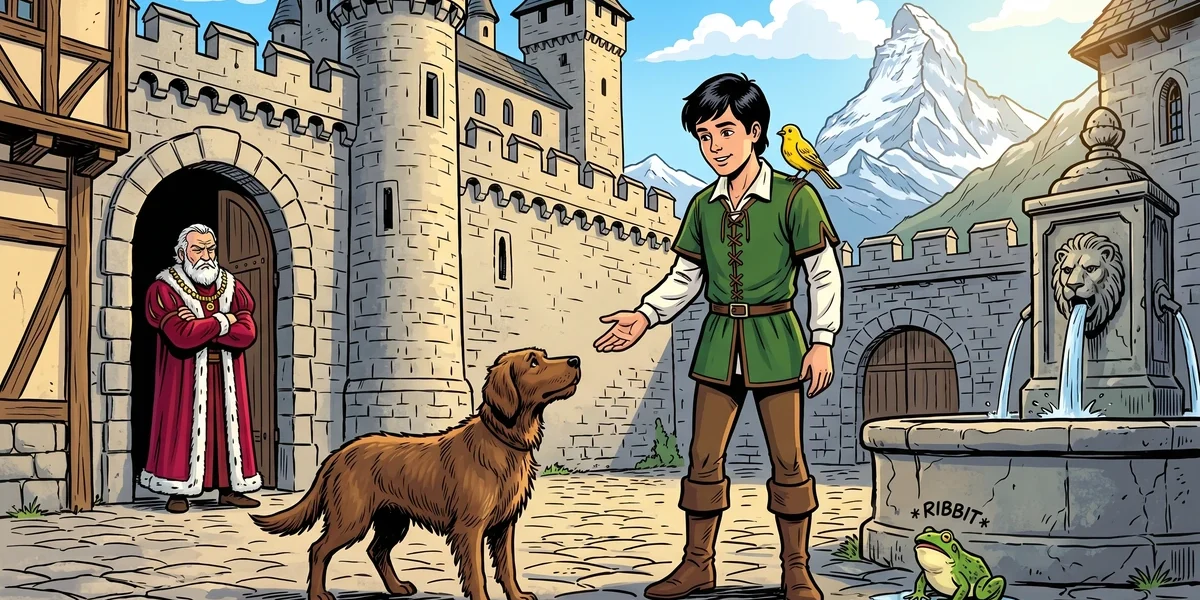
An aged count once lived in Switzerland, who had an only son, but he was stupid, and could learn nothing. Then said the father: ‘Hark you, my son, try as I will I can get nothing into your head. You must go from hence, I will give you into the care of a celebrated master, who shall see what he can do with you.’ The youth was sent into a strange town, and remained a whole year with the master. At the end of this time, he came home again, and his father asked: ‘Now, my son, what have you learnt?’ ‘Father, I have learnt what the dogs say when they bark.’ ‘Lord have mercy on us!’ cried the father; ‘is that all you have learnt? I will send you into another town, to another master.’ The youth was taken thither, and stayed a year with this master likewise. When he came back the father again asked: ‘My son, what have you learnt?’ He answered: ‘Father, I have learnt what the birds say.’ Then the father fell into a rage and said: ‘Oh, you lost man, you have spent the precious time and learnt nothing; are you not ashamed to appear before my eyes? I will send you to a third master, but if you learn nothing this time also, I will no longer be your father.’ The youth remained a whole year with the third master also, and when he came home again, and his father inquired: ‘My son, what have you learnt?’ he answered: ‘Dear father, I have this year learnt what the frogs croak.’ Then the father fell into the most furious anger, sprang up, called his people thither, and said: ‘This man is no longer my son, I drive him forth, and command you to take him out into the forest, and kill him.’ They took him forth, but when they should have killed him, they could not do it for pity, and let him go, and they cut the eyes and tongue out of a deer that they might carry them to the old man as a token.
The youth wandered on, and after some time came to a fortress where he begged for a night’s lodging. ‘Yes,’ said the lord of the castle, ‘if you will pass the night down there in the old tower, go thither; but I warn you, it is at the peril of your life, for it is full of wild dogs, which bark and howl without stopping, and at certain hours a man has to be given to them, whom they at once devour.’ The whole district was in sorrow and dismay because of them, and yet no one could do anything to stop this. The youth, however, was without fear, and said: ‘Just let me go down to the barking dogs, and give me something that I can throw to them; they will do nothing to harm me.’ As he himself would have it so, they gave him some food for the wild animals, and led him down to the tower. When he went inside, the dogs did not bark at him, but wagged their tails quite amicably around him, ate what he set before them, and did not hurt one hair of his head. Next morning, to the astonishment of everyone, he came out again safe and unharmed, and said to the lord of the castle: ‘The dogs have revealed to me, in their own language, why they dwell there, and bring evil on the land. They are bewitched, and are obliged to watch over a great treasure which is below in the tower, and they can have no rest until it is taken away, and I have likewise learnt, from their discourse, how that is to be done.’ Then all who heard this rejoiced, and the lord of the castle said he would adopt him as a son if he accomplished it successfully. He went down again, and as he knew what he had to do, he did it thoroughly, and brought a chest full of gold out with him. The howling of the wild dogs was henceforth heard no more; they had disappeared, and the country was freed from the trouble.
After some time he took it in his head that he would travel to Rome. On the way he passed by a marsh, in which a number of frogs were sitting croaking. He listened to them, and when he became aware of what they were saying, he grew very thoughtful and sad. At last he arrived in Rome, where the Pope had just died, and there was great doubt among the cardinals as to whom they should appoint as his successor. They at length agreed that the person should be chosen as pope who should be distinguished by some divine and miraculous token. And just as that was decided on, the young count entered into the church, and suddenly two snow-white doves flew on his shoulders and remained sitting there. The ecclesiastics recognized therein the token from above, and asked him on the spot if he would be pope. He was undecided, and knew not if he were worthy of this, but the doves counselled him to do it, and at length he said yes. Then was he anointed and consecrated, and thus was fulfilled what he had heard from the frogs on his way, which had so affected him, that he was to be his Holiness the Pope. Then he had to sing a mass, and did not know one word of it, but the two doves sat continually on his shoulders, and said it all in his ear.
Moral
A father’s impatience blinds him to his son’s true learning; the youth who ‘masters’ animals, dogs and frogs proves wiser than those who despise his unconventional education and mocked abilities.
Historical & Cultural Context
The Grimm Brothers’ Kinder- und Hausmärchen (1812) gathered oral German folk tales from peasants, nursemaids and educated informants. Their stories preserve pre-industrial European magic, forest-lore and moral ambiguity, and reshaped global fairy tale tradition.
KHM 33 (Die drei Sprachen). A wisdom-test tale (Aarne-Thompson type 674). The Grimm collection preserves the Swiss setting and the didactic theme: education and intelligence are not limited to classical learning. Collected from oral Swiss tradition, the tale reflects Renaissance humanist tensions between schooled and practical knowledge. The 1857 edition maintained the story’s celebration of unexpected wisdom and the supernatural gift of animal language.
Reflection & Discussion
- Why does the father initially reject his son’s education in animal languages? What prejudice drives his judgment?
- How do the boy’s abilities to speak to animals, dogs, and frogs eventually prove more valuable than conventional learning?
- What does this story suggest about recognizing and valuing forms of intelligence that differ from formal schooling?
Did You Know?
- The Brothers Grimm, Jacob and Wilhelm, collected their famous fairy tales from oral storytellers across Germany in the early 1800s.
- Many well-known fairy tales like Cinderella, Snow White, and Rapunzel were popularized by the Brothers Grimm.
- The original Grimm’s fairy tales were much darker than the versions we know today, and were edited to be more child-friendly over time.
What This Tale Teaches Us Today
Old stories keep their power because their lessons never stop being useful. Here is how this one still applies:
- Traditional stories remind us that wisdom belongs to many cultures. No single tradition holds all the answers.
- Every folk tale is also a time machine – a small window into how our ancestors thought about the world.
- Reading folk tales aloud to children builds vocabulary, imagination, and a sense of cultural inheritance.
Why This Story Still Matters
The Three Languages joins a vast global library of folk tales that human beings have been telling one another for thousands of years. Every culture has produced its own stories, but the deepest themes – courage, kindness, cleverness, loyalty, the cost of greed – appear again and again in different clothes. Modern readers who spend time with folk tales inherit something precious: a sense that people have always wrestled with the same basic questions, and that good stories can still help us find good answers. That is why these tales persist. Each one is a small tool for living, handed down quietly through generations.
Cultural Context and Continuing Influence
Folk tales like this one survived for hundreds of years through oral storytelling before any scholar thought to write them down. Grandparents told them to grandchildren, travelers traded them along roads and rivers, and mothers repeated them to babies who would one day repeat them to their own children. Each small retelling sharpened the story, discarded unnecessary parts, and polished the essential lesson. That long process of refinement is why a good folk tale feels so weighty – it has been shaped by thousands of listeners across generations, each contributing something small to the story we read today.
Modern readers sometimes wonder whether folk tales are still relevant in an age of apps and smartphones. The answer is yes, perhaps more than ever. The technology changes, but the underlying questions – about kindness, courage, loyalty, greed, family, fear, love – do not. These are the same questions that children asked around a fire in ancient India, around a hearth in medieval Ireland, around a campfire in 19th-century Korea. And they are the same questions children ask their parents today, just phrased differently. That is why a family that reads folk tales together is doing real cultural and emotional work, not simply entertaining itself.
Why Children Still Love This Story
This tale has been shared for many, many years, and children all over the world still enjoy it today. That is because stories like this one do not grow old. The characters may wear different clothes than we do, and the world they live in may look different from ours, but the feelings inside the story are feelings we all know. We have all felt afraid. We have all been tricked. We have all had to think fast to solve a hard problem. When a story shows those feelings in a clear and honest way, it stays fresh no matter how much time passes.
Children also love this story because it feels fair. Bad choices lead to bad endings, and good choices lead to good endings. That is how children wish the real world worked, and in a folk tale it really does work that way. Every time you read the story, the clever helpers still win, the bullies still lose, and kindness still matters. That is a wonderful feeling, and it is one of the reasons we keep coming back to tales like this one.
There is one more reason this story stays alive. It is easy to remember and easy to share. You can tell it around a campfire, whisper it at bedtime, or read it aloud in a classroom. Some stories need a whole book to unfold, but this one fits neatly into a short visit. That is the quiet magic of folk tales – they travel lightly, and they travel far. A grandmother in one village can pass the tale to a child, and that child can pass it to a friend, and before long the story is living a whole new life in a brand-new place.
Talk About This Story
After you finish reading, try these questions with a friend or a family member. You can answer them in any order you like, and there are no wrong answers. The best answers are the ones that make you stop and think for a moment.
- Which character did you like the most, and why did you pick that one?
- Was there a moment when you wanted to shout a warning to someone in the story?
- If you had been inside the story, what would you have done in a different way?
- Have you ever seen something in real life that reminded you of this tale?
- What single word would you use to describe the lesson of the story?