Rumpelstiltskin
Rumpelstiltskin: By the side of a wood, in a country a long way off, ran a fine stream of water; and upon the stream there stood a mill. The miller’s house was
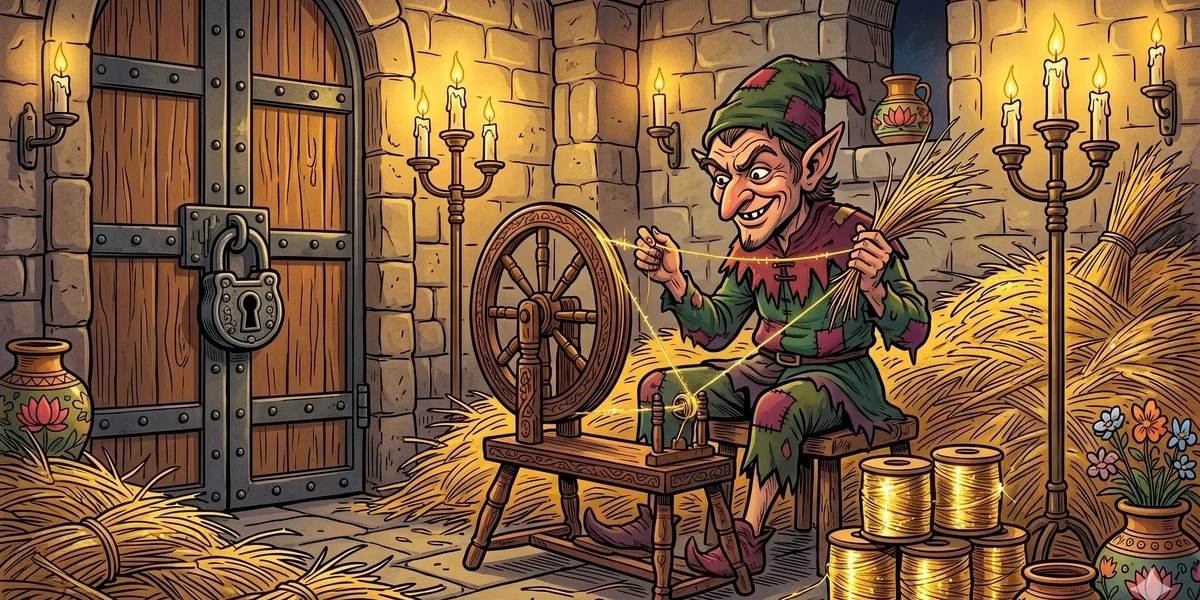
Rumpelstiltskin is the Grimm collection’s most philosophically concentrated tale of names, power, and the hidden economy of magical compacts. A mysterious creature spins straw into gold for a desperate miller’s daughter in exchange for escalating payments — first her necklace, then her ring, then her first-born child — and his power over her is absolute until she discovers his name. Through Indian philosophical frameworks, the tale enacts the Vedic doctrine of nāma-śakti (the power inherent in names), the guhya-vidyā (secret knowledge) tradition in which knowing a being’s true name constitutes power over that being, and the dharma of maternal protection that ultimately overrides any earlier binding.
The Tradition: Nāma-Śakti and the Ontology of Names
The Vedic tradition holds that names are not arbitrary labels but encoded realities: nāmarūpa (name-and-form) together constitute the structure of manifest existence. The Chāndogya Upaniṣad teaches that the primordial creative act was the naming of things, and the Ṛgveda‘s creation hymns suggest that to know the name of a thing is to possess a form of authority over it. This is not mere superstition but a recognition that naming is the act through which consciousness organizes reality — and that therefore the one who possesses the name possesses the organizational key.
The Tantric tradition develops this into mantra-śāstra: the teaching that certain names are themselves bīja (seed) syllables that encode the essential nature of divine beings, and that the practitioner who knows the correct name and knows how to invoke it gains access to the being’s power. Rumpelstiltskin’s compulsive self-revelation when his name is spoken — his destruction at the moment the queen correctly names him — is the Grimm folk enactment of this principle: his power is his secret name, and its disclosure dissolves that power instantly.
Plot and Philosophical Analysis: The Compact, the Child, and Mātr̥-Dharma
The miller’s daughter’s situation is one of compounding crisis: her father’s boast (a lie of social ambition) creates an impossible demand; the king’s greed exploits her desperation; Rumpelstiltskin’s help creates an ever-escalating debt. The final payment — the promise of her first-born — represents the deepest possible collateral: not a thing but a life, not a possession but a relationship. This is the Arthaśāstra’s worst-case scenario for the borrower: the creditor who holds one’s future child as security has effectively become the co-parent of that child’s existence.
The queen’s desperate effort to discover Rumpelstiltskin’s name is driven by mātr̥-dharma (maternal duty) — the most fundamental relational obligation in Indian ethics. The Mahābhārata’s Kuntī, the Rāmāyaṇa’s Kaikeyī (however distorted her expression), and the Devī-Māhātmya’s vision of the Goddess as cosmic mother all establish that maternal protection of the child is among the most primordial dharmic forces. The queen’s refusal to surrender her child — her willingness to try every name in the kingdom before giving up — is mātr̥-dharma in its purest form: the rejection of any prior compact when a child’s life is at stake.
The Mīmāṃsā school’s analysis of pratiśruti (promise, vow) holds that some promises are inherently invalid because they conflict with prior or more fundamental dharmic obligations. A promise made under coercion (she had no other option but to promise) against a person who has no prior claim (Rumpelstiltskin contributed labor, not kinship) to a child not yet born is precisely such an invalid pratiśruti. The queen is not breaking a valid contract; she is refusing to honor an invalid one.
Scholarly Synthesis: The Hidden Name as Guhya-Vidyā
Rumpelstiltskin’s name-concealment is his primary strategy of power: he has no social position, no lineage, no recognized identity — his power comes entirely from remaining unnamed, and therefore unlocatable within the social order that might constrain him. The Atharvaveda‘s nāma-vidyā (name-knowledge) tradition holds that hostile forces maintain their power through anonymity: once named, they become subject to the cosmic order that names organize. The queen’s messenger who discovers Rumpelstiltskin dancing and singing his own name in the forest is the classic cara (spy/scout) of the Arthaśāstra — the intelligence operative whose discovery of the enemy’s hidden information becomes the decisive weapon. The name, once known, is the queen’s brahmastra: the ultimate weapon that cannot be defended against.
“To know a being’s name is to know what they are and therefore what they cannot be — and the creature who would make a mother surrender her child always has a name, always tells it to the forest when he thinks no one is listening, and always destroys himself the moment that name is spoken back to him.”
Why This Story Lasted
Rumpelstiltskin endures because it encodes a truth that every culture has known: that hidden things have power only as long as they remain hidden. The creature who extracts impossible promises by exploiting desperation, who accumulates debts that cannot be repaid, who seems invincible — has a name. And the name, when discovered, strips away every power. The tale survives because it gives form to the conviction that no power that hides in the dark is truly invincible, that there is always a messenger who will find the fire in the forest, and that the determined mother who refuses to surrender her child will eventually hear the name that dissolves the compact.
Frequently Asked Questions
What is the meaning of Rumpelstiltskin?
The tale enacts the Vedic doctrine of nāma-śakti — the power inherent in names. Rumpelstiltskin’s power rests entirely on remaining unnamed, and its dissolution at the moment his name is spoken correctly reflects the Tantric teaching that to know a being’s true name is to possess authority over that being. The queen’s discovery of his name is her brahmastra (ultimate weapon) against his seemingly invincible compact.
Why does Rumpelstiltskin want the queen’s child?
The desire for a child represents a form of social legitimacy and kinship unavailable to a nameless, socially unlocatable creature. In Indian terms, Rumpelstiltskin seeks gotra (lineage connection) that his anonymity denies him. This is also why the correct naming destroys him — it denies him the child and simultaneously removes the anonymity that was his only source of power.
Are there Indian parallels to the Rumpelstiltskin story?
The Atharvaveda’s nāma-vidyā (name-knowledge as power over hostile forces) is the closest parallel. Tantric mantra-śāstra holds that knowing the correct name of a divine or demonic being grants power over it. The Arthaśāstra’s cara (intelligence operative) tradition parallels the messenger who discovers the name. Mātr̥-dharma (maternal duty) as an obligation that overrides prior compacts appears throughout the Mahābhārata.
Is the queen breaking a valid promise when she refuses to give her child?
Mīmāṃsā analysis holds that promises made under coercion, against a party with no prior claim, regarding a person not yet in existence are inherently invalid pratiśruti (vows). The queen is not breaking a legitimate contract; she is refusing to honor an invalid one. Her mātr̥-dharma (maternal duty) — the more fundamental prior obligation — supersedes any compact extracted through desperation.
Why does Rumpelstiltskin destroy himself when his name is discovered?
His self-destruction mirrors the Vedic teaching that hostile forces maintain power through anonymity — once named, they become subject to the cosmic order that names organize. Rumpelstiltskin’s entire identity was his secret; he had no social position, no lineage, no recognized status. When the name is spoken, he loses the only power he possessed, and with it, any basis for his existence in the social world the queen inhabits.
You May Also Like
 Grimm's Fairy Tales
Ages 9-12
Grimm's Fairy Tales
Ages 9-12
The Miser In The Bush
A faithful servant who shows kindness to a magical being gains reward while a cruel miser faces supernatural retribution.
 Grimm's Fairy Tales
Ages 9-12
Grimm's Fairy Tales
Ages 9-12
The Fisherman and His Wife: A Brothers Grimm Tale
The Fisherman and His Wife: A Brothers Grimm Tale: In a small cottage on the edge of a vast sea lived a fisherman named Heinrich and his wife Margaretta. The
 Grimm's Fairy Tales
Ages 9-12
Grimm's Fairy Tales
Ages 9-12
Fundevogel
Fundevogel: There was once a forester who went into the forest to hunt, and as he entered it he heard a sound of screaming as if a little child were there.