The Dog And The Sparrow
A shepherd's dog had a master who took no care of him, but left him to starve. The dog ran away into the forest where he met a sparrow who took pity on him.
“The Dog and the Sparrow” is the standard English title under which the Brothers Grimm’s tale KHM 58, Der Hund und der Sperling, has been read in the Anglophone world since Edgar Taylor introduced a paraphrase of it in his 1823 first volume of German Popular Stories (London: C. Baldwyn) and since Margaret Hunt published her standard literal translation in Grimm’s Household Tales (London: George Bell & Sons, 1884), volume I, pages 246–249. Jacob and Wilhelm Grimm first printed the tale at number 58 in volume one of the first edition of their Kinder- und Hausmärchen (Berlin: Realschulbuchhandlung, 1812), and retained it in every subsequent canonical edition through the seventh and final “Ausgabe letzter Hand” (Göttingen: Dieterich, 1857), where it appears at the same number with only minor stylistic revisions to the wagoner’s speeches. Wilhelm Grimm’s notes in the Anmerkungen zu den Kinder- und Hausmärchen (Göttingen: Dieterich, 1856) record that the tale’s primary informant was the Cassel cloth-merchant family of Hassenpflug, and most particularly Marie Hassenpflug (1788–1856) and her sisters Jeanette and Amalie, who supplied the brothers with a great body of Hessian and Hugenot material between 1808 and 1812. The Hassenpflugs were of French Huguenot descent and bilingual in German and French, which has led modern editors including Heinz Rölleke (in Die älteste Märchensammlung der Brüder Grimm, Cologny-Geneva: Fondation Martin Bodmer, 1975) to detect Perrault and La Fontaine echoes in some of the Hassenpflug-sourced Grimm tales, although Der Hund und der Sperling in its present form is overwhelmingly Hessian in idiom and unmistakably oral in its rhythm. Folklorists place the tale under ATU 248 “The Dog and the Sparrow” in Hans-Jörg Uther’s revised Types of International Folktales (FFC 284–286, Helsinki: Suomalainen Tiedeakatemia, 2004), with motif clusters B211.1.7 (speaking sparrow), B435.4 (helpful sparrow), B524.1.2 (sparrow as friend of dog), Q211.6 (death of innocent animal avenged), Q581 (villain perishes by his own contrivance), K891.5.4 (rage-driven self-destruction by axe-throw), L315.1 (small bird outwits great man), J2102 (futile rage), and N255 (the curse fulfilled in stages). The tale is a member of the smaller animal-vengeance group within the larger ATU 200–299 cluster of “Wild Animals and Domestic Animals,” and is cognate with Aesop’s Fables on the lion and the wagoner, with the medieval Roman de Renart on the cock and the carter, with the Indian Pancatantra tale of the sparrow and the elephant in book one (Mitra-Bheda, “The Loss of Friends”), and with the African Fante tale of the bird and the hunter recorded by R. S. Rattray in Akan-Ashanti Folk-Tales (Oxford: Clarendon, 1930). The Pancatantra cognate is particularly close: in book one of Vishnu Sharman’s collection a small tittibha sparrow whose mate is killed by the careless tread of a great elephant raises an alliance of frog, fly, and woodpecker that destroys the elephant in turn — a plot that is structurally identical to the Grimm tale’s sparrow-and-wagoner sequence and that suggests an Indo-European deep-folkloric memory of the “small bird’s vengeance” type stretching back at least to the third or fourth century of the common era.
I. The Starving Shepherd-Dog and the Sparrow on the Road
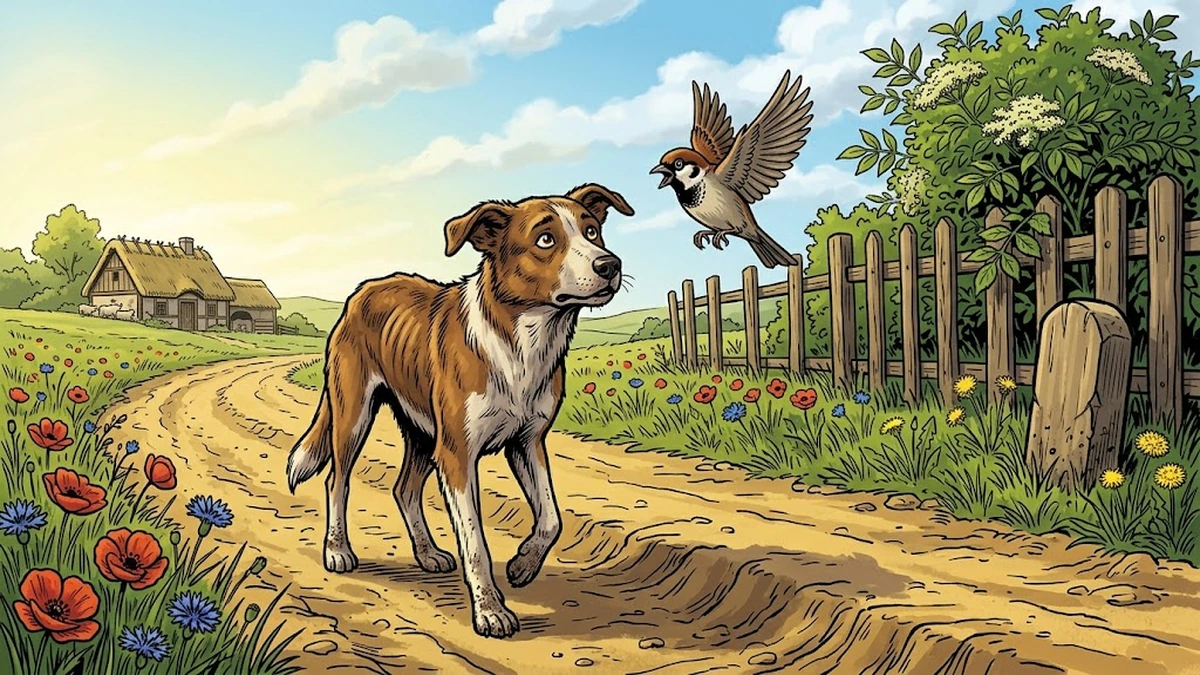
The opening of Der Hund und der Sperling is one of the most economical and quietly indignant in the entire Grimm corpus, and it sets the tale firmly in the small Hessian agrarian world from which the Hassenpflug informants spoke. There was once upon a time, the tale begins, a shepherd’s dog whose master took no care of him, but often let him suffer the greatest hunger. At last the dog could bear it no longer; so he took to his heels, and off he ran in a very sad and sorrowful mood. The phrasing is plain and almost juridical, and Hessian listeners of 1812 would have heard in it the same small social complaint that recurred across the Grimm collection in tales such as Die Bremer Stadtmusikanten (KHM 27) and Der alte Sultan (KHM 48): a working animal, having served his master faithfully, has been denied his keep, and must take his welfare into his own paws. The tale, at this opening, is a parable of the small mistreatments that obtain in any village economy where the labour of beasts is taken for granted; the dog is not a romantic protagonist but a hungry retired sheepdog whose master has reduced his food ration once his teeth no longer suffice to herd the flock.
On the road, in the small dry walking-pace of the Grimms’ opening sentences, the dog meets a sparrow that says to him, “Warum bist du so traurig, mein Freund?” “Why are you so sad, my friend?” The dog answers, in the canonical Hessian formula that the Grimms preserved exactly, that he is very hungry and has nothing to eat. The sparrow’s reply is one of the small quietly-decent moments in the Grimm corpus, and it carries the whole moral weight of the first half of the tale: “If that is all,” says the sparrow, “come with me into the next town, and I will soon find you plenty of food.” The bird-as-helper motif is one of the most ancient in the comparative folklore index — motif B435.4, the “helpful sparrow,” appears in tale types as far apart as the Aesopic Bird and the Beggar, the Welsh Llef Llaw Eraint, and the Russian Vorobei i okhotnik. What is distinctive in the Grimm version is the small egalitarian dignity of the sparrow’s offer: she is not a magical bird in disguise, not a transformed prince, not a saint sent down to test the dog’s virtue, but simply, in the unmistakable Hessian phrasing of the original, a sparrow on the road who decides to help. The Grimms’ informants seem to have understood, with the small clear-eyed political sense of the post-Napoleonic Hessian poor, that small kindnesses between the dispossessed are themselves a kind of mutual-aid contract; the tale will turn on whether that contract is kept.
The two friends walk into the next town. The sparrow leads the dog past a butcher’s shop where a piece of meat lies upon the edge of an open shelf, and tells him to wait below while she pecks the meat off the shelf and onto the ground. She perches above the meat, looks carefully about her to see if anyone is watching, pecks and scratches at the steak until it falls, and the dog snaps it up and scrambles away with it into a corner. Motif K366.1, the “cooperative theft of food by helpful bird and hungry quadruped,” is a small Pancatantra-cognate device that appears widely in the European fable tradition and that the Grimms’ informants seem to have inherited through some combination of the medieval Reineke Fuchs tradition and the Hassenpflug family’s French Huguenot reading of La Fontaine’s Fables (Paris, 1668–1694). The sparrow then leads the dog to a baker’s shop and pecks down two rolls in the same fashion, and then to a third shop for more. When the dog has eaten enough, the sparrow asks him whether he has had his fill; he answers that he has, and they walk together out of the town and onto the high road, where the warm afternoon sun begins to slant across the fields.
II. The Nap on the Road and the Wagoner’s Three Casks of Wine
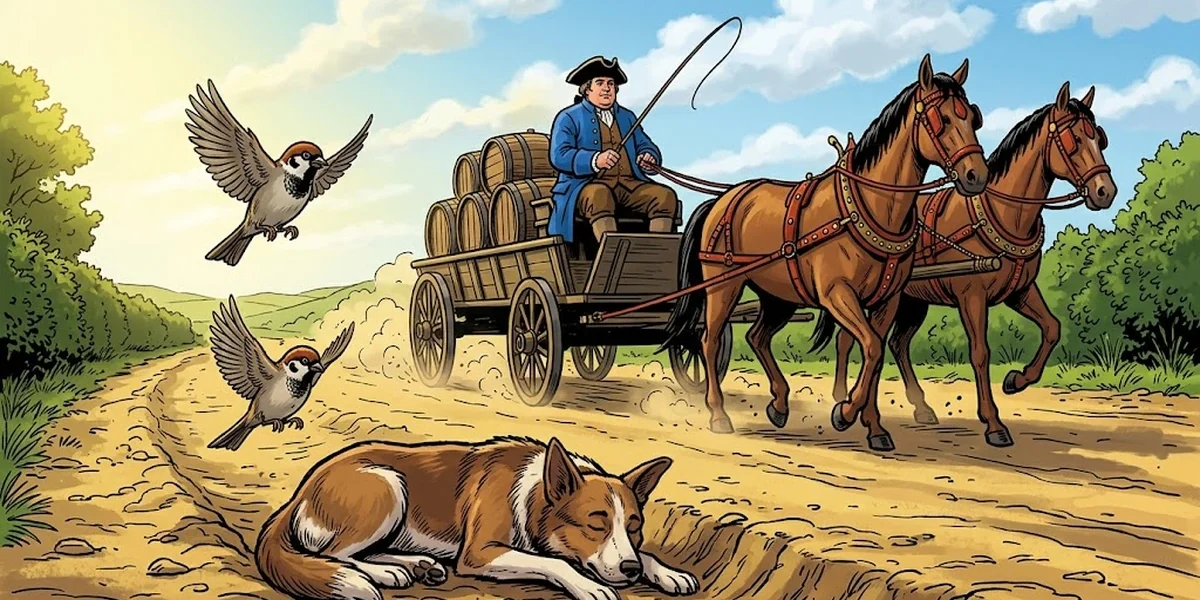
The pivotal scene of the tale begins with one of the smallest and most domestic moments in the entire Grimm corpus. The dog, full at last after his long hunger, says to the sparrow that he is very tired and would like to take a nap. “Sehr gern,” the sparrow answers, “thue es nur, ich will indessen auf einen Zweig sitzen.” “Very gladly — do so, and in the meantime I will sit on a branch.” The dog stretches himself out across the wheel-rut of the high road, in the precise unwise place where a Hessian dog of the period might well have lain down in the open shadow of a hedge, and falls asleep at once. The sparrow takes up her post on the branch of a wayside tree above him, watching the road. The arrangement is itself a small unmistakable political image: the sparrow as sentinel, the dog as sleeping comrade, and the dusty Hessian high road as the territory across which their small mutual-aid contract is now being tested. The Hessian post-roads of the early nineteenth century were unmetalled and deeply rutted by the heavy timber- and wine-wagons that travelled between Cassel, Marburg, and Frankfurt, and the dog’s lying-down in the rut places him exactly in the path of any such vehicle. The audience of 1812 would have recognised the danger at once.
Within minutes a wagoner comes along the road. The Grimms render the scene with a wonderful small precision: he drives a cart drawn by three horses, and the cart is loaded with three casks of wine. The wagoner is a Hessian carter of the rough country type that Wilhelm Grimm later memorialised in his collection of Deutsche Sagen (Berlin, 1816–1818): broad-shouldered, dust-streaked, irritable, with a long whip in his hand and a flat cap pulled down against the sun. The sparrow sees him coming, flies down to the wagoner’s shoulder, and warns him in plain unmistakable speech: “Wagner, thu’s nicht, oder ich mache dich arm.” “Wagoner, do not do it, or I will make you poor.” The warning is a perfect small piece of Hessian peasant prose, and the language — arm machen, “to make poor” — carries the precise contractual register that the rest of the tale will work out. The wagoner, however, growls back at the bird that she is no concern of his and that he will drive over what he pleases; he cracks his whip, and the cart-wheel rolls over the sleeping dog and kills him on the spot. Motif Q211.6, the “death of innocent animal avenged,” is the trigger of the entire second half of the tale. The sparrow’s response, in the Grimms’ rendering, is one of the most quietly terrible small lines in the whole collection: she perches on the dog’s body, looks down at it, and says, “Du hast meinen Bruder Hund todtgefahren; das soll dich Wagen und Pferd kosten.” “You have driven over my brother dog and killed him; that shall cost you wagon and horse.”
III. The Vengeance of the Sparrow: Casks, Bridles, and Eyes
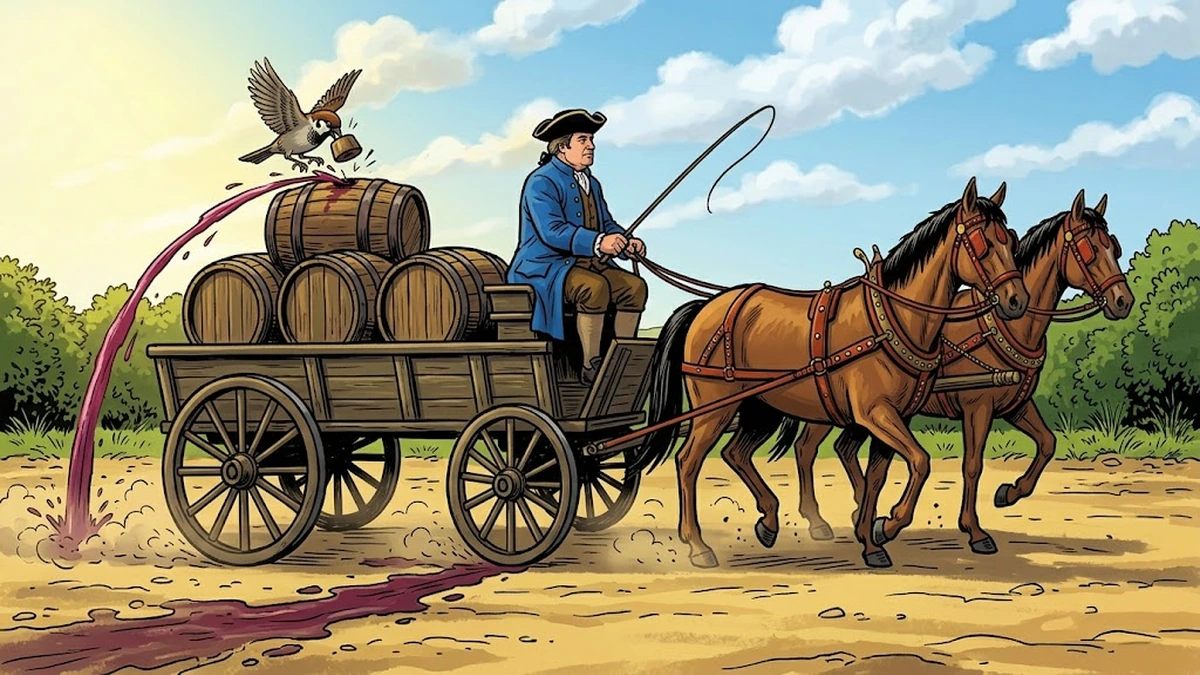
The sparrow’s vengeance follows in a sequence of escalating stages that is one of the most beautifully constructed in the entire Grimm corpus, and that the Hessian informants of the Hassenpflug circle had clearly polished by retelling over many years. The bird flies up onto the cart, perches on the bung of the foremost wine-cask, and pecks at it until the bung-stopper falls out and the wine begins to run away into the dust of the road. The wagoner does not at first notice; the cart rolls on for a while; the sparrow pecks at the second cask, and at the third, until all three are running freely. Only when the wagoner happens to look back over his shoulder does he see the dark trail of wine-stained dust behind him, and reaches at once for a cudgel; but by the time he has stopped the cart and discovered that all his wine has run out, the sparrow has flown ahead. Motif K2351, the “wine-cask emptied by small bird,” is one of the smaller folkloric jokes of the European peasant tradition, and the Grimms’ rendering is unmatched for its precision: each cask is named, each bung is described, and the wagoner’s slow late discovery of the loss is given the small dry comic timing that the Hessian audience of 1812 would have recognised at once.
The sparrow now flies to the head of the foremost horse, perches between its ears, and pecks out its eyes. The wagoner, in fury, throws his axe at the bird; the axe misses the bird, who has flown clear, and strikes the horse on the head, killing it. The sparrow then flies to the second horse, perches between its ears, and the same scene is enacted: the wagoner’s axe-throw misses the bird, but kills the horse. And then the third. The repetition is the small canonical Hessian three-fold, the same narrative grammar that organises Aschenputtel, Brüderchen und Schwesterchen, and the dozen other three-fold Grimm tales: each repetition is a small fresh injury to the wagoner’s purse and his pride, and each is the wagoner’s own doing — for the sparrow, in the canonical formula of the tale, neither pulls a horse from its harness nor drives an axe into its skull, but simply perches in the place where the wagoner’s rage will direct his own axe. Motif Q581, the “villain perishes by his own contrivance,” is the precise folkloric description of the device, and it appears in the Aesopic The Lion and the Mosquito, in the medieval Reineke Fuchs sequence of the bear and the honey-tree, in the Pancatantra tale of the sparrow and the elephant, and in the Russian Vorobei i muzhik (“The Sparrow and the Peasant”). What is distinctive in the Grimm version is the perfect cleanness of the three-fold escalation: the wagoner has lost his wine, then his first horse, then his second, then his third; he stands at last in the dust of the high road with no cart to draw, no horses to draw it, no wine to sell, and a small angry sparrow circling his head.
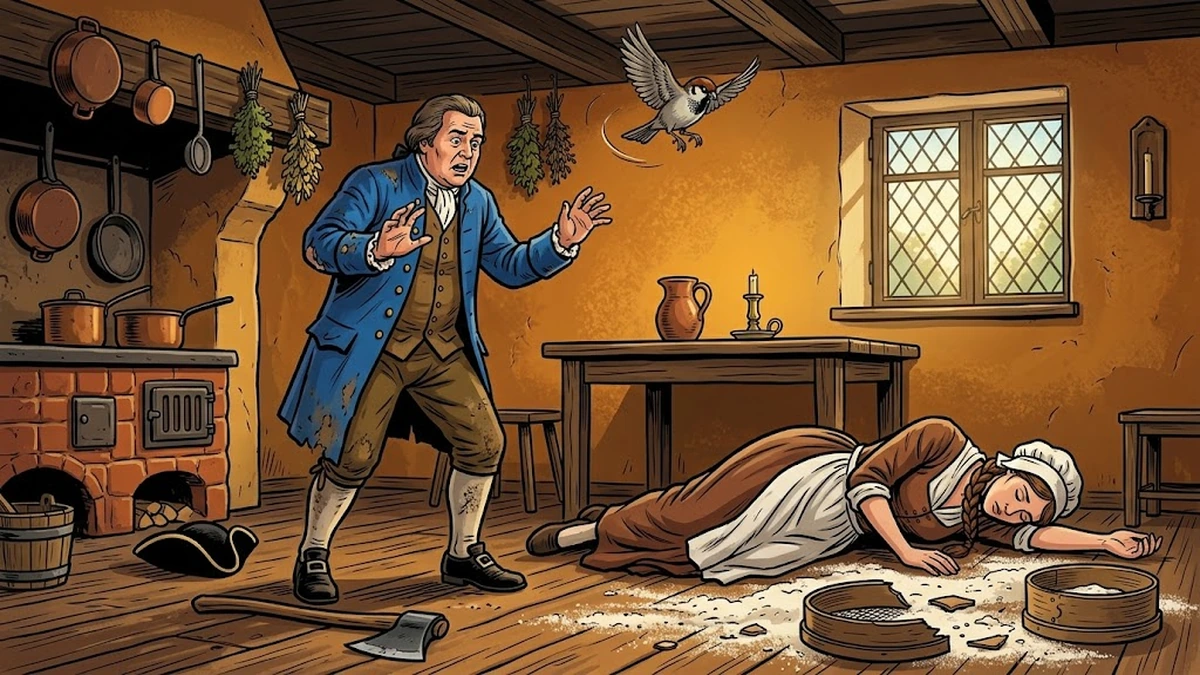
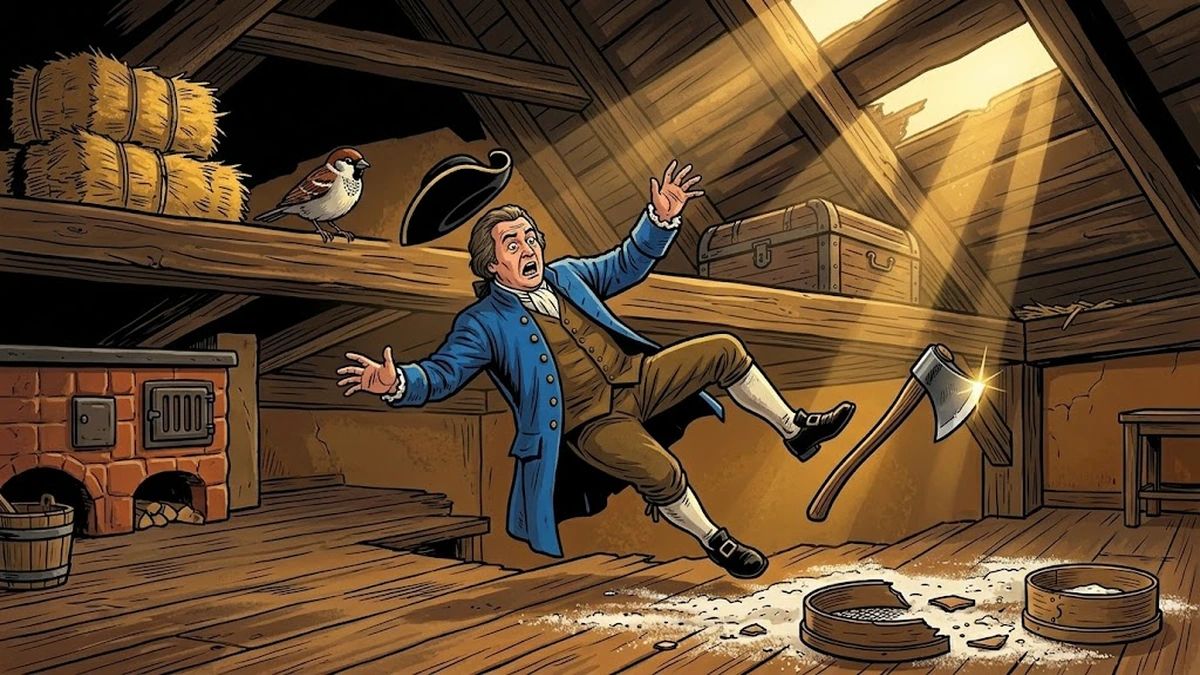
The wagoner walks home in despair. The sparrow follows. He arrives at his own house in the late afternoon, sits down at his kitchen table, lays his head on his arms, and tells his wife, in a small flat sentence that the Grimms’ informants delivered with the precise dry comic timing of Hessian peasant oratory, “Ach, was für ein Unglück ist mir heute begegnet!” “Oh, what a misfortune has met me today!” The misfortune, of course, is one he has authored himself. His wife, who is sieving meal at the table, asks him what has happened; he tells her of the dog and the sparrow, of the wine running into the road and the three horses dead; and as he is finishing his account, the sparrow flies in at the open kitchen window and perches on the rim of the meal-sieve. The wagoner reaches for an axe again. The sparrow flies up onto his wife’s head. The axe-throw misses the bird, who has flown clear, and strikes the wife on the temple, killing her on the spot. The wagoner stands frozen in the kitchen, the axe in his hand, his wife dead at his feet, the meal scattered across the floor, and the small black sparrow circling slowly in the rafters above him. Motif K891.5.4, “rage-driven self-destruction by axe-throw,” is the technical folklorist’s name for what has just happened; the Hessian peasant audience of 1812 would have called it the small inevitable closing of the wagoner’s case.
IV. The Last Pursuit and the Fall of the House
The wagoner has now lost his cart, his three horses, his three casks of wine, and his wife, and the sparrow remains untouched. He sits down at his empty table; he mourns; he weeps; and he resolves, in a fit of small final rage, that he will not rest until he has killed the bird. The sparrow flies to the kitchen-cupboard, perches on the dishes, and the wagoner throws a plate at her; the plate breaks. She flies to the bread-rack; he throws a bowl at her; the bowl breaks. She flies to the meal-bin; he throws the meal-sieve at her; the sieve breaks. She flies to the wine-rack; he throws a flagon at her; the flagon breaks. The sequence, in the canonical Grimm rendering, runs through every breakable object in the wagoner’s kitchen and pantry; by the time the sparrow takes refuge in the loft above the rafters, the entire ground floor of the wagoner’s house is a wreck of shattered crockery, broken furniture, and scattered meal. The Grimms’ informants seem to have polished this last sequence by long retelling: each breakage is named, each room is gone through, and each step is the wagoner’s own doing. Motif J2102, the “futile rage,” appears here in its purest folkloric form — the rageful man who, in attempting to destroy a small enemy who is beyond his reach, destroys instead everything he himself owns. Motif N255, “the curse fulfilled in stages,” runs as a steady undercurrent beneath the comic surface: the sparrow had said, on the high road in the moment after the dog’s death, that her brother’s death would cost the wagoner his wagon and horses; the cost has now extended through the wine, the wife, and every object in the house, and the sparrow has not yet finished.
The wagoner, at last, takes up his last and largest axe, and runs the sparrow into the loft. She perches on a beam; he throws the axe; the axe misses the bird, who has flown clear, and lodges itself in a beam directly above the wagoner’s head. He climbs up to retrieve it. As he reaches for it, the sparrow flies down at his head; he flinches; he loses his footing; he falls from the loft, the axe falls with him, and at the moment when his head strikes the kitchen floor the heavy axe-blade falls upon his neck. He dies in the wreck of his own kitchen, the sparrow circling above him, the meal still scattered on the floor and his wife’s body lying where it had fallen earlier in the afternoon. The Grimms’ closing sentence is one of the plainest in the entire collection, and it carries the small bitter dignity of the Hessian peasant storytelling tradition: “So fiel der Wagner durch eigene Schuld zu Boden, und der Sperling flog in den Wald zurück.” “So the wagoner fell to the ground through his own fault, and the sparrow flew back to the wood.” No moral is appended; no grief is recorded; the bird simply flies away into the trees, and the camera, as it were, lingers on the broken kitchen and the dead carter for one last small moment before the tale closes.
V. The Quiet Closing and the Sparrow’s Departure
The closing of Der Hund und der Sperling is one of the most economical and morally unsentimental in the entire Grimm corpus. There is no return of the dog to life, no reconciliation, no funeral for either dog or wagoner, no village reckoning, no court trial, no judicial punishment. The sparrow has avenged her brother by what is technically a sequence of perfectly legal small acts — she has perched, and the wagoner has thrown — and the consequences have followed by the wagoner’s own hand in each case. The Grimms’ phrase “durch eigene Schuld”, “through his own fault,” is a small precise legal-moral formula in Hessian peasant German, and it is the formula in which the tale’s closing judgement is rendered. The sparrow, having delivered the curse stage by stage, simply flies back to the wood from which she came. There is no triumph, no song, no proverbial closing rhyme; the bird returns to her place in the natural order, and the wagoner’s house is left behind her in the small dry wreckage of his own three-fold rage.
The Hassenpflug informants seem to have understood that the tale’s power lies precisely in this small unflinching closing, and the Grimms in revising the text for the 1819 and later editions were careful to preserve it intact. Heinz Rölleke, in his commentary in the standard Reclam edition, notes that the 1857 final edition’s only change to the closing was a slight tightening of the wagoner’s last sentence in the loft, with no change at all to the sparrow’s flight back to the wood. The tale is, in this respect, one of the most archaic of the animal-vengeance Grimms: it preserves the older folkloric grammar of the small bird who avenges a murdered companion in three escalating stages, with no moral commentary, and it leaves the audience to draw whatever lesson they choose. The Hessian peasant audience of 1812, whose own small mutual-aid contracts had been tested by the Napoleonic occupation and the long winters of post-war scarcity, would have drawn the lesson at once: a wagoner who runs over a sleeping dog has crossed a small but unforgiving line, and a small bird with patience and a steady aim is enough to bring down a great house.
The Moral: Cruelty to the Helpless and the Small Bird’s Patience
The Grimms, in their canonical practice, refused to print an explicit moral after the body of the tale. But the closing fits the older Hessian peasant couplet that Heinrich Pröhle recorded in his Kinder- und Volksmärchen (Leipzig: G. A. Avenarius, 1853) as the proverbial summary of every Hund-und-Sperling retelling told over Hessian fireplaces by old shepherds and travelling carters:
“Wer einem schlafenden Hund das Rad überfährt,
Hat sich am Ende selber das Haus zerstört.”“Whoever drives the wheel over a sleeping dog, / In the end has destroyed his own house.”
— Hessian closing couplet to Der Hund und der Sperling, recorded in H. Pröhle, Kinder- und Volksmärchen (Leipzig, 1853), no. 27.
The proverb, like all good Hessian peasant couplets, is precise about the kind of cruelty it is condemning. It is not the great cruelty of war or famine or judicial murder, the cruelty that fills the chronicles of the Napoleonic occupation and the trial-records of the early-modern witch-hunts; it is the small everyday cruelty of a working man who, in his impatience to reach his destination, drives his wheel over a sleeping animal that has done him no harm. The dog has not bitten the wagoner’s horses, has not eaten his wine, has not stood in his way; he is simply asleep in the dust of the road, and the wagoner’s decision to drive over him rather than around him is the small unprovoked unkindness on which the tale’s entire moral mechanism turns. The moral of Der Hund und der Sperling, in its purest form, is that small unprovoked cruelties to the helpless are paid out, in the long fullness of time, in larger and more painful currencies than the cruel man can imagine — and that the bird who watches from the branch is, as often as not, the one who keeps the books.
The tale’s second moral, beneath the first, is the small bright lesson of mutual-aid friendship: the dog and the sparrow are an unlikely pair, the sparrow gains nothing materially from her befriending of the hungry dog, and the dog has nothing to offer the sparrow except his companionship on the road. Yet when one of them is in trouble the other helps without question, and when one of them is killed the other avenges him without hesitation. The small egalitarian dignity of their friendship is one of the quietly radical small notes in the Grimm collection, and it has caught the imagination of every later Hessian socialist and Christian-democratic editor of the Kinder- und Hausmärchen from Walter Benjamin in the 1930s to Hans Mayer in his post-war Leipzig commentary. The dog and the sparrow, in a small bright Hessian formulation, are friends because each has helped the other when help was needed; and the wagoner’s fate is in part the punishment for his having broken the larger informal contract of mutual aid that holds village life together at all.
Why It Lasted: The Vengeance of the Small Bird from Vishnu Sharman to the Hassenpflugs
The placement of Der Hund und der Sperling under ATU 248 “The Dog and the Sparrow” puts it at the centre of one of the older animal-vengeance tale-families in the comparative index. Hans-Jörg Uther’s revised Types of International Folktales lists more than ninety attested variants of the tale-type from across Europe, the Mediterranean, the Caucasus, and South Asia. The earliest cognate is in the Indian Pancatantra of Vishnu Sharman, datable in its Sanskrit form to roughly the third or fourth century of the common era and known to modern editors through the Pahlavi translation of Burzoy (c. 570 CE), the Arabic Kalila wa Dimna of Ibn al-Muqaffa (c. 750 CE), and the Hebrew, Latin, and Old French translations of the high Middle Ages. The relevant Pancatantra tale is in book one (Mitra-Bheda, “The Loss of Friends”), and concerns a tittibha-bird whose mate is killed by the careless tread of a great elephant: the bird raises an alliance of frog, fly, and woodpecker, and together they bring the elephant down by stinging him into a fall. The structural identity with the Grimm version is complete: a small bird, a careless great traveller, the death of an innocent companion, the bird’s vow of vengeance, the small enemy’s use of the great enemy’s own movements against him, and the great enemy’s eventual fall. Franklin Edgerton, in his standard 1924 reconstruction of the Pancatantra (The Panchatantra Reconstructed, New Haven: American Oriental Society), regarded the type as “perhaps the oldest of the Pancatantra animal-vengeance plots,” and the modern comparative folklorists who have worked on ATU 248 since — Theodor Benfey, Stith Thompson, Heda Jason, Hans-Jörg Uther — have all accepted the Pancatantra version as the deep Indo-European source from which the European cognates ultimately descend.
The Aesopic cognate is the fable usually translated The Lion and the Mosquito (Perry index 255), in which a small mosquito stings a great lion to death and is then caught in a spider’s web; the moral, in the Augustana redaction, is that the small enemy can bring down the great. Phaedrus, in his Latin redaction of the late first century, gives the fable as Culex et Leo (book IV, fable 25); Babrius, in his Greek choliambic redaction of the late second century, gives it as fable 84; the medieval Aesopus of Steinhöwel (Ulm, 1476) preserves it in its Latin and German parallel; and La Fontaine, in his Fables (Paris, 1668), gives it as Le Lion et le Moucheron at book II, fable 9. The Roman de Renart cycle of the twelfth and thirteenth centuries contains a related cock-and-carter sequence in branch eight, in which Chantecler the cock is run down by a wagoner and avenged by the fox. The Russian cognate is Vorobei i muzhik, “The Sparrow and the Peasant,” recorded by Aleksandr Afanasyev in his Russkie narodnye skazki (Moscow, 1855–1863), in which a sparrow whose nest is destroyed by a careless peasant exacts revenge in three escalating stages that follow the Grimm sequence almost exactly. The African Akan cognate is the Fante tale of the bird and the hunter recorded by R. S. Rattray in Akan-Ashanti Folk-Tales (Oxford: Clarendon, 1930), no. 47, in which a small bird whose mate is shot avenges him by stinging the hunter’s donkey. The Chinese cognate is in book four of the Soushen ji of Gan Bao (4th century CE), in which a sparrow whose nest is robbed avenges herself on the robber by leading him into a tiger’s territory.
What makes the Grimm version distinctive within this great family is the precise Hessian agrarian setting and the central role of the wine-cart. Where the Pancatantra version is set in the forests of Ujjain and uses an elephant, where the Aesopic version is set in the savannas of the eastern Mediterranean and uses a lion, where the Russian and African versions use peasants and hunters respectively, the Grimm version is unmistakably set on the dusty post-roads of the Hessian uplands and uses a wagoner with three casks of wine. The wine-cart is the small precise economic detail that places the tale in its Hessian post-Napoleonic setting: the wine-trade between the Rhineland and the Hessian inland was, in the early nineteenth century, one of the few small surviving sources of liquid cash for the rural carting trade, and the loss of three casks of wine on the high road would have been, for a Hessian wagoner of 1812, a small catastrophic financial blow. The Grimms’ informants — the Hassenpflug family of Cassel — would have known wagoners of exactly this kind from the streets of their own provincial capital, and their telling of the tale carries the small unmistakable economic precision of urban Hessian observers of the rural carting trade.
Iconography: The Sparrow on the Cart, the Axe in the Beam, the Empty Kitchen
“The Dog and the Sparrow” entered Anglophone visual tradition through the engravings of George Cruikshank for Edgar Taylor’s German Popular Stories (London: C. Baldwyn, 1823), in which the wagoner is shown at the moment of the axe-throw with the sparrow rising clear of the horse’s head and the cart visible behind him on the high road. The German visual reference is Otto Ubbelohde’s 1907–1909 ink illustrations for the Turm-Verlag edition of the Kinder- und Hausmärchen, in which the dog is rendered as a Hessian shepherd’s mongrel of the heavy-chested type and the sparrow as a small ordinary house-sparrow rather than the more decorative finches preferred by some later illustrators. Walter Crane’s 1882 wood-engravings for the English Household Stories (London: Macmillan), translated by his sister Lucy Crane, give a particularly fine image of the sparrow perched on the foremost wine-cask while the wagoner walks ahead of his horses unaware. Arthur Rackham’s 1909 watercolours for the English Fairy Tales of the Brothers Grimm (London: Constable) include a quietly devastating image of the wagoner’s wrecked kitchen with the meal-sieve broken on the floor and the sparrow circling above the rafters. Wanda Gág’s sturdy 1936 woodcuts for Tales from Grimm (New York: Coward-McCann) gave the dog and the sparrow a small Mid-Western dignity that suits the tale’s plain register. Hans Fischer’s 1953 lithographs for the Swiss-German Märli von den Brüdern Grimm (Zurich: Atlantis-Verlag) are perhaps the finest twentieth-century treatment, with the Hessian high-road, the wine-cart, and the broken kitchen all rendered in the precise dry small realism of the Bernese illustration tradition. Modern adaptations include the 1989 East-German DEFA animated short Der Hund und der Sperling, directed by Klaus Georgi, which gave the tale a quietly mordant GDR reading; the 2005 illustrated edition by Lisbeth Zwerger (Vienna: Neugebauer Verlag), whose pale watercolours rendered the wagoner’s kitchen as a quietly fading Old-European interior; and the 2014 Swiss children’s book Der Hund und der Spatz by Jürg Schubiger.
Reading with Children
For parents, teachers, and storytellers reading Der Hund und der Sperling aloud, four details from the Grimms’ text repay slowing down for. First, the dog’s decision to leave. The opening sentence — that the master took no care of him and often let him suffer the greatest hunger — is one of the bluntest small lessons in the unfairness of the adult world that the Grimm collection has to offer. Pause after the dog takes to his heels, and let listeners feel the small justice of his decision. Older children often have strong responses to this scene, recognising in the master’s neglect the small adult callousnesses they have already begun to notice in the world. Second, the sparrow’s offer of help. The bird’s plain unornamented “If that is all, come with me into the next town,” is one of the loveliest small models of unconditional friendship in the entire Grimm collection: the sparrow does not ask the dog for anything in return, does not test his virtue, does not wait for him to deserve her aid. Pause on the offer, and let listeners feel its small egalitarian dignity. Third, the warning to the wagoner. The sparrow’s plain spoken warning — “Wagoner, do not do it, or I will make you poor” — is one of the clearest small examples in the Grimm corpus of how a spoken warning, given freely and disregarded freely, becomes the moral pivot of the whole subsequent action. The wagoner is not punished for an unconscious offence; he is punished for the conscious choice to drive over the dog after the sparrow has told him plainly not to. Pause on the warning, and let older listeners notice the small grammar of moral responsibility that is being established. Fourth, the sparrow’s flight back to the wood. The closing line — that the wagoner fell to the ground through his own fault, and the sparrow flew back to the wood — is one of the quietest and most adult small endings in the entire Grimm collection. There is no song, no triumph, no celebration; the bird simply returns to her place in the natural order, and the camera lingers for a moment on the broken kitchen before fading. Der Hund und der Sperling is among the more violent of the animal-vengeance Grimm tales, with the deaths of three horses, a wife, and the wagoner himself in its sequence, and parents reading aloud to younger children may wish to soften the wife’s death (Hunt’s 1884 translation describes it directly; Edgar Taylor’s 1823 paraphrase omitted it altogether) or to render the wagoner’s end as the simple closing of his own bad day. Suitable for read-aloud from age six upwards in the full version, or from age four in the softened version with the wife’s death and the wagoner’s fall both rendered as the wagoner’s “losing all his fortune through his own bad temper.”
A Note on Sources
The text on this page follows KHM 58, “Der Hund und der Sperling,” in Jacob and Wilhelm Grimm, Kinder- und Hausmärchen, 1st edition, volume I (Berlin: Realschulbuchhandlung, 1812), no. 58, with reference to the canonical 7th edition (Göttingen: Dieterich, 1857), which made small stylistic revisions to the wagoner’s speeches and slightly tightened the closing kitchen scene. The English wording is closely adapted from Margaret Hunt’s standard 1884 translation, Grimm’s Household Tales (London: George Bell & Sons), volume I, pages 246–249, with reference to Lucy Crane’s 1882 Household Stories for the warning-to-the-wagoner dialogue and to Edgar Taylor’s earlier 1823 German Popular Stories, volume I, in which a paraphrase of the tale first appeared in English. The provenance of the tale is documented in Wilhelm Grimm’s Anmerkungen zu den Kinder- und Hausmärchen, 3rd edition (Göttingen: Dieterich, 1856), volume II, where the brothers credit the Hassenpflug family of Cassel — particularly Marie, Jeanette, and Amalie Hassenpflug — as the principal informants. For the role of the Hassenpflug circle in the Grimm collection the indispensable modern reference is Heinz Rölleke, Die Märchen der Brüder Grimm: Eine Einführung (Stuttgart: Reclam, 1985), chapter 4, and Donald Haase (ed.), The Greenwood Encyclopedia of Folktales and Fairy Tales (Westport, Conn., 2008), entry on the Hassenpflug family. For the comparative folklore the standard reference remains Hans-Jörg Uther’s The Types of International Folktales (FFC 284–286, Helsinki, 2004), entry on ATU 248; for the motif inventory, Stith Thompson, Motif-Index of Folk-Literature, revised edition (Indiana University Press, 1955–58), motifs B211.1.7, B435.4, B524.1.2, Q211.6, Q581, K891.5.4, L315.1, J2102, N255, K366.1, K2351. For the Pancatantra cognate the now-standard reference is Franklin Edgerton, The Panchatantra Reconstructed (New Haven: American Oriental Society, 1924), book one, with the comparative apparatus of Theodor Benfey, Pantschatantra: Fünf Bücher indischer Fabeln, Märchen und Erzählungen (Leipzig: Brockhaus, 1859), still indispensable for the Indo-European pre-history of the type. For the Aesopic cognate, Ben Edwin Perry, Aesopica, vol. I (Urbana: University of Illinois Press, 1952), Perry index 255 (The Lion and the Mosquito); for the medieval Latin and German tradition, Heinrich Steinhöwel, Aesopus (Ulm: Johann Zainer, 1476–1477), reprinted in the modern critical edition of Hermann Österley (Stuttgart, 1873). The Pröhle dialect couplet is preserved in Heinrich Pröhle, Kinder- und Volksmärchen (Leipzig: G. A. Avenarius, 1853), no. 27. All cited editions are in the public domain and freely available through the Internet Archive and the German Deutsches Textarchiv.
Read time: about 10 minutes. Suitable for ages 6 and up; suitable for read-aloud from age 4 in the softened version with the wife’s death and the wagoner’s fall both rendered as the wagoner’s “losing all his fortune through his own bad temper.”
You May Also Like
 Grimm's Fairy Tales
Ages 9-12
Grimm's Fairy Tales
Ages 9-12
The Frog King (Iron Heinrich)
The Frog King (Iron Heinrich): In the days when wishes still came true and a frog could speak the language of men, there was a King with a daughter of terrible
 Grimm's Fairy Tales
Ages 9-12
Grimm's Fairy Tales
Ages 9-12
Clever Hans
Clever Hans: The mother of Hans said: ‘Whither away, Hans?’ Hans answered: ‘To Gretel.’ ‘Behave well, Hans.’ ‘Oh, I’ll behave well. Goodbye, mother.’ ‘Goodbye
 Grimm's Fairy Tales
Ages 9-12
Grimm's Fairy Tales
Ages 9-12
First Story
First Story: The Beginning of All Tales. Why do we tell stories? Discover how stories came to be and why they matter to human hearts throughout history.