Frederick And Catherine
Frederick And Catherine: There was once a man called Frederick: he had a wife whose name was Catherine, and they had not long been married. One day Frederick
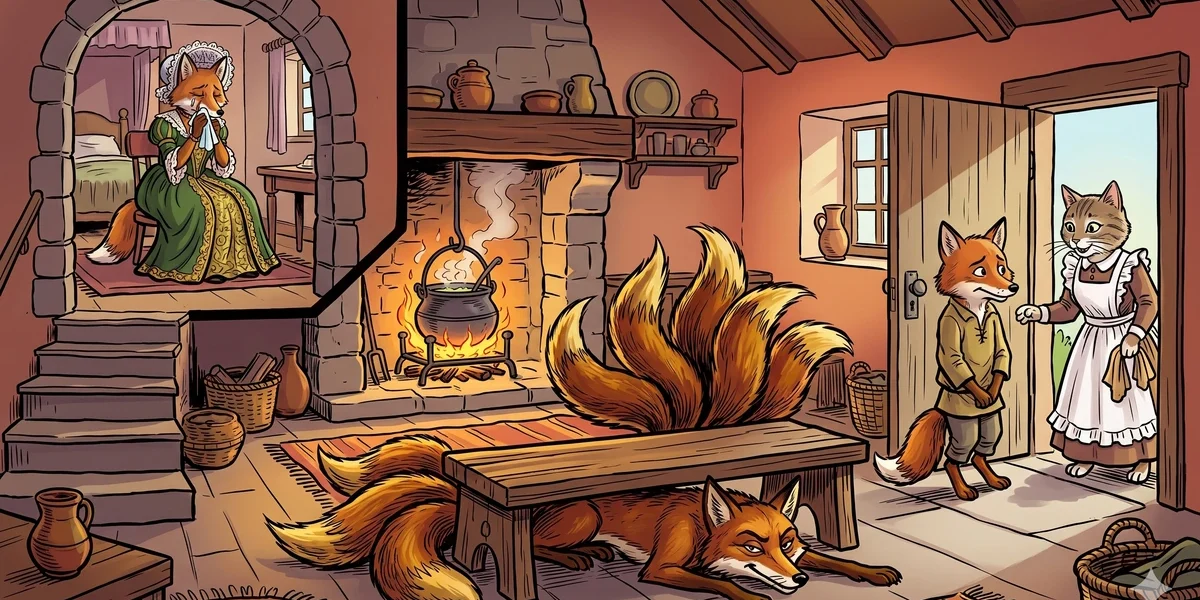
In the Grimm treasury, Frederick and Catherine presents the eternal comedy of conjugal mismatching — the earnest husband whose practical instructions collide catastrophically with his wife’s literal, creative, and ultimately ruinous interpretations. Beneath the slapstick lies a profound inquiry into dampati dharma, the mutual covenant of householder partnership, and the Sanskrit philosophical concept of anyathā-khyāti — erroneous cognition that mistakes one thing for another — as the very engine of domestic life’s comic tragedy.
The Tradition: Dampati Comedy and the Fool’s Wisdom
The “foolish wife” or “foolish spouse” tale is among the most ancient in world folklore, appearing in Sanskrit collections such as the Vetālapañcaviṃśati and the Kathāsaritsāgara, where household misadventures illuminate deeper truths about the gap between instruction and comprehension. The Grimm version, collected from Hessian oral tradition, belongs to a pan-Eurasian genre that Indian narratology classes under hāsya rasa — the aesthetic mood of laughter — but never as mere mockery. The fool in these traditions is rarely malicious; Catherine’s disasters spring from literal-minded earnestness, which Sanskrit poetics calls sābhiprāya-vacanasyāpahastana — the unintentional subversion of intended meaning through over-faithful execution.
In Indian village storytelling, the mūrkha-patnī (foolish wife) cycle served a specific social function: it created communal laughter that released the tensions of gṛhastha āśrama (householder life) without threatening its foundational dignity. The couple survives; the household endures. Humor is the oṣadhi — the medicine — that sustains the institution.
Plot and Philosophical Analysis: Anyathā-Khyāti and the Grammar of Instruction
Frederick, departing for work, leaves Catherine a cascade of instructions: tend the animals, prepare food, mind the house. Catherine executes each directive with perfect sincerity and catastrophic creativity. The Nyāya school of Indian philosophy distinguishes between pramā (valid cognition) and apramā (invalid cognition), further subdividing the latter into smṛti (memory), saṃśaya (doubt), viparyaya (contrary cognition), and anyathā-khyāti (erroneous substitution). Catherine’s errors are precisely of this last type: she cognizes the instruction correctly at the lexical level but maps it onto the wrong referent in execution.
When Frederick says “pour the cask” she pours the wine; when he says “mind the house” she interprets it through her own pragmatic schema. The Mīmāṃsā school would observe that vākya-artha (sentence meaning) requires not only ākāṅkṣā (syntactic expectation), yogyatā (semantic fitness), and āsatti (proximity), but also tātparya — the speaker’s actual intention. Without tātparya, even grammatically perfect instruction fails. Frederick, as instructor, bears half the epistemic burden: his commands, however clear to him, were under-specified for Catherine’s interpretive frame.
The Buddhist Jātaka parallels are instructive: in several tales, a devoted but literal-minded servant destroys what he was sent to protect, and the moral always distributes responsibility — the one who gives unclear orders shares in the ensuing chaos. The Pañcatantra‘s framing device itself — teaching princes through story — rests on the axiom that instruction must be calibrated to the receiver’s adhikāra (intellectual capacity and readiness).
Scholarly Synthesis: Vivāha as Complementary Incompleteness
Indian marriage philosophy, particularly in the Gṛhyasūtras, frames vivāha (marriage) not as the union of two complete beings but as the creation of a composite whole greater than its parts: the couple together forms ardhanārīśvara-like completeness. Frederick and Catherine are each incomplete; their comedy arises precisely from this incompleteness operating independently rather than in genuine partnership. The Taittirīya Upaniṣad‘s dictum “satyaṃ vada, dharmaṃ cara” — speak truth, walk righteously — implies that communication within dharmic relationship requires not just honesty but comprehensibility. Frederick’s instructions, however honest, lack the transparency that makes communication an act of genuine care.
The Arthaśāstra devotes considerable attention to household management, noting that the gṛhapati (householder) must ensure that those under his direction have both the knowledge and the context to execute tasks correctly — failure of outcome is as much a managerial failure as an executory one. Kauṭilya’s pragmatism thus anticipates modern organizational theory: systems fail not only because individuals err but because instruction-giving is itself a skill that must be practiced and refined.
“Where two minds meet in sincere effort yet miss each other’s meaning, the comedy that follows is the universe’s gentle reminder that communication is itself an art requiring as much craft as the work it commands.”
Why This Story Lasted
Frederick and Catherine endures because it makes laughter the mirror of a universal experience: the sincere attempt to help that somehow makes everything worse. Every household has known its Catherine — not from malice but from the unbridgeable gap between one person’s mental map of a task and another’s. The story survives because it refuses to assign pure blame; both characters are sympathetically limited, and their love, however chaotic, is never in doubt. In doing so it performs the oldest function of comedy: reconciliation. We laugh at the disaster, then return to our own homes slightly more patient, slightly more willing to over-explain, slightly more aware that domesticity is an ongoing negotiation rather than a series of completed instructions.
Frequently Asked Questions
What is the central theme of Frederick and Catherine?
The central theme is the comedy of miscommunication in marriage — specifically, the gap between a speaker’s intended meaning and a listener’s sincere but erroneous interpretation, which Indian philosophy calls anyathā-khyāti (erroneous cognition). The story explores how good intentions without shared context produce comic chaos.
Is Catherine meant to be mocked in this Grimm tale?
No — the tale belongs to the hāsya rasa tradition of compassionate comedy. Catherine’s errors spring from sincere effort and literal-minded earnestness, not stupidity or malice. The Grimm framework, like its Indian parallels in the Pañcatantra, uses such characters to invite laughter without condemnation.
How does Indian philosophy interpret Frederick’s role in the disasters?
Mīmāṃsā philosophy holds that valid verbal communication requires the speaker to convey tātparya — true intention — not merely grammatical instructions. The Arthaśāstra adds that a household manager must calibrate instructions to the receiver’s capacity. Frederick’s failure to communicate with sufficient context makes him co-responsible for Catherine’s misadventures.
What Indian story parallels exist for foolish spouse tales?
The Vetālapañcaviṃśati and Kathāsaritsāgara both contain domestic misadventure tales where literal interpretation of instructions causes household chaos. The Pañcatantra similarly uses foolish-servant stories to teach that instruction must be matched to the listener’s adhikāra (cognitive readiness).
What makes Frederick and Catherine a timeless folk tale?
Its universality lies in the shared human experience of sincere miscommunication. Every culture has known the comedy of instructions faithfully executed in entirely the wrong way. The tale endures because it transforms domestic frustration into laughter and reminds audiences that genuine partnership requires not just goodwill but the ongoing craft of mutual comprehension.
You May Also Like
 Grimm's Fairy Tales
Ages 9-12
Grimm's Fairy Tales
Ages 9-12
The Fisherman and His Wife: A Brothers Grimm Tale
The Fisherman and His Wife: A Brothers Grimm Tale: In a small cottage on the edge of a vast sea lived a fisherman named Heinrich and his wife Margaretta. The
 Grimm's Fairy Tales
Ages 9-12
Grimm's Fairy Tales
Ages 9-12
Snow White and the Seven Dwarfs
Snow White and the Seven Dwarfs: In a kingdom where mountains touched the clouds and forests stretched endlessly, there lived a king and queen who ruled with
 Grimm's Fairy Tales
Ages 9-12
Grimm's Fairy Tales
Ages 9-12
Old Sultan
Old Sultan: A shepherd had a faithful dog, called Sultan, who was grown very old, and had lost all his teeth. And one day when the shepherd and his wife were