Lily And The Lion
Lily And The Lion: A merchant, who had three daughters, was once setting out upon a journey; but before he went he asked each daughter what gift he should
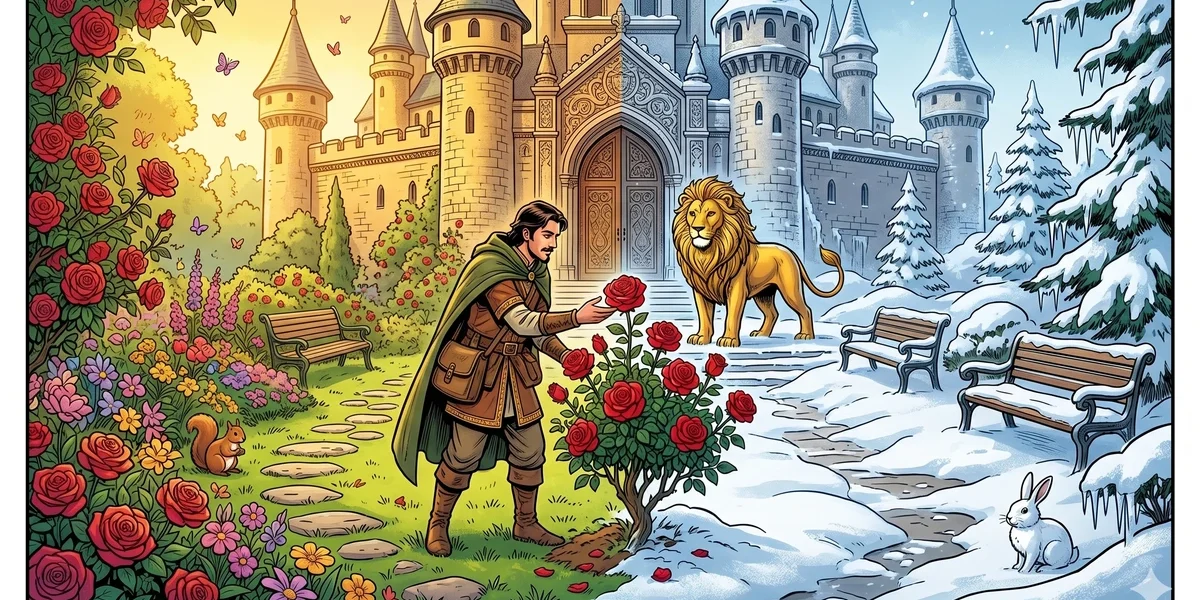
Lily and the Lion — the Grimm variant of the Beauty and the Beast tale type — explores the paradox at the heart of transformative love: that the beloved’s liberation requires the lover’s absolute faithfulness, and that the moment of transgression, however innocent, triggers a dissolution that only extraordinary devotion can reverse. Through Indian philosophical frameworks, the tale maps onto the shāpa-vimochana (curse-release) narrative structure pervasive in Sanskrit literature, the pativratā ethics of absolute conjugal loyalty, and the cosmological interplay between the deva and asura aspects of the transformed husband.
The Tradition: Shāpa-Vimochana and the Enchanted Beloved
The motif of an enchanted husband — powerful, partly monstrous, held under a spell that the wife’s perfect faithfulness alone can break — is among the most richly documented in Sanskrit literature. The Kathāsaritsāgara alone contains dozens of shāpa-vimochana (curse-release) narratives in which a god, gandharva, or king has been cursed to inhabit a diminished or monstrous form until a specific condition is met, typically the unerring devotion of a partner who loves the essence beneath the form. The Mahābhārata‘s Damayantī recognizes Nala despite his transformed appearance; Sāvitrī pursues her husband Satyavān even past death. These are pativratā archetypes: women whose love is so total that it functions as a cosmic corrective force.
The specifically Grimm version — a merchant’s daughter who chooses to live with a lion, the lion revealed as an enchanted prince who can assume human form only at night — compresses the shāpa-vimochana structure into domestic intimacy. The enchantment here is partial: the lion-prince has both forms available but cannot stabilize into his human self until the curse is fully broken. This partiality is philosophically significant: he is neither fully beast nor fully human, suspended in a liminal state that mirrors the antarābhava (intermediate state between death and rebirth) concept in Buddhist thought.
Plot and Philosophical Analysis: The Transgression, the Quest, and Prem-Śakti
The wife’s brothers, ignorant of her chosen life and convinced she is imprisoned, bring torches to illuminate the sleeping lion — breaking the darkness that protected his enchanted rest. The light kills him (or in some versions forces him away), and the wife must then undertake an extended, arduous quest across three mountains, wearing out three pairs of iron shoes, to find and restore him. The iron shoes are a striking motif: iron (ayaḥ in Sanskrit, associated with Saturn/Śani and endurance through obstruction) worn through to nothing represents the complete exhaustion of impatience and ego-urgency as preconditions for the grace of recovery.
The Bhakti tradition’s concept of viraha — the anguish of separation from the beloved as itself a spiritual discipline — is directly relevant. The Gīta Govinda‘s Rādhā in separation from Kṛṣṇa undergoes a viraha so intense that it functions as the highest form of devotion, more purifying than any form of union. Lily’s quest across three mountains, in iron shoes, is precisely viraha made into physical pilgrimage: her longing is not passive but active, not merely felt but enacted. She does not wait for the beloved to return; she travels toward him, through every obstacle, until no obstacle remains.
The three magic gifts she receives from three helper figures — a golden spinning wheel, a golden reel, and a golden hen — are devices through which she purchases access to the enchanted prince, who has by this point married another woman and forgotten his first life. The golden objects function as yantra: concentrated symbolic forms whose beauty attracts the consciousness of the bewitched prince back toward the reality he has forgotten. When he hears her lament and remembers, the secondary enchantment (forgetfulness, induced by the false bride) dissolves, and the original enchantment can finally be broken.
Scholarly Synthesis: Smṛti (Remembrance) as the Final Liberation
The Advaita Vedānta tradition holds that liberation (mokṣa) is not the acquisition of something new but the remembrance (smṛti) of what was always true. The jīva (individual soul) in saṃsāra has not lost its identity as Brahman but has forgotten it; the guru’s function is to trigger the remembrance that ends suffering. The enchanted prince’s situation is structurally identical: he has not lost his true nature (human, beloved, husband) but has been made to forget it. Lily’s three nights of lament, heard through his drugged sleep, function as the guru’s repeated teaching — each night pressing deeper until the remembrance finally breaks through.
The false bride who drugs the prince is avidyā (ignorance) in personified form: the force that maintains the forgetting by ensuring the prince never becomes fully conscious during Lily’s visits. Her ultimate defeat is precisely the defeat of avidyā — not by force but by the persistence of love speaking into the darkness until consciousness finally responds.
“Love that wears out iron shoes searching through three mountains for what it has lost demonstrates something that no philosophy can teach but every heart already knows: that the one who is truly loved is always worth the distance, always worth the iron, always worth arriving at the final mountain worn down to bare feet.”
Why This Story Lasted
Lily and the Lion endures because it speaks to the specific grief of loving someone who has become, through circumstances beyond anyone’s control, temporarily unreachable — changed by enchantment, illness, forgetting, distance, or the interference of others. The tale does not offer false reassurance that love automatically succeeds; it insists that the recovery of the beloved requires extraordinary, exhausting, persistent effort. But it also insists that such effort is possible, and that it is the highest expression of what love actually means when tested by reality.
Frequently Asked Questions
What is the meaning of Lily and the Lion in the Grimm tales?
The tale is a shāpa-vimochana (curse-release) narrative: an enchanted prince in lion form can only be restored through his wife’s absolute faithfulness. When innocent transgression breaks the conditions of his partial liberation, Lily must undertake a viraha quest — wearing out iron shoes across three mountains — to find and awaken him through the persistence of remembered love.
What do the iron shoes symbolize in Lily and the Lion?
Iron shoes worn through to nothing represent the complete exhaustion of ego-urgency and impatience as spiritual preconditions for recovery. Iron in Sanskrit tradition (ayaḥ) is associated with Saturn and endurance through obstruction. To wear out three pairs of iron shoes is to demonstrate a love so sustained and patient that no obstacle — however many mountains — can exhaust its persistence.
Are there Indian parallels to Lily and the Lion?
The Kathāsaritsāgara contains dozens of shāpa-vimochana tales where enchanted husbands are restored by wives’ total devotion. Damayantī’s recognition of Nala despite his changed form in the Mahābhārata and Sāvitrī’s pursuit of Satyavān past death are the paradigmatic pativratā parallels. The Gīta Govinda’s viraha motif — separation as purifying spiritual discipline — also directly maps onto Lily’s quest.
Who is the false bride in Lily and the Lion and what does she represent?
The false bride who drugs the prince represents avidyā (ignorance) in personified form — the force that maintains forgetting by preventing consciousness from becoming fully aware during Lily’s nocturnal visits. Her defeat is the defeat of avidyā: not by force but by the persistence of love speaking into darkness until consciousness finally responds and remembers its true nature.
Why must the prince remember Lily for the enchantment to break?
In Advaita Vedānta terms, liberation is not the acquisition of something new but smṛti — remembrance of what was always true. The prince’s enchantment is not loss of identity but induced forgetting; the guru-function of Lily’s three nights of lament is to press the remembrance deeper until consciousness breaks through the drug-imposed veil. When he remembers, the forgetting’s power dissolves and the original liberation can complete.
You May Also Like
 Grimm's Fairy Tales
Ages 9-12
Grimm's Fairy Tales
Ages 9-12
Sweetheart Roland
Sweetheart Roland: There was once upon a time a woman who was a real witch and had two daughters, one ugly and wicked, and this one she loved because she was
 Grimm's Fairy Tales
Ages 9-12
Grimm's Fairy Tales
Ages 9-12
Snow White and the Seven Dwarfs
Snow White and the Seven Dwarfs: In a kingdom where mountains touched the clouds and forests stretched endlessly, there lived a king and queen who ruled with
 Grimm's Fairy Tales
Ages 9-12
Grimm's Fairy Tales
Ages 9-12
Pied Piper of Hamelin | German Legend of Promises Broken (9-12+)
The German legend of Hamelin: rats, a broken bargain, and the children who followed the piper. History, moral, and FAQ.