The Pink
The Pink: There was once upon a time a queen to whom God had given no children. Every morning she went into the garden and prayed to God in heaven to bestow on
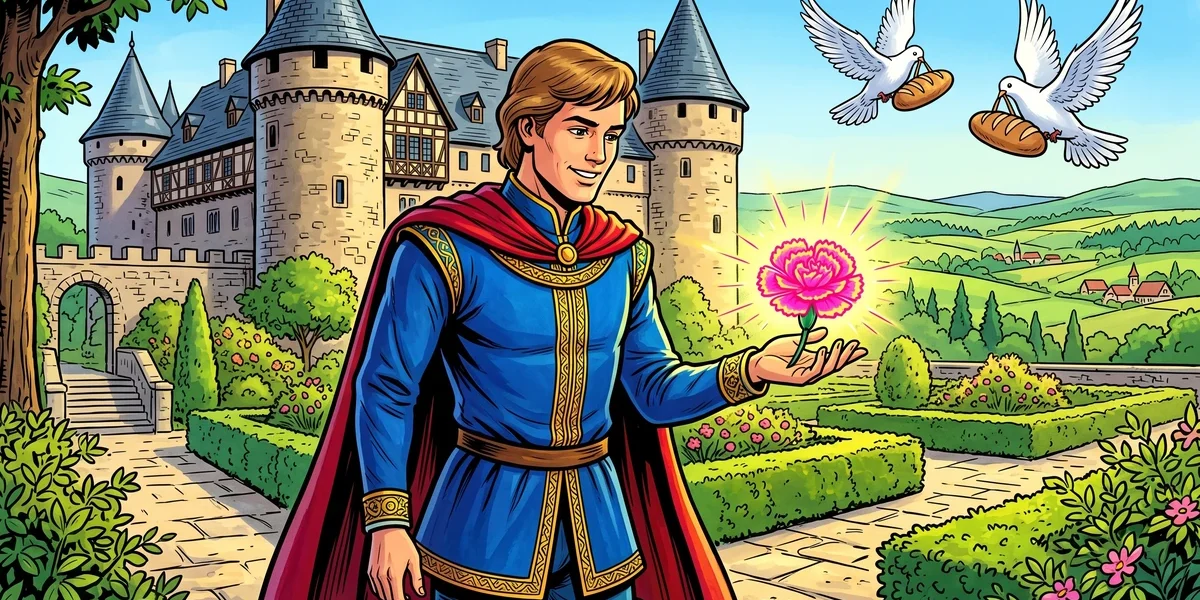

In the Brothers Grimm collection a small flower carries an enormous fate. Die Nelke — Englished as The Pink or The Carnation — is the strange, tender story of a king’s son whose every wish becomes immediate reality, and who survives a wicked cook’s plot only because, in the end, he can fold his own person up into a single crimson blossom and tuck himself away from harm. It is a tale of stolen children, walled-up queens, white doves that descend twice daily with bread, and a flower that proves stronger than a knife.
Canonical Attribution
The Pink is catalogued as KHM 76 in the seven editions of the Brothers Grimm’s Kinder- und Hausmärchen (Children’s and Household Tales) published between 1812 and 1857. The German title is Die Nelke; English translators have rendered it variously as “The Pink” (Edgar Taylor; Margaret Hunt) and “The Carnation” (Lucy Crane and later editors). It first appeared in the first edition of 1812 and was thereafter substantially expanded by Wilhelm Grimm — the word count grew from roughly 675 in the 1812 redaction to about 1,680 in the final 1857 edition, a doubling and more that reflects Wilhelm’s lifelong polishing of cadence, dialogue and Christian imagery.
In the international tale-type catalogue the story is ATU 652, “The Boy Whose Wishes Always Come True” — a type that the German folklorist Ulrich Marzolph traces back, in part, to the medieval Dutch abele spel Esmoreit (c. 1350), and which he and Richard van Leeuwen also locate in Judeo-Arabic narrative. Richard M. Dorson recorded the type sporadically in fifteen European countries with a concentration in Finland; the Canadian folklorist Carmen Roy described its distribution as très répandu across Germany, Scandinavia, southeastern Europe, Turkey, and into the Indian subcontinent (the “Indes”). The tale was first published by the firm of Realschulbuchhandlung, Berlin, with later editions issued by Reimer; the English translations relevant to anglophone readers are Edgar Taylor’s German Popular Stories (1823, illustrated by George Cruikshank), Lucy Crane’s Household Stories (1882, illustrated by Walter Crane), and Margaret Hunt’s authoritative two-volume Grimm’s Household Tales (1884), which is the version most often anthologised today.
Although Heinz Rölleke’s magisterial source-criticism of the Grimms does not pin Die Nelke to a single named storyteller — the tale entry in the Grimms’ own annotations (the third volume of 1822, expanded in 1856) gives only the laconic note that the tale was “aus Hessen” (from Hesse) — the literary fingerprints of the Grimms’ closest Hessian circles are everywhere on it: the formulae of the Hassenpflug family of Cassel, the pious doves and walled tower of Dorothea Viehmann’s repertoire, and the elegant courtly framing favoured by the Wild family of Cassel. It is, in other words, a Hesse-Cassel composite, refined by Wilhelm into the version we now read.

The Childless Queen and the Angel in the Garden
The story opens with a sorrow as old as folklore itself: a queen who cannot bear a child. Every morning she walks into the palace garden and addresses Heaven directly, asking for a son or a daughter. The petition is answered not by her husband, not by physician or wise woman, but by an angel who arrives in the garden — a small but decisive theological detail. Wilhelm Grimm’s revisions across the editions sharpen this divine framing; the angel does not merely promise a child but specifies the gift: “a son with the power of wishing, so that whatsoever in the world he wishes for, that shall he have.”
This is, in the language of folklore, a donor episode: a supernatural agent confers a magical attribute that will drive the rest of the action. Yet in The Pink the gift is also a hazard. Every later wound — the abduction, the false accusation, the seven-year imprisonment in the lightless tower — flows directly from the public knowledge that the unborn child possesses an irresistible power. As Marzolph observes, ATU 652 belongs to a small group of European types in which a hero’s passive virtue (here, the involuntary granting of every articulated wish) is at once his protection and the mechanism of his testing. The queen is overjoyed; the king is overjoyed; but the cook, listening at a wall the audience cannot see, is already turning the news into a plan.
The Cook’s Plot and the Tower of Doves
Of all the false accusers in the Grimm canon — the witch in Hansel and Gretel, the queen-mother in The Six Swans, the disguised maid in The Goose-Girl — the cook of Die Nelke is among the most chillingly procedural. He waits, the tale says, until the queen has fallen asleep with the child in her arms beside the clear stream where the wild beasts are kept. Then he carries the boy away to a secret place, kills a hen, and stains the queen’s apron and dress with its blood. He tells the king that the wild beasts have devoured their son.
The blood-on-the-apron is the same forensic motif that animates Snow White (KHM 53), The Goose-Girl (KHM 89), and dozens of European tales: the substituted heart-and-tongue or stained garment that buys a fugitive’s life. But in Die Nelke the trick is run twice. First the cook frames the queen with the hen’s blood, and the king — rendered tractable by grief and rage — orders a tower built “in which neither sun nor moon could be seen,” walls his wife into it, and decrees that she shall die in seven years of hunger. Then, much later, the cook orders the maiden to bring him the boy’s heart and tongue, and she substitutes those of a young hind — the Snow-White device pivoted ninety degrees and used by an innocent against the wicked instead of the wicked against the innocent.
The seven-year imprisonment is the tale’s great theological set piece. The queen does not perish. Gott aber schickte zwei Engel vom Himmel in Gestalt zweier weißer Tauben — “but God sent two angels from heaven in the shape of two white doves” — and the doves flew to her twice a day for seven years and brought her food. The image fuses three of the deepest currents in Christian symbolism: the dove of the Holy Spirit (Matthew 3:16), the ravens of Elijah (1 Kings 17:6), and the bread of the Eucharist. It is one of the moments where the Grimms’ Lutheran-Reformed Hessian piety surfaces most plainly through the tale’s ostensibly secular surface.

The Wishing Boy, the Maiden, and the Pink
While the queen is fed by doves in her dark tower, the cook puts the wishing boy to work. He instructs the boy to wish for a beautiful palace with a garden and everything that pertains to it; the words are scarcely out of the boy’s mouth when the palace stands. He then suggests the boy wish for a companion, “a pretty girl,” and immediately such a maiden appears, “more beautiful than any painter could have painted her.” The two children live together in the wished-for palace and love each other with all their hearts. The cook, dressed as a nobleman, goes hunting in the forest about them.
The peril sharpens. Fearing that the boy might one day wish to see his father, the cook orders the maiden to murder him in his sleep and bring back his heart and tongue. The maiden refuses inwardly — “Why should I shed the blood of an innocent boy who has never harmed anyone?” — and arranges instead the substitution of a young hind. When the cook discovers the deception, the boy — who has all this while been concealed under his bedclothes — throws off the quilt and pronounces sentence: “You old sinner, why did you want to kill me? Now will I pronounce thy sentence.”
The judgement that follows is both miraculous and merciful: the boy wishes the cook to be turned into a black poodle with a gold collar — a punishment that fixes the wicked man into a domestic, dependent shape, neither killed nor freed — and forces him to swallow burning coals so that flames flicker from his throat. Then, in the moment for which the tale is named, the boy wishes the maiden to become a beautiful pink, a single carnation, which he carries safely in his pocket as he sets out to find his father. The metamorphosis is the heart of the story: the maiden is both protected and portable, and the king’s son becomes a kind of botanical guardian, the keeper of a flower that is in fact a beloved.

Restoration: The Doves, the Father, and the Flower Restored
The hero arrives at his father’s court disguised as a hunter and offers to provide game, since the king’s table has gone short of meat. Bringing in a fine deer and arranging it on the table, he asks — in the deferential way of folktale heroes — that all the king’s court be summoned, “that I may eat with them.” The king assents. The boy then asks that one further person be brought from the tower: the queen, his mother, who has been kept these seven years on bread brought by doves. The doors of the lightless tower are unsealed; the wasted, half-blind queen is led out into the hall.
The recognition scene is one of the Grimms’ great quiet climaxes. The boy, still unrecognised, asks to set out in his own dish first; he produces the carnation from his pocket, places it on a plate, wishes — and the maiden stands there in her own restored body. The cook is dragged forward in his poodle shape; the truth is told; the queen is given the seat of honour at her husband’s right hand; and the king, learning at last that his wife was innocent and his son alive, is reconciled to both. The cook-poodle, in some redactions, dies of his own malice; in others he is allowed to live in chained shame.
The closing tableau places the four figures — king, queen, son, restored maiden — in the configuration the angel had promised in the very first paragraph: a complete royal family. The pink itself, though no longer needed for concealment, remains in the tale as a kind of relic, a flower that has carried a soul.
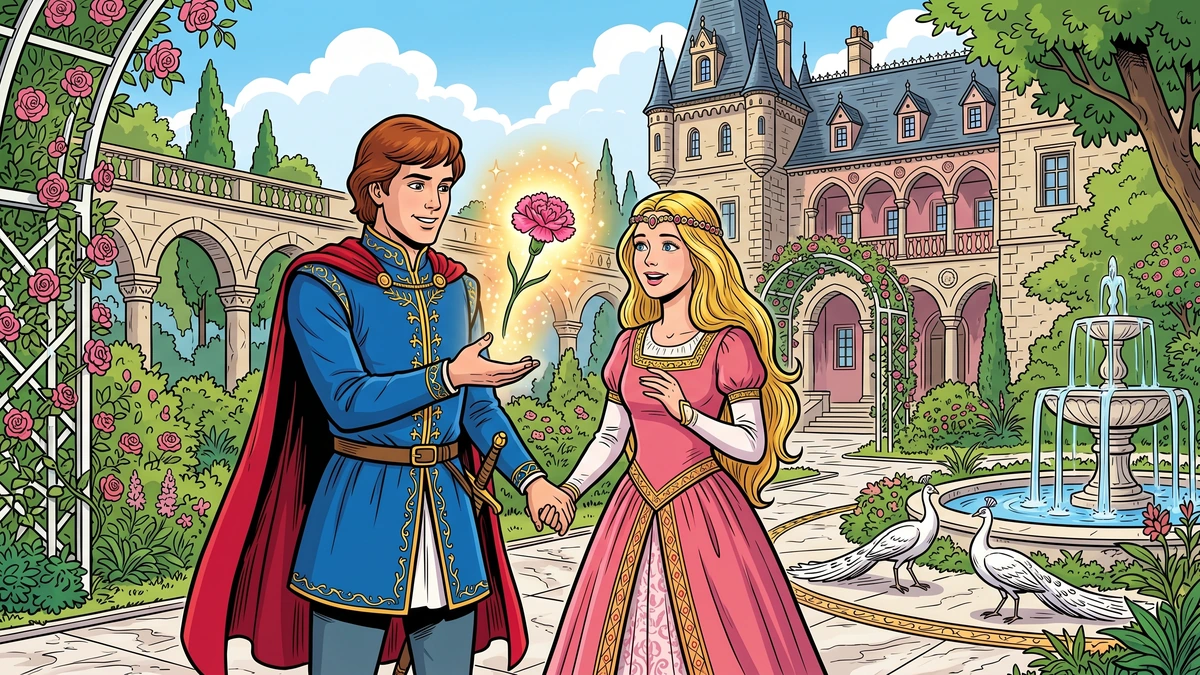
Moral — Was Gott zusammenfügt
„Gott aber schickte zwei Engel vom Himmel in Gestalt zweier weißer Tauben, die mußten ihr zweimal des Tages Speise bringen, bis die sieben Jahre vorbei waren.“
— Brüder Grimm, Kinder- und Hausmärchen (KHM 76)
The moral of Die Nelke is the moral of every tale in which patience and innocence outlast deception. The queen does not curse her husband, nor pound on the walls of her tower; she eats the bread the doves bring and waits seven years. The maiden does not bargain with the cook; she substitutes a hind and lies still under her own quilt. The boy, given the power to remake the world with a single sentence, uses it to protect rather than to revenge: a poodle for his enemy, a carnation for his beloved, a deer for his father’s table. The Grimms’ readers in 1812 and 1857 alike would have heard, beneath the wishing magic, the steady cadence of the catechism: was Gott zusammenfügt, soll der Mensch nicht scheiden — what God has joined, let no man put asunder. The tale insists, in the gentlest possible way, that providence is patient, that lies do not last seven years, and that even a pretty girl in a stranger’s palace can be carried home as a flower.
Why The Pink Has Lasted
Of all the wishing-boy variants in the European corpus, Grimm’s Die Nelke is the one that has lodged most firmly in the popular imagination, and for reasons that go beyond its place in the canonical KHM. It is, first, exquisitely compact: a tower, a cook, a hen’s blood, two doves, a hind, a poodle, a flower — six emblems through which a complete moral universe is conducted. Second, it folds its violence into mercy. The cook is not killed but transformed; the maiden is not lost but pressed between the hero’s fingers like a bookmark; the queen is not made into a martyr but slowly fed back into life by birds. Third, the carnation itself — die Nelke, the flower whose name in German is shared by the spice clove (die Gewürznelke) — has the precise iconography needed for the moment: small enough to fit in a pocket, vivid enough to be unmistakable, fragrant enough to mark a wedding bouquet. Across Europe the carnation has been the flower of betrothal, of maternal love (the modern Mother’s Day pink), and of saintly visitation (the “blossom of incarnation” in late medieval Marian iconography). The Grimms place all of these meanings inside a single five-petalled bloom and let it carry the tale’s heart from chapter to chapter.
For modern readers — including the children for whom Indian Folk Tales republishes the tale — the most striking note is how recognisable the moral architecture remains. A wished-for power that is also a wound; a guardian who turns out to be a thief; a wronged mother fed by birds; a beloved hidden in a flower. These images recur in every great tradition of household tale, from the Sanskrit Pañcatantra to the Pali Jātaka, from the Jewish aggadah to the Celtic imramma. Die Nelke, modest in its German shire and humble in its prose, belongs at the same table.
The Carnation in European Folklore
The choice of flower is not incidental. In late medieval and early modern European symbolism the pink or carnation (Dianthus caryophyllus, German Nelke, French œillet, Italian garofano) carried a uniquely concentrated emblematic charge. In Flemish and German devotional painting from the fifteenth century onwards a single carnation in a vase or held by the Christ Child signalled the Incarnation itself — a visual pun on the Latin caro (flesh) and the flower’s “flesh-pink” colour. Hans Memling, Albrecht Dürer, and the workshop of Lucas Cranach the Elder all painted the bloom this way; the so-called Madonna with the Carnation attributed to the young Leonardo da Vinci is the most famous late medieval example. In Hessian and Thüringian wedding custom, recorded by the folklorist Wilhelm Mannhardt in the 1860s, the bride was given a single carnation as a token of fidelity; in Italian parlance a red carnation was a man’s pledge of betrothal long before the rose displaced it in the nineteenth century.
The Grimms’ choice of die Nelke as the boy’s containment-vessel for his beloved therefore activates an entire symbolic economy: the flesh-pink bloom of the Incarnation; the betrothal token; the token of maternal love (Mother’s Day, in its early-twentieth-century Anna Jarvis form, would later codify the white carnation as the flower of the absent mother and the pink as the flower of the living one). Wilhelm Grimm, who polished the tale from edition to edition, knew his Christian iconography — the white doves and the carnation are not decoration but a quiet doctrinal frame around the action.
ATU 652 in International Parallels
Outside Germany the type appears under names that telegraph its core idea: in Finnish tradition, where Antti Aarne first catalogued it, Poika jonka toivomukset toteutuvat (“the boy whose wishes come true”); in Italian Calabrese as ’U figghiu d’e desidèri. Stith Thompson’s The Folktale (1946) groups ATU 652 under his motif numbers D1761 (“magic wishes”) and S322 (“children abandoned by hostile relative”). The Marzolph–van Leeuwen Arabian Nights Encyclopedia (2004) identifies the Judeo-Arabic parallel and the medieval Dutch Esmoreit, an abele spel of c. 1350, as the line of literary descent through which the type entered northern Europe; the Esmoreit tells of a Sicilian prince stolen at birth, raised in a foreign court, and at last restored to his parents through a token recognition — the same skeleton as Die Nelke, with a Mediterranean dressing.
The Indian subcontinent supplies the closest oriental analogue. In the Kathāsaritsagara (Somādeva, eleventh century) and in several living oral traditions of Bengal and the Punjab, the “wishing prince” appears in stories where a hidden hero, identifiable only by a small token (a flower, a ring, a thread), is restored to his rightful court after the unmasking of a usurper. The Grimms could not have known these texts directly; what their tale demonstrates is that the type travelled, by routes whose exact tracing is the work of comparative folklorists, from a common Indo-European stock into both the Hessian household and the Bengali grandmother’s evening recitation.
Editorial Note — Sources and Translations
The version retold above follows the seventh and final 1857 redaction of Kinder- und Hausmärchen, which is the standard text used by Margaret Hunt in her 1884 English translation and by all subsequent anthologies. Edgar Taylor’s 1823 German Popular Stories — the first English Grimm, illustrated by George Cruikshank — gave the tale to anglophone readers under the title “The Pink”; Lucy Crane’s 1882 Household Stories, illustrated by her brother Walter Crane, printed it as “The Carnation.” The pioneering source-criticism of Heinz Rölleke (notably in his 1980 Die älteste Märchensammlung der Brüder Grimm and his three-volume Reclam edition) confirms that the tale is “aus Hessen” without a single named informant; later folklorists Hans-Jörg Uther and Christine Shojaei Kâwan have placed it in the Hesse-Cassel composite group of which the Hassenpflug, Wild and Viehmann families are the chief contributors.
Modern German scholarship distinguishes the 1812 first-edition text from the 1857 final text as two related but distinct versions of the tale. The 1812 redaction is shorter, less Christianised, and includes a slightly different judgement scene in which the cook is killed outright. Wilhelm Grimm’s revisions softened the violence, deepened the doves-and-tower piety, and gave the carnation its central place; it is the 1857 text that has lasted.
You May Also Like
 Grimm's Fairy Tales
Ages 9-12
Grimm's Fairy Tales
Ages 9-12
How Chanticleer And Partlet Went To Visit Mr Korbes
2. How Chanticleer And Partlet Went To Visit Mr Korbes: Another day, Chanticleer and Partlet wished to ride out together; so Chanticleer built a handsome
 Grimm's Fairy Tales
Ages 6-8
Grimm's Fairy Tales
Ages 6-8
Rapunzel: Love, Freedom, and the Power of Truth
Rapunzel: Love, Freedom, and the Power of Truth: The Forbidden Garden Near a great castle, there grew a garden so beautiful that it was said to contain every
 Grimm's Fairy Tales
Ages 9-12
Grimm's Fairy Tales
Ages 9-12
Briar Rose
Briar Rose: A king and queen once upon a time reigned in a country a great way off, where there were in those days fairies. Now this king and queen had plenty