The Twelve Dancing Princesses: A Grimm Retelling
The Twelve Dancing Princesses: A Grimm Retelling: In a grand castle overlooking fertile valleys and dense forests, there lived a king with twelve daughters.
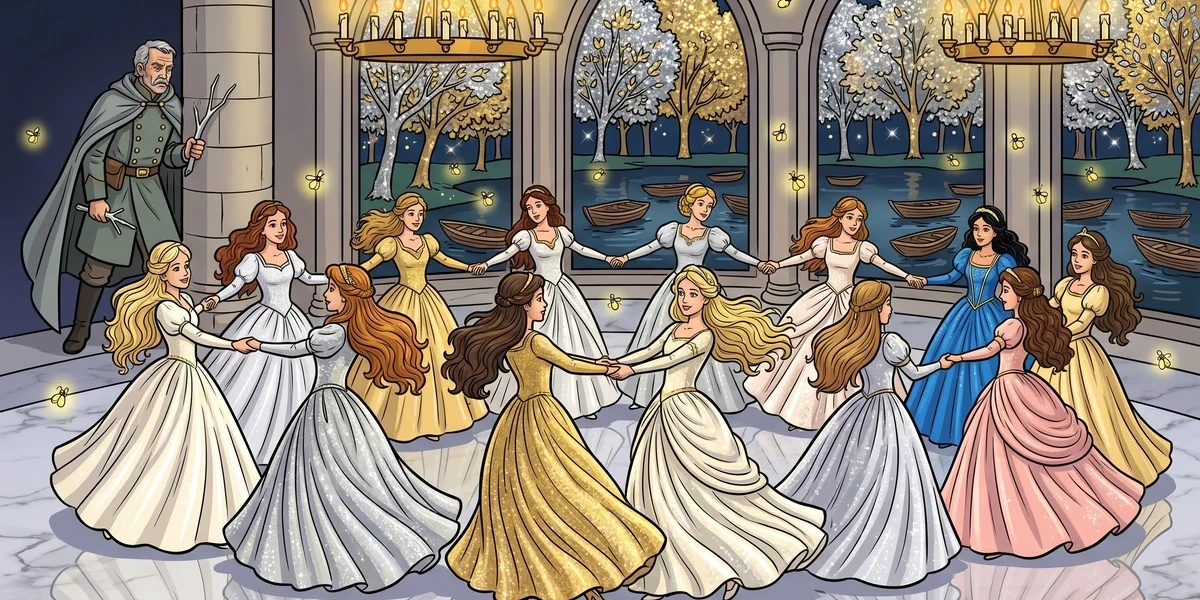
The Twelve Dancing Princesses — known in its native German as Die zertanzten Schuhe, “The Shoes That Were Danced to Pieces” — is one of the most enchanting and quietly subversive entries in the Brothers Grimm’s Kinder- und Hausmärchen. Catalogued as KHM 133, the tale was first added to the canonical collection in the second edition of 1815 (volume two), supplied to Wilhelm and Jacob Grimm in manuscript by their friend Jenny von Droste-Hülshoff, who had recorded it from oral tradition in the Münster region of Westphalia. By the seventh and final edition of 1857 it had taken the polished form in which it has travelled the world ever since.
Folklorists classify the tale as Aarne–Thompson–Uther type 306 — “The Danced-Out Shoes” or “The Princess in the Underworld” — a venerable narrative pattern in which a hero discovers a hidden subterranean kingdom by following an enchanted bride. Variants are recorded across Romania, Hungary, Russia, Scotland, and Scandinavia, but the Grimms’ rendering is the version that crystallised into world literature and into a remarkable series of operatic, balletic, and cinematic afterlives — from the Pas de douze tradition of nineteenth-century European dance to Walter de la Mare’s verse retelling, to Jeanette Winterson’s prose, to the Pixar storyboard seminars where the tale is taught as a paragon of “secret-room” structure.
Setting the Scene: A Castle of Locked Doors and Worn Shoes
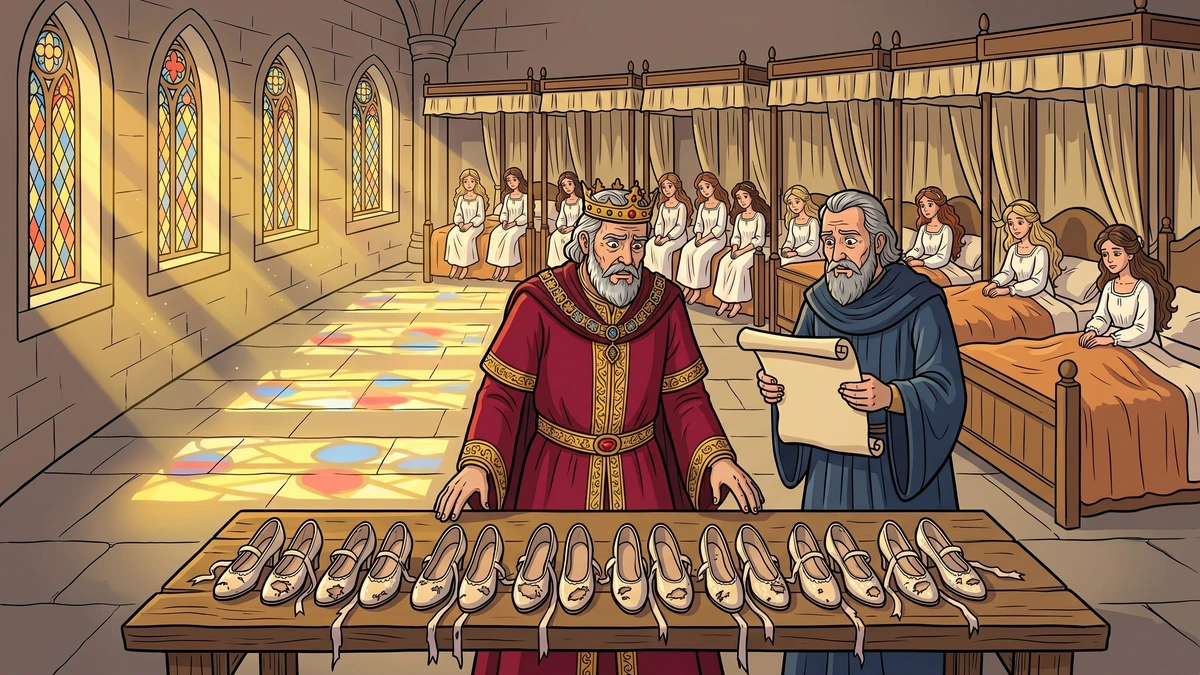
The Grimms open with one of their tightest expositions: a king with twelve daughters who slept in a single great chamber, twelve beds in a long row, and a single door which the king bolted with his own hand each night. “Aber des Morgens, wenn er sie aufschloß, so waren ihre Schuhe zertanzt, und niemand konnte herausbringen, wie das zugegangen war” — “But every morning when he unlocked the door, their shoes were danced to pieces, and no one could discover how it had come to pass.” The image is a small masterpiece of folk-narrative compression: a single sentence that simultaneously establishes the mystery, the supernatural element, and the king’s anxious, controlling love.
The kingdom in which this happens is the high-medieval Germany of the Grimms’ imagination — half real, half dreamed — a country of fertile valleys and dense oak forests, of stone keeps with crenellated towers and orchard gardens. The princesses themselves are described only as twelve and beautiful; the Grimms decline to differentiate them by name or temperament, leaving each reader to populate the row of beds with a dozen distinct faces. This deliberate emptiness is part of the tale’s enduring charm: the princesses are at once a single radiant collective and twelve private souls, and any retelling that names them too eagerly tends to dilute the hush of the original.
Beat One: The Royal Proclamation and the Failed Suitors
Unable to solve the mystery, the king issues a proclamation worthy of an Iron-Age riddle contest: any man who can discover where the princesses go at night and how their shoes are danced to ruin shall have one of them as his bride and inherit the kingdom; any man who tries and fails after three nights shall forfeit his life. The terms are brutal, and the fairy-tale calculus of the situation is exact — the prize is twelvefold, and so is the risk. Princes from neighbouring courts arrive in their plumed retinues, are admitted to a small antechamber adjacent to the princesses’ bedroom, and are bidden to keep watch through the night with the door wide open between them.
One after another, each prince is defeated by a single domestic gesture: the eldest princess brings him a cup of wine “for refreshment”, and within the hour he is fast asleep. Morning reveals the same story — the princesses’ shoes worn through, the prince humiliated, his head soon to fall. The Grimms catalogue the failures with grave economy, neither dwelling on the executions nor sentimentalising them. The princes’ deaths are the price of a problem that requires a different sort of cleverness than royal blood can supply: it requires the patient, sceptical eye of someone who has known hard nights and learned to mistrust easy comforts.
Beat Two: The Soldier and the Old Woman’s Gift
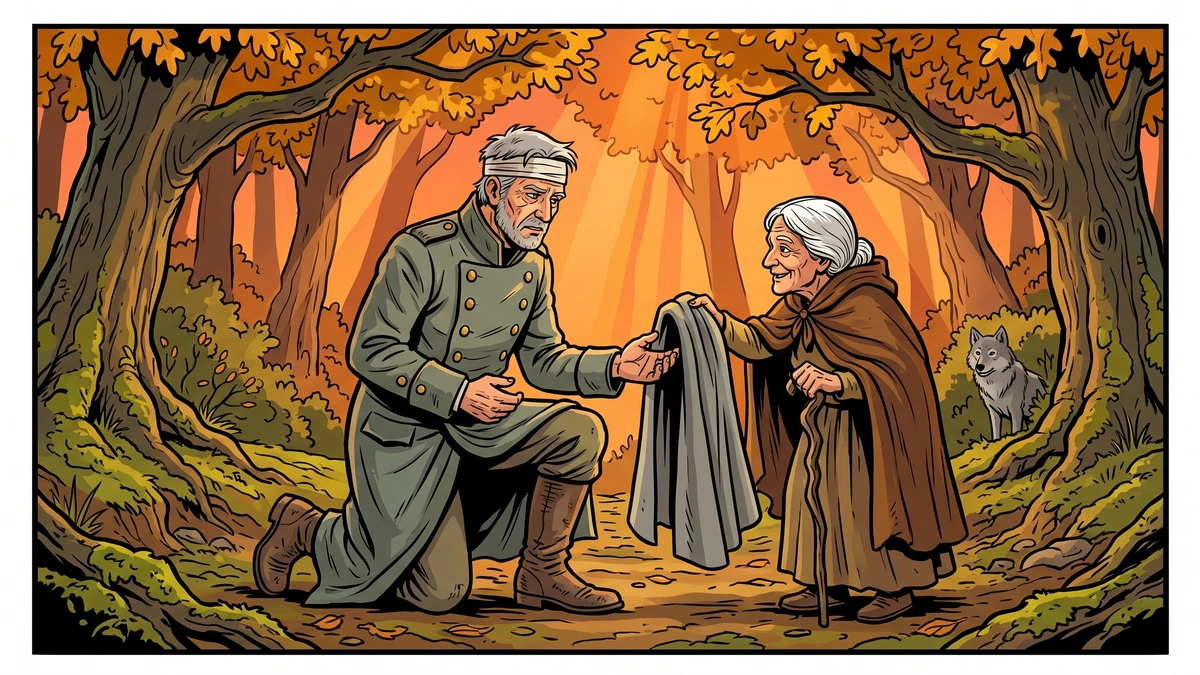
That different sort of cleverness arrives in the form of a wounded soldier — in the Grimm original a nameless veteran, here given the affectionate name Emile in the long Anglo-French retelling tradition — who has been dismissed from service and is making his way home through the forest. He meets an old woman on the road, the kind of crone who in Grimm always knows more than the kingdom’s chancellor: white-haired, sharp-eyed, leaning on a knotted staff. She asks where he is going; he answers honestly that he scarcely knows. She tells him of the king’s proclamation, of the princesses, of the princes who have died, and then she gives him three pieces of counsel that will save his life.
“Trink den Wein nicht,” she says — “Do not drink the wine. The princess will offer it; pour it away when she is not looking, and pretend to fall asleep. And here, take this little cloak: it will make you invisible. Wear it when the princesses leave their chamber, and follow them wherever they go.” She presses into his hands a folded grey Tarnmäntelchen — a “little cloak of concealment” — and disappears into the woods as such old women always do, before thanks can be offered. The soldier walks on, the cloak heavy in his pocket, his heart steadier than it has been in years.
Beat Three: The Underground Kingdom of Silver, Gold, and Diamond Trees
That night Emile is brought to the antechamber. The eldest princess, “die älteste”, brings him a cup of red wine. He thanks her, pretends to drink, and pours it secretly into a sponge he has tied beneath his beard. Then he lays his head down, breathes deeply, and lets out the slow snores of a working soldier exhausted at the end of a long road. The princesses laugh quietly. “Auch der hätte sein Leben sparen können,” the youngest whispers — “This one too could have spared his life.” And then they begin to dress.
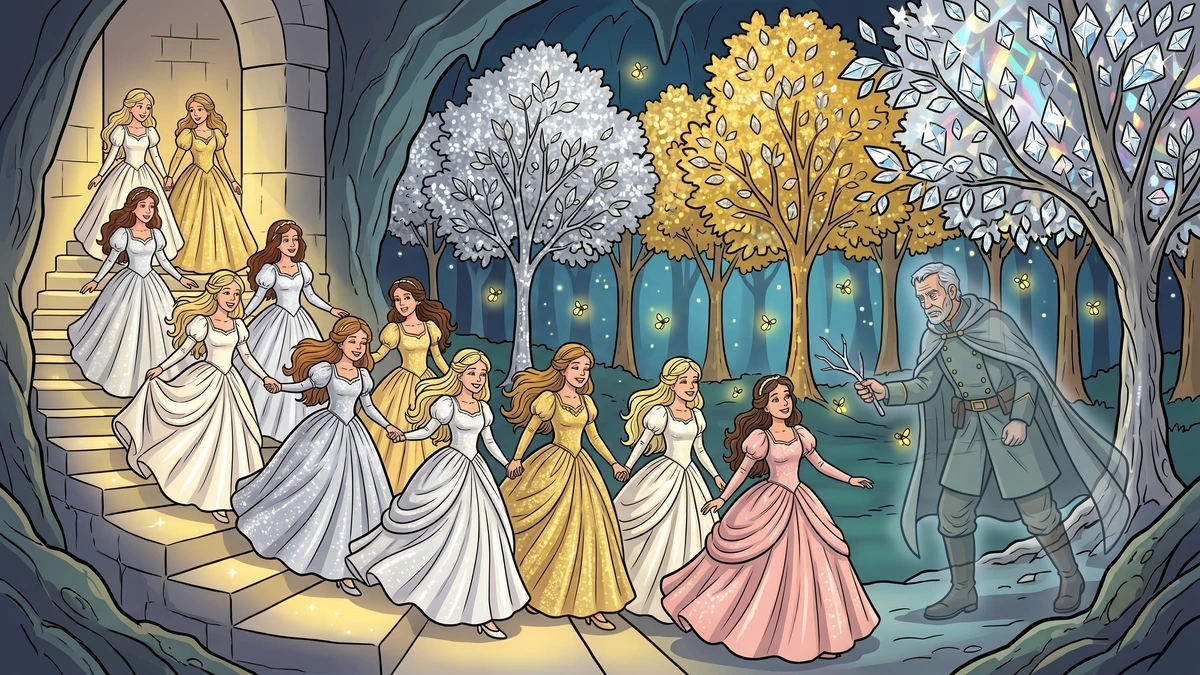
From beneath their beds the princesses bring out gowns of such splendour that the antechamber seems to fill with light: gowns of pearl, gowns of moonsilver, gowns of woven gold. They comb their hair and laugh and skip with the giddy delight of girls who have a secret. Only the youngest is uneasy. “Mir ist so seltsam zu Mute,” she says — “I feel so strange tonight. I do not know why, but my heart is heavy.” Her elder sister scolds her gently; the soldier is plainly asleep; all the princes were always asleep. The eldest claps her hands; one of the beds slides aside as though it weighed nothing; and a stone staircase opens into the floor, leading downward into a glow.
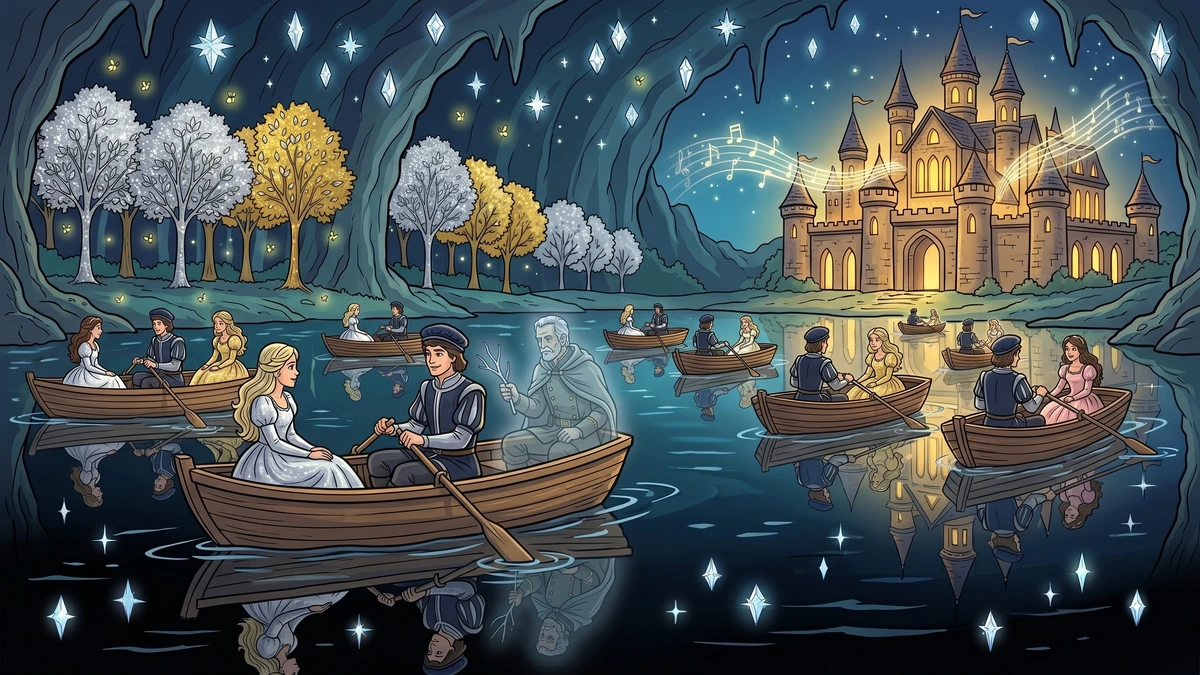
The soldier rises, throws his grey cloak around his shoulders, and follows. The staircase descends into the earth and opens at last upon a glade out of dream — a forest in which the leaves of the first row of trees are silver, the leaves of the second row are gold, and the leaves of the third row are pure diamond. As Emile follows, he breaks a small twig from each row to bring back as proof. At the snap of the silver twig the youngest princess starts and cries out, but her sisters reassure her: it is only the salute of the castle gunners. They walk on, the trees glittering above them like a frozen sky.
Beat Four: The Lake, the Twelve Boats, and the Enchanted Castle
Beyond the diamond forest lies a great underground lake of black water, and on the shore are twelve small boats, each waiting with its rower — twelve handsome enchanted princes, dressed in dark blue and silver, who greet the princesses with bows and hand them aboard. Emile slips into the boat of the eldest, sitting opposite her under his cloak of invisibility, and the rower remarks that the boat seems heavier tonight than it ought to be. The eldest princess laughs; the prince rows on; the lake glides black and quiet beneath the prow.
On the far shore stands a castle ablaze with light, and from its windows pours music — flutes, lutes, dulcimers, and the deep heartbeat of a tabor. The princesses leap onto the marble landing and run inside; the princes follow; and there in the great hall begins the dancing that has wearied so many shoes. Emile watches from the gallery: the princesses spin and turn, exchange partners, laugh with the breathless joy of any young woman at a midnight ball — and dance and dance until their shoes are worn through to the soles. As the cocks crow at three, the company hurries back to the boats; Emile, growing bolder, drinks from the eldest princess’s golden cup and slips it into his coat as a third piece of evidence. Up the stair, the bed sliding shut behind them, the princesses fall into their beds; the soldier resumes his pretended snoring; and the night is over.
Beat Five: The Solving of the Mystery and the Old Soldier’s Reward
Two more nights pass in the same fashion. Each evening the soldier pours away the wine; each night he follows the princesses through the silver, the gold, and the diamond forests to the lake, the boats, and the castle of the dancing; each dawn he returns with another twig and another keepsake. On the third morning, when the king summons him and demands an account, Emile lays before the throne the silver twig, the gold twig, the diamond twig, and the golden cup, and tells the whole tale from the wine to the boats. The king turns to his daughters; the eldest, blushing, confirms that every word is true.
“Da sprach der König: ‘Welche willst du zur Frau haben?’ Er antwortete: ‘Ich bin nicht mehr jung, so gebt mir die älteste.'”
— “Then the king asked, ‘Which one will you have for your wife?’ He answered, ‘I am no longer young, so give me the eldest.'”
The wedding is celebrated that very day. The king names Emile his heir; the eldest princess, now a wife, smiles with the calm of a woman who has been seen at last; and the princes who rowed the boats are condemned to as many additional nights of enchantment as they have danced. The story closes — as so many Grimm stories do — with a single line of laconic moral arithmetic, leaving the listener to do the rest of the sums.
Sources, Variants, and the Tale’s Long Afterlife
The Grimms’ source for the tale was the manuscript supplied by Jenny von Droste-Hülshoff, sister of the celebrated poet Annette von Droste-Hülshoff, in 1813. Jenny had collected the story from a maidservant in the Münster countryside; the manuscript survives in the Grimm archives in Kassel and shows that Wilhelm Grimm’s editorial hand was unusually light here — the bones of the tale as told by a Westphalian woman in her kitchen are visible beneath the polished prose. A closely related Romanian variant collected by Petre Ispirescu, a Hungarian variant in Elek Benedek’s compilations, and a Russian variant in Afanasyev’s Narodnye russkie skazki all preserve the core of ATU 306, attesting to the tale’s deep root system across the Indo-European folk tradition.
In the centuries since, Die zertanzten Schuhe has migrated triumphantly into other media. Walter de la Mare rewrote it in dreamlike English prose in his Told Again (1927). Jane Yolen retold it as The Twelve Dancing Princesses (1989) with illustrations by Charles Mikolaycak. Diana Wynne Jones wove it into Hexwood; Robin McKinley reworked it in The Door in the Hedge; Juliet Marillier spun it into the lush Wildwood Dancing. Frederick Ashton choreographed it for the Royal Ballet; the ballet pioneer Marius Petipa drew on it for Le Pavillon d’Armide; Walt Disney studios, Barbie Entertainment, and Studio Ghibli have all adapted the framework. The tale’s structural neatness — twelve sisters, three forests, three nights, one soldier — makes it almost preternaturally adaptable.
The Symbolic Architecture: Three Forests, Three Nights, Twelve Sisters
Folklorists from Marie-Louise von Franz to Maria Tatar have read the tale’s architecture as a carefully tiered descent into the unconscious. The silver forest stands traditionally for the mother-realm — the moonlit interior life of the feminine soul. The golden forest stands for the solar daylight of the conscious adult ego. The diamond forest stands for the crystalline, almost crystallographic clarity of insight that lies on the far side of both. The princesses are descending, each night, into a layered psychic architecture in which they can be wholly themselves, away from the bolted door of the patriarchal castle. The soldier’s gift — the Tarnmäntelchen, the cloak of invisibility — is precisely the gift of being able to see without being seen, the analyst’s gift, the contemplative’s gift, the gift that allows him at last to honour the mystery rather than merely punish it.
This reading also illuminates why the soldier asks for the eldest princess rather than the youngest — a choice that has surprised generations of readers raised on the Disney logic that always pairs the hero with the prettiest. The eldest is the keeper of the secret, the one who first led her sisters down the staircase, the one whose cup he has stolen. To choose her is to choose the woman who knows what she has done, not the youngest who merely felt strange about it. Emile, “no longer young,” chooses partnership over prize.
The Moral at the Heart of the Tale
The Grimms themselves do not append an explicit moral, but the tale’s ethical centre of gravity is unmistakable. The mystery of another person is not a problem to be solved by force, but a country to be entered with patience and respect. The princes who came before Emile tried to watch the princesses; they failed because they brought royal arrogance instead of peasant patience. The soldier’s invisibility cloak is, at its deepest level, the disguise of humility — the willingness to walk beside the princesses’ boats without claiming his place at the oars. He returns with twigs and a cup not as a hunter brings trophies, but as a pilgrim brings relics. He has been somewhere holy, and he has not damaged it.
“Wer Geheimnisse erfahren will, muß leise gehen.”
— “Whoever would learn secrets must walk softly.”
Why It Has Lasted: The Tale’s Enduring Modern Echo
More than two centuries after Jenny von Droste-Hülshoff first wrote the tale down, Die zertanzten Schuhe still sings to the modern reader because it speaks at once to the desire for hidden wonder and to the integrity of letting wonder remain partly hidden. We live in an age that has learned to surveil everything — phones, conversations, locations, search histories — and the tale’s quiet rebuke is that surveillance, even royal surveillance, can never produce love or loyalty. Only the soldier who first refuses to drink the wine, then walks softly behind the princesses’ silver gowns, earns the right to know where they go.
The tale also offers, in its ribbon of three forests, a luminous image of how one might live well: pass through the silver of the imagination, the gold of the doing, and the diamond of the understanding, and dance until the shoes wear out — but be sure to come home before the cock crows. And when one finds, at the end of life or of love, that one’s twelve nights of dancing have grown into a marriage, choose the one who knows what you have done, and who chose to dance with you anyway.
That is why this small, near-perfect Grimm tale has outlasted dynasties, ideologies, and a hundred passing literary fashions. The shoes are danced to pieces; the soldier finds the truth without breaking it; and for as long as there are children who hear the story whispered at bedtime, the silver leaves above the staircase will still glitter, and somewhere, very faintly, the music from the underground castle will still be playing.
Frequently Asked Questions
The five questions and answers that follow are also encoded as schema.org FAQPage data for search engines and voice assistants.
What is the original German title and KHM number of “The Twelve Dancing Princesses”?
The tale appears as KHM 133 in the Brothers Grimm’s Kinder- und Hausmärchen, where its German title is Die zertanzten Schuhe (“The Shoes That Were Danced to Pieces”). It was added to the second edition of the collection in 1815 (volume two), supplied in manuscript by Jenny von Droste-Hülshoff of Westphalia, and was retained in every subsequent edition through the canonical seventh edition of 1857.
What is the Aarne–Thompson–Uther tale-type, and where else does this story appear?
The tale is classified as ATU 306, “The Danced-Out Shoes” (sometimes “The Princess in the Underworld”). Variants are recorded across Romania (Petre Ispirescu’s collections), Hungary (Elek Benedek), Russia (Afanasyev’s Narodnye russkie skazki), Scotland, and Scandinavia, all sharing the core motif of a hero who follows enchanted maidens to a hidden underground kingdom and breaks their nightly compulsion to dance. The Grimms’ Westphalian version is the rendition that became canonical in world literature.
Who is the soldier in the original Grimm version, and why is he sometimes called Emile?
In the Grimms’ 1815 text the soldier has no name; he is simply “ein armer Soldat”, “a poor soldier” who has been wounded in service and dismissed. The name Emile entered the tradition through nineteenth-century Anglo-French theatrical adaptations, notably French stage versions and English children’s-book retellings of the late Victorian period, where giving the soldier a personal name made it easier to follow the action. Many modern English retellings, including the version preserved on this page, retain the name out of affection for that long performance history.
What is the symbolic significance of the silver, gold, and diamond forests?
Folklorists and Jungian readers (notably Marie-Louise von Franz and Maria Tatar) read the three forests as a tiered descent into the inner life: silver for the lunar, intuitive realm of the feminine imagination; gold for the solar realm of conscious adult action; diamond for the clarified crystalline insight that lies on the far side of both. The princesses are not merely escaping a locked door; they are travelling each night through a layered psychic landscape, and the soldier’s invisibility cloak — which lets him see without being seen — is the contemplative gift of accompanying that journey without violating it.
Why does the soldier choose the eldest princess and not the youngest?
This is one of the tale’s quiet inversions of the standard fairy-tale formula. The Grimms’ soldier explicitly says, “Ich bin nicht mehr jung, so gebt mir die älteste” — “I am no longer young, so give me the eldest.” The eldest is the leader of the nightly excursions, the keeper of the sisters’ secret, and the woman whose golden cup he has carried home. To choose her is to choose the woman who fully knows what she has done, rather than the youngest who only felt vaguely uneasy. The choice signals an adult partnership of equals rather than a romance of rescue, and it is one of the reasons feminist readers from Angela Carter onwards have returned with affection to this particular Grimm tale.
You May Also Like
 Grimm's Fairy Tales
Ages 9-12
Grimm's Fairy Tales
Ages 9-12
The Blue Light
The Blue Light: There was once upon a time a soldier who for many years had served the king faithfully, but when the war came to an end could serve no longer
 Grimm's Fairy Tales
Ages 9-12
Grimm's Fairy Tales
Ages 9-12
The Wolf and the Seven Young Goats
The Wolf and the Seven Young Goats: In the days when animals spoke and understood the human tongue, there lived a mother goat with seven children born under a
 Grimm's Fairy Tales
Ages 9-12
Grimm's Fairy Tales
Ages 9-12
How Chanticleer And Partlet Went To Visit Mr Korbes
2. How Chanticleer And Partlet Went To Visit Mr Korbes: Another day, Chanticleer and Partlet wished to ride out together; so Chanticleer built a handsome