How Chanticleer And Partlet Went To Visit Mr Korbes
2. How Chanticleer And Partlet Went To Visit Mr Korbes: Another day, Chanticleer and Partlet wished to ride out together; so Chanticleer built a handsome
The Visit That Was Not a Visit: Justice Disguised as Courtesy
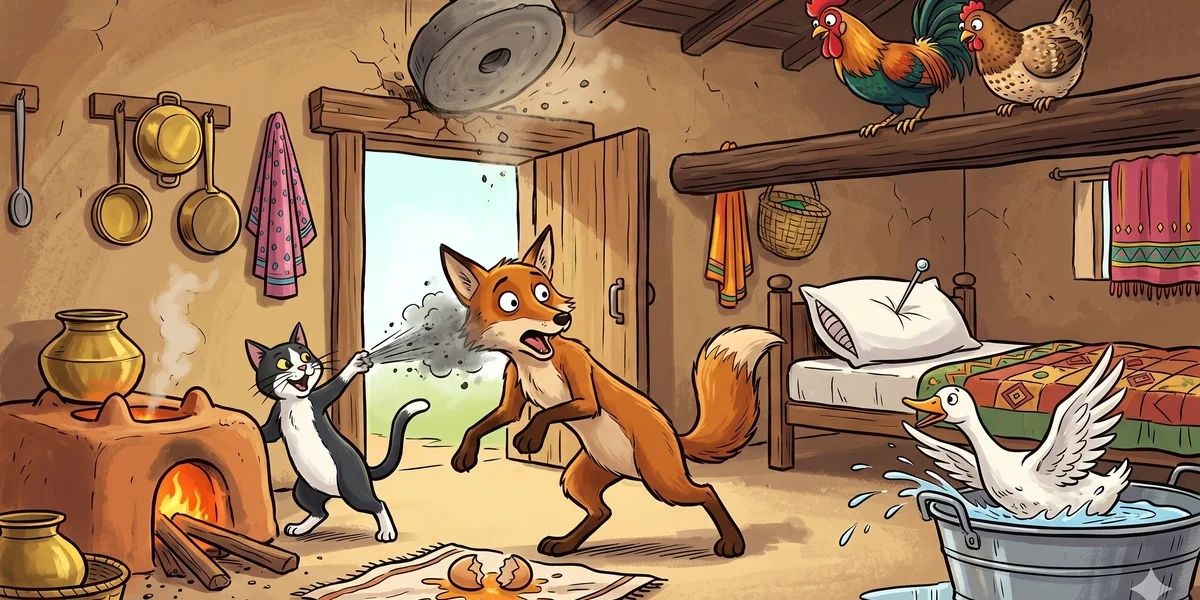
When Chanticleer and Partlet decide to pay a visit to Mr. Korbes — a character whose name suggests “raven” or “crow” in Germanic folk tradition, and whose household will be found hostile — they accumulate along the way an army of unlikely companions: a duck, a pin, a needle, and a millstone. What appears to be a neighborly visit becomes, by the tale’s end, an elaborate collective retribution for Mr. Korbes’s hospitality crimes. This tale — the second story in the Grimm brothers’ Chanticleer and Partlet cycle — is one of the most peculiarly satisfying revenge narratives in European folk tradition, precisely because the agents of justice are so incongruously humble: a needle in the chair, a duck in the water bucket, a millstone above the door.
The tale’s structure resonates with a rich cross-cultural genre of the “disguised retribution” narrative — stories in which justice is delivered not through obvious confrontation but through the activation of seemingly harmless elements of the ordinary environment that the wrongdoer has failed to notice or has treated with contempt. In Indian folk tradition, the equivalent tales involve humble people or creatures who embed themselves in the wrongdoer’s household and, at the critical moment, act in concert to deliver the consequence the wrongdoer has earned. The Panchatantra’s Book V (“Imprudence and Its Consequences”) contains multiple tales organized around exactly this principle.
Mr. Korbes and the Threshold Violated: Hospitality Ethics in European and Indian Tradition
The tale’s moral structure turns on hospitality ethics: Mr. Korbes receives guests — however uninvited — and treats them with contemptuous violence rather than customary welcome. In medieval German custom (as in Indian tradition), the threshold of the home was a sacred boundary; those who crossed it were entitled to basic treatment as guests. Mr. Korbes’s violation of this threshold-ethic is the act that earns the collective retribution delivered by the companions he never noticed.
The Indian concept of atithi-devo-bhava (the guest is as god) articulates this principle in its strongest form: the guest’s arrival at the threshold activates a sacred obligation on the part of the host. To harm a guest — even one who arrived uninvited — is to violate a cosmic hospitality law that carries consequences far beyond the immediate social embarrassment. Both European and Indian folk traditions encode this principle in their revenge narratives: the wrongdoer who violates hospitality is not merely rude but cosmically wrong, and the universe’s correction mechanisms activate accordingly.
The Weapons of the Humble: Pin, Needle, Duck, and Millstone
The tale’s genius lies in the identity of its avengers. The pin and needle who hide in chairs and beds, the duck who conceals itself in the water bucket, the millstone who positions itself above the door — these are not powerful beings but ordinary household objects and creatures whose power derives entirely from their positioning and timing. They are the classic trickster-army of folk narrative: helpless individually, devastating in concert, invisible until activated.
This weapon-of-the-humble motif connects directly to Indian narrative theory’s analysis of the weak party’s strategic options. The Arthashastra identifies the strategy of upajapa (infiltration and internal disruption) as one of the most effective tools available to a weaker party facing a stronger one: rather than confronting strength directly, the weaker party embeds agents within the stronger party’s household and activates them at the moment of maximum vulnerability. The pin in the chair, the needle in the bed, the duck in the bucket — these are all forms of upajapa, delivered with the deadpan humor that marks the best folk narrative comedy.
The Comic Timing of Justice: When the Universe Laughs
The tale’s comedy is inseparable from its justice: each of Mr. Korbes’s encounters with the disguised avengers is timed perfectly to maximum comedic effect. He sits in the chair — pin. He lies in the bed — needle. He reaches for water — duck. He opens the door — millstone. The timing is so precise, and the sequence so perfectly escalating, that the comedy and the justice become indistinguishable: we laugh because justice is being served so efficiently, and we approve the justice because it is delivered so elegantly.
Indian aesthetic theory (rasa-shastra) identifies this comic-justice fusion as hasya-vira (heroic comedy): the form of comedy that arises when laughter and righteous satisfaction occur simultaneously. The audience does not merely laugh at Mr. Korbes’s discomfort; they experience the deeper satisfaction of witnessing a universe in which the small and humble — the pin, the needle, the duck — are not powerless after all. Their power was always there; it simply required the right moment, the right positioning, and the right antagonist’s arrogance to activate it.
“He thought he was alone in his house — but the chair knew, and the pillow knew, and the water bucket knew, and above the door the millstone was patient.”
Why This Story Lasted
How Chanticleer and Partlet Went To Visit Mr. Korbes has lasted because it satisfies one of the deepest wishes of folk narrative audiences: the wish that the humble objects and creatures that surround us — treated with contempt by the powerful — might one day act in concert to deliver justice in a way that no court or authority could orchestrate. The millstone above the door, the needle in the pillow: these are the household’s own verdict, delivered in its own time, requiring no external authority to implement. In a world where official justice is slow, expensive, and uncertain, the folk tale’s instant karma is deeply appealing — and its comedy makes the medicine go down with pleasure.
Frequently Asked Questions
What does the name Korbes mean in this tale?
The name Korbes is thought to derive from Germanic words related to “raven” or “crow” — birds associated in European folk tradition with cunning and ill omen. The name signals that Mr. Korbes is not a neutral character but one whose nature the story has already encoded in his name, much as Sanskrit narrative tradition uses character names to signal essential nature (svabhava).
What hospitality law does Mr. Korbes violate?
He violates the threshold-law of hospitality — the medieval German equivalent of India’s atithi-devo-bhava (the guest is as god). Both traditions hold that those who cross the household threshold are entitled to basic guest treatment. Harming guests — even uninvited ones — is not merely rude but cosmically wrong, activating retributive mechanisms that the wrongdoer cannot anticipate or prevent.
How does the Arthashastra’s upajapa strategy relate to this tale?
Upajapa (infiltration and internal disruption) is Kautilya’s strategy for weaker parties facing stronger ones: embed agents within the opponent’s household and activate them at maximum vulnerability. The pin in the chair, needle in the bed, duck in the bucket, millstone above the door are all forms of upajapa — ordinary objects positioned and timed to deliver devastating collective effect, the classic trickster-army of folk narrative.
What is hasya-vira rasa and how does this tale produce it?
Hasya-vira (heroic comedy) is the Indian aesthetic experience where laughter and righteous satisfaction occur simultaneously. The tale produces this by timing each avenger’s activation to perfect comic effect — chair-pin, bed-needle, bucket-duck, door-millstone. The audience laughs because justice is delivered efficiently, and approves the justice because it arrives elegantly. The comedy and the moral are inseparable.
Is the millstone’s role in the story symbolic?
The millstone — a heavy, grinding instrument of transformation — is the collective retribution’s final and most emphatic act. Its weight and irreversibility make it the signature weapon: not a pinprick (temporary) or a needle-stab (painful but recoverable) but a definitive statement. In folk symbolism, the millstone represents the grinding of consequence — the universe’s own slow but unstoppable process of turning acts into their outcomes. Its position above the door makes it both a trap and a threshold judgment.
You May Also Like
 Grimm's Fairy Tales
Ages 9-12
Grimm's Fairy Tales
Ages 9-12
Frederick And Catherine
Frederick And Catherine: There was once a man called Frederick: he had a wife whose name was Catherine, and they had not long been married. One day Frederick
 Grimm's Fairy Tales
Ages 9-12
Grimm's Fairy Tales
Ages 9-12
Second Story
Second Story. Kids-friendly retelling with setting, characters, moral, and a lesson for today.
 Grimm's Fairy Tales
Ages 9-12
Grimm's Fairy Tales
Ages 9-12
Cinderella (Aschenputtel)
Cinderella (Aschenputtel): Long ago in a merchant’s grand estate, there lived a young girl of extraordinary grace and kindness. Her name was Ella, though after