Snow-White And Rose-Red
Snow-White And Rose-Red: There was once a poor widow who lived in a lonely cottage. In front of the cottage was a garden wherein stood two rose-trees, one of

“Schneeweißchen und Rosenrot”—Snow-White and Rose-Red—is a Black Forest fairy tale of two devoted sisters whose patient kindness toward a winter-bound bear and an ungrateful dwarf restores a stolen kingdom. Recorded as KHM 161 in the Brothers Grimm’s Kinder- und Hausmärchen (Children’s and Household Tales), the story entered the canon in the fifth edition of 1843 after Wilhelm Grimm rewrote a literary version published in 1818 by the Baltic-German children’s author Caroline Stahl. International folklorists classify it as ATU 426—”The Two Girls, the Bear, and the Dwarf”—a tale-type unusual within Grimm for its hopeful tone, sororal devotion, and almost complete absence of cruelty between siblings.
Origin and Canonical Attribution
The Brothers Grimm did not collect Snow-White and Rose-Red from an oral storyteller in the Hessian villages around Kassel, as they did with most of their household tales. Wilhelm Grimm took the plot from a printed German source: Caroline Stahl’s “Der undankbare Zwerg” (“The Ungrateful Dwarf”), which appeared in her 1818 collection Fabeln, Mährchen und Erzählungen für Kinder (Fables, Fairy Tales and Stories for Children), printed in Nuremberg by Friedrich Campe. Stahl, born in 1776 in the Baltic city of Reval (modern Tallinn), wrote in the moralizing tradition of the German Kindermärchen, and her dwarf tale was already a polished literary product when Wilhelm came to it.
Wilhelm Grimm’s revision was extensive and is now regarded as one of his most original interventions in the entire Kinder- und Hausmärchen. To Stahl’s spare account he added the widow’s cottage with its two rose-trees, the names Schneeweißchen and Rosenrot, the entire opening sequence with the protective angel of the children, the long winter friendship with the speaking bear, the bear’s nightly knock at the cottage door, and—crucially—the closing transformation that reveals the bear to be a prince robbed and bewitched by the dwarf. He published the rewritten tale first in Wilhelm Hauff’s Mährchen-Almanach für 1827 under the title “Schneeweißchen und Rosenroth”, then incorporated it as tale 161 in the second volume of the fifth large edition of the Kinder- und Hausmärchen in 1843. It remained in every subsequent edition through the seventh and final Ausgabe letzter Hand of 1857.
The international tale-type is Aarne–Thompson–Uther 426, “The Two Girls, the Bear, and the Dwarf,” a type whose only other widely recorded form is precisely this Grimm narrative. Stith Thompson’s Motif-Index of Folk-Literature attaches several strong motifs: D 711 (disenchantment by decapitation), D 313.3 (transformation of prince to bear), F 451.5.2 (malevolent dwarf), and N 815 (helpful supernatural beast). Folklorist Heinz Rölleke, the most authoritative modern editor of the Grimm corpus, treats KHM 161 as a hybrid of literary Kunstmärchen and folk material, noting that the dwarf’s beard repeatedly caught in awkward objects—a stump, a fishing line, the talons of an eagle—is a comic motif also found in older Tyrolean dwarf legends collected by Ignaz Vinzenz Zingerle.
The Widow’s Cottage and the Two Sisters
There was once a poor widow who lived in a lonely cottage at the edge of the forest. In front of the cottage was a little garden, and in that garden stood two rose-trees: one bore white roses, the other red. The widow had two daughters who were like the two rose-trees, and so she called them Schneeweißchen and Rosenrot—Snow-White, for the elder, who was as quiet and gentle as her name; and Rose-Red, for the younger, who would rather run through the fields catching butterflies and gathering wildflowers. They were as good and as happy as ever two children in the world were, and they loved each other so dearly that whenever they walked out together they always held one another by the hand.
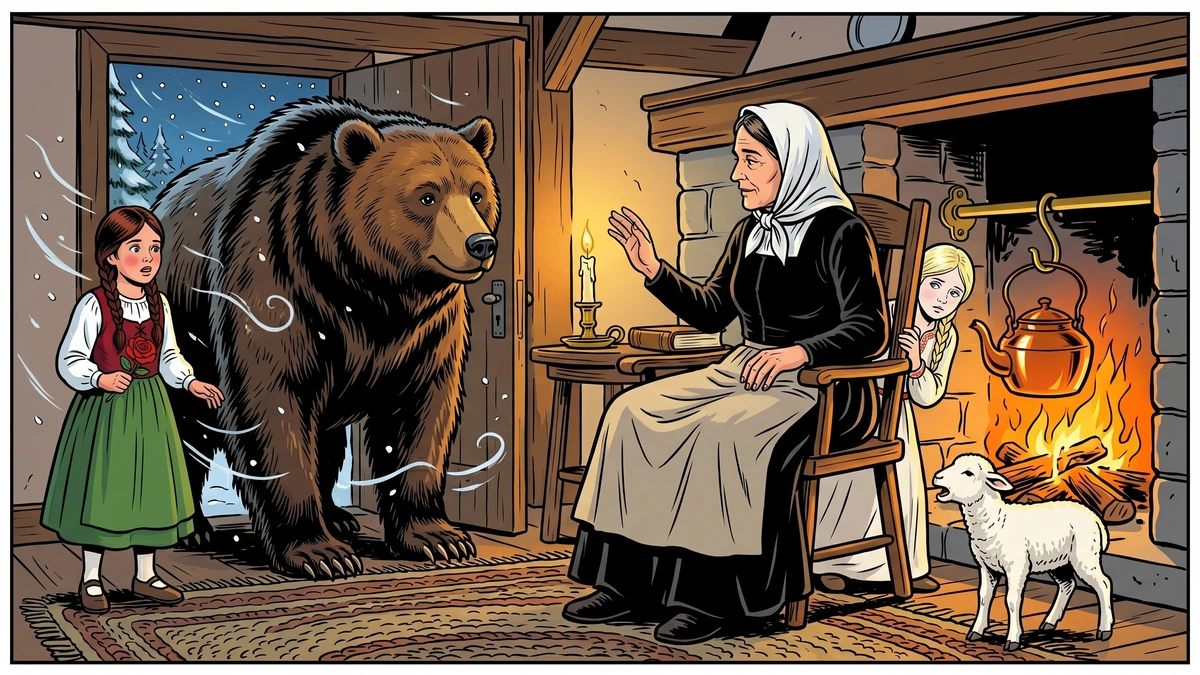
The two sisters kept the cottage so clean it was a pleasure to step inside. In summer, Snow-White cared for the house: she swept the floor, laid white roses by her mother’s bed each morning, and read aloud from a thick old book of stories when there was nothing else to do. In winter, when snow fell so deep that the postman could not reach the door, Rose-Red bolted the shutters fast, fed wood into the fire, and hung the great copper kettle on the brass hook over the flames. The kettle, being polished bright, shone like gold. Their mother sat in her chair with her spectacles on her nose, reading aloud from the same thick book, while the two girls sat at her feet and span thread on their little wheels. Beside them lay a lamb on a piece of carpet, and behind them on a perch sat a white dove with its head tucked under its wing.
One night, as the family sat together in this peaceful tableau, there came a heavy knock at the door, as though somebody outside were demanding shelter. The mother said, “Quick, Rose-Red, open the door; it must be some traveller seeking refuge from the storm.” But when Rose-Red drew back the bolt, no traveller stood in the snow. There stood, instead, a great brown bear, who pushed his broad black head into the room. Rose-Red screamed and sprang back; the lamb bleated; the dove fluttered up; and Snow-White hid behind her mother’s chair. The bear, however, lifted his head and spoke in a deep, courteous voice: “Fürchtet euch nicht, ich thue euch nichts zu Leide, ich bin halb erfroren und will mich nur ein wenig bei euch wärmen.” (“Do not be afraid; I will do you no harm; I am half-frozen, and only wish to warm myself a little here with you.”)
The Winter Friendship with the Bear
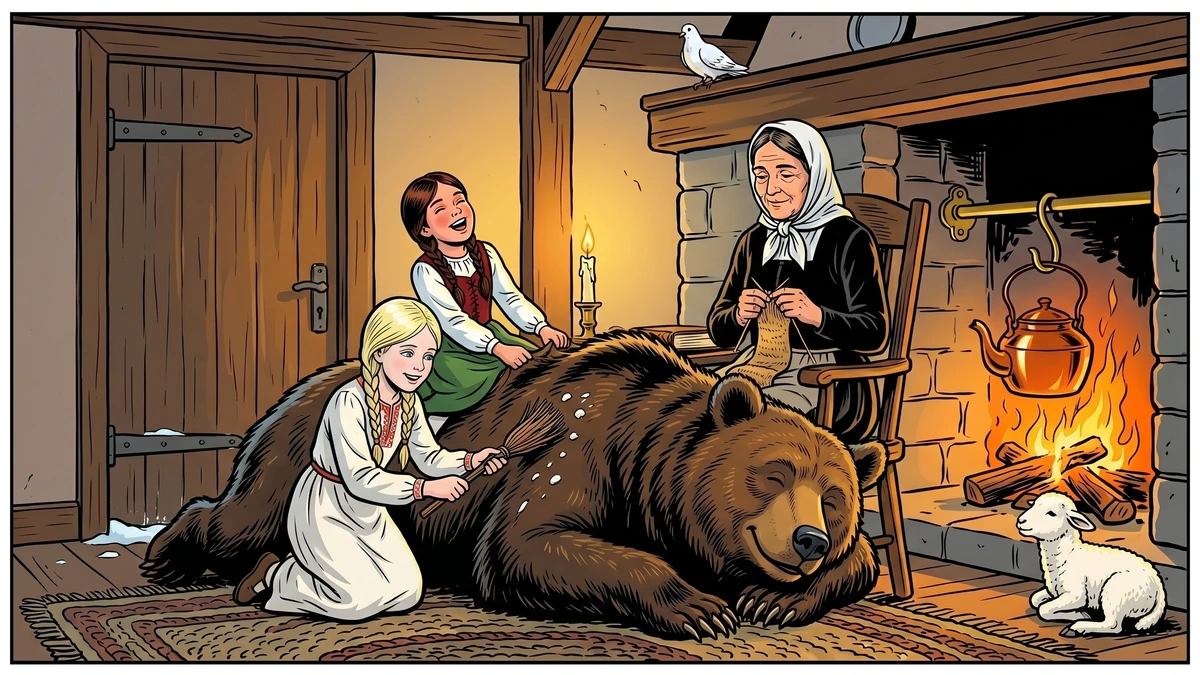
The widow felt pity for the great trembling creature and bid him come in and lie down before the fire, only warning him to take care that his fur did not catch fire. She called Snow-White and Rose-Red out from behind her chair, telling them that the bear meant them no harm and would do them honest good. The two children came forward shyly, and by little degrees they brought the lamb and the dove nearer too, and presently they all lost their fear. The bear stretched out his huge length on the hearth-rug and asked the children, in his gentle, deep voice, to beat the snow out of his fur with their little brooms. They did so, sweeping clean his coat, and when they were done they nestled themselves against his warm flanks and tugged playfully at his thick coat. They climbed on his back, rolled him over, beat him with a hazel switch, and laughed when he growled in pretended anger. The bear bore it all patiently; only when they pulled too roughly did he cry, “Laßt mich am Leben, ihr Kinder—Schneeweißchen, Rosenroth, schlägst dir den Freier todt!” (“Leave me alive, you children—Snow-White, Rose-Red, you’ll beat your suitor to death!”) The children did not know what these words meant, and laughed all the more.
When it was time for bed the mother said to the bear, “You may stay all night by the hearth, in heaven’s name—you will be safe from the cold there.” So it became the custom: every evening at the same hour the bear came to the cottage door, lay down on the hearth-rug, and let the children play with him as much as they pleased. They grew so used to him, and so fond of him, that they would not bolt the door at night until their black playmate had arrived. But when at last the snows began to thaw and the green earth showed through, the bear said one morning to Snow-White, “Nun muß ich fort und darf den ganzen Sommer nicht wiederkommen.” (“Now I must go away, and may not come again the whole summer.”) “Where are you going, dear bear?” asked Snow-White. “I must go into the forest,” answered the bear, “and guard my treasures from the wicked dwarfs. In winter, when the earth is frozen hard, they must stay below ground; but now, when the sun has thawed the soil, they break through and steal whatever they can carry away. What once falls into their hands, and into their caves, does not easily come back to the light.” Snow-White was very sorrowful at his going, and as she undid the bolt for him, the bear, in pressing through the doorway, caught his coat against the latch; a piece of skin tore loose, and Snow-White seemed to see something glistening like gold beneath. But she could not be sure, for the bear was already running away and was soon hidden among the trees.
The Ungrateful Dwarf and the Three Encounters
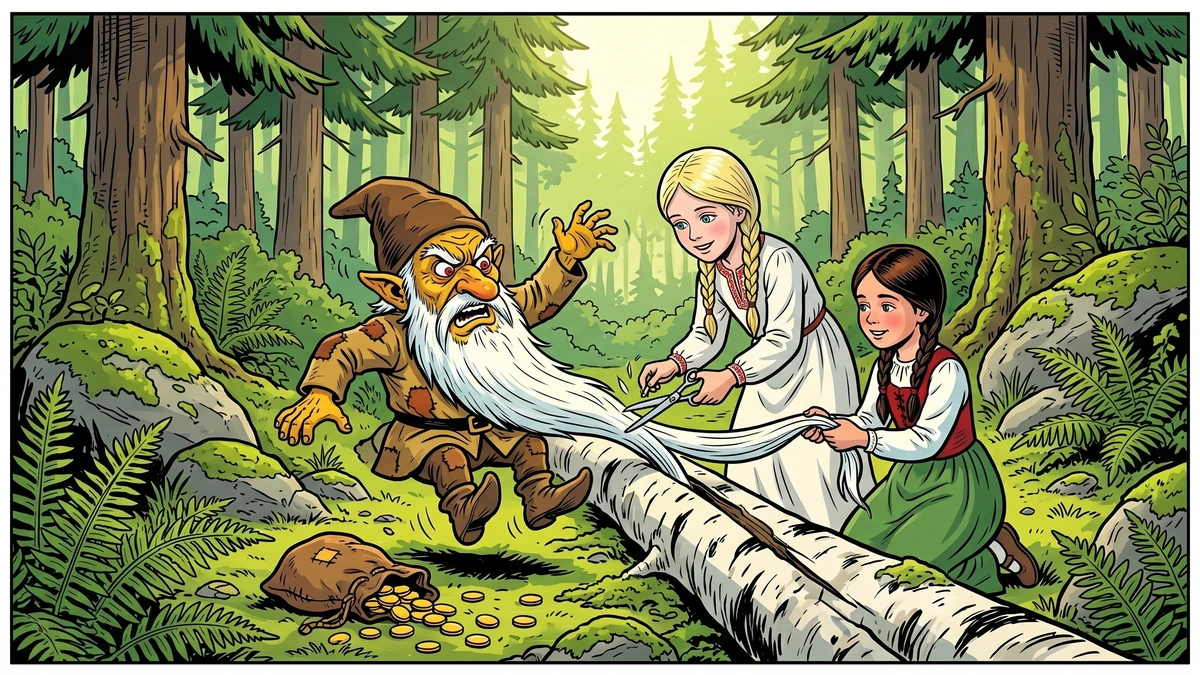
Some time afterwards the mother sent her two daughters into the forest to gather brushwood. They came to a great fallen tree, and on the trunk something was leaping and bobbing furiously. The girls drew nearer and saw a small dwarf with a long, withered face and a beard of snowy white that was a yard long. The end of the beard was wedged fast into a split in the tree-trunk, and the little man was hopping about like a dog at the end of a chain, unable to free himself. He turned his fiery red eyes on the girls and screamed, “Why do you stand there gaping? Can you not come and help me?” “What were you doing, little man?” asked Rose-Red. “You stupid prying goose!” the dwarf answered. “I was going to split the tree to get a little wood for cooking, the great lumps of these forest logs would burn up the small bit of food we cook—we do not gobble down so much as you coarse, greedy folk! I had driven my wedge into it nicely, and all would have gone well, but the wretched wedge was too smooth and sprang out, and the tree closed so quickly that I could not pull out my beautiful white beard. Now it is fast in there, and I cannot get away!” The girls tried hard, but the beard was too tightly held, so Snow-White took out her scissors and snipped off the end of the beard. As soon as the dwarf was free he picked up a sack full of gold that lay among the roots, swung it on his shoulder, and made off, grumbling, “Uncouth creatures, to cut off a piece of my fine beard! Bad luck go with you!”
Some time after, Snow-White and Rose-Red went to catch a dish of fish for supper. As they came near the brook, they saw something like a large grasshopper hopping toward the water, as if it were going to leap in. They ran nearer, and recognised the dwarf again. “Where are you going?” said Rose-Red. “You surely don’t want to jump into the water?” “I am no such fool!” cried the dwarf. “Don’t you see that this confounded fish wants to drag me in?” The little man had been sitting there fishing, and unluckily the wind had twisted his beard into the line; just then a great fish had bitten, and the helpless little creature had not strength enough to draw it out; the fish was the stronger and was pulling the dwarf nearer and nearer the water. He held on to all the reeds and rushes, but it was of little use; he must follow the fish’s movements, and was in great danger of being dragged into the brook. The girls came just in time; they held him fast and tried to free his beard from the line, but in vain—beard and line were entangled too closely. Nothing remained but to bring out the scissors and snip off another small piece of the beard. When the dwarf saw what was done, he cried out in fury, “You toad-stools! Is that the way to disfigure one’s face? Was it not enough to cut off the end of my beard? Now you have cut off the best part of it! I cannot let myself be seen by my own people!” Then he fetched up a sack of pearls that lay among the rushes, and without saying another word he dragged it away and disappeared behind a stone.
Soon afterwards the mother sent the two girls to the town to buy needles and thread, and laces and ribbons. The road led them across a heath upon which great pieces of rock lay scattered. There they saw a large bird hovering in the air, sweeping slowly above them, and gradually descending until it darted down at last upon a rock a little way off. Immediately they heard a loud, piteous cry. They ran up and saw, with horror, that the eagle had seized their old acquaintance the dwarf, and was about to carry him off. The kind children at once took tight hold of the little man, and pulled against the eagle so long that at last he let his prey go. As soon as the dwarf had recovered from his first fright, he cried out in his wicked little voice, “Could you not have done it more carefully? You dragged at my brown coat so that it is all torn and full of holes, you hateful, awkward hussies!” Then he took up a sack of precious stones and slipped into his hole again under the rock. The girls, who by this time were used to his ingratitude, went on their way and did their business in the town.
The Bear Returns and the Spell Is Broken
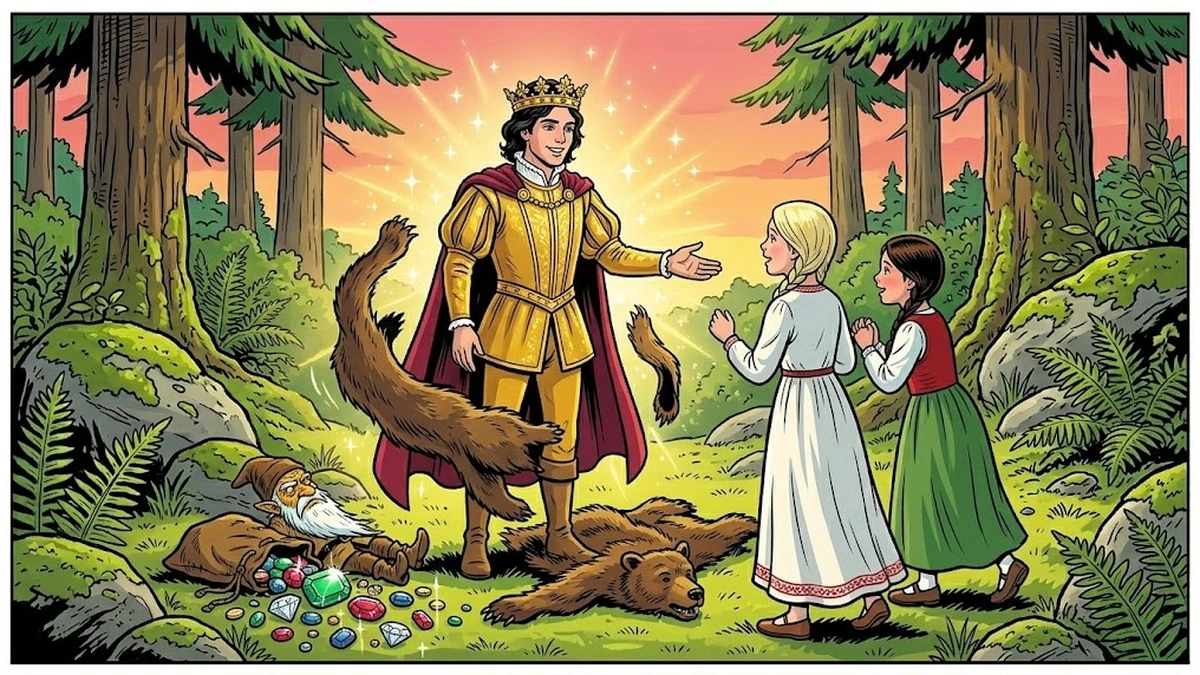
As the two sisters were coming home across the heath they surprised the dwarf again, who had emptied his bag of precious stones in a clean little spot, and had not thought that anyone would come by so late. The evening sun shone upon the brilliant stones, and they glittered and sparkled with all colours so beautifully that the children stood still and looked at them. “Why do you stand gaping there?” cried the dwarf, and his ashen-grey face became copper-red with rage. He was about to go on with his bad words when a loud growling was heard, and a great black bear came trotting toward them out of the forest. The dwarf sprang up in a fright, but he could not reach his cave, for the bear was already close. Then in his terror he cried out, “Dear Mr. Bear, spare me, I will give you all my treasures; look, the beautiful precious stones lying there! Grant me my life; what good can such a slender little fellow as I be to you? You would not feel me between your teeth. Come, take these two wicked girls; they are tender morsels for you, fat as young quails; for mercy’s sake, eat them!” The bear did not trouble himself to answer the wicked creature, but gave him a single blow with his great paw, and the dwarf moved no more.
The girls had run away in terror, but the bear called after them, “Schneeweißchen und Rosenrot, fürchtet euch nicht, wartet, ich will mit euch gehen!”—”Snow-White and Rose-Red, do not be afraid; wait, I will come with you.” Then they recognised his voice and waited; and when he came up to them his bear-skin suddenly fell off, and he stood there a handsome man, clothed all in gold. “I am the son of a king,” he said, “and was bewitched by that wicked dwarf, who had stolen my treasures; I have had to run about the forest as a savage bear until I should be freed by his death. Now he has got his well-deserved punishment.” Snow-White was married to him afterwards, and Rose-Red to his brother, and they divided between them the great treasure which the dwarf had hoarded in his cave. The old mother lived many years peacefully with her children, and she carried the two rose-trees with her, and they stood before her window, and every year bore the most beautiful roses, white and red.
Moral and the Original German Closing
“Die alte Mutter aber lebte noch lange ruhig und glücklich bei ihren Kindern. Die zwei Rosenstöcke aber nahm sie mit, und sie standen vor ihrem Fenster und trugen jedes Jahr die schönsten Rosen, weiß und roth.”
—Brüder Grimm, Kinder- und Hausmärchen, KHM 161 (Ausgabe letzter Hand, 1857)
The closing image of the two rose-trees, transplanted from the cottage garden to bloom outside the prince’s window every year in white and in red, is the moral compressed into a single domestic emblem. Snow-White and Rose-Red were unfailingly kind even to the dwarf who insulted them at every turn, and unfailingly loyal to the bear no one else could see was a man. Patient, undemanding kindness ripens, in its own slow way, into the only treasure worth keeping—a household where two sisters who love each other still walk hand in hand, where their mother grows old in peace, and where the rose-trees keep flowering. The dwarf’s gold and pearls and jewels, hoarded underground and stolen from a prince, did him no good in the end; the sisters, who never asked for any of it, inherit half of it without ever having coveted a single stone. In the moral economy of the Grimm tale, what is grasped greedily collapses, and what is given freely returns multiplied.
Why the Tale Has Lasted
Of all the two hundred-odd tales in the Kinder- und Hausmärchen, Snow-White and Rose-Red is one of only a small handful in which two sisters love each other unreservedly from beginning to end. There is no jealous elder, no cruel younger, no mother who favours one over the other; the angel who watches over the children at the opening of the tale is in some sense the whole emotional climate of the story. Modern readers and folklorists alike have noticed how unusual this is: most fairy tales, as Bruno Bettelheim and Maria Tatar have written, work by splitting feminine experience into rival doubles—Cinderella and her stepsisters, the queen and Snow White, the kind girl and the unkind girl at the well. KHM 161 refuses that split. Snow-White and Rose-Red are different in temperament but equal in goodness, and the story rewards them with husbands who are themselves brothers, so that the sisters need never be parted. For more than a hundred and eighty years readers have come back to the tale because it offers a vision, rare in the Grimm corpus, of female kinship as an unbroken bond. The fact that the kingdom is restored and the prince disenchanted only because two ordinary girls were patient with a half-frozen bear and a bad-tempered dwarf is, in the end, the deeper claim the tale makes: that the world is mended not by heroes who cut down enemies but by sisters who keep the door open in winter.
Frequently Asked Questions
Who wrote ‘Snow-White and Rose-Red’ and where does it come from?
Wilhelm Grimm wrote the version we know today. He took the basic plot from Caroline Stahl’s 1818 children’s tale ‘Der undankbare Zwerg’ (The Ungrateful Dwarf), published in Nuremberg, and rewrote it extensively, adding the widow’s cottage, the two rose-trees, the long winter friendship with the bear, and the closing transformation. He published it first in Wilhelm Hauff’s Mährchen-Almanach für 1827 and then included it as KHM 161 in the 1843 (fifth) edition of the Brothers Grimm’s Kinder- und Hausmärchen, where it remained through the final 1857 edition.
What is the international tale-type number of this story?
Folklorists classify it as ATU 426 in the Aarne-Thompson-Uther Index — ‘The Two Girls, the Bear, and the Dwarf.’ This Grimm tale is in fact the chief and most widely recorded representative of ATU 426; the type is otherwise rare. Stith Thompson’s Motif-Index links it to motifs D 313.3 (transformation of prince to bear), D 711 (disenchantment by killing the enchanter), F 451.5.2 (malevolent dwarf), and N 815 (helpful supernatural beast).
Why is the bear under a spell, and what breaks it?
The bear is a prince whom the wicked dwarf has bewitched and robbed of his kingdom’s treasures. The spell can only be broken by the death of the enchanter himself — a classic ATU 426 / motif D 711 disenchantment. When the dwarf is killed by a single blow of the bear’s paw on the heath, the bear-skin falls away and the prince stands revealed in golden robes. He then marries Snow-White, and his brother marries Rose-Red, so the two devoted sisters need never be parted.
Who are Caroline Stahl and Heinz Rölleke, and why do they matter to this story?
Caroline Stahl (1776–1837) was a Baltic-German children’s author whose 1818 collection ‘Fabeln, Mährchen und Erzählungen für Kinder’ contained ‘Der undankbare Zwerg,’ the literary kernel that Wilhelm Grimm rewrote into KHM 161. Heinz Rölleke is the most authoritative modern editor of the Grimm corpus; in his commentary on the Kinder- und Hausmärchen he identifies Stahl as the source and shows how Wilhelm transformed her spare moral tale into a full-length household fairy tale, weaving in older motifs of the dwarf whose beard repeatedly catches in awkward objects, found in Tyrolean dwarf legends collected by Ignaz Vinzenz Zingerle.
What is unusual about the relationship between the two sisters in this tale?
Of all the two-hundred-odd tales in the Grimms’ Kinder- und Hausmärchen, this is one of only a small handful in which two sisters love each other unreservedly from beginning to end. There is no jealous elder, no cruel younger, no mother who favours one over the other — a striking departure from the rival-doubles pattern (Cinderella and her stepsisters, Snow White and the queen, the kind girl and the unkind girl at the well) that runs through most of the Grimm corpus. The story rewards them with husbands who are themselves brothers, so that Schneeweißchen and Rosenrot can keep walking hand in hand even after they marry.
You May Also Like
 Grimm's Fairy Tales
Ages 9-12
Grimm's Fairy Tales
Ages 9-12
Clever Hans
Clever Hans: The mother of Hans said: ‘Whither away, Hans?’ Hans answered: ‘To Gretel.’ ‘Behave well, Hans.’ ‘Oh, I’ll behave well. Goodbye, mother.’ ‘Goodbye
 Grimm's Fairy Tales
Ages 9-12
Grimm's Fairy Tales
Ages 9-12
The Twelve Dancing Princesses
The Twelve Dancing Princesses: There was a king who had twelve beautiful daughters. They slept in twelve beds all in one room; and when they went to bed, the
 Grimm's Fairy Tales
Ages 9-12
Grimm's Fairy Tales
Ages 9-12
The Seven Ravens
The Seven Ravens: There was once a man who had seven sons, and last of all one daughter. Although the little girl was very pretty, she was so weak and small