The Twelve Dancing Princesses
The Twelve Dancing Princesses: There was a king who had twelve beautiful daughters. They slept in twelve beds all in one room; and when they went to bed, the
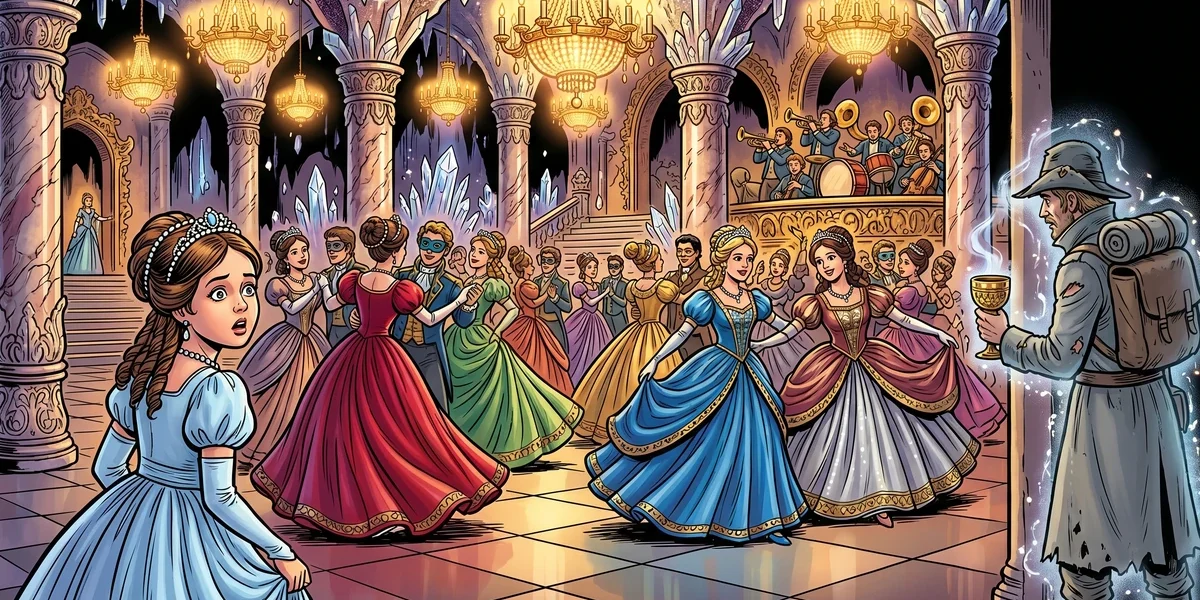
Die zertanzten Schuhe — “The Shoes That Were Danced to Pieces,” better known to English readers since Edgar Taylor’s 1826 German Popular Stories as The Twelve Dancing Princesses — is one of the most luminous mysteries in the Brothers Grimm collection. It is KHM 133 in the canonical seventh edition (1857) of the Kinder‑ und Hausmärchen, classified as ATU 306, “The Danced‑Out Shoes,” in the international Aarne–Thompson–Uther index. The tale entered the Grimm corpus in 1815 as tale number 47 in volume two of the first edition (Realschulbuchhandlung, Berlin), drawn from the Westphalian aristocratic circle around Jenny von Droste‑Hülshoff of Münsterland and a parallel Paderborn variant supplied by the von Haxthausen family. It is a story not of giant‑slaying or bloodied wedding vows but of a riddle the daylight cannot solve: every morning twelve pairs of dancing shoes lie silent and ruined on the bedroom floor, and no one knows why.
I. The Locked Door and the Worn‑Out Shoes
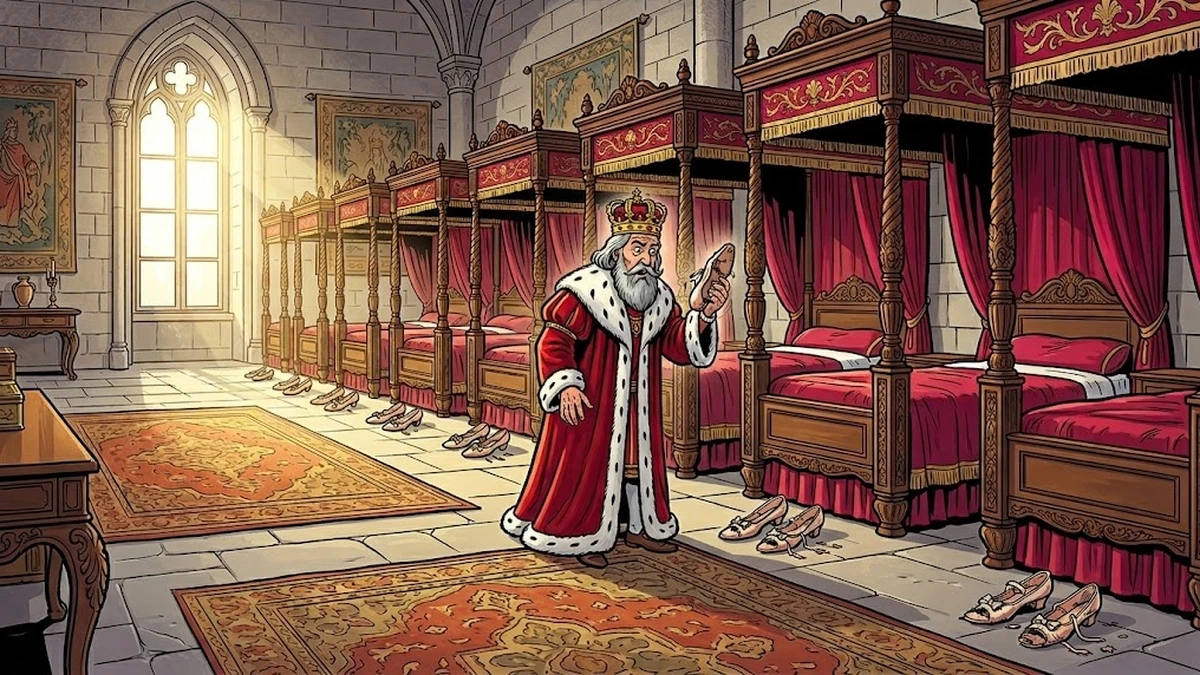
A king has twelve daughters, “each more beautiful than the last,” who sleep in a single long room behind a heavy door he locks himself every night. Each morning the door is found bolted as he left it; yet each morning, beneath each bed, lies a pair of dancing shoes “with their soles all in pieces” (ganz zertanzt). The king is at first amused, then curious, then ruined: shoemakers cannot keep up, and he cannot keep his mind on affairs of state. He proclaims throughout the kingdom that whoever discovers where his daughters dance away their nights for three nights running shall choose one of them for a wife and inherit the crown. Whoever fails forfeits his life.
The Grimms begin the märchen as a problem of evidence rather than valor. The court is not at war; no dragon waits at the gate. What threatens the kingdom is something the king cannot see — and what he cannot see he cannot govern. Many king’s sons come and go. Each is given a chamber adjoining the princesses’, each is told to keep watch. Each falls asleep, and at dawn the worn‑out slippers accuse him of having failed. After three nights they are led out to the executioner. The riddle accumulates a body count.
II. The Old Woman in the Wood and the Cloak of Invisibility
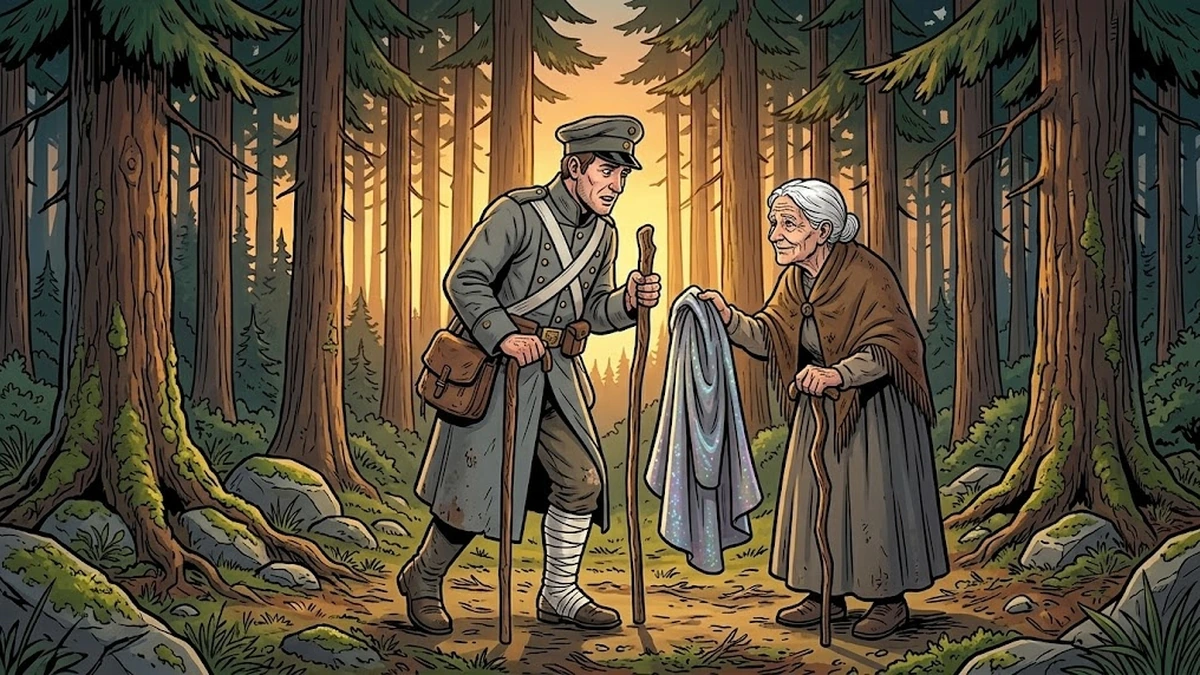
Into this kingdom limps a poor soldier, “wounded and no longer fit for service,” walking the forest road in search of bread. He meets an old woman — that figure beloved of the Westphalian tellers, half almsgiver, half initiated witch — who asks where he is bound. He tells her, half‑joking, that he hardly knows; perhaps he ought to find out where the king’s daughters wear out their shoes, and become king. The old woman is not amused. She is precise. She gives him two pieces of advice and one gift, and the gift is the engine of every subsequent scene.
“Drink no wine,” she says, “that is offered to you in the evening, and pretend to be fast asleep when you are watched.” Then she hands him a small cloak: “wenn du den umhängst, so bist du unsichtbar” — “when you put it on, you are invisible.” The soldier follows the path to the palace, presents himself to the king, and is taken on as the next watcher. Every detail of what is to come depends on these three transactions: the refused wine, the pretended sleep, the hidden cloak. The Grimms’ style is famously economical here; the old woman names the trap and gives him the means to walk through it, and the märchen never explains who she is. Folklorists since Bolte and Polívka have read her as the genre’s “donor” figure (Schenker), the tutelary helper whose presence in ATU 306 is structural rather than psychological.
III. The Trapdoor Beneath the Bed
That evening the eldest princess brings him a goblet of wine “as one brings a kindness.” The soldier raises it to his lips, but he has tied a sponge under his beard, and the wine runs into the sponge while not a drop passes his throat. He lies down, snores theatrically, and the princess laughs: “Der hätte auch sein Leben sparen können” — “He, too, could have saved his life.” They throw open their wardrobes, dress in gowns “such as one finds nowhere on earth,” and the youngest sister hesitates. “Mir ist so eigen zumute,” she says — “Something feels strange to me; I do not know what is the matter.” The eldest scolds her: “You are a goose; you are always frightened.” But the moment, brief and almost discarded, is the one the märchen most loves. In every dance‑and‑disappearance tale across Eurasia, it is the youngest who senses what the older sisters have learned to ignore.
The eldest knocks on her own bedstead. The bed sinks into the floor. A trapdoor opens. A flight of stairs descends into the earth. One after another the twelve princesses go down, the soldier — now wearing his invisible cloak — close behind the youngest. Once he treads on her gown by accident; she cries out, “Something has caught my dress!” The eldest answers, “It is only a nail in the wall.” So he learns to walk lightly. So the tale teaches its own listener that the invisible witness must also tread without weight.
IV. Trees of Silver, Gold, and Diamond — and the Twelve Princes of the Lake
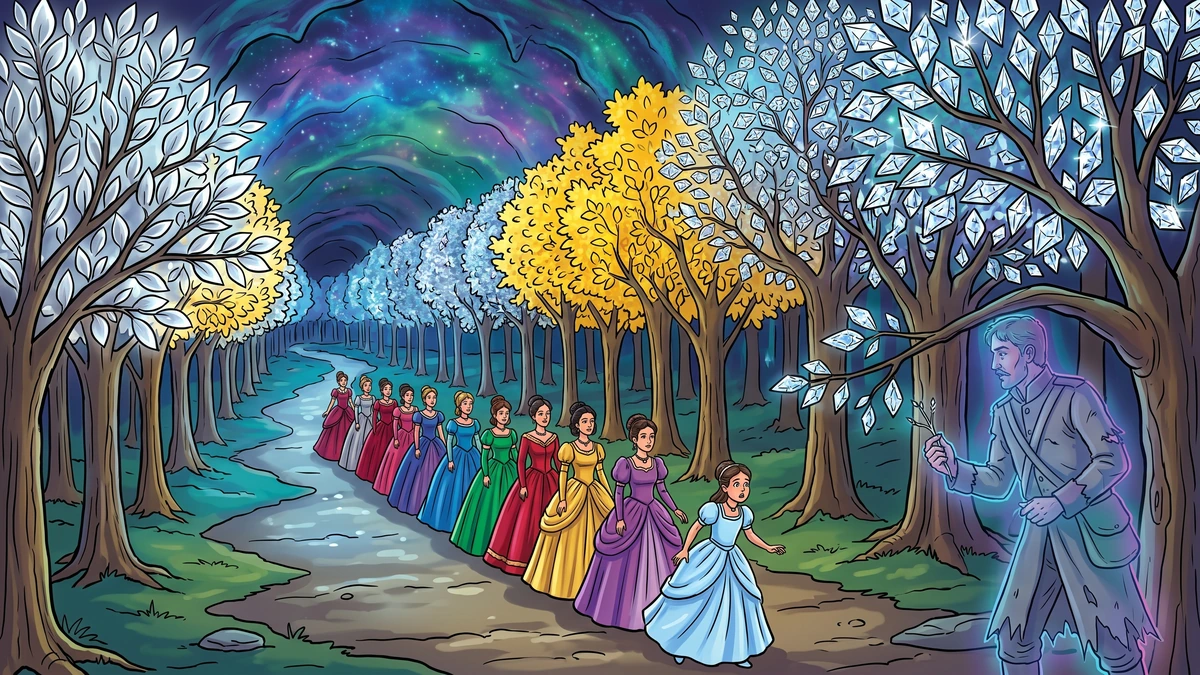
What waits underground is not a hell, nor a hoard, but a landscape so radiant that every English translator since Edgar Taylor has felt obliged to slow his prose. The princesses pass first through “an avenue of trees with leaves all of silver,” then through one whose leaves are gold, then through a third whose leaves are “von lauter Diamanten” — of pure diamonds. To carry proof, the soldier breaks a twig from each. The youngest hears the snap. “What is that crack?” she cries. “It is the joy in our princes’ guns,” answers the eldest, “for tomorrow we shall be set free.” So he learns that this is not the princesses’ first night. It is one in a long, perhaps endless, sequence; whatever spell holds them, they call it freedom, and they expect it to be lifted soon.
They reach a great underground lake. Twelve boats wait, with twelve handsome princes — one for each princess. The soldier steps into the youngest’s boat. Her prince rows hard and complains: “I do not know how it is — the boat is so heavy tonight, I am quite tired.” She glances at her sisters and at the dark water and is silent. They cross to a brilliant castle, “from which lights blazed out and the sound of drums and trumpets came.” There, until three in the morning, the twelve princesses dance until “their shoes are full of holes and they are forced to leave off.”
V. Three Nights, Three Tokens, and the Soldier’s Quiet Reckoning
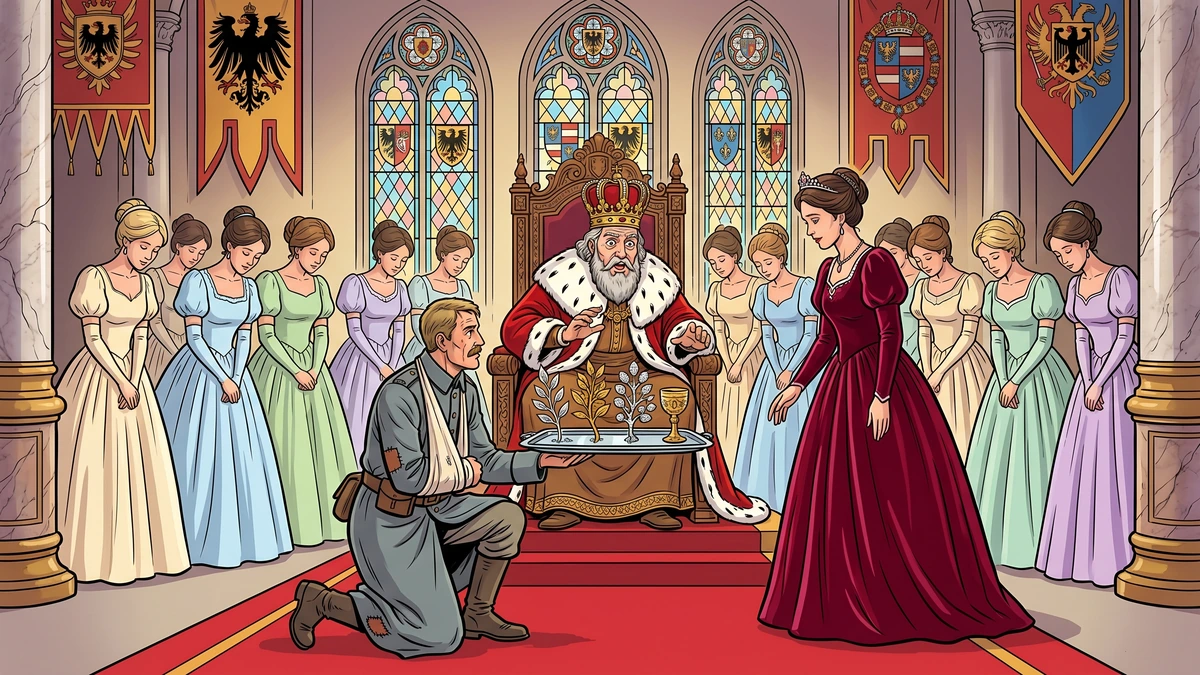
On the way back the soldier — still invisible — drinks from each princess’s goblet so that they reach the surface thirsty and disordered. He is in his room, snoring, before they re‑enter. In the morning he says nothing. The king summons him: “Where did my daughters dance their shoes to pieces?” “I have nothing to say yet, your Majesty,” he answers. “Give me two more nights.” The Grimms hold the suspense over three full nights — the folkloric tripling that ATU 306 demands — but they never let the soldier boast. He gathers his evidence as a soldier would: a silver twig, then a gold one, then a diamond twig, and on the third night a small golden goblet from the underground feast. Each is wrapped quietly into his coat.
On the morning after the third night the king asks again. This time the soldier kneels, lays out the four shining tokens, and tells the whole story — the wine, the sponge, the bedstead, the trees, the lake, the dance — exactly as it happened. The king calls in the princesses. They cannot deny what is on the table before them; they confess. The king turns to the soldier: “Which of them will you have for your wife?” The soldier answers, with the blunt practicality of his trade and station, “Ich bin nicht mehr jung; so gebt mir die älteste” — “I am no longer young; so give me the eldest.” That same day the wedding is celebrated. The princes who rowed the boats below are sentenced to remain enchanted “as many days more as they had danced nights with the twelve princesses” — an exact, almost ledger‑like reckoning. The riddle closes; the kingdom is whole again; the locked door, at last, is only a door.
Moral
“Drink keinen Wein, den man dir abends reicht, und stelle dich, als wärest du fest eingeschlafen.”
“Drink no wine that is offered you in the evening, and pretend to be fast asleep when you are watched.”
— the old woman of the wood, in Die zertanzten Schuhe, KHM 133 (1857)
The moral the märchen actually teaches is not “do not dance,” nor even “do not deceive your father.” It is closer to the old soldier’s economy of attention: the world’s most stubborn riddles are not solved by force but by refusing the cup, keeping silent, and watching carefully for three nights. Where his royal predecessors hurried — drank the offered wine, slept proudly, demanded an answer in a single morning — the soldier accepts that real evidence costs three full nights, four heavy tokens, and the discipline to walk so lightly that even the youngest princess, who alone could feel him, is overruled by her sisters. In that quietness the tale locates its ethic. Vigilance, in the Westphalian moral imagination of the Grimms’ informants, is the form love and government both finally take.
Textual Origins, Variants, and Editorial Hand
The Grimms first printed Die zertanzten Schuhe as tale 47 of volume 2 of the 1815 first edition (the so‑called “kleine Ausgabe” of the brothers’ early manuscript practice was not yet in circulation). In their own scholarly notes — collected after 1819 in volume three of the second edition and in greatly expanded form in the 1856 final apparatus — the brothers list the tale as “aus dem Münsterland” (from Münsterland), the family seat of Jenny von Droste‑Hülshoff (1795–1859), elder sister of the poet Annette von Droste‑Hülshoff. Jenny and her circle around Bökendorf — including her aunts and the daughters of August von Haxthausen — were among the most productive of the Grimms’ Westphalian informants. The Grimms also note a Paderborn variant, supplied by the Haxthausen household, in which only three princesses dance, escorted by three giants, and a soldier outwits them by tipping the drugged wine into a sponge tied beneath his beard. The sponge detail, the Paderborn version’s most distinctive folktale signature, is the one the Grimms preserved in the canonical text.
Across the seven editions printed in their lifetime — 1815, 1819, 1837, 1840, 1843, 1850, and 1857 — the brothers (chiefly Wilhelm) trimmed coarser detail and clarified motivation: in early editions the eldest princess says simply that the watchers “have come for the same fate” as before, while in 1857 she says it with the cool theatrical pity that is a hallmark of Wilhelm’s late style. The number of trees climbed (silver, gold, diamond) is held constant from 1815 onward; the goblet brought back from the dance hall — sometimes a cup, sometimes a small jeweled bowl in earlier oral variants — settles in the canonical edition as “einen Becher”, a handled drinking vessel of the kind Westphalian estates of the Droste‑Hülshoff sort still kept in their plate cupboards. The translation history follows that 1857 text. Edgar Taylor‘s 1826 German Popular Stories Vol. II rendered it as “The Shoes of Dance,” for a London juvenile audience; Margaret Hunt‘s 1884 Grimm’s Household Tales standardized the English title as “The Shoes That Were Danced to Pieces”; Andrew Lang‘s Red Fairy Book (1890) introduced the durable English title “The Twelve Dancing Princesses” through a French source as well; Lucy Crane‘s 1882 illustrated edition (Macmillan, with Walter Crane’s plates) and the Margaret Hunt 1884 translation together fixed the English vocabulary that Anglophone readers still use today.
The international index records ATU 306 (“The Danced‑Out Shoes”) as a discrete tale type with attestations across central Europe — Germany, Austria, Bohemia, Slovakia, Poland, Hungary — and outliers in France, Scotland, and Russia. Hans‑Jörg Uther’s 2004 revision retains 306 as a stable type and groups the Grimm version with the Czech “O dvanácti tanečnicích” and the Hungarian variants in which the youngest princess rather than the eldest is given to the soldier. The Westphalian text is, by Uther’s reckoning, the locus classicus of the type. Its closest published cousin is “Kate Crackernuts,” a Scottish märchen first printed by Andrew Lang in 1889 from an Orcadian source — there too a watcher follows enchanted royalty into an underground dance hall, and there too the spell is broken by what the watcher quietly carries home.
Why It Has Lasted
Eight centuries of European storytelling have produced no shortage of locked‑door mysteries, but few have survived translation as gracefully as Die zertanzten Schuhe. There are several reasons. The first is structural: ATU 306 is one of the few fairy‑tale types whose hero is neither prince nor pauper’s son but a discharged soldier — wounded, unfit for service, and walking home with nothing but a coat. He carries the war into the palace as a habit of caution, and the märchen rewards that habit. From Edgar Taylor’s 1826 English version through Margaret Hunt’s 1884 standard translation, Andrew Lang’s Red Fairy Book (1890), and Walter de la Mare’s 1927 adaptation, every retelling has held onto the soldier’s quietness as the tale’s true engine.
The second reason is the underground itself. The avenues of silver, gold, and diamond trees have given Western artists a stable iconography for over a century — Arthur Rackham’s 1909 Fairy Tales of the Brothers Grimm illustration of the soldier breaking the diamond twig is still the image most readers carry. The third is the bookkeeping at the end. The Grimms’ märchen does not punish the princesses; it does not even moralize their dancing. It simply closes the trapdoor, returns the kingdom to legibility, and pays the underground princes for their dance‑nights in days of further enchantment. There is no villain; there is only a riddle, and the careful man who solves it. That, more than any of the lustrous trees, is why “The Twelve Dancing Princesses” has outlasted the kingdom that locked the door.
One last point of textual interest: the märchen ends not with a wedding feast description, as so many Grimm tales do, but with a sentence of judicial bookkeeping. The underground princes are punished “for as many days as they had danced nights” — a calendrical equivalence so exact that Heinz Rölleke, in his definitive 1985 commentary on the canonical text (Kinder‑ und Hausmärchen, Ausgabe letzter Hand), notes its kinship with the early modern Stundenbuch tradition of measuring sin and penance in matched units of time. Where many fairy tales banish their unbroken antagonists into vague forests or vague seas, the Westphalian informants of Die zertanzten Schuhe understood the language of accounts. Time owed in nights of stolen dancing must be repaid in days of further enchantment, and the sum, once balanced, closes the case. It is the most quietly Protestant of all the Grimm endings, and one of the reasons the tale has felt at home in every nineteenth‑ and twentieth‑century retelling without ever needing the moralizing apparatus that other märchen had to be lent.
You May Also Like
 Grimm's Fairy Tales
Ages 9-12
Grimm's Fairy Tales
Ages 9-12
Cat and Mouse in Partnership
A cat and a mouse hide a pot of fat for winter, but not every friend keeps a promise.
 Grimm's Fairy Tales
Ages 9-12
Grimm's Fairy Tales
Ages 9-12
The Queen Bee
The Queen Bee: Two kings’ sons once upon a time went into the world to seek their fortunes; but they soon fell into a wasteful foolish way of living, so that
 Grimm's Fairy Tales
Ages 9-12
Grimm's Fairy Tales
Ages 9-12
Briar Rose
Briar Rose: A king and queen once upon a time reigned in a country a great way off, where there were in those days fairies. Now this king and queen had plenty