1003+ Stories from Ancient India — Free to Read! Explore all stories →

The Wolf and the Seven Young Goats

The Wolf and the Seven Young Goats: In the days when animals spoke and understood the human tongue, there lived a mother goat with seven children born under a

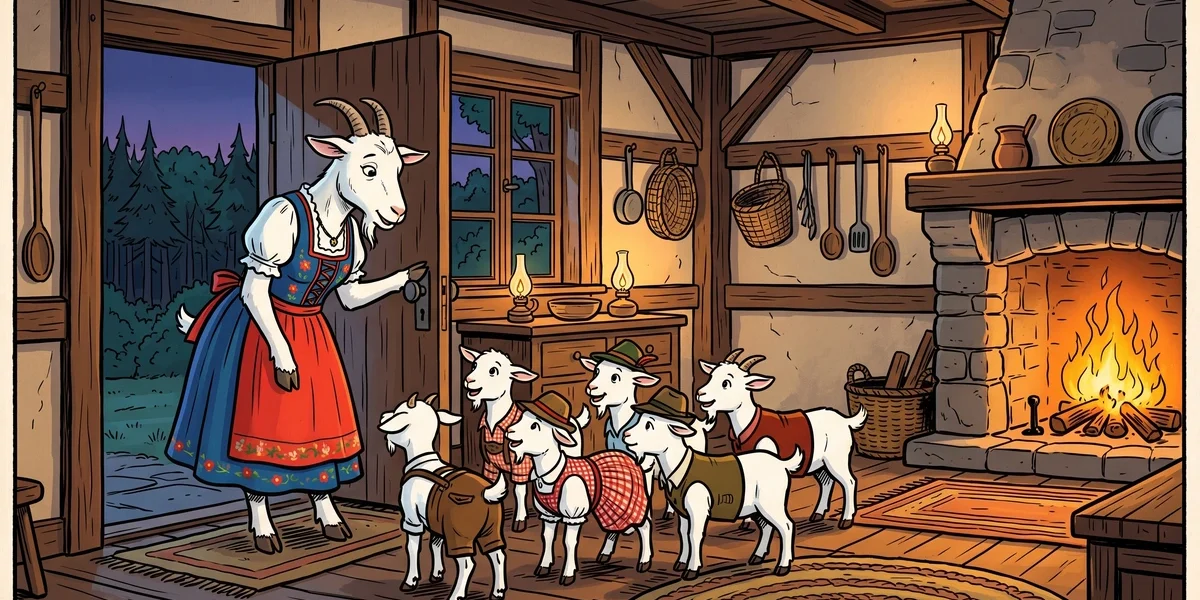
Mother goat with seven young goats in German cottage ACK style
Ad Space (header)

The Wolf and the Seven Young Goats — in German Der Wolf und die sieben jungen Geißlein — is one of the most beloved animal fables in the Brothers Grimm collection. It appears as tale number 5 (KHM 5) in the Kinder- und Hausmärchen, the “Children’s and Household Tales,” first published by Jacob and Wilhelm Grimm in Berlin in 1812 by the Realschulbuchhandlung. Folklorists classify the story as ATU 123, “The Wolf and the Kids,” in the Aarne–Thompson–Uther international index. Stith Thompson’s motifs K311.3 (disguise as the mother to gain entrance) and G81 (cruel wolf swallows victims, who are later rescued from his belly) are its narrative spine. The Grimms collected the story from the Hassenpflug family of Cassel — sisters Marie, Jeanette and Amalie — whose Huguenot-descended household supplied many of the most polished tales in the first edition. The tale is one of the oldest documented animal fables in Europe: a recognisable version appears in the medieval Latin fable collection Romulus, and an even closer cousin survives in Jean de La Fontaine’s Le Loup, la Chèvre et le Chevreau (Fables IV.15, 1668). Its lessons about obedience, deception and a mother’s tireless love have travelled across nine centuries without growing old.

The Wolf and the Seven Young Goats — mother goat with seven kids, ACK style illustration

The Mother’s Warning

In the days when forests still pressed close upon every farmstead and every mother knew the names of every wild creature beyond her gate, there lived an old goat in a snug timber cottage at the edge of the Hessian woods. She had seven young kids whom she loved with the whole strength of a goat’s heart: seven small, snowy creatures with bright eyes and the silly, skittering legs of all goat children. One bright morning the mother needed to fetch food from the forest, for her larder was bare and her seven hungry mouths bleated for fresh milk and clover. Before lifting the latch she called her kids around the wooden table and said in her gravest voice, “Dear children, I must go into the forest. Be on your guard against the wolf. If once he gets into the house he will eat you all up — skin, hair and all. The villain often disguises himself, but you may know him at once by his rough, gruff voice and his coal-black feet.”

The kids nodded earnestly, each promising to mind. “We will take good care, dear mother,” they answered with their seven small voices. “You may go without anxiety.” Reassured, the old goat bleated softly, gave each kid a tender lick upon the forehead, and trotted off down the woodland path with her market-basket slung across her back. In the cottage the seven young goats locked the heavy door, settled themselves around the warm hearth, and began to play their innocent games: telling riddles, leaping over the broom, drinking warm milk from the wooden bowl their mother had left ready. Outside the windows, the German pines rose dark and silent. And not far down the path, lurking behind a great mossy oak, the wolf was already watching the cottage with hungry yellow eyes.

Mother goat warns her seven young kids before leaving the cottage

The Wolf’s Three Cunning Disguises

The wolf was no ordinary forest creature. He had haunted the borders of these woods for many winters and learned the cleverest tricks of mimicry. Knowing the warning the mother had surely given, he set out at once to disguise the two things that would betray him — his rough voice and his coal-black paws. Soon he stood at the cottage door, knocked sharply, and called in a voice he made as deep and gravelly as he could manage: “Open the door, dear children — your mother is here, and has brought back something for each one of you.” But the wolf’s harsh voice betrayed him. “We will not open!” cried the seven kids in chorus. “You are not our mother. She has a soft, pretty voice. Your voice is rough — you are the wolf!” And they kept the door fast.

The wolf slunk away furious but not defeated. He hurried to the village and pushed open the door of the merchant’s shop. “A great lump of chalk, quickly!” he growled, and swallowed the chalk down whole, for he had heard from older wolves that white chalk would soften any rough voice. He returned to the cottage and knocked once more. “Open the door, dear children. Your mother has brought a present for each of you.” The voice was sweet now — sweet as cream — but as he leaned against the door his black paw fell upon the windowsill, and the kids saw it. “We will not open!” they cried. “Our mother has not a black foot like you. You are the wolf!”

So the wolf ran a third time, this time to the bake-house, and bullied the baker into spreading his paws thickly with white dough. Then he ran to the miller and demanded that fine white flour be sifted upon the dough until each paw was as snowy as a mother goat’s hoof. The miller hesitated, fearing he was about to do harm to someone, but the wolf threatened to eat him too, and so the trembling miller obeyed. With his voice now soft and his feet now white, the wolf returned a third time and knocked upon the cottage door. “Open the door, dear children. Your mother is here. She has brought home something good for each of you.”

The grey wolf with black paws at the cottage window, goats peering out suspiciously

The Hiding and the Swallowing

“Show us your foot first,” cried the kids cautiously, remembering their mother’s warning. The wolf placed one floured paw upon the windowsill, and the kids, seeing how white and gentle it looked, believed everything he said and unbarred the heavy door. Then in burst the wolf, eyes blazing, jaws wide open. The seven young goats screamed and scattered. The first kid leapt under the table; the second dove into the bed; the third hid in the iron stove, which was cold; the fourth ran into the kitchen pantry; the fifth squeezed into the cupboard; the sixth slipped behind the great brass washtub; and the seventh and youngest, the smallest, the cleverest, climbed into the case of the tall grandfather clock and pulled the door shut behind him. But the wolf hunted them out one by one. He pulled the first from beneath the table and swallowed it down whole. He yanked the second from the bed and swallowed it. He found the third, fourth, fifth and sixth, and swallowed them all in turn. Only the youngest in the clock-case, holding his breath behind the heavy oak door, escaped notice. With six fat kids weighing in his belly, the wolf staggered out of the cottage, lay down in the cool meadow under a green tree by a brook, and fell into a thick, snoring sleep.

It was not long before the mother goat came home from market. What a sight greeted her at her own gate! The door stood open. The chairs were overturned. The wash-basin lay broken. The bedclothes were dragged across the floor and the pillows lay scattered like spilled feathers. She searched and called for her children, one by one, by name, but received no answer. Tears welled in the old goat’s gentle eyes, and she sank by the hearth in despair. Then, faintly, came a small voice from inside the great clock-case: “Dear mother, I am here, in the clock!” She pulled open the door and found her youngest, trembling and weeping. He told her, tearfully, of the wolf’s terrible trick: how the chalk-softened voice and flour-whitened paw had deceived his brothers and sisters, how the wolf had swallowed them all and gone away.

Wolf bursts into the cottage, seven goats scatter and hide everywhere

The Rescue and the Stones

The mother goat wept aloud, but her grief was a fierce, working grief and not a helpless one. With the youngest kid trotting at her heels, she ran out across the meadow to find the villain. There, in the long grass under a green tree, lay the wolf snoring like a felled oak, his belly so swollen with stolen kids that it heaved up and down with each breath. And what did she see then? The fat belly was moving. Something inside was kicking and twitching. The kids were still alive! The wolf had been so greedy that he had bolted them down whole, without chewing.

The old goat sent her youngest sprinting back to the cottage for scissors, needle and thread. Then, while the wolf snored on, she opened her great pair of shears and snipped open his belly along one neat seam. Out leapt the eldest kid, alive and shaken; out came the second, the third, the fourth, the fifth, the sixth — all unharmed, for the wolf had been so hasty he had swallowed them whole. They tumbled, blinked at the sun, and threw themselves around their mother’s neck weeping for joy. But the mother had not finished. She bade her children fetch big round stones from the brookside as quickly as they could carry them. They filled the wolf’s empty belly with the stones, and the mother sewed the seam shut again with such fine careful stitches that the sleeping wolf never stirred. When her work was finished, mother and seven kids stole quietly back to the cottage and waited.

Mother goat rescues her six kids from the wolf's belly with scissors in sunny meadow

At last the wolf woke. The stones in his belly made him terribly thirsty, so he stood up to walk to the brook for a drink. But the heavy stones knocked together as he went and rolled inside him, and he muttered to himself, half-frightened: “What rumbles and tumbles inside me so? I thought I had eaten six little kids, but they feel like nothing but stones.” When he reached the brook’s edge and bent down to drink, the weight of the stones overbalanced him; he toppled head-first into the water and was drowned. From the meadow the seven kids saw the splash and cried out together, “The wolf is dead! The wolf is dead!” They danced with their mother around the brook in the bright morning, seven small white shapes circling one larger one, and the meadow rang with their happy bleating until the sun began to set.

Moral — Hütet euch vor dem Wolf

“Hütet euch vor dem Wolf, wenn er hereinkommt, so frißt er euch alle mit Haut und Haar.”
— The mother goat’s warning, Kinder- und Hausmärchen, KHM 5, Brothers Grimm 1812

The Grimms’ closing line, in the German of the 1812 first edition, can be translated as “Beware the wolf, for if he gets inside he will devour you, hide and hair alike.” The moral works on three layers at once. On its plainest surface, it is a parental survival lesson: do not open the door to strangers, no matter how sweet the voice or how fair the hand. On a deeper layer, it warns about the seductive power of disguise — that wickedness rarely arrives in honest dress, and that vigilance must extend beyond the obvious. And on its deepest level, the tale is a lesson in maternal courage and resourcefulness. The mother does not collapse before disaster; she gathers scissors and needle, opens the belly of evil itself and rescues what was lost. The story’s comfort is precisely this: the danger is real, but a watchful, patient love is stronger than the danger. That is why mothers across two centuries have read this story aloud at the bedside of small children — not to terrify, but to reassure.

Why This Story Has Lasted Two Centuries

The endurance of Der Wolf und die sieben jungen Geißlein rests on an architecture that folklorists call “the rule of three made unforgettable.” The wolf attempts the deception three times and is foiled twice before succeeding; the kids hide in seven places (matching their seven number); the rescue uses three tools — scissors, needle and stones. This rhythm of repetition with variation is precisely the structure that small children remember and that adults find comforting. Bolte and Pólivka, in their monumental Anmerkungen zu den Kinder- und Hausmärchen (1913, vol. I, §5), show that ATU 123 is documented continuously in European tradition since at least the eleventh-century Latin Romulus Aesop redaction, with cousins in Slavic, Italian, French and Hungarian collections. Jean de La Fontaine’s elegant 1668 verse Le Loup, la Chèvre et le Chevreau is a direct ancestor of the Grimm version: in La Fontaine the kid alone faces the wolf and uses the password “Foin du loup et de sa race,” (Down with the wolf and his race), but the central motif — the wolf imitating the mother’s voice and being unmasked — is identical. The Grimms’ great achievement was to combine the verse fable’s elegance with the deeper folkloric power of seven children, the three escalating disguises (voice, paw, paw-and-flour), and the magnificent ending of belly-cutting and stone-swapping — a primal image of justice that goes back to Greek myth (Cronos and his swallowed children) and to Norse legend.

The tale also occupies an important place in modern children’s culture. Walt Disney filmed it twice in the early Silly Symphonies era. It was the inspiration behind Sergei Prokofiev’s Peter and the Wolf (1936), which lifted the wolf-figure directly from this tradition. In Asian markets, especially Japan and China, it is one of the most-translated Grimm tales, often paired with Little Red Riding Hood in school readers because both feature ATU 333/123 wolf-trickster motifs. The Hassenpflug sisters’ oral text — gathered in their Cassel parlour during the Napoleonic wars — has thus become a piece of nearly universal world heritage.

Historical and Cultural Context

The Brothers Grimm collected this tale during one of the most turbulent decades of German history. Cassel, where the Grimms lived, had been annexed by Napoleon’s brother Jérôme into the puppet Kingdom of Westphalia in 1807. By the time the first volume of Kinder- und Hausmärchen went to press in Berlin in December 1812, the brothers had spent five years quietly assembling oral material under French occupation, partly as a deliberate act of cultural preservation. The Hassenpflug family — daughters of Johannes Hassenpflug, a senior official in Cassel — were among their earliest informants. Marie Hassenpflug (1788–1856), Jeanette (1791–1860), and Amalie (1800–1871) are credited (in Wilhelm Grimm’s own marginal notes) with supplying KHM 1 (The Frog King), KHM 21 (Cinderella), KHM 26 (Little Red Riding Hood), and many others, alongside KHM 5. Their family was of Huguenot descent, and their version of the wolf-and-kids tale therefore carries direct French literary echoes — particularly La Fontaine’s — folded into a German oral idiom.

The 1819 second edition softened the language for younger ears. By the 1857 seventh edition (Grosse Ausgabe, published in Göttingen by Dieterichsche Buchhandlung), Wilhelm Grimm had polished the prose into the form most readers know today. Edgar Taylor’s English translation of 1823 (German Popular Stories) and Margaret Hunt’s definitive Grimm’s Household Tales (1884) both kept the title The Wolf and the Seven Young Kids; Lucy Crane’s 1882 children’s edition introduced the lush watercolour aesthetic that has shaped every Western illustrator from Walter Crane and Arthur Rackham through Trina Schart Hyman. Today the tale is taught in German Grundschule reading curricula and is a standard text in international comparative-literature courses on European fairy tales.

Why It Still Matters in 2026

For modern parents, the story’s power lies in its honesty. It does not pretend that the world has no wolves. It does not soften the truth that small creatures — children, especially — can be deceived by sweet voices and clean-looking hands. But it insists, with great tenderness, that watchfulness is teachable, and that love is rescuable. The youngest kid, hiding in the clock-case, is the still small voice of vigilance every parent hopes their child will keep alive. The mother goat, with her scissors and needle, is the figure of patient, practical, restoring love. Two hundred and fourteen years after its first printing, the story still says to a child at bedtime: The dangers in the world are real, but so is the love that watches over you. That is why — in Hessian cottages, in Hindi-language anthologies in Indian schools, in Japanese picture-books, in the libraries of folklore departments from Helsinki to Hyderabad — Der Wolf und die sieben jungen Geißlein still finds new readers each year. It is one of the great mother-and-children stories of world literature, and it has earned every one of its two centuries.

Ad Space (in-content)
Ad Space (after-content)

Get a New Story Every Week!

Join thousands of parents and teachers who receive our hand-picked folk tales every Friday. Stories with morals your kids will love.

Free forever. No spam. Unsubscribe anytime.