The Turnip
The Turnip: There were two brothers who were both soldiers; the one was rich and the other poor. The poor man thought he would try to better himself; so
Origin: Germany — Kinder- und Hausmärchen, Brothers Grimm, KHM 146 (“Die Rübe”), first published in the second edition, vol. 2 (Berlin: Realschulbuchhandlung, 1819). Tale type: ATU 1689A “Two Presents for the King” + ATU 1960D “The Giant Vegetable” + episode of ATU 1737 “The Clergyman in the Sack to Heaven.” Translators: Edgar Taylor (London, 1826, German Popular Stories, vol. 2) and Margaret Hunt (London, 1884). Read time: 10 minutes.
The Story Behind the Story: A Medieval Latin Comedy in Peasant Disguise
“The Turnip” is one of the most unusual tales in the Grimms’ collection because, almost uniquely among the two hundred märchen, its written source is known and survives. While most KHM tales were collected from oral informants in Hesse, the Wilhelm and Jacob Grimm reworked KHM 146 from the Rapularius, an anonymous Latin elegiac verse poem composed in southern Germany around the year 1200, in the Ovidian style favored by twelfth- and thirteenth-century learned schoolmen. The Rapularius — its title literally meaning “the turnip-narrative” — combines two episodes from the wider European trickster tradition: the giant root presented to a king, and the cunning servant who tricks his greedy rival into being carried into the forest in a sack. Jan M. Ziolkowski’s landmark study (Journal of Medieval Latin 13, 2003) demonstrated in line-by-line comparison how the Grimms compressed the medieval poem’s clerical satire into a folk tale fit for a German nursery, stripping the Latin classroom jokes and Ovidian flourishes while preserving the comic geometry of the plot.
The two brothers of the märchen — one rich, one poor; one a soldier, one a gardener — descend straight from the medieval poem’s two clerks of opposing fortunes. The vast turnip itself comes from a much older tradition: Pliny the Elder, in his Naturalis Historia XIX.78, records that turnips in Germany sometimes grew “to forty pounds in weight,” and the medieval Latin verse turns this Plinian curiosity into a vegetable so colossal it requires two oxen to draw it. The motif of the giant vegetable presented as tribute to a sovereign migrated across Europe through the Latin schoolbooks; it surfaces in Russia, in Austria, and even in late Roman gardening manuals before settling into the Grimm canon.
The First Brother: A Soldier Turns His Sword into a Spade
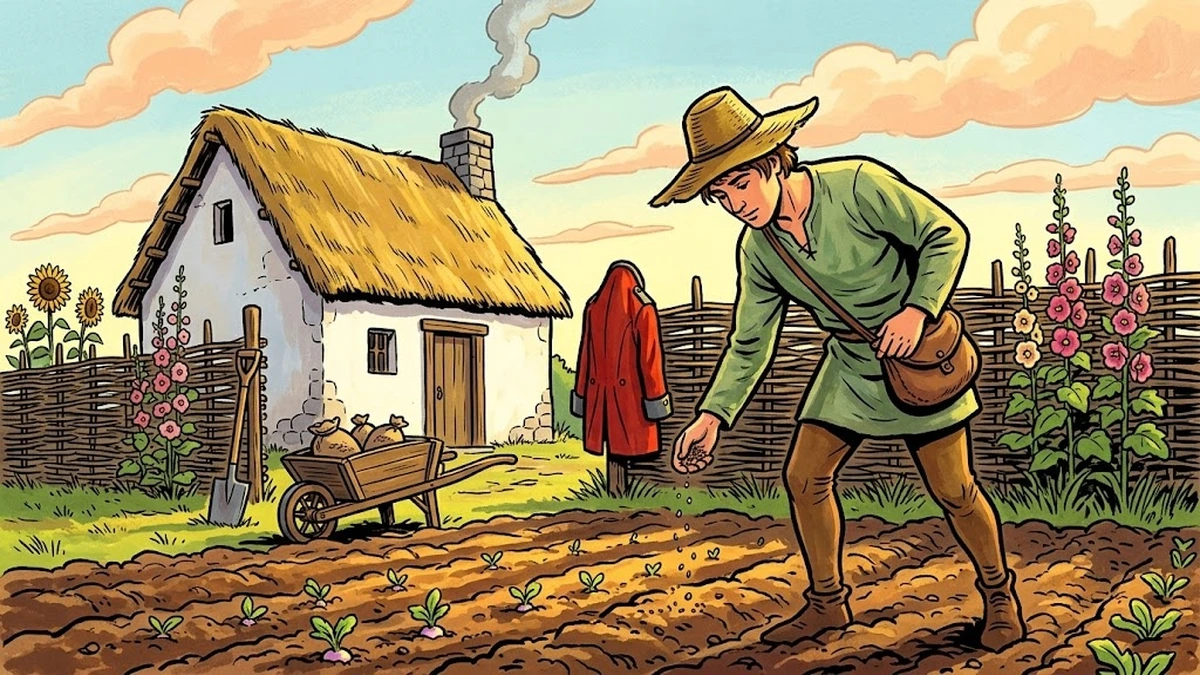
The tale opens with two soldier-brothers home from war. The elder is rich, having bought himself a fine farm with his pay; the younger is poor, having spent his on drink and dice. Determined to better himself by honest labor, the poor brother lays aside the red coat of his regiment and takes up the spade. He digs a small plot, sows turnip-seed, and waits. From the very first sowing, one plant rises taller than the others, broader, prouder, swelling day by day until it splits the earth around it like a green crown forcing through the soil. By harvest the turnip is so vast that no man can lift it; the gardener yokes a pair of oxen and even they bend to the load.
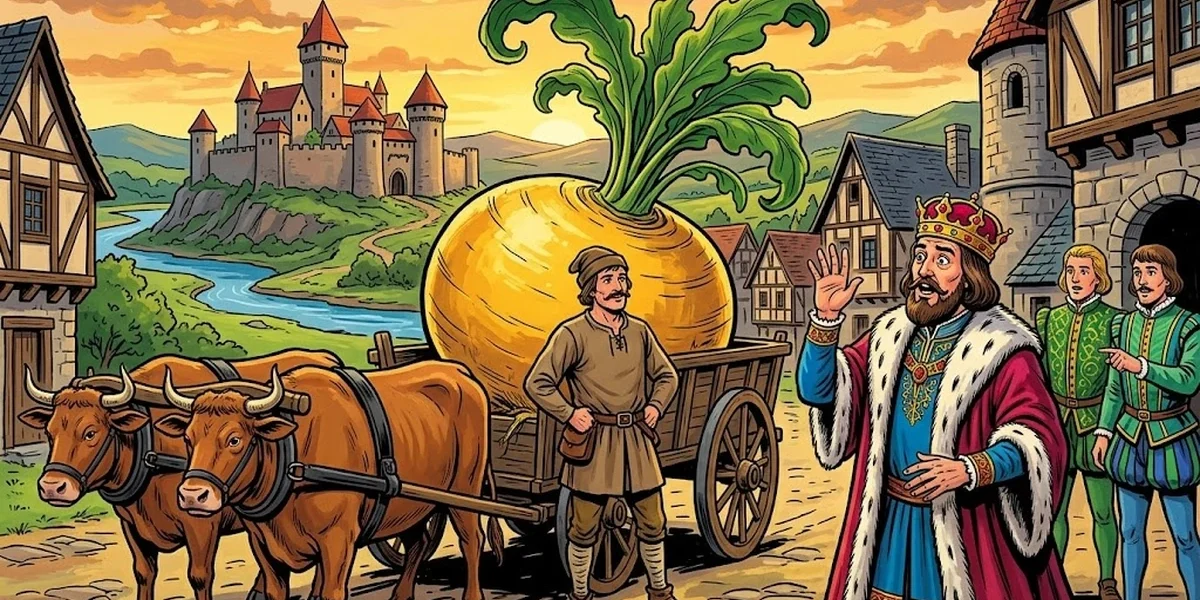
The choice that follows reveals the gardener’s character. He cannot sell the monstrous turnip — the market wants small, sweet ones, not a fairground curiosity. He cannot eat it — the flesh of so old and woody a root would be tough as oak. He decides instead to do the kingly thing: he will give it away. “I will carry it to the king,” he says, “as a mark of respect, that he may know what the soil of my garden can do.” It is the gesture of a man whose spade has taught him generosity, and whose poverty has not soured him. He leads his oxen to the palace gate.
The king receives the turnip with the same wonder a connoisseur shows before a relic. He has seen many strange things — campaigns, princesses, foreign embassies — but never a vegetable to fill a wagon. He questions the gardener about his life: how he sows, how he reaps, why he chose the spade over the sword. Touched by the man’s industry and modesty, the king bestows on him a great estate, herds of cattle, fields of corn, and a fortune in gold sufficient to make him richer than any soldier in the kingdom. The poor brother goes home a great lord. The turnip stays in the royal garden as a marvel.
The Second Brother: Envy Takes the Road to Court
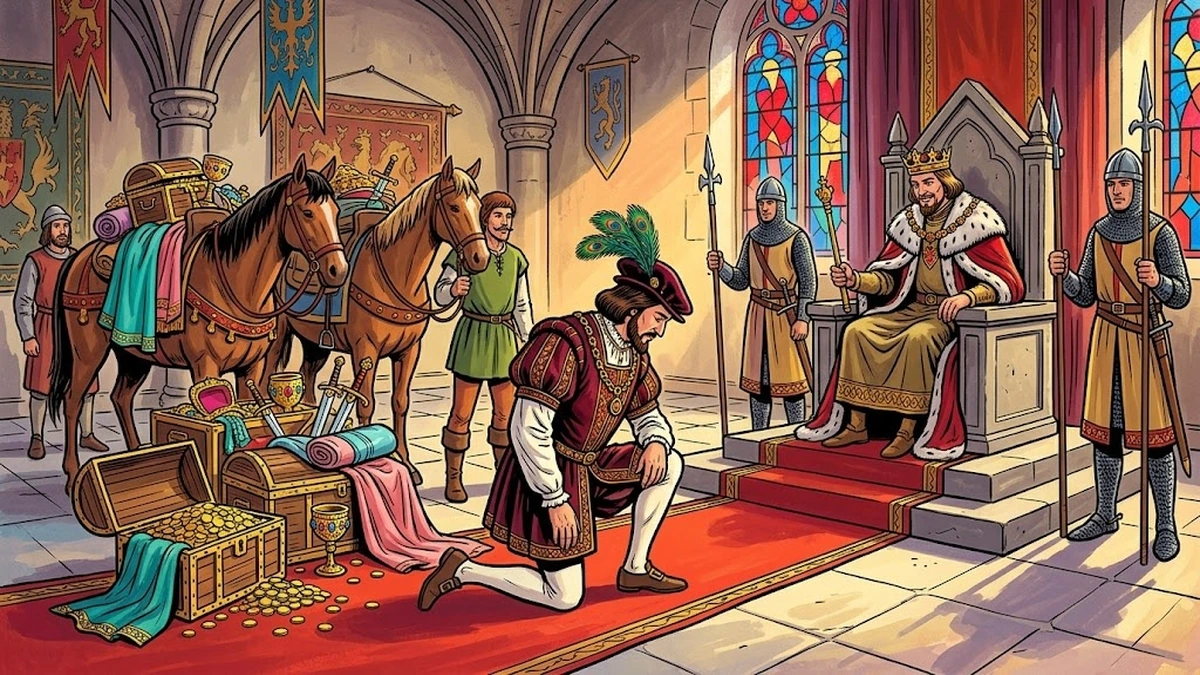
Word of the gardener’s fortune travels fast. When his rich elder brother hears of it, envy gnaws him like a worm in fruit. If a turnip earned my brother lands and gold, he reasons, what shall I receive for finer presents? He gathers from his coffers the best he owns — gold pieces, fine horses, jeweled cups, woven silks — and rides to court with a baggage train of treasure, expecting to outshine his sibling and return loaded with royal favor.
The king accepts the gifts politely and considers the matter. To this rich brother who already has so much, what could be a fitting return? After long thought he decides upon the rarest and oddest treasure in his palace — the giant turnip itself. With grave ceremony he presents the great root to the elder brother, declaring it the most singular object in his kingdom. The rich brother rides home with his prodigy of a vegetable, his envy turned to fury. He had brought silks and gold and received a turnip in exchange. He had set out to humiliate his brother and ended up the laughing-stock himself.
The Sack in the Forest: The Plot That Comes Undone
Envy ripens fastest into murder. The rich brother hires a band of cutthroats to ambush his now-prosperous sibling in the woods, slay him, and report the deed for a price. They find their man on a forest road, drag him from his horse, and bind him hand and foot. Just as they prepare to kill him, the sound of a horn cuts through the trees — a hunting party is approaching. The murderers, fearing discovery, hoist their victim into a great sack, hang the sack from the topmost branch of a tall tree, and flee.
The bound man twists in the sack and finds, by good fortune, that he can work loose enough rope to wriggle his hands free. But he cannot climb down without falling to his death. So he hangs, and waits, and listens.
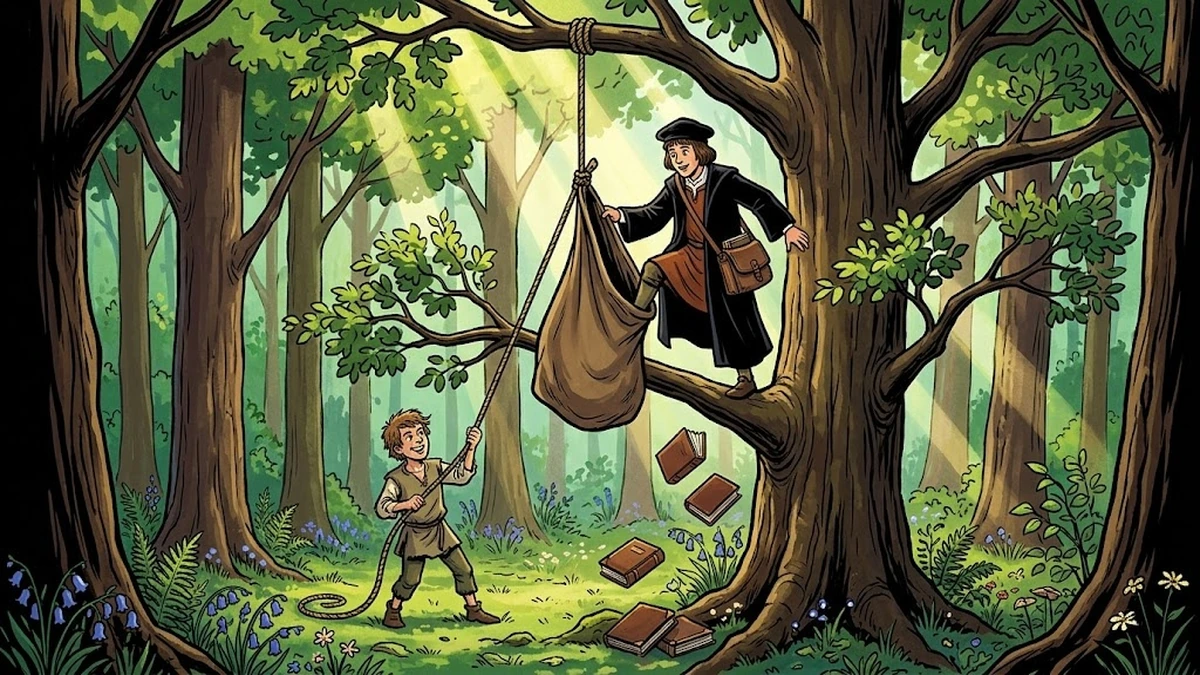
Soon a wandering scholar — a young clerk of the universities, with his books and his thin purse — comes singing along the path beneath the tree. The poor brother, struck by sudden invention, calls down to him: “Greetings, learned sir! I am the Sack of Wisdom, and whoever sits inside me sees all things, knows all things, becomes the wisest man in the world.” The scholar stops, astonished, and asks how this is possible. “I was hung up in this sack at noon,” replies the prisoner, “and already I have learned the secrets of every star and stone. But I have grown weary of so much knowledge. If you will lower me down, you may take my place, and within an hour you shall surpass every doctor in Christendom.”
The scholar, like every clerk before him, is undone by the lure of effortless learning. He climbs the tree, lowers the sack, helps the man out, and crawls in himself. The poor brother hauls the sack back into the branches, ties it fast, and leaves the scholar hanging there, calling down for more wisdom while the squirrels chatter in the leaves.
The Final Twist: The Trap That Closes on Its Maker
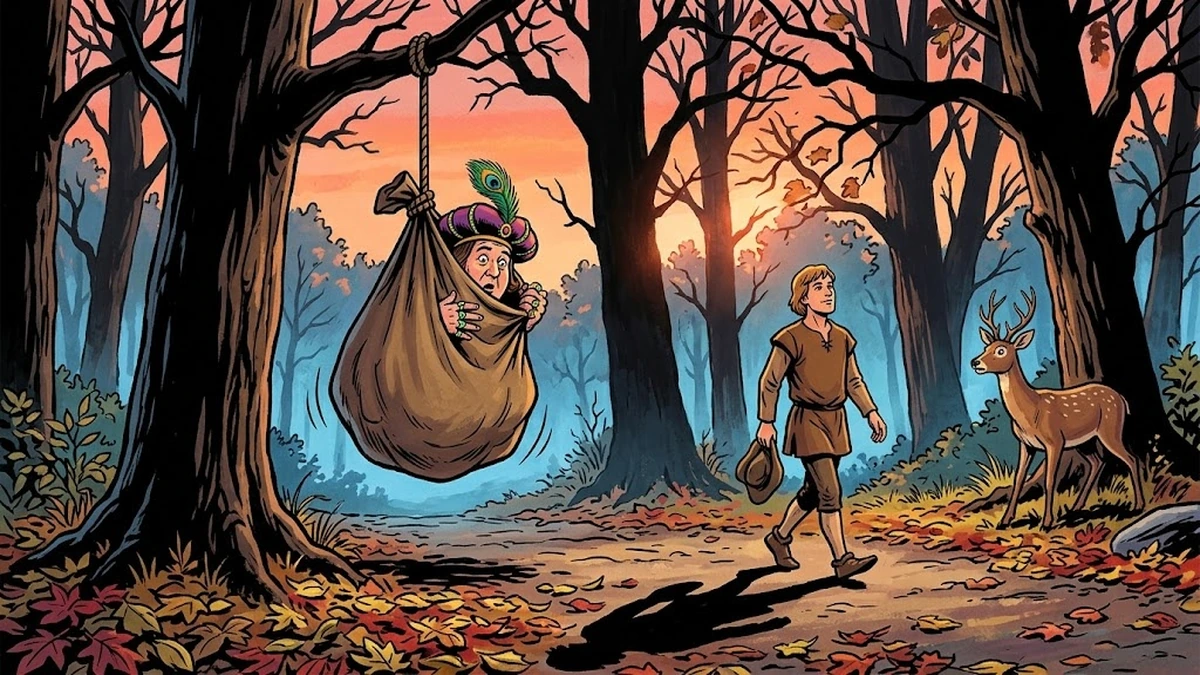
The poor brother walks down the road and meets, before the day is out, his rich brother, who has come to confirm the murder. “Where do you go in such haste?” he asks the elder. “I look for the corpse of my brother,” says the rich man, who does not at first recognize the man before him. The poor brother smiles. “Then you must look upward, brother. I have been into the Sack of Wisdom that hangs in yonder tree, and I have learned more in a single hour than in all my schooldays. Climb in if you doubt me — and you too shall come down a sage.”
Greed, which had already cost the rich brother his honor, now costs him his caution. He hurries to the tree, finds the scholar still hanging in the sack (much subdued by his afternoon of knowledge-seeking), pulls him out, and demands his own turn. The poor brother helps him into the sack, hauls him up to the topmost branch, ties him fast, and leaves him there to learn whatever wisdom envy has earned him. The forest closes around the swinging sack, the wind rocks it gently, and the rich brother is heard from no more in the tale.
The Moral the Grimms Preserved from the Latin
“Wer einem andern eine Grube gräbt, fällt selbst hinein.” — German proverb appended to KHM 146.
“He that diggeth a pit shall fall into it.” (Ecclesiastes 10:8)
The medieval Rapularius ended with a Latin tag of similar import — that the snare a man sets for his neighbor returns to catch his own foot. The Grimms preserved this moral exactly, choosing for it the homely German proverb that schoolchildren still recite. The lesson is not that poverty is virtue or wealth is sin; the rich brother is condemned not for being rich but for being unable to bear his brother’s good fortune. Generosity carried the gardener to the king’s chair; envy carried the soldier to the topmost branch. Both men climbed by their own hands.
Why “The Turnip” Has Lasted Eight Centuries
“The Turnip” is older than printing presses, older than the German states, older than most of the languages it has been translated into. Composed in Latin around 1200, glossed in monastery schools through the Reformation, taken up by Wilhelm Grimm in 1819, set down in English by Edgar Taylor in 1826, illustrated by Walter Crane and Arthur Rackham, retold in twentieth-century picture books, and now read on phone screens in every continent — it has endured because its three central images are all unforgettable. The wagon-sized vegetable; the bag of “wisdom” hanging from the tree; the brother who climbs into his own snare. Each of them is a single, vivid picture that needs no explanation. Together they make a fable of justice that even children grasp at first hearing: that envy is its own punishment, that generosity is its own reward, and that whoever tries to ride downward on another’s neck most often ends up swinging from a tree branch in a borrowed sack.
Eight centuries on, the moral feels neither stale nor scolding. It feels, like the giant turnip itself, simply true — startling in its size, immovable in its weight, and surprisingly nourishing once one has learned how to carry it home.
Frequently Asked Questions
Q. Who wrote “The Turnip”?
A. It was retold from the medieval Latin poem Rapularius (c. 1200, southern Germany) by Wilhelm Grimm and published in the second edition of Kinder- und Hausmärchen, vol. 2 (Berlin, 1819) as KHM 146. The first English translation was by Edgar Taylor (London, 1826).
Q. What does ATU 1689A mean for this tale?
A. It is the Aarne–Thompson–Uther type “Two Presents for the King,” where a poor man’s modest gift earns a great reward and a rich man’s lavish gift earns only a worthless one in return. The story also incorporates ATU 1960D (“The Giant Vegetable”) and an episode of ATU 1737 (“Clergyman in the Sack”).
Q. Where did the giant turnip motif come from?
A. From classical antiquity. Pliny the Elder, in Naturalis Historia XIX.78, records that German turnips grew “to forty pounds in weight.” Medieval Latin schoolmasters elaborated this curiosity into the wagon-sized turnip of the Rapularius, which the Grimms inherited.
Q. What is the moral of “The Turnip”?
A. The German proverb appended to KHM 146 says it best: “Wer einem andern eine Grube gräbt, fällt selbst hinein” — “He that diggeth a pit shall fall into it.” Envy and treachery turn upon their own makers; generosity is its own reward.
Q. Why is “The Turnip” considered scholarly important?
A. Because its written source — the Rapularius — survives, this is one of very few KHM tales where scholars can compare the Grimms’ final text directly with their source. Jan M. Ziolkowski’s study (Journal of Medieval Latin 13, 2003) used this rare pairing to show exactly how the brothers transformed learned Latin poetry into folk märchen.
You May Also Like
 Grimm's Fairy Tales
Ages 6-8
Grimm's Fairy Tales
Ages 6-8
The Frog Prince: A Promise Kept, A Curse Broken
The Frog Prince: A Promise Kept, A Curse Broken: In a kingdom where crystal towers caught the sunlight and turned it into rainbows, there lived a princess
 Grimm's Fairy Tales
Ages 9-12
Grimm's Fairy Tales
Ages 9-12
Hans In Luck
Hans In Luck: Some men are born to good luck: all they do or try to do comes right all that falls to them is so much gain all their geese are swans all their
 Grimm's Fairy Tales
Ages 9-12
Grimm's Fairy Tales
Ages 9-12
Rapunzel
Rapunzel: There were once a man and a woman who had long in vain wished for a child. At length the woman hoped that God was about to grant her desire.