The Twelve Huntsmen
The Twelve Huntsmen: There was once a king’s son who had a bride whom he loved very much. And when he was sitting beside her and very happy, news came that his
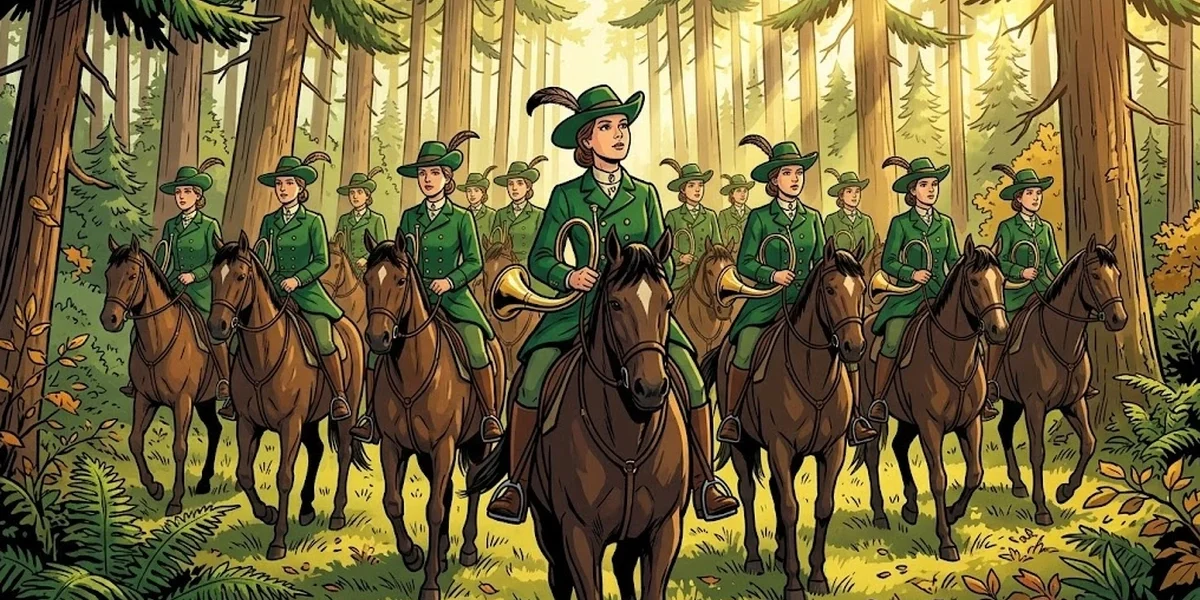
Die zwölf Jäger — “The Twelve Huntsmen” — is one of the quieter, slyer triumphs of the Brothers Grimm collection: a tale in which the rescue of a betrothal is carried out not by sword but by stratagem, not by a champion knight but by twelve identical young women in green hunting coats. It is KHM 67 in the canonical seventh edition (1857) of the Kinder‑ und Hausmärchen, classified as ATU 884, “The Forsaken Fiancée: Service as Menial,” in the Aarne–Thompson–Uther international index. The tale entered the corpus in 1812 in volume one of the first edition (Realschulbuchhandlung, Berlin) under a different title — Der König mit dem Löwen, “The King with the Lion” — and was renamed in 1819 with the appearance of the second edition. The Grimms’ own annotations credit Jeanette Hassenpflug (1791–1860) of the Hessian-French Huguenot circle in Kassel, one of the household’s most trusted oral informants, who supplied the märchen along with several other stories from her family’s repertoire.
I. The Deathbed Promise and the Ring of Remembrance
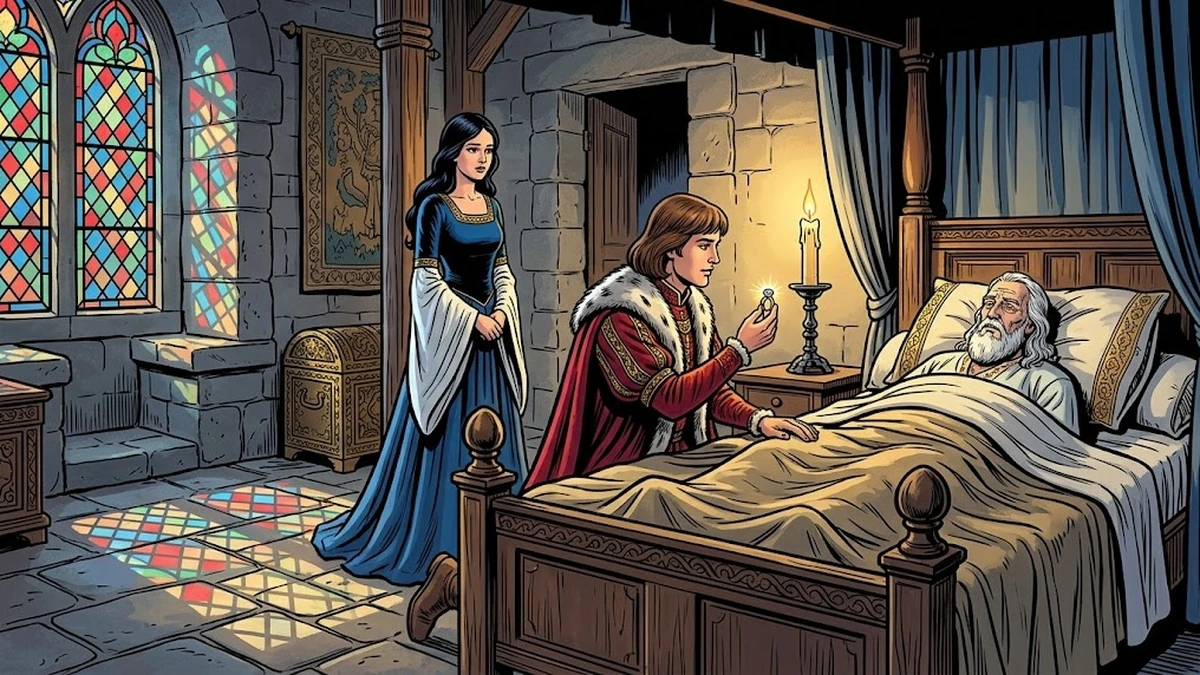
A prince loves a king’s daughter and is betrothed to her. The opening sentence of the tale lays the entire emotional architecture in a single breath: “Es war einmal ein Königssohn, der hatte eine Braut, die er sehr lieb hatte” — “There was once a king’s son who had a bride whom he loved very much.” Then word arrives that his father lies sick unto death and wishes to see him once again. The prince says to his beloved that he must go, and gives her a ring as a remembrance. He promises, when he is king, to return and fetch her. So he rides to his father, who is in his last hours.
What happens at the bedside is the moral fulcrum of the entire tale, and the Grimms render it without ornament. The dying king names a certain other king’s daughter as the bride he wishes his son to take, and the son — distracted by grief, unable in that moment to think what he is doing — answers, “Ja, lieber Vater, euer Wille soll geschehen,” “Yes, dear father, your will shall be done.” With those nine syllables he has betrayed both his betrothed and himself. The king closes his eyes and dies. When the mourning is over, the new king is forced to keep the promise. He sends for the chosen princess, and she is granted to him.
The first betrothed hears of the betrothal that displaces her. The Grimms’ verb is härmen — to grieve, to fret, to waste away — and she fretted so much over his unfaithfulness that she nearly died. Her father, alarmed, asks what she wants; she shall have whatever she wishes. The whole engine of the tale turns on her answer.
This opening movement is a small marvel of Grimm psychological economy. In just three short paragraphs the märchen has installed a death, a vow, a substituted vow, and a bride wasting away on the receiving end of someone else’s grief. There is none of the punitive vocabulary of “Schneewittchen” or “Aschenputtel” — no wicked stepmother, no jealous queen — and yet the wrong done is no less real for being accidental. The Grimms, in transcribing Jeanette Hassenpflug’s telling, were careful to keep the king’s first failure tonally innocent: he is overwhelmed by his father’s dying, not corrupted. The wronged bride must therefore restore a betrothal that no one quite intended to break.
II. The Eleven Doubles and the Cloaks of Green
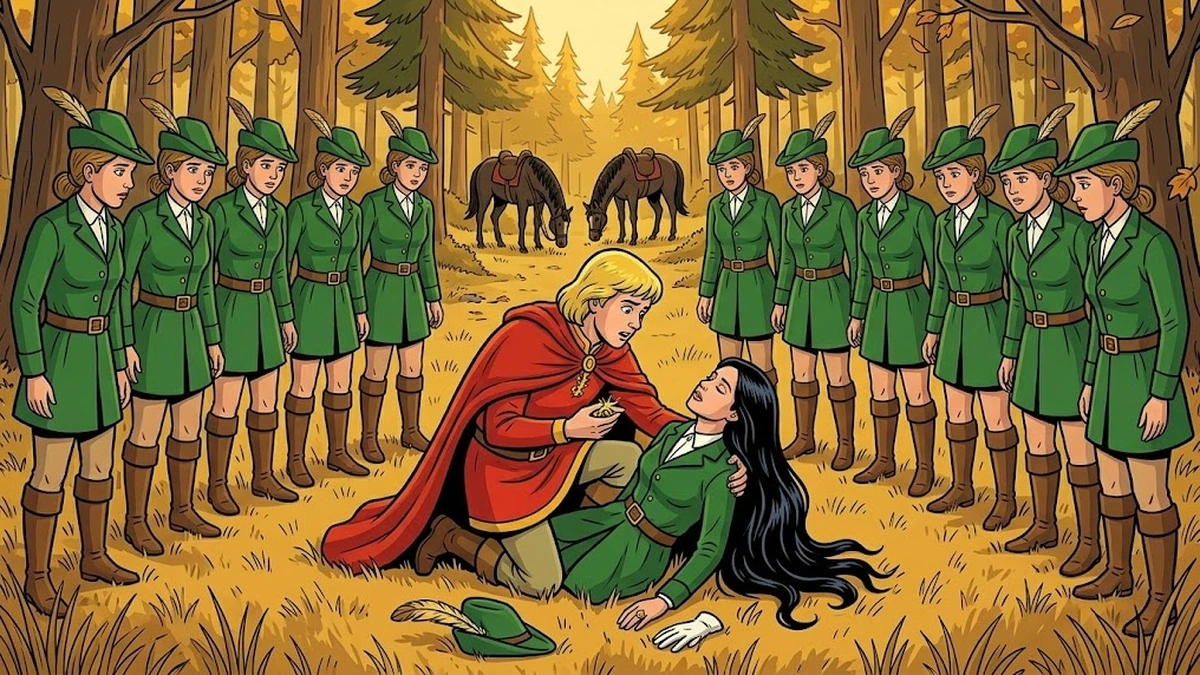
The wronged bride asks her father for eleven young women — “elf Mädchen” — exactly like herself in face, figure, and size. Her father at once sets searchers throughout his kingdom, and after long looking, eleven maidens are found whose features, height, and shape match hers as if poured from a single mould. The bride then orders that twelve huntsmen’s coats be made, all alike, and the twelve dress themselves in identical green and ride out, with the bride at their head, into the wider world.
The Grimms have here lifted, almost intact, an old motif of folkloric disguise: the wronged woman who refuses passive grief and goes after her lost betrothal in the male costume of the hunter — armed, mounted, and indistinguishable from a company of men. The disguise belongs to the same European family as the cross-dressed warrior of “The Soldier-Maid” ballads and the woman-as-prince of central Italian novelle, but the Grimms have stripped it of melodrama. There is no scene of cutting hair, no farewell to femininity. The bride simply orders the coats, dresses, and rides. The reader is in no doubt that she is the captain. So is, eventually, the king.
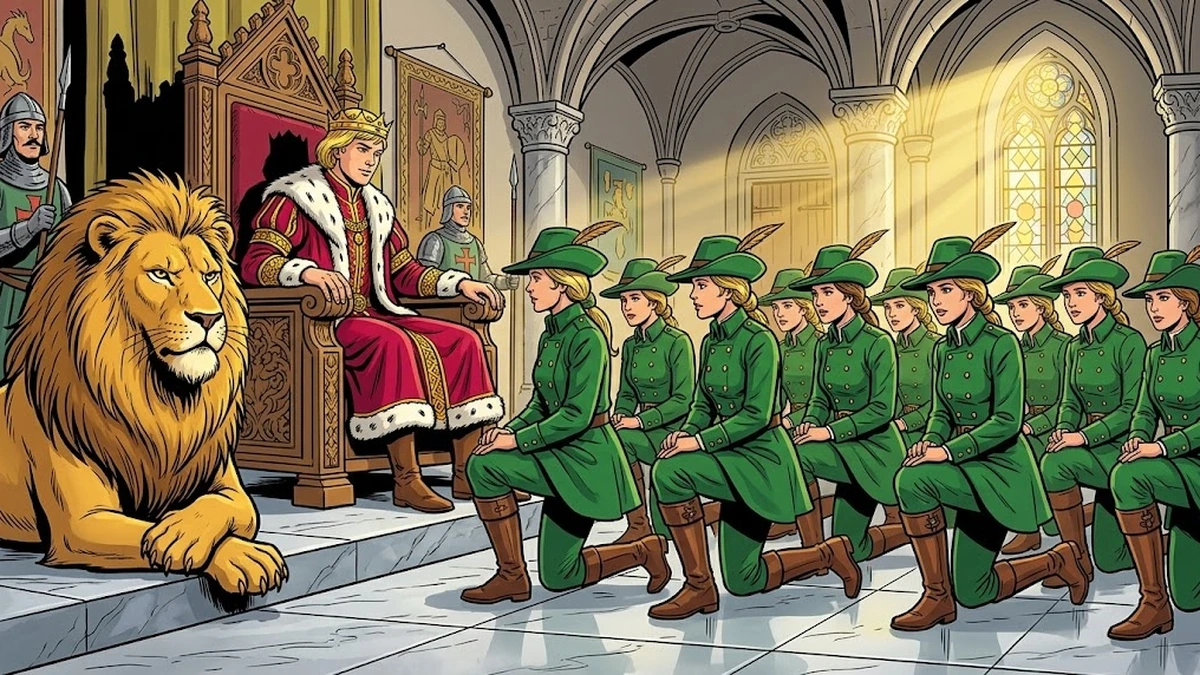
She rides to the court of her former betrothed and asks him whether he will take her and her companions into his service as huntsmen. He looks at her without recognising her — the green coats, the years apart, the calculated sameness of the twelve faces have done their work — and says he will gladly take all twelve. They become his huntsmen, and the bride becomes the closest of them, riding at his side day after day.
III. The Lion Who Sees What the King Cannot
The king has an old lion. The Grimms describe him as “ein wunderbares Tier”, a wonderful creature, one who knows hidden and secret things, and the king trusts him as a counsellor. One evening the lion comes to his master and says, “You think you have twelve huntsmen there, do you? Well, I tell you, those are twelve maidens.” The king will not believe him; he has hired huntsmen, his eyes have seen huntsmen, his huntsmen ride and shoot like men. But the lion offers a test: scatter peas in the antechamber through which they must pass, and watch how they tread. Men, the lion says, walk firmly across peas; maidens trip and slide.
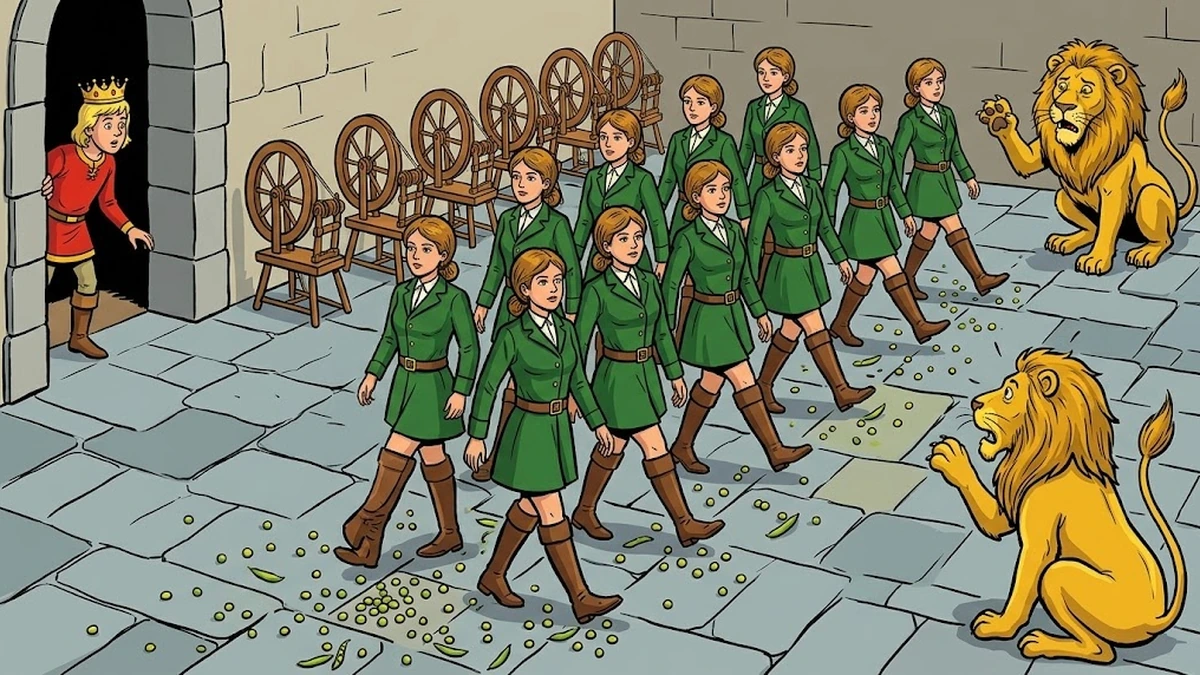
The Grimms here are at their most economical. The lion’s test is one of the great quiet pieces of detective work in the canon — a piece of folk-zoology used as forensic instrument. The peas are scattered. But one of the king’s servants, who wishes the huntsmen well, warns the bride beforehand: a test is coming, the lion has counselled it. The bride, hearing this, calls her eleven and tells them that for once, this once, they must walk across peas as men do — heavy, even-footed, indifferent to slipping. They do. The peas roll, the boots tread firm, no maiden’s foot betrays itself. The king afterwards laughs at the lion: “You see, you have lied to me; they walk like men.” The lion, undisturbed, says he will try again.
The second test is even subtler. Twelve spinning wheels are set up in the antechamber, the prized object of every Hessian women’s room. Maidens, the lion insists, will look and stare and want to spin; men will pass without so much as a glance. Again the warning reaches the bride; again she instructs her eleven; again the twelve walk past the spinning wheels with the indifference of men who have spent their life in stables and forests. The king turns to the lion in triumph: “Du Lügner — you liar — they walked past the spinning wheels like men.” The lion, in the märchen’s grave understatement, “saw that he had been deceived” and made no further accusations. Here the tale steps cleanly out of the proof structure of fable into the moral structure of comedy: the watcher who cannot see, the watched who must not be seen, and the small grace of the warning servant who keeps the disguise alive across two near-misses.
Heinz Rölleke, in his standard 1985 critical edition of the Kinder‑ und Hausmärchen for Reclam, points out that the lion’s two tests form one of the few episodes in Grimm where a wonder-creature is not magically all-knowing but reasons by stereotype. The lion deduces from gendered habits — pea-walking, spinning-wheel attention — and is twice outwitted not by counter-magic but by the bride’s discipline of body and gaze. It is one of the Grimms’ rare pieces of forensic comedy, and Rölleke notes that the trope has parallels in Bohemian and Slovak ATU 884 variants where the disguising woman is similarly tested by spinning wheels, embroidery, and the placement of mirrors.
IV. The Recognition: The Faint, the Ring, and the Cancelled Wedding
The huntsmen continue to ride at the king’s side. One day, while they are in the field, news comes that the second bride — the one promised to the dying father — is on her way to be married. Hearing this, the chief huntsman falls to the earth in a faint so deep that the king, alarmed, runs to her and pulls off her glove to feel her pulse. As the glove comes off, the ring of remembrance, the very ring he had given her at their parting, slips into view on her finger. The king looks at the ring; he looks at the face; and at last, after the long apparatus of disguise and forensic peas, he sees what he should have seen on the first day. “Du bist meine erste Braut,” he says, “you are my first bride, and no other shall be my wife.”
The recognition scene is in many ways the gentlest and quickest in the Grimm collection. There is no monstrous trial, no wronged bride consigned to a barrel of nails. The king sends a messenger to the second bride asking her to return to her own kingdom, since he already has a wife — and one who has finally been found again does not need to be sought. The marriage is celebrated. The lion regains the king’s favour, “for he had told the truth after all.” The closing line of the märchen, in the sober register the Grimms reserve for happy endings, is little more than: und sie lebten zufrieden zusammen, “and they lived contentedly together.”
V. Editorial History: From “The King with the Lion” to “The Twelve Huntsmen”
The textual history of this märchen is unusually well-documented and helps explain its unusual narrative balance. In the 1812 first edition, the tale appeared under the title Der König mit dem Löwen — “The King with the Lion” — a title that placed the wonderful counsellor-beast at the centre of the story rather than the bride who outwits him. By the time of the second edition (1819), Wilhelm Grimm — whose hand grew steadily heavier in the editorial process across the seven editions of his lifetime — had reweighted the title in favour of the disguise itself. Die zwölf Jäger moves the heroic apparatus from the lion’s nose to the bride’s stratagem. The shift is small in word-count but immense in emphasis: the märchen is now named for what the wronged woman does, not for what the lion sees.
The Hassenpflug source itself is worth a moment’s attention. Jeanette and her sisters Marie (1788–1856) and Amalie (1800–1871) were daughters of the Hessian Oberhofgerichtsrat (court of appeals chief justice) Johann Ludwig Hassenpflug, whose family was of Huguenot French descent and had settled in Hanau and Kassel after the revocation of the Edict of Nantes. The sisters’ bilingual French-German upbringing brought them into contact with seventeenth-century French literary fairy tales — Perrault, d’Aulnoy, the Cabinet des Fées — and modern Grimm scholarship since Heinz Rölleke’s foundational studies of the 1970s has been candid about the degree of French literary residue in the Hassenpflug-supplied tales. “The Twelve Huntsmen” carries fewer obvious French traces than, say, “Sleeping Beauty” or “Little Red Cap,” both of which the Hassenpflugs almost certainly knew via Perrault. But its disguise-and-recognition architecture, its near-comedy tone, and its courtly setting all suggest a märchen that had passed through more than one polite drawing-room before Wilhelm wrote it down.
VI. The Moral: A Promise Kept by the One Who Was Wronged
The unusual moral architecture of “The Twelve Huntsmen” is what has kept Grimm scholars returning to it. There is no villain in the tale. The dying father is not wicked; the second bride is not jealous; the king himself is faithless only by accident, by haste, by the disorientation of grief. The lion is not a tester sent by malice but a counsellor offering candour. The wronged woman, who in a less generous märchen would have made her case at court and demanded justice, instead constructs the scaffolding of her own restoration: she does not denounce, she does not curse, she does not weep and wait. She rides with her eleven into the king’s service and trusts that proximity, time, and the ring on her finger will eventually reach him.
“Du bist meine erste Braut, und keine andere soll mein Weib werden.”
— “You are my first bride, and no other shall be my wife.”
(Brothers Grimm, Die zwölf Jäger, KHM 67, 7th edition 1857)
The tale’s moral, then, is not the simple moral of fidelity, although fidelity is everywhere in it. Its lesson is structural: that a promise once given is not always kept by the giver but, in extremity, by the one to whom it was made. The first betrothed keeps the prince’s word for him. She holds his promise across his father’s death, his second betrothal, the years of forgetting, until the moment when, with a glove pulled off in the field, she can return it to him whole. The fairy tale is in this sense a parable about the labour of memory: the work that someone, in the end, has to do to keep a vow alive when the one who first uttered it has lost his way.
VII. Why It Has Lasted
“The Twelve Huntsmen” has lasted in part because it disarms expectation. Readers come to a Grimm tale braced for blood, for the hot iron shoes of “Schneewittchen,” the cannibal mother of “Der Machandelboom,” the boiling oil of “Der treue Johannes.” Here they find peas, spinning wheels, an honest lion, and a bride whose worst weapon is a perfect disguise. The tale is small but rigorously made: every motif counts, every test rhymes with another, the recognition is purchased not by a dropped slipper but by a ring slipping out from under a glove — a touch of psychological exactness that the Grimms found in Hassenpflug’s telling and were careful not to over-write.
The disguised-female-warrior motif places the tale alongside an entire European tradition: the ballad cycle of “Lord Gregory” and “The Soldier Maid,” the prose figure of Britomart in Spenser, the Chinese ballad of Mulan, the Italian contadina who follows a soldier-husband in his own uniform. ATU 884 is widely attested across Germany, Bohemia, Poland, France, and Italy, and the Grimms’ Hassenpflug version is the sleekest of the family. It compresses what in other variants takes a dozen episodes — service, suspicion, vindication — into the shape of a chamber piece: one antechamber, one lion, three trials, one ring.
What lasts, finally, is the figure of the bride herself. She is one of the Grimm collection’s quietly remarkable women: she does not curse, she does not weep, she does not go mad. She procures eleven doubles, learns to walk across peas, refuses to glance at a spinning wheel, rides at her betrayer’s side until he is ready to see her, and then faints precisely once — the only break in her composure across the whole tale. The faint is not weakness; it is timing. It is the moment she chooses to allow herself to be discovered. In a corpus full of waiting maidens, the chief huntsman of “The Twelve Huntsmen” stands as the one who arranged her own rescue.
It is also one of the few märchen of the canon in which a woman is permitted to be funny. The tale’s comedy is sotto voce — the lion outwitted twice, the king’s two triumphant taunts of “you liar!”, the spinning wheels passed without a glance — and the joke is on the man who cannot see the woman at his side until she falls senseless from her horse. Modern stage adaptations from the 1970s onward, including Briandaniel Oglesby’s twenty-first-century one-act play, have leaned into that comedy, but the Grimm-Hassenpflug original keeps a perfectly straight face. The result is a tale that has been recovered, again and again, by readers — feminist scholars in the 1980s, queer-reading critics in the 2000s, theatre-makers in the 2010s — looking for figures of female agency the canon often refuses to surface. The chief huntsman, who never gives her name, has been waiting all along.
You May Also Like
 Grimm's Fairy Tales
Ages 9-12
Grimm's Fairy Tales
Ages 9-12
The Six Swans
The Six Swans: In a kingdom bordered by enchanted forests and ancient mountains, a King mourned his first wife, a woman of wisdom and grace. Years passed in
 Grimm's Fairy Tales
Ages 9-12
Grimm's Fairy Tales
Ages 9-12
Rapunzel
Rapunzel: There were once a man and a woman who had long in vain wished for a child. At length the woman hoped that God was about to grant her desire.
 Grimm's Fairy Tales
Ages 9-12
Grimm's Fairy Tales
Ages 9-12
The Fox And The Horse
A farmer had a horse that had been an excellent faithful servant for many years. At length the horse grew old and worthless, and the farmer wanted to get rid of him without giving anything.